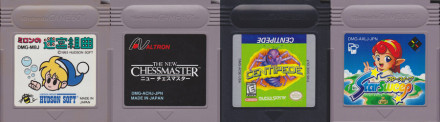
Reviews of Milon’s Secret Castle, Chessmaster, Centipede & Star Sweep.
My name is Ray Larabie, and I’m talking to you from Nagoya, Japan. Welcome to episode 37 of Game Boy Crammer. Today I’ll be reviewing Milon’s Secret Castle, Chessmaster, Centipede, and Starsweep. Here we go! Next to a Game Review! Milon’s Secret Castle from Hudson was released in Japan in March of 1993.
It was called Milon no Meikyuu Kumikyoku, which means Milon’s Maze Suite. Came out the same time in the U.S., a little bit later in Europe. It’s based on a 1986 game that came out in Japan on the Famicom, a couple years later on the NES. It’s notoriously difficult. At least the NES and Famicom version was notoriously difficult.
We’ll get to that later. You play Milon. He lives in the land of Hudson. People communicate with music, but he’s tone deaf. He comes to visit the castle, to visit the queen. She’s gone. Some evil maharito guy has taken all the musical instruments and has taken over the castle, so it is your responsibility to defeat this evil warlord.
The castle has this wizard guy who gives you some sort of bubble ability, and you’re going to find these little shops. Not really shops, but places where you can meet this wizard and you can buy stuff and you can get hints. You control this Milon character. You can run and jump, and you can shoot bubbles.
The castle has four stories, and you can’t just climb up the stairs. You’ve got to defeat bosses and stuff to get up to the fourth level. There are also two towers on the side, but you can’t get to those until you get to the third floor. You have one life in this game. If you die, it’s game over, but you have a health bar.
You need items to finish this game. Nothing really explains exactly what you need, but these hints can help you along. This is a pretty early platforming game. This came out only a couple years after Super Mario Brothers, so the rules had not been fully solidified. In this game, to get out of the level you’re in, for most levels, you have to find a key, and then you have to find a door.
The key is hidden and the door is hidden. You can’t just walk back out the way you came from. So once you go into a room, you have to finish it. There’s money all over the place. You’re going to need money to buy things from the wizard. There are monsters all over the place. They’re not smart monsters.
They just follow different paths. Most of the monsters you can kill with one shot. But to make this a little more difficult, when you fire these bubbles, they go up, because they’re bubbles. If you want to shoot down, you have to press down and fire. It takes a little bit of getting used to, because most games you just fire straight ahead.
When you defeat monsters, sometimes you get a power up. Hearts will fill up your health meter. Umbrellas will make you shoot bubbles faster and further. But mostly what you’re going to be shooting in this game is blocks. Blocks are where all the secrets are. When you shoot blocks, sometimes the blocks turn into money.
Sometimes when you take the money, it lets you get through to a place you couldn’t normally get to. Sometimes a block will be hiding a door. You have to basically shoot every block in the game. This game is not for everybody. If you’re the kind of person who plays Zelda and chops down every plant and moves every rock, you’re probably going to like this game.
Usually when I play Zelda, I’m very thorough. I just go and bang against every wall and bomb every rock. That’s the way I play these games, so I found this thing not too bad, because generally I’m going to hit every block anyway, just to check out what’s there. But there are some things where there’s no way you could ever figure it out.
You just have to keep shooting randomly and hope for the best. The game doesn’t really explain exactly what you can do, and there’s kind of a difficult part at the beginning of the game that I got stuck on. I didn’t realize at the beginning. You can push blocks. It hardly ever happens, but there are a few situations where you’ll see a block that’s kind of on its own, it seems suspicious, like it doesn’t turn into money when you shoot it.
Why is that block there? Well, oftentimes that’s a block that you need to push. And there’s one part right near the beginning where there’s a shop that you can’t see. The door doesn’t appear until you push the block and shoot the spot where the block was. This game is filled with this kind of thing, and I think that’s why it’s so hated.
Like if you search for this game for reviews, it’s thoroughly hated. There are not a lot of people defending it. In one of the early episodes of Game Center CX, if you haven’t seen that, that’s a Japanese show where Adino-san, a Japanese comedian, he’s not that good at video games, but he plays these old Nintendo games and tries to play them all the way through.
Anyway, one of the first episodes was that. And I was intimidated. You know, at first I didn’t recognize, I was like, Milan, what’s that, and I brought it home and I was like, oh no, that’s the game. In the original game, when you got hit by something, your health would just keep dropping. Like you didn’t bounce out of the way or blink like in a normal game.
You could just, your health could just disappear and it’s game over just from one enemy. And in the original one, there was no continues. Yeah, there was continues if you looked it up in Nintendo Power or something like that and you knew there was a cheat. You had to hold left or right I think and hold hit start, I don’t know.
But in this version, once you get past the first floor, you’re going to get a password, so you know, that difficulty is gone. And the collisions are a little better, when enemies hit you, you don’t drop your health that much. Items in the shops are cheaper, they just lower the overall difficulty. So don’t feel intimidated by these reviews that say it’s so difficult.
It’s really not that difficult. The first time I played it, it was kind of hard because I didn’t really know what I was supposed to do. But then when I recorded the sound for this thing, I had to play through again and it was just a breeze. I had my full health the whole time, like I didn’t get hit by anything and I got halfway through the second level.
I was finished recording the sound. It’s really not that challenge. The bosses are very easy. What’s fun about it, I think, is just discovering all this stuff. One thing you might want to do, though, is look for a map that just shows you which doorway goes where. Because when you’re outside the castle, first of all, half the time there’s lightning bolts firing at you, so that’s no fun.
But you go in these doorways and they all kind of look the same and you’re not sure if you’ve gone into that room. And if you do go into the same room a second time, you can’t just walk back out. You have to go and find the doorway to get out. You don’t have to get the key a second time. But still, there’s a lot of backtracking.
Especially when you get up to the third floor, there are a lot of doors you can go into that bring you all the way back down to the bottom. Now let me get back to the items. I mentioned the heart and the umbrella. There’s also a balloon. It only appears in one part of the game, and it’s used to escape the level.
So don’t grab it if you don’t want to leave the level. When you shoot blocks, sometimes they turn into money. Sometimes they’ll turn into a little honeycomb. You’ll want to grab these. This will make your health meter longer and it’ll fill up your health. Occasionally, you’ll see the Hudson Bee. Played any other Hudson games, you’ve probably seen this thing.
Grab this thing and you’ll get a shield that’ll take two hits. If you grab it a second time, if you already have the shield, or even if you just collect a heart while you have the shield, you’ll get a four hit shield. So even though you only have one life in this, you can get a pretty big health bar going on.
Once in a while, you’ll find a music box. You get this by bonking your head on a block. It’s really kind of random. Once in a while, I thought, wow, that looks a little suspicious and I hit my head and I got it right. But most of the time I just hit them by accident. If you grab this music box, you go into this weird little bonus level.
Music notes are coming up out of the ground. You got to grab the notes, but don’t grab the flats, grab the sharps or the regular notes. It counts all the sharps that you catch as two points. The regular notes is one point and then one less point for every flat. You need all the money you can get in this game.
It’s a little bit tight near the end. Not that tight, but you can’t go around wasting money on health. There are a few situations where a different store will have the same item for a different price, especially the lamp. There’s a big difference in the lamp price. The lamp lets you see certain platforms and kind of dark levels.
It’s hard to see what you can jump on, but without it, you can still jump on. It’s just really hard to see. A vest is very important for the fire levels. Don’t go into those levels. If you see a fire guy, go back and get the vest. Shoes will let you jump on springy platforms. Right near the beginning of the game, you’ll see these little different looking platforms that don’t seem to do anything.
You buy the shoes. They’re right near the beginning of the game. That’ll let you jump on those platforms. When you jump on those platforms, just hold your button down and you’ll jump really high. If you try to push up and jump, it doesn’t work. It’s a really weird control system for the jumping on those platforms.
There’s a boxing glove you’re going to see right near the beginning that punches you in the head and does damage. Which, well, if you get this medicine stuff right near the beginning, you will shrink after it punches you, which is very important for solving certain puzzles. There’s a hammer. You need this to get through the walls.
There are doors that you can’t even see. Just kind of stand on a platform and go through the doors from the outside. And there’s all kinds of stuff. But it’s all stuff you pretty much need. The only ones you don’t need, there’s a blimp. Kind of expensive, but if you have the money, get it. It just lets you hold the jump button while you’re falling and you can float a little bit.
It’s not super useful, but it kind of makes things a little bit easier. There’s a feather that’s kind of expensive. You really don’t need it. There’s an elevator in one level. It’s the only time an elevator shows up. It’s totally unnecessary. You can actually jump and get to the… like it doesn’t let you get to anything you couldn’t normally get to.
So if you’re low on money, skip the blimp and the feather. After you finish each level, you get a crystal. That crystal will let you surpass that level’s boss. So next time you go into that room, the boss isn’t there and you can go back in. There’s a lot of… you’re going to be going back down to that first floor and you’re going to have to go back up.
So always remember which door you need to go into to get to the next floor. So just go around in circles. I really enjoyed this game, but I did find myself looking up… I didn’t need a walkthrough, but I did need a map of all the doorways and where they go because I really got confused. And there’s a part where you have to go into the towers from the top.
There are two towers on the side of the castle and it’s a long way down and if you go the wrong way, it kind of bops you back out to the first floor. If you like these kind of Japanese 80s games that are kind of difficult and kind of dumb, but challenging, this one’s pretty good. The NES version is available on the 3DS eShop.
I don’t think the Game Boy version is. Having played a little bit of the NES version on an emulator, I definitely recommend the Game Boy version. At least play the Game Boy version first just to get the feel of it and then maybe go back and play the really hard version. Look for DMG-M8J for the Japanese version, DMG-M8 for the US version, DMG-M8-UKV for the European version.
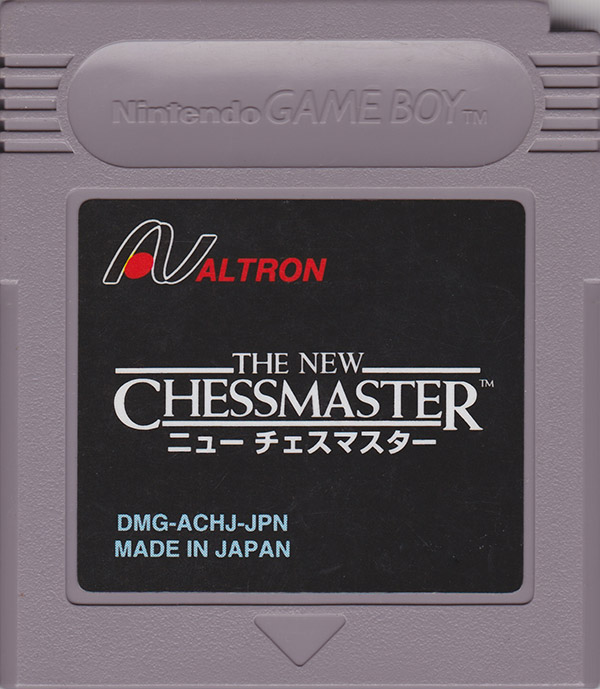
The Chess Master was released in the US in January 1991, in Europe sometime in 1992, and in Japan in October 1994. So this is chess, you’ve heard of it, it’s known and loved around the world. If you’ve never played chess before, maybe this is a good way to learn it. This is pretty straightforward chess.
You move a piece, your opponent moves a piece. If you hold select, you’re going to get a settings screen. If you hold it again, you’re going to get a second settings screen. On this screen, you can set your difficulty level, how many players you want, you can let the Game Boy play against itself, you can tell it how long you want it to think about a move, like how many moves ahead it’s going to think, you can turn on a chess clock for timed moves, you can swap black and white.
Teaching mode is great if you’ve never played chess before, if you’re just a beginner. All it does is when you choose a piece, it’ll show you your possible moves. So for beginning players, it’s really easy to figure out how the pieces move. This game doesn’t use a battery, but it does have a save. If you go to the settings menu, you’re going to see a password.
It’s kind of a long password, but it’ll save your current state of the game. If you hold your B button, you can kind of rewind the game. You’re not actually taking back moves, but you can see what the previous moves were. There’s no music in the game, but it does play a digitized voice. You can kind of hear in the background when I’m talking.
It’s a little bit scratchy. There’s kind of a little musical sting after each move. It would have been nicer if that part was chiptune instead of this scratchy digitized sound. I’m kind of glad there’s no music. You don’t really want music with chess. Now I would think if you’re a real chess player, you’re probably going to play chess on a modern touchscreen device.
Because if you crank up the difficulty level on this thing, the CPU really kind of grinds down. You’re going to be waiting a while for each move. But for beginners, you can kind of set it on easy, and it’s still tough. I’m pretty bad at chess. You know how some games, like let’s say Doom, sometimes the best strategy is to run into the room with guns blazing?
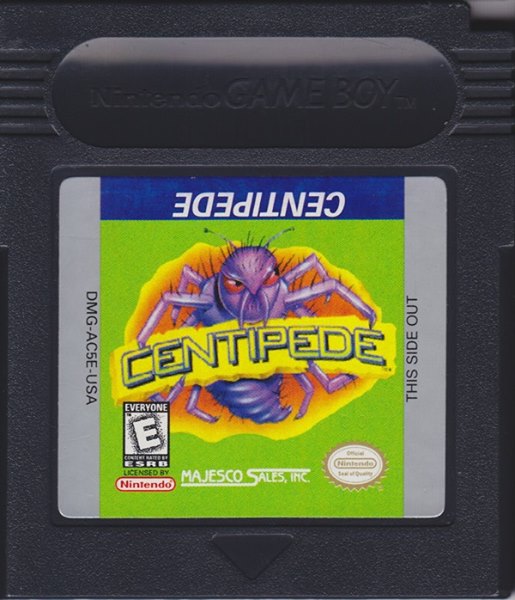
Chess ain’t like that. If you make one reckless move, you’re finished. If you get the Japanese version, there’s right at the beginning of the game, it lets you choose English or Japanese. If you’re looking for the US or European versions, DMG-EM. Japanese version, DMG-EMJ. Centipede, developed by the Code Monkeys, was released in December 92 in the US and Europe.
Published by Accolade, it came out again in 1998 in one of those black cartridges, a split Game Boy Color slash Game Boy cartridge. And it came out again in August 95 in a cart called Arcade Classic Number 2 Centipede slash Millipede. None of these versions ever came out in Japan. You know, some Japanese games never came out in the US and Europe.
Well, that sometimes happened with American games. Games that you think everybody would know about just are not really a thing over here, like Missile Command, Asteroids, they’re just not big in Japan. Centipede from Atari was an arcade game in 1981. It was designed by Ed Logg and Donna Bailey, a female programmer, which I think was a first in video games at the time.
It had this beautiful cabinet. I actually made a font called Chillapod based on this Centipede logo. It was this really colorful game. It’s a shooter, a trackball shooter. You control a gun at the bottom of the screen and you’re shooting at a centipede. To get to the next level, kill the centipede. There are spiders, fleas, and scorpions.
You got mushrooms all over the screen. When the centipede hits a mushroom, it changes directions. You can shoot the mushrooms in four shots. The scorpion poisons the mushrooms. If a centipede touches a poisoned mushroom, it dives to the bottom of the screen. Fleas will generate more mushrooms. They take two shots to kill.
The first shot makes them speed up. A certain number of mushrooms are required to be on the screen. If you wipe out a lot of mushrooms, the fleas will come and generate more. If you shoot a centipede in the middle, it splits into other centipedes. If you shoot it in the head, you get 100 points. Each body part, 10 points.
You get more points for a spider if you shoot it at close range. Scorpions, a thousand points. Mushrooms, only one point. Poison mushroom, five points. If you get hit by any of these creatures, you die and you lose a life. Centipede is one of those games that didn’t translate sometimes to home systems, although it’s been released on almost every home system.
One of the reasons it doesn’t translate is vertical screen in the arcade version. It’s a little bit hard to play on a wide screen. The centipede starts a lot closer and you have a big range to move back and forth. Luckily, the Game Boy screen is square, so you don’t really have that disadvantage. Centipede isn’t just one of my favorite arcade games.
It is my favorite arcade game. If there’s an arcade and there’s a centipede, that’s the one I’m playing first. A long time ago, when I worked at Grey Matter Games, they had a Tempest and a centipede and a Jama cabinet. I would just play that centipede all the time. Drive everyone crazy. It’s kind of noisy when you hit the track ball.
And I’ve played a lot of home versions of centipede. This one fares pretty well. There’s nothing really added to it. It just plays like normal centipede. In the original Game Boy version, the graphics are pretty good. It’s a light background and dark graphics, which makes sense for the Game Boy screen.
Everything’s pretty easy to see. I don’t like the design in the mushrooms in the black and white version. They’re kind of a weird little shape, but one thing I find that’s important is that you have to be able to see the path, the spaces between the mushrooms. In the original arcade version, the mushrooms were almost fill up the whole square of each little space they were in.
With this one, it’s a little harder to see the negative space between the mushrooms. A small, small complaint. It feels a little bit easier than the arcade version. Even though I’ve played centipede for about 30 years, I can still get knocked out pretty quickly. With this one, I can get through about 30 levels before I break sweat.
It’s pretty easy. One of the reasons is the spiders. In the arcade version, the spiders are fast. And they’re just mean. They tease you and you just… It’s very random. They’re not actually smart. But, man, those spiders. In this one, the spiders are not really a problem. And the trick with the spiders is, in the arcade version or any version, is Don’t just hold your fire button down and go under the spider.
Let go of the fire button, move under the spider and hit your fire button. That way, even if it’s moving down as you’re moving into it, you’ll still hit it. It only takes one shot to kill. One thing that’s really important with the black and white version is that you can really see which mushrooms are poisoned.
The scorpion goes across the screen and poisons mushrooms. When centipede touches that, they dive bomb. You have to be conscious of which mushrooms are poisoned because you need to get under those things when they’re dive bombing or avoid them. And between levels, if you have time, sometimes as a couple, you can clear out and then you don’t have to deal with it.
Sometimes there’s a little flake, a little piece of a poison mushroom. So you need to know that they’re there. Even a tiny fleck of poison mushroom counts as a poison mushroom. So, yeah, the color version. In the arcade version, the colors change with every screen. You kill the centipede, there’s a new centipede coming down and all the mushrooms change color.
Not just some of them, they all change color, except for the poison ones. If you play the Game Boy Color split cartridge on a Game Boy Color, you get a black background. Everything looks pretty much the same, except the mushrooms actually look like the mushrooms in the arcade. So that’s an improvement, except that they’re multicolored.
They made fancy multicolored mushrooms to make it look pretty, but it makes it really hard to see the poison mushrooms. Poison mushrooms show up as black. It’s a white outline of the black mushroom, so they don’t really stand out. It’s really easy to miss them. That becomes a big distraction, especially later on, when you’re really trying to pay attention to these things coming down.
And, you know, it’s really easy to miss one of those poison mushrooms. So if you have a choice, I would play the black and white version. There are a lot of strategies people use for centipede. And one of the most famous is the tunnel strategy. When you come back from dying or when you start the game, just slightly to the left of your gun, you’ll see that’s where the centipede comes out.
If you concentrate on building a tunnel, so a line straight up, when the centipede starts there, a full centipede, it’s going to come straight down. You can just fire your gun through there and kill the whole centipede. And the best part is you’re shooting it in the head, so you’re getting the full points for each piece.
You don’t want to shoot it in the middle, because you only get 10 points as opposed to 100 for shooting the head. So you can really rack up your score. You also want to go and try to eliminate mushrooms on the bottom, because that’s going to make the flea come down and generate more and more mushrooms.
It’s not sure fire. It doesn’t mean every centipede’s going to keep coming down the middle, and you can just win the game by holding your button down. The way it works is, you know, you’ll get a full centipede, then you’ll get a centipede with one separate head, then you’ll get a centipede with two separate heads, and then after a while you get a completely disjointed centipede that’s just a bunch of pieces coming down.
But after you kill the one that’s completely separate, the next one is going to be a straight full centipede that’s going to come right down the middle, and you can shoot the whole thing. You can do like two or three in a row, just like that. You don’t have to make a solid background of mushrooms. You just want to make sure you have a nice tunnel build.
When the other heads are coming down, try not to shoot too many mushrooms, try not to ruin your little tunnel. There’s also a way to build a trap on the side. You can space the mushrooms one apart on the edge and leave one space from the edge, so there’s a gap. The centipede’s going to go down there, and because it’s every second mushroom, it’s going to zigzag all the way down.
You can just shoot the whole thing in there. If you’re new to centipede, don’t forget, the spider only goes one direction. He never backs up, so you can kind of go on the safe side of it and then just kind of pop over and kill it. This game was so successful, a year later, in 1982, they came out with a sequel called Millipede.
Basically the same game with a few extra little elements. That was never released as a separate game on the Game Boy, but you can get it as the arcade classic number two, Centipede Millipede cartridge. If you have a Super Game Boy, for some reason, the Centipede Millipede combo cartridge doesn’t have anything special about it, but if you get the Centipede black cartridge, that one actually has a really nice screen overlay on the Super Game Boy that looks like the arcade game.
The original black and white Game Boy version, US or Europe, DMG-CZ for the US only Game Boy Color slash Game Boy version, the black cartridge, DMG-AC4E. If you want arcade classic number two, Centipede Millipede, DMG-ACPE for the US version, DMG-ACPP for the European and Australian versions. The Centipede multiplies and divides and comes after you from every side.
Faster and faster, row by row, he slides through the rocks to get you from below. Oh, Centipede, you can’t run away. You can’t run away. Let’s do an arcade review. Star Sweep by Alexa was released in Japan in December of 1997. Star Sweep is a falling blocks puzzle game. It came out in 1997 in the arcade and also on the PlayStation.
That’s a little bit like Panel de Pawn, a little bit like Puyo Puyo, and a little bit like Tetris, I guess. Star Sweep has these cute little anime characters, some kind of storyline that doesn’t really matter. You have a regular one player game, which has 42 levels. There’s a story mode and you have some problem solving kind of stuff where you have to solve puzzles.
These blocks are not like Tetris, different kind of shapes. It’s a three by one block. These blocks have one or two symbols on either end, never a symbol in the middle and never two different symbols. So your average block might be, let’s say, with a star or a moon symbol. So you’ll have one end that has a star, nothing in the middle, and either a star or blank on the other end.
To get rid of the blocks, you have to make sure two or more of these symbols align. But they’re not just falling from the top of the screen. You have a cursor, so you can drop them wherever you want. If you need something to go underneath, you can actually put your cursor under there and drop it in. You can rotate the piece horizontally or vertically.
If you have a symbol only on one end, you can rotate it around so it’s facing the other way. As these games go, this one gives you a lot of control. Because you have so much control, you don’t just have to rely on luck to win. And there aren’t that many different types of symbols, so you can get yourself out of a lot of very difficult situations.
Before you start the game, you choose your skill level. It’s all in Japanese, but basically the ones on the top are easy, the ones on the bottom are harder. At the bottom of the screen, things are being pushed upwards. So everything’s kind of coming upwards. So you’re going to see new pieces coming from the bottom.
Coming from the top, you’ll see clouds dropping down. These clouds need to be destroyed. If anything reaches the top of the screen, it’s the end of the game. But you can continue. In one-player mode, you’re going to have bosses. You don’t usually see bosses in these falling-block puzzle games. It’s a giant bald head, and you have to drop…
You’ll see it has a certain number of hearts. You just have to make sure you knock out pieces on top of his head, and it’ll knock out those hearts, and you can defeat the boss. You’re going to encounter this boss again a little bit later. This time he’s got more hearts, and then a third time a lot of hearts, fourth time even more hearts.
And before the last boss, there’s going to be a very difficult sequence of clouds falling. You have to be able to get rid of those clouds really quickly. It piles up really fast. In story mode, there’s a lot more cloud dropping going on. It gets faster and faster as you go. But I found the last two levels to be very hard.
I barely got through in very easy mode. The Game Boy is very suited to puzzle games, and I find there are way too many puzzle games that are exactly like Puyo Puyo or Dr. Mario. This one is at least different. I really like that. You can use different strategies. It’s not just blocks falling from the top that you’re moving from side to side.
It’s very addictive. I had a lot of fun with it. The difficulty is very well balanced. The easy is easy enough that anyone can get to the end of the game. And hard is very hard, so you have a lot to choose from. The story mode kind of forces you to read a whole bunch of dumb dialogue, and I kind of gave up translating it because it was pretty dumb.
That’s the only problem with the story mode. Otherwise, it’s kind of interesting. This game looks really great on the Super Game Boy. It’s only available in Japanese, but there’s really no reading you need to do to play this. It’s not really, really common. I don’t see it that often in Japan. But if you like calling block puzzle games, this is a good one to have.
DMG-AXLJ.