Reviews of Kid Dracula (Akumajou Special: Boku Dracula-Kun), Looney Tunes, Gargoyle’s Quest 2 (Makai-Mura Gaiden: The Demon Darkness), Soldam & Heiankyo Alien.
My name is Ray Larabie, and I'm talking to you from Nagoya, Japan. Welcome to episode number 44 of Game Boy Crammer. Today I'll be reviewing Kid Dracula, Looney Tunes, Gargoyle’s Quest II, Soldam, and Heiankyou Alien. The deadline for the Pokémon Y3DS contest is June 18th, 2014.
For details, listen to episode number 43. Let's start the show! Akumajou's special, Boku Dracula-kun, developed and published by Konami, was released in Japan in January of 1993. In the US and Europe it was called Kid Dracula, and it was released a little bit later in 1993. This is a port of a game on the Famicom, but the Famicom version didn't come out in English.
There was no Kid Dracula on the NES. Akumajou's special, Boku Dracula-kun, is a spinoff of Castlevania. In fact, the main boss in the game, Garimov, shows up in Castlevania Symphony of the Night. Unlike the Castlevania games, this is not dark. This is just funny, silly. In fact, it's almost a satire of these types of games.
The dialogue and the storyline, and even the boss fights, are kind of making fun of the whole genre. It's kind of like the Parodius of Dracula-based platform games. So you play Kid Dracula. In this story, you've forgotten all your abilities, so every time you go through a level, there are eight levels, you get back one of your abilities.
If you press select, you can choose which of these abilities you're going to use. When you start the game, you're going to have the bat ability. At the bottom of the screen, it'll say bat or normal. You can use select to toggle that, or press start to pause, and then you can use select to choose the one you want, and then unpause.
Even if you're in the middle of a battle, you can pause, take your time and choose which ability you want to use, and unpause. A is jump, B is shoot, but if you hold down B, it'll activate that ability. And in the first level, that's bat ability, which will let you fly around just for a few seconds. You'll see a countdown timer at the bottom. You can use these abilities as many times as you want.
Your character can shoot unlimited shots if you select normal as your ability. Hold B down, you'll fire a large fireball. These are very useful in boss battles. You can fire up, you can even fire down. If you jump up and shoot down, you can fire downwards. At the beginning of the game, you'll see these bats. I don't know why vampires are worried about bats.
You can actually shoot them down before they get to you, unlike normal video game bats that just fly in your face and you can't do anything about it. As you go through these levels, you'll get so many different abilities that it gives you many different ways to solve the levels. Like, there are a lot of situations where you need to fight something, but if you remember you have the bat thing, you can pretty much fly over anything.
Between levels, there are some mini-games that give you a chance to get extra lives. Not just a couple lives, you can build up a lot of lives if you really want to. First of all, you gotta collect coins. You shoot enemies, you get coins. Then you can gamble. There's a coin game where you just place a bet and it's a roulette wheel.
Here's a hint, at least as far as I can tell, your best chance is about 190 degrees away from your starting point. So let's say you want to hit a certain number. If you wait, the cursor will go around. You want to start not quite straight across, kind of a little bit before, a little bit before 180 degrees from where you want to hit.
You're not guaranteed to hit it, but it's usually within about two of that. When you have enough coins, you can play these life games. There are four different games you can choose. First game, grab bat. You have a net, you try to catch bats. If you get ten bats, you get two lives. Fifteen bats, four lives.
Stick'em is like, well in Japan we have this game, I don't know if it's only in Japan, but it's a kids' game where you have a barrel and a pirate, and you stick the swords in and the pirate's head pops off if you put the sword in the wrong place. This is kind of like that, it's just a game of chance.
Rock, paper, scissors. It took me a few tries to figure out the interface, but I'm actually bad at rock, paper, scissors anyway. I always miss the Q. And then you have jump and pop. To me this is the best one, you can get the most lives with this. You're jumping on a pogo stick and you're trying to pop balloons.
You can move from side to side so you can avoid hitting the regular balloons and try to hit the ones that'll give you 1-ups. The higher up you can get, the more 1-ups you can get. You can get quite a bit. On one try I got about eight. There's really no problem loading up on lives in this game. The graphics in this game are incredible. This is Konami at the top of their game.
The animation is beautiful. There's sound effects to go along with the really great music. The storyline's funny. Well, corny funny, but funny. In between levels you'll have passwords saved. However, there's one thing you have to consider. You can pick up heart containers once in a while. These are big hearts that don't look quite like the regular health hearts that you find around the levels.
These will give you an extra heart in your container so you can have more health. But if you quit the game and come back with a password, you don't get those back. So if you want to have lots of heart containers at the end of the game, you have to play through all the way. Which might sound like a big restriction, but it's not, because this game is kind of a breeze.
It's not super easy, but it's pretty easy. The boss battles are fun, but not really that hard. With this game you don't want to look up stuff online. Don't look up any walkthroughs or cheats or anything, because it is a little on the easy side, and you kind of want these things to be a surprise. Pop the cartridge in and just play.
I think when you finish the game you're going to play at a higher difficulty. The storyline at the end of the game kind of gave a hint that that was the case, but I didn't continue. I just turned it off. It's not a long, long game. I don't know how much replay value it has. Just for the quality, it's a must-have.
You can get the Japanese version. You'll miss some of the humor, but it's completely playable. And really they're just telling you, oh, you have a new ability. Here it is. And they demonstrate it. For the Japanese version, look for dmg-dfj-jpn. US and Europe, dmg-df. Looney Tunes by Sunsoft was released in late 1992 in US, Japan, and Europe.
It's a platform game starring the Looney Tunes characters. The very same Sunsoft that made the detestable Sunsoft Batman. But that was 1990. By the time 1992 rolled around, they'd gotten better at making Game Boy games. You had Blaster Master Boy, Trip World, and Tumble Pop, released not too far apart from each other.
Looney Tunes is a hop-and-bop platformer, but you can also shoot with some characters. It's a typical side-scrolling platformer. You're walking to the right, jumping over things, and shooting things. You're going to play several different characters in this game. After each level, you get a new character to play.
You only have a few lives, but you have infinite continues. So if you finish the Daffy Duck part, and you start the Tweety Bird part, and you die, you only have to go back to do the Tweety Bird part again. But there's no save game or no password, so you have to do this all in one sitting. The Daffy Duck and Tweety Bird levels are pretty much jumping on things.
You've got bosses to jump on and shoot. Well, Tweety Bird doesn't shoot, but Daffy Duck shoots a frisbee. Don't know why. You have three hearts. You run out of hearts, you die. And there are heart power-ups you can pick up once in a while, and one-ups. When you're Tweety Bird, you just have to avoid Sylvester and falling into holes.
Now, Porky Pig is flying a plane. It's a side-shooter with a really incredible parallax-scrolling clouds effect. Pretty amazing for 1992. This game looks great. The animation of the characters looks like Looney Tunes animation. Even though it was made in Japan, they got the look just right. But it's weird, you know, Looney Tunes, you have so many characters to choose from.
You've seen those drawings where they draw all the Looney Tunes characters in one drawing, and there's just so much to choose from. But they ended up making up a lot of enemies in this game. Like, when you're in the plane with Porky Pig, you're going to fight a black, flying star as a boss. When there's countless actual Looney Tunes characters and stories to choose from.
After that, you play the Tasmanian Devil. This is kind of a bonus level where you just try to score points. And then, to me, the hardest level is Speedy Gonzales. Speedy Gonzales is a little hard to control and has a really bad attack, where you just kind of fire off stars in random directions, but they don't go very far and they don't go where you want them to go.
So a little luck is involved. There's a Coyote Roadrunner scene where you play the Roadrunner and you have to run away from the Coyote and jump on his head and avoid Acme weapons. At these later levels, it gets very, very difficult. In one sitting, in your first try, you'll probably get pretty far into the game, but unlikely that you'll get right to the end without a little bit of practice, because there are a few things where it's hard to predict without trying it a few times to know what to avoid.
Something weird, right at the end there's a boss rush, and one of the bosses doesn't show up in any other part of the game. It looks a little bit like Cool Spot, you know, the 7-Up guy with the little glasses? It's just weird. This game, I didn't really like it much, but it's hard to really pick it apart, because while it's not really special and doesn't really have that much going for it, it does everything right.
It does all the things a platformer is supposed to do, and I imagine in 1992 having this on your Game Boy still would have been pretty cool. It's easy to be jaded now and look back at this stuff and shrug it off. Personally, I don't want to play it again. It's just a nice, okay platformer. I looked up some cheat codes on this.
At the title screen, if you hit A, B, B, A, Select, Select, you get five extra lives to start with. There's no reading to do in this game, so there's no reason not to get the Japanese version if you can find it cheaper. For the Japanese version, look for DMG-LNJ. For the European and US version, DMG-LN.
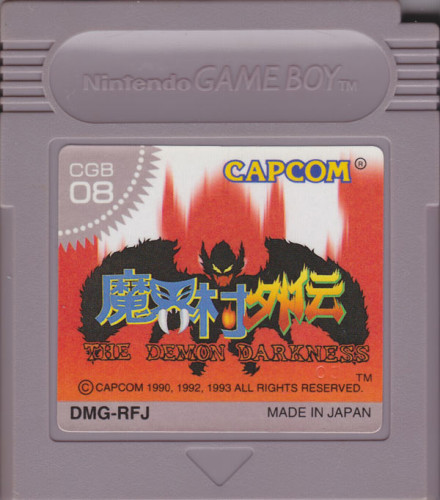
Makai Mura Gaiden, The Demon Darkness, was released in Japan only in April of 1993. It's a prequel to Red Eremur, Makai Mura Gaiden, or Gargoyle's Quest. The first one came out in 1990, but the prequel never made it out of Japan, except in NES form. Around the time Super Nintendo was really big, they were still making NES games, and this is one of them.
I reviewed the first game in episode 30. I'm going to skip over the basics. This game is basically the same as the first game. It's a platform game. You can jump, you can stick to walls. If you tap your jump button again, you'll fly only for a limited amount of time. You can fire shots that can be upgraded.
You can get longer flying time. Same thing. One minor difference in this version is that when you're walking around in the overworld, there are no random encounters, which is good in a way because those random encounters in the first game, they're almost always the same little mini-level over and over.
But it means you're going to be doing a lot of walking around with nothing to do. Much like the first game, the overworld stuff is really about telling the story and, to be honest, a little bit of time-wasting. There's no reason to make these worlds so large and to have so many dead ends. So many times you'll think you're getting somewhere.
Oh, here's an interesting little path. I'll take it all the way to the end, and there's nothing. While the platforming sections are about the same as the first game, the overworld is just really poorly designed. It seems really amateurish. Not too far from the beginning of the game, you're going to go into this cave, and it's just a featureless maze.
There's really no point except just to kill time. If someone can hack this game, make the guy go faster on the overworld. There's no reason for it to be so slow. The difficulty is around the same as the first game. Something that wasn't in the first game, you've got this tornado weapon that creates a little platform that you can jump on so you can get to areas you couldn't get to before.
I haven't played the NES version, but I've read that there's a couple of extra levels in the Game Boy version. Like the first game, save games, you have to go into a building and talk to someone. They're going to give you a password. It's a pretty long password in this one. Since this game is in Japanese, there's a lot of reading to do, and a lot of characters are just saying unimportant things that don't really relate to the plot, and they kind of ramble on a bit.
So I found it really frustrating, tiring to actually read all this stuff. And there are certain things where you need to do something with an object at a certain place where you'll actually need to read to do this. You can kind of bumble around a little bit, but there are some points where you really have to read.
You might be able to make your way through with a walkthrough for the NES version, even though it's not exactly the same, it's probably mostly the same, or patched ROM. An English translation patch for the Japanese ROM came out in 2013. It's based on the dialogue from the NES version. You're going to need a tool called Beat, a patching tool.
Just make sure you run it in a folder like I put it in C colon slash temp, because it doesn't like long folder names. It just crashes if you have a long path. So if you really, really enjoyed the original Gargoyle’s Quest and you just want some more, that's all this is. To get this cartridge, look for dmg-rfj.
Soul Dam by Jalco Entertainment was released in Japan only in August of 1993. Soul Dam was an arcade game that came out in 1992, so this was a current arcade game. It's a block puzzle game based on the characters from Rodland. Rodland was a platform game kind of like Bubble Bobble that I reviewed back in episode 11, with two female lead characters, Tam and Rit.
They're fairies. One of them might be a dude. I don't know. I compared it with the arcade version, it's pretty much a port. Instead of blocks falling from the top, you have bubbles or little blob characters, depending if you play the regular mode or story mode. These bubbles come down in groups of four, so think of them as squares.
You can press A to rotate them and you can just kind of move them down or left and right, just like Tetris. When you move left and right, you move in two bubble increments, so essentially it's like having five full squares across the screen. Each square is two by two bubbles. This isn't a typical match type situation.
This is more like the rules of Othello. So if you have a row of black and there's white at the end and you put down white, it's going to fill in that whole row. This will affect vertical, horizontal, and diagonally. However, you can only clear out horizontal lines, so you need a full line of white or a full line of black to clear out.
When you start the game, you get three choices. The third choice is two-player. The first choice is a regular game. Second choice is, I wouldn't call it story mode, but just craziness mode. So let's start with the normal game. You can pick whatever level you want to start on, and it keeps getting faster and faster.
Of course, bubbles reach the top of the screen, it's game over, but you can continue. But where it gets really weird is the other mode, craziness mode. The play mechanic is the same, except now you've got a little character on the right. This character is going to mess with you in various ways. Sometimes it throws out a really big bubble.
Sometimes it replaces your upcoming bubbles with a really big, unbreakable one. The only way you can get rid of it is to get rid of two lines beside it. It's hard to explain, so you'll have to just kind of try it to see how you knock these things out. But they're a real pain. Later, they're going to be throwing stuff and smashing your pieces.
You'll get characters that will actually hide what comes up next. Normally, on the top right of the screen, you can see which bubbles are coming next. Some of these characters will block it out for you. Nice. There are 60 levels. Every few levels you advance, you get a different character. And these characters are enemies or bosses from the original Rodland game.
So you're going to see the crocodile that you fought, the elephant, the starfish. Oh, and the elephant jumps up and down, and everything just slams down, like your piece will immediately slam down to the bottom. This game is hard enough without these guys messing with you, but it's fun. If the screen fills up, you can continue.
But there's another thing that makes this very interesting. Once in a while, one of the bubbles, it'll still be a black or a white. It'll have an E, an X, T, R, or A. You know how that works in these games. You want to collect all the letters to the words extra. A fairy will come out and wipe out the entire screen for you.
And this makes the game, you know, as long as you can keep up with the speed, you can just keep continuing and continuing until you finish the game. Because when you continue, the extra pieces that you've collected are still there. So keep trying, and eventually you'll beat this thing. There's one boss that looks like a minotaur or something.
You're going to see his horns will light up. When the horns light up, you have very little time to dodge it. He's going to try to shoot the bubbles that are coming down and turn it into one of those immovable ones. So you kind of have a chance, if you can time it right, if you can watch those horns. And it's hard because everything's moving so fast.
And just push to the right, all the way to the right, and that shot will miss, if you're lucky. And you won't get any of those blocking bubble things. Just like when you're playing Othello, it's not just about making all of the pieces one color. You want to use strategy to try to make it so you can clear a whole bunch at once.
With all these falling tile games, and I probably said this with every game, you need to have a strategy that is going to hold up when the game gets crazy and fast. If I don't really have a place to put something, I try to keep the sides either white or black. Try not to mix up the sides too much. If you have kind of random black and white going up the sides, it can get really hard to dig down.
There's no reading you're going to need to do in this game, and there's no battery to replace. It's not a super common game, but also not very expensive. If you like these kind of games, I do recommend this one, because it's the only one I've seen that really has that Othello thing going on. It's not your typical Dr. Mario type of thing.
If you want to get Sold-Am, look for DMG-S9J. Let's do a game review. Heiankyou Alien, developed by Hyperware, published by Meldac, was released in January of 1990 in Japan, April of 1990 in the U.S. Both versions are called Heiankyou Alien. They didn't angle-size the title like they do with a lot of Japanese games.
Now, the original Heiankyou Alien goes all the way back to 1979. University of Tokyo's Theoretical Science Group created this game for the PC-8000 by NEC. Now, the PC-8000 series was not the first Japanese PC, but one of the first Japanese PCs. You didn't have to buy it as a kit. You'd buy the keyboard.
You could buy a monitor and a cassette thing, similar to maybe a VIC-20 or an Apple. It came with 16 or 32K. And the CPU was Z80 compatible, just like a Game Boy. A year later, Denki Onkyo, you don't hear of this company much, released this game as an arcade game on the same hardware as Head-On. You could actually play it two players cooperative or head-to-head.
This is a maze game in the Trap-Em-Up genre. Trap-Em-Up games are where you set traps for opponents instead of shooting opponents. A good example is Lode Runner. Or one of the games I previously reviewed, Boomer in Asmik World, is very similar to this game. The play mechanics are almost the same. Space Panic is another one.
This game also came out in the Super Famicom. There's something called the Nichibutsu Arcade Classics Collection, which, if you're in Japan, you can get for pretty cheap for Super Famicom. And it has a whole bunch of old Nichibutsu games, including Heiankyou Alien. Heiankyou refers to Kyoto, what we now call Kyoto.
So, in the Heian period in Japan, from 794 to 1185 AD, the capital, Kyoto, was called Heiankyou. So, aliens have invaded Heiankyou, and, of course, at this time, there were no guns. What do you do when aliens are attacking? You dig holes in the ground. You bury them really quickly. Aliens have different vulnerabilities, like in the movie Signs.
They don't like to get wet. These aliens are not good at keeping out of holes in the ground. You run around a maze, which is supposed to be a town, which is supposed to be Kyoto. You'll be running around buildings and stuff like that. You hold your A button, and you'll dig a hole in the ground. The holes dig rather slowly. They don't just appear instantly.
And then you use your B button to bury, so an alien will fall into the hole. You hit your B button, you'll bury the alien, and that's how you defeat the aliens. If you wait too long, the alien will get out. You don't want to be too close when it gets out, because these aliens will kill you. And other aliens can help that alien out of the hole.
So, if you see two aliens coming, and you've dug a hole, you should get out of the way, because the other one's probably going to help them out. Once all the aliens are defeated, you go to the next level. There are two versions of this game you can play. So, when you get to the front menu, you can hit select.
You can choose from the new game and the old game. So, let's start with the old game. This is exactly like the 1979 version. Or, I should say, exactly like the 1980 version, because that's the only one I've played. So, you've got a maze, and you run around, and you're really tiny. The screen doesn't scroll around. Everything's right there.
And you run around and build traps. But the traps go very slowly, so you really have to gauge how far away the aliens are before you start digging a hole. Part of the fun of this game is figuring out your own strategy, so I don't want to spoil it for you, because with this type of game, that's all there is.
But one thing that's really obvious from the beginning, there's not really any AI going on with these things. They seem to go randomly, but they don't like to turn a lot of corners if they don't have to. So, what happens is, they all usually end up running around the outside more. So, you're always safer in the middle.
There's less of a chance of an alien coming into the middle of the maze. And at the beginning, if there's a lot of aliens, you don't want to have a group of them. You don't want to try to trap a group. You want to try to trap one on its own, because you don't want the friends helping you. You can't walk over these holes, either.
Even if you just started to dig a hole and you abandoned it, it'll stay there, and you can't walk over it. Aliens will only get trapped in a completed hole. Even if it's almost fully dug, they'll just walk right over it and erase it. As you complete the levels, you get more aliens each subsequent level, and they get a little faster.
There's no time limit shown on the screen, but there is a time limit. If you wait too long, a whole bunch more aliens will show up, and they'll start moving crazy fast, which means you're pretty much doomed. And if you die, you still go back to this level with aliens running rampant. The only way you can maybe survive this, and I've survived once, is you have to anticipate, oh, I'm in trouble. I've run out of time.
Start just laying down holes like crazy, because then you'll at least have a chance, because they just start running so quickly. And the whole game speeds up. It's not just them going faster and you going slower. It's like they sped up the CPU or something. It just goes crazy. Pretty much game over, unless you can defeat them. So don't let that time run out.
When you get near the end of the game, or when the game cycles, you want to just start taking out aliens really quick. Even if you have to risk, if you have some spare lives and you have to risk your life to do it, you gotta do it. This game will loop after 15 levels. When you get to level 16, it's exactly level 1.
The time limits seem short, so it's not exactly the same as the first level. Now these old games were mean, right? It's not like these modern games where you get an extra life every several thousand points. You get an extra life at 30,000 and that's it. No more extra lives. And since this is kind of meant to be retro, it has all the old style sound effects and stuff like that.
Let's talk about the new game. New game, same play mechanic, with a few differences. Number one, you're gonna get extra lives. That makes a huge difference. And you start with a lot of lives, so… You move faster, the aliens move slower, the holes dig and bury much quicker. The graphics definitely look better. It looks like a town.
You have two types of aliens now. You've got these aliens that look a little bit like Ren from Ren and Stimpy. And then these other things are like a little octopus. Those octopus type aliens, they move faster, they move in groups, and they seem to follow you more. Like in the old game, everything was random. These ones seem to have some kind of AI.
Smarter than random. Instead of just killing you, you get this graphic of being eaten by these things. It's kind of cool. There's music, and the levels are smaller. Everything's bigger. But the actual size of the levels is smaller. You also aren't trapped in corridors. You have places where you can walk around.
In the original game, it was kind of like Pac-Man, where, you know, you're always beside walls. In this one, there's some slightly open area, so… That makes a different kind of strategy, because in the original game, you could easily trap yourself. In this one, you can leave yourself some room to move around.
They're lanterns. They kind of turn on and off. They look like power-ups, but they're not. They're basically doors that open and close. If it closes while you're standing on it, you can stay. Aliens can't go on these things. Metal plates. You just can't dig on them. In the later levels, there's a boat that moves back and forth at the top of the screen.
You can use that as transport to get across. The aliens can't go on the boat, so you're safe while you're on it. In this new game, there are only 12 levels. Even though it's easier than the old game, it's still pretty hard. There's nothing to read in this game. There's no reason not to get the Japanese version.
But here's the trick. The Japanese version. I missed it so many times, because I didn't know what it was. It's really hard to read the label. Even though I can read Katakana, they kind of squished it vertically, so you can't even… Like, now that I see it, I can see it says alien on it. Just keep your eye out for a bright red cartridge label with a very detailed gold monster on it.
Just like a gold ink, old-style print. And black writing vertical on the side. It's actually not a very common cartridge. I don't see it around that much. If you like maze games, this one's pretty good. To find the Japanese version, look for DMG-HAA. US version DMG-HAA.