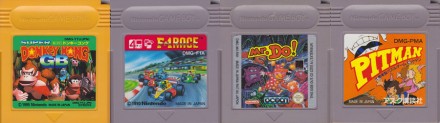
Reviews of Donkey Kong Land, F1 Race, Mr. Do! & Pitman.
Hey, it’s me, Ray Larabie. I’m talking to you from Nagoya, Japan. Welcome to episode number 27 of Game Boy Crammer. Today I’ll be reviewing Donkey Kong Land, F-1 Race, Mr. Do, and Pitman. You’ll notice the sound quality is a little different on F-1 Race.
That was actually only the second review I ever recorded. I was looking through some old folders, and I found the file there all ready to go. I’d completely forgotten I’d recorded it. If you can spare the time, please try to mention this show on blogs, or on Facebook, or on Twitter, or whatever. I’m really worried there’s some sad Game Boy nerd out there who doesn’t know about this show.
That would be the worst tragedy ever. So please think of the nerds. Alright, let’s start the show. You don’t stop playing because you get old. But you could get old if you stop playing. Game Boy, from Nintendo. Let’s do a big review. Game Boy, from Nintendo. Let’s do a big review. He’s the beast you loved on Super NES.
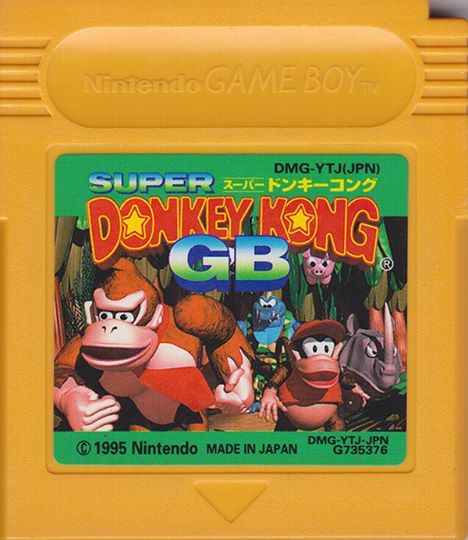
And now we’ve captured him on Game Boy, in an all-new game with all-new enemies and worlds. Donkey Kong Land, new for Game Boy and Super Game Boy. Super Donkey Kong GB was released in the summer of 1995 in U.S., Japan, and Europe. In U.S. and Europe it was called Donkey Kong Land. It was the sequel to the Super Nintendo Donkey Kong Country.
And this game came out before Donkey Kong Country 2 on Super Nintendo. It’s not a port of Donkey Kong Country, it’s actually a different game. There are a lot of the same elements in there, but it’s not the same levels. There are two more sequels to this. There was Donkey Kong Land 2, which in Japan was just called Donkey Kong Land, and then Donkey Kong Land 3.
Now, Donkey Kong Land 3 didn’t come out in Japan. Three years later they released it on Game Boy Color, an enhanced version for Game Boy Color called Donkey Kong GB. Dinky Kong and Dixie Kong. That came out in January of 2000. This is a hop-and-bop platform game. The big attraction at the time was that the characters were pre-rendered.
They used these really expensive SGI workstations to make these 3D-modeled characters. They don’t look like much now, but at the time it was kind of a big deal. Instead of hand-drawing all the backgrounds, they used kind of an interesting compression technique, which would reuse some of the blocks. You can actually see it if you play it on a bigger screen.
If you play it on the Super Game Boy, you can see how the backgrounds kind of look, I guess you could say, kind of JPEG-y. This is a technique to reduce the amount of memory that’s needed to display the backgrounds. Getting this game onto a Game Boy was a big technical achievement. I’m sure doing the Super Nintendo version was pretty hard, but getting this thing on an 8-bit system was a real showpiece.
I remember when this came out, it was kind of a big deal. It was like you couldn’t believe that this was done on the Game Boy. This game does have a save game on it. It has a battery, so you will have to replace that battery. It’s a yellow cartridge, but it doesn’t have any Game Boy Color enhancements.
It does, however, have enhancements for the Super Game Boy. But if you’re playing on the Game Boy Color, you won’t really see those enhancements, although there’s some palette changes that seem to happen once in a while. But really, the best way to enjoy this game is on the Super Game Boy. The characters in this game are pretty big compared to the size of the screen.
You know, if you compare it to the Super Mario Land, where your character is only a few pixels high. These guys are pretty big. You move around with your control pad. The A button will jump or swim. The B button will do a roll or pick up a barrel. You let go of the button to throw it. And the Select button will switch to Diddy or Donkey Kong, so you have two characters that you can switch.
Also, if you’re playing a level you’ve already completed, you can hit Start, then Select, and you can exit the level. Now, if you hold the B button down and move around, you will move a lot faster. It’s a little bit like Super Mario that way. If you hit B and A at the same time, you’ll jump higher. So Donkey Kong is the bigger guy.
He is stronger, but he doesn’t jump as far as Diddy Kong. Diddy Kong is Donkey Kong’s pal. He’s not his son, apparently. He can’t beat certain enemies, but he jumps further. You’re also going to be able to ride a rhino and an ostrich. That’s all the animals you’re going to see in this game, as far as rideable ones.
With the rhino, you just kind of run in stuff. With the ostrich, you have to hit B to flap your wings. These animals are in boxes. You’ll see a box on the ground and you’re getting an animal. The storyline is pretty funny. I like how these mid-’90s Donkey Kong games were kind of making this kind of self-referential thing to the earlier 8-bit games.
So you’ve got Cranky Kong, who is… That’s the ape in the original Donkey Kong. He’s complaining about how games were better in the 8-bit days. Donkey Kong and Diddy Kong are listening to his boring story and finally, they can’t take it anymore. So Grandpa challenges the apes to beat the enemy, K. Rool, on an 8-bit system, for example, the Game Boy, and they accept the challenge.
That is the storyline. So as you’re running through these levels, barrels, it’s all about barrels, right? Because it’s Donkey Kong. About halfway through the level, you’re going to find a continue barrel. So that way, if you die, you’re going to come back to that point. There’s a barrel with a DK on it.
That will have Donkey Kong or Diddy Kong in it. If you get killed once, you’ll turn into the other guy. So if you’re playing Donkey Kong, you get killed, you’re going to turn into Diddy Kong, and then if you get killed again, then you go back to the beginning. But if you break open a Donkey Kong barrel, you get your Donkey Kong back, and then you can switch again.
There are regular barrels that you can pick up and roll across the ground, and then throw it right at an enemy. There are these metal barrels that you pick up and they roll along the ground and smash into a wall or enemies. There are barrels that you jump into, and they’ll spin around or move, and then you hit your A button, and it’ll shoot you out of the barrel.
So there’s a lot of kind of puzzle elements where you’re going from barrel to barrel. And there are barrels that kind of work automatically, like you jump into them, and they automatically fire you to some other part of the level. Some that you kind of bounce on. There’s a dynamite barrel you pick up and it explodes.
They will blow up if you don’t throw them, and there’s a fire barrel that will blow up sections of the wall. They don’t show up too often. Now the Kong tokens. These are big floating coins. If you collect these, you’re going to end up on a bonus level later. It’ll give you a chance to get some extra lives.
While you’re running through these levels, you can see these balloons that are just kind of out of reach. If you really run for them, you can catch them. That’s an extra life. It’s hard to predict where they’re going to happen, but you end up doing these levels 20 or 30 times, so I’m sure you’ll catch them once in a while.
That’s actually a really nice touch, but it’s a good way to not end up running out of lives. As long as you can catch that balloon at the beginning of the level, you can just keep trying and trying again. Of course, you collect bananas. There are bunches of 10 bananas or single bananas. If you get 100, you get an extra life.
There are tires you can bounce on. Some of them you can move around. There’s some puzzle kind of elements where you have to move a tire and then bounce on it. There’s something called tornado tires, which look like little tornadoes. You can bounce on them as well. Once in a while, you’ll see a rope on the ground and you’ll jump on that and it’ll take you to a bonus level or something.
And then there’s swinging ropes, like Tarzan kind of swinging ropes. Now, the Kong letters are very important. You’ll see K-O-N-G somewhere around the level. If you collect all four of these, then you can save your game. Without that, you can’t save your game. There are four worlds in this game. The first world has 10 levels, the second one has 8, the third has 8, and the fourth has 8.
It’s a pretty long game and it’s pretty hard. Most of it is memorization, so you’ll eventually grind your way through it, but don’t expect to finish this thing in a few hours. It does help if you’ve played some of the other Donkey Kong Country games. I recently got the Super Famicom version and I’ve been playing that quite a bit, so then when I picked this one up, I was a little bit used to it.
But even then, it’s pretty tough. The fancy graphics sometimes make it hard to see stuff. Everything’s a bit fuzzy and noisy. I mean, that was the case on the Super Famicom, but, you know, when it’s black and white, it makes it a little more difficult. One thing that drives me crazy is the platform edges are not sharp.
You know, in Mega Man, where you can walk your character exactly in the right pixel to make a jump. With this one, it’s very nebulous. You’re not sure if you’re going to make the jump or not. And very often, you fall to your death. This is a game that I bought in the 90s, and I had a good time with it, and I think you’ll probably like it.
Although it is frustrating, you’ll want to throw it at the wall sometimes, but if you keep grinding away at it, you’ll probably get through it. There’s no reason not to get the Japanese version. There’s not a lot of reading to do. I just told you the storyline, so it’s actually really cheap in Japan.
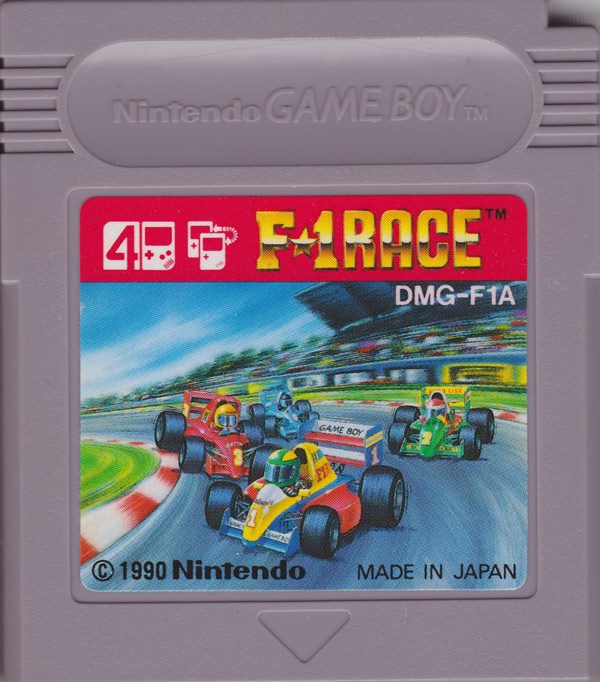
You see them all the time. This is a Japanese version of the game. It’s called DmG-YT, or DmG-YTJ for the Japanese version. This guy’s got his own race. F1 Race from Nintendo was released in November 1990 in Japan, February 1991 in the US, and October 1991 in Europe. This is Nintendo’s racing game. Mario Kart.
There are some Nintendo characters in the game, some cameo appearances, but they’re not actually part of the race itself. You’re just a race car. It’s in third-person perspective, kind of like pole position or something like that. So you’re behind the car, looking at the track. The world is a bunch of stripes, basically.
So you can see your movement by the moving kind of cycling stripe pattern. And there’s actually kind of a neat effect where when you’re going slow, there’s a high contrast pattern. When you speed up, it’s a medium contrast, and then a low contrast pattern, because it looks like the ground is changing colors.
There’s no shifting or anything you need to do. Left and right on the D-pad. A button to accelerate, B to brake. You’ve got a jet booster. You hold up, and you can activate a jet booster. And you can just kind of tap it if you need a little bit at a time. There’s a meter showing how much of this stuff you have.
Also on screen, you can see how many laps you have left and what your position is. Of course, you want to come in first. You can be second or third, but you don’t get to go on to the next race, unless you get first place. There’s an actual in-game map, like you can see the map on the screen, which is pretty impressive for a 1990 Game Boy game.
It’s not a technical racing game. Just because it says F1 on it doesn’t mean it’s going to be one of these technical kind of racing games where you’re picking gearboxes and stuff like that. Before you start the race, you have a choice of two cars. Now these choices change depending on what track you’re on.
And the actual engine size, they don’t just increase as the game goes on. It depends on what’s appropriate for a certain track. Some of them have a lot of curves, some of them have a lot of straightaways. There is an advantage to choosing different cars for different tracks. I noticed this experiment. It’s pretty subtle at the beginning.
I noticed especially in the Brazil level, you want to pick A because of the B car. I don’t think it’s possible to win. Now watch your speed, because when you hit that jet booster, you kind of hear it winding up. It makes this really great rreeeeee sound. It sounds like it’s really going fast. Flames shoot out the back of your car.
But don’t just go by your ears, actually look what it does to this pedometer. You don’t have to hold it down that long. And if you’re kind of low on jet juice, tap or let go a little bit. Just kind of use it with a little bit of rhythm. and get your speed almost as high as if you were just pinning it down.
So don’t just think the B car is gonna be the faster one all the time. It depends on the… they have a different boost capacity. Like some of them actually are slower, but they’re faster with the boost. Some are faster just on their own, but not as fast with the boost. Since this is Nintendo, of course we gotta see some Nintendo characters.
After you win the first race in Australia, you’re gonna see Toad from Mario. After you beat Canada, you’ll see Luigi, and maybe I should stop telling you everybody you’re gonna meet. You’re gonna be racing in Australia, Canada, USA, Portugal, Japan, Brazil, the USSR, India, and Egypt. This is a pretty hard racing game.
Because it was from Nintendo, I was kind of expecting it to be a little bit more Mario Kart-easy, you know? How… Mario Kart kinda eases you in, right? The first few levels aren’t that hard. You play in the 50cc to get started. This one’s pretty tough. Now, the first level’s not that hard, but Canada took me a lot of tries to win.
I kept coming second place, second place, every time. You’ll wanna pick the A car, by the way, if you wanna win it. It gives you just a little extra to get past the finish line before the other guy. The difficulty doesn’t ramp up too high. Once you’ve gotten past the Australia level, which is pretty easy, they’re all pretty much as hard as Canada.
I’m not… Canada was hard. It took me a lot of tries. And I’m… I’m not terrible at racing games. There are no hills in this game. There’s no scenery. The only scenery is the… there’s a backdrop. You know, the kind of sky backdrop changes for each area. Otherwise, you can’t really tell you’re in Portugal or Japan or Brazil.
What I really like about this game is that boost sound. It’s really great. Now, not only are you doing races, there’s also a time trial mode, like most racing games, right? Now, since they’re a time trial, they put a save game in there. That’s kinda nice. You know, there’s an actual battery you’re gonna have to change in this thing, but surprising for a game of 1990.
There weren’t a lot of battery save games in 1990. You can link four players with a link cable on this. There were a lot better and a lot worse games that came out of the Game Boy, but this is kinda one of the early ones, and it’s a Nintendo one. You can kinda think of it as a prequel to Mario Kart. It’s not a hard one to find, at least the Japanese version one.
You see it all the time. This is a universal game, so there’s no difference between the Japanese or English version. If you wanna find this thing, search for DMG-F1A. Mr. Do, published by Ocean Software, was released in Europe and the U.S. in November 1992. It was not released in Japan. Mr. Do started all the way back in 1982 as a coin-op game.
It was one of the first conversion games. You could take another arcade cabinet and convert it over to this. And it was from Universal. Now, this is not the Universal like the movie company. This is Universal, the game company. They made pachinko machines and a lot of slot machines. They didn’t have a lot of big video game hits, but they did have Ladybug.
In the original version of the game, the main character was a snowman, and they later changed it to a clown, because not enough people hate snowmen, I guess. While Dig Dug is digging under the ground, Mr. Do is digging through shrubbery, which kinda makes sense. He’s running away from monsters, and clowns, I guess, could cut through shrubbery.
But what doesn’t make sense is there are these apples, and the apples fall down as if there’s gravity. So it’s like there’s a shrub that’s really, really tall and square, and you’re kinda digging your way through it. It’s just… I guess that could happen. The life of a clown is shrouded in mystery. To clear the level, you need to eat all the cherries, or kill all the monsters, one or the other.
There’s a couple ways you can kill these guys. You can crush them with apples. It’s just like the rocks in Dig Dug. You kinda go underneath and then try to get them to fall on the enemies. And you also have this power ball. So if you turn back and fire that through the tunnel you just made, it’ll bounce around and hopefully hit an enemy.
It just keeps bouncing around until it hits something. So you can’t just keep firing these things. You have to kinda use them when you need them. And that way, it’s a little bit easier than Dig Dug, because you don’t have to be right next to the enemy to defeat them. The enemies, you have bad guys, diggers, blue chompers, and alpha monsters.
Most of the time, you’re dealing with bad guys. They just kinda wander around. They don’t have any special abilities. But they do move quickly. This is one way it really differs from Dig Dug. In Dig Dug, everything’s kind of, at least for the first bunch of levels, you’re not that slow compared to the monsters.
In this one, you’re really slow compared to the monsters. They can really catch up to you quickly. Diggers can dig through the shrubbery. If you trap a bad guy behind an apple, eventually he’ll turn into a digger, but just enough to get out of the trap. And then you have the blue chompers and alpha monsters.
In the middle of the screen where the bad guys are generating, you’ll see there’s some kind of snack there. In the first level, it’s like a cherry cake slice. Then you’ve got graham crackers, fried eggs, sundae, cheeseburger, banana, muffin, Game Boy, cookie, phone, milk bottle, carrot, fish, drumstick, umbrella, boot, and then it repeats.
If you grab this treat, and you gotta be careful, because things are generating from that point, it freezes the enemies on the screen. They can still hurt you. Don’t just run into them. And then a bunch of blue chompers and an alpha monster come out. All hell breaks loose. Try to destroy that alpha monster.
The other guys don’t really matter. You wanna get that alpha monster, throw your powerball at him if you have to, and you’re gonna get a letter. If you spell the word E-X-T-R-A, you get an extra life. Once in a while, inside an apple, you’ll find a diamond. I don’t even remember finding one of these. They’re very rare.
If you get one of these, you can skip the level. Originally, in the arcade version, if you found that diamond, you get an actual credit, which is really rare for an arcade game. Yeah, that’s kind of a pinball thing, if you think about it, getting a free game. But you’d actually get a credit on the game.
Going back to the arcade, Mr. Do, uh, Mr. Do was pretty successful, and there were some other games that came out. There was Mr. Do’s Castle, Mr. Do’s Wild Ride, and something called Do Run Run, which is a little bit hard to find. I don’t think I’ve seen it out in a while. This is a game I used to play in the arcade when I was a kid, and it was punishing.
And I even watched other people play it, and it was rare to get past level five if you didn’t really know the patterns. If you threw enough quarters in there, you could get to six, maybe seven. I don’t remember seeing anyone get to level ten. Like, it just… the difficulty ramps up ridiculously fast.
And there was no ending to the arcade version. The levels just loop. This version is a lot easier. Even if you don’t really know what you’re doing, you can probably get to level ten in a few tries. Which is fun, but in a way, that means they should really offer something more for people that play a lot more levels in.
But it doesn’t really offer that. Really, once you’ve done a few levels, it just kind of repeats, and the difficulty kind of plateaus. After about twenty, the difficulty doesn’t seem to get harder. Sometimes when I’m reviewing these games, I’ll go back in with an emulator and use save states just to see how far in the game you can actually get.
There’s no great reward at the end. The levels repeat. There’s actually a few buggy levels where you eat all the cherries and the level doesn’t finish. I don’t know what that is. And then after ninety-nine, it just goes back to zero again and just keeps going. It really is the kind of game where you don’t try to beat it or accomplish anything.
It’s just kind of a fun diversion. Something a little different from the arcade version is that when you throw your Power Ball, you don’t have to turn back to throw it. You can kind of throw it in front of you and it bounces back behind. Which doesn’t seem to happen in the arcade version. Not that I remember.
The music is really good. It’s sort of… it has nothing to do with the original Mr. Do, I don’t think. It sounds like one of those Amiga 4K demos. Really nice chiptune techno thing going on. There’s a high-score feature, but there’s no save on the cartridge. The graphics look good. In the Intermission, the graphics look really amateur.
But actually in the arcade version, the Intermission’s had this different but still very amateur style. So I guess it’s true to the original. If you’re a huge Mr. Do purist, you’re probably not gonna like this. But if you want a fun and not-so-frustrating arcade game, you really can’t go wrong. When I was searching for information about this cartridge, I found a lot of reports that it is very expensive.
I’ve actually seen it for sale on different sites where it’s under 10 bucks, and I picked one up on eBay for 7 bucks. Maybe if you want it in the original package, it’s expensive. But just picking up a loose cart is probably not that expensive. In 1999, Sunsoft released a game called Quest Fantasy Challenge.
In Europe, it was called Holy Magic Century. For Game Boy Color, it was never released in Japan. Everybody hates it. But don’t be scared off Mr. Do if you’ve played that one. That one was totally unrelated. Um, it is really bad. I tried it. It’s not just the same game with different graphics. It was like, they made their own crappy version of Mr. Do and messed it up.
Mr. Do is a little bit hard to find, but keep trying, you’ll find it. DMG-M4. Pitman was released in June of 1990 in Japan. This is an early Game Boy game. It came out in the U.S. in September 1990, but it was called Catrap, or Catrap. It was made by Asmik Ace Entertainment. They’re the ones that did the Boomer’s Adventures game, or Asmikun games.
They didn’t do a lot of Game Boy games, they did a couple others. This is a platform puzzle game. It’s a little bit like Flappy Special. But unlike Flappy Special, the characters are nice and big, you know, but you do have to scroll around the levels. You play these two cute characters. You can choose either character, there’s a boy and a girl.
These kids were cursed with becoming cats, and they have to beat a hundred levels of monsters to turn back into humans. So you can walk up platforms, you can’t jump, you can climb ladders, you can fall off ladders, you don’t get hurt, and you can push blocks. But in this game, you don’t have to worry about enemies.
As soon as you walk up to an enemy, you haul back and deck them. So the goal is to punch out all the enemies on the level. You don’t have to get to an exit or anything like that, just punch everybody. And the levels start off nice and easy, like the first couple of levels just kind of breeze through, just get the idea of how it works.
And the sounds and animation and music are really cute. If you find Flappy Special to be a little bit dry and the soundtrack to be kind of irritating, this one’s a lot of fun. This game has another interesting feature. You know, if you make a mistake, you don’t have to go and restart the level if you don’t want to.
You can hold the A button, which will rewind. It’s amazing. This is the kind of thing you saw in games in the 2000s. And I think it’s the first occurrence of a game where you could actually rewind and go back. I mean, it’s incredible. Now, it still affects your time limit. You do have a time limit that’s ticking down.
It’s pretty generous in the early levels. And the time limit doesn’t really matter, because once you’ve figured out the level, you can just play it again and just do everything in the right order. There’s no real timing elements, although some of the levels are very complicated later on. There’s a password, which will let you save how many levels you’ve cleared.
However, you can play any level you want. There’s a level select, and you can just pick a level you want to play. There’s also a level editor. Now, there’s no save game on this cart. The password saved, like I said. So, what’s the point of editing levels? Well, you can edit your own level, and then you can actually save it.
It gives you a rather long password, but, you know, it has to save all the blocks you’ve put down, and you can save your own custom levels. When you’re editing levels, you move your cursor around, use the start button to change which block you want to put down, and you can kind of arm one block on your A button, one on your B button.
So, let’s say I have bricks on one and enemies on the other. My A button is going to lay down bricks, and the B button is going to drop enemies. Pitman, or Cat Trap, is a very, very well-balanced puzzle platformer. There are so many puzzle platformers to choose from on the Game Boy. This would be one of my top choices.
And now that I’ve played it, I don’t really want to play Flappy Special anymore. If you want to find the cartridge, look for DMG-PMA for the Japanese version, DMG-PM for the Cat Trap US version. There was no European version, but now Europe and Australia can get it on 3DS Virtual Console.