Reviews of Doraemon 2, Crayon no Shin-chan 2 (Ora to Wanpaku Gokko Dazo), Xenon 2, Boomer’s Adventure in Asmik World 2 (Asmik-kun World 2) & Adventure Island 2, Aliens in Paradise (Takahashi Meijin no Boukenjima III).
My name is Ray Larabie and I'm talking to you from Nagoya, Japan. Welcome to episode number 45 of Game Boy Crammer. Today is an episode of sequels. I've got Doraemon 2, Crayon No Shin-Chan 2, Xenon 2, Boomer's Adventures in Asmik World 2, and Adventure Island 2.
Chester Roberts, omedetou gozaimasu. You won your very own copy of Pokémon Y for 3DS. And thanks to everyone else who entered the contest. I appreciate all those tweets and retweets you've been giving me. Don't stop now. Paul Johns left a great review for the podcast on iTunes. I really, really appreciate iTunes reviews.
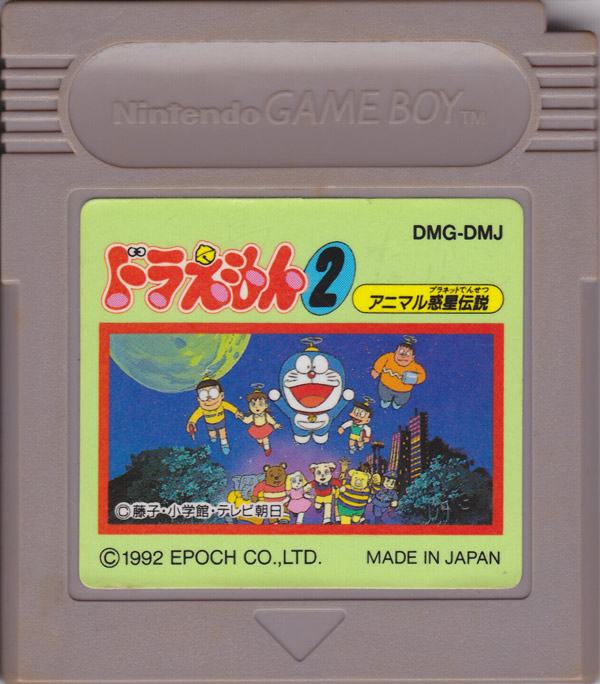
It makes it a lot easier for people to find this podcast. The more reviews you have, the higher it shows up in a search for retro games. And right now I'm still pretty far down the list. If you can spare a few minutes, please give me a review. Let's start the show. Let's do a big review. Doraemon 2, Animal Wakusei Densetsu, developed by Agenda, published by Epic, was released in Japan only in December of 1992.
This is a sequel of Doraemon, which I reviewed in episode 16. This is not the same as Doraemon 2 on the Super Famicom. Animal Wakusei Densetsu. You've heard Densetsu a lot in game titles. Legend. I'll say, if you look at the kanji, you'll see the kanji for star. It means planet. So Animal Planet Legend.
This was before Animal Planet was a channel. Doraemon, the friendly robot cat from the future, and the usual Doraemon crew, you know, the core crew, Shizuka-chan, Nobita-kun, Suneo and Jyan, they're headed to the Animal Planet because some bad thing happened and the sweet little puppy dogs and other adorable animals are being harassed by evil robots and aliens.
Most of the game takes place on the Animal Planet, but there might be some space travel because you're gonna have to fight these aliens on their own turf. Like the first game, there's an overworld, I would not call it an RPG, although you will be collecting objects and you can switch weapons, so there's a slight Zelda resemblance, but very slight.
You're in a top-down view, walking around a scrolling map. Usually you're Doraemon, there are times when you're not, but you don't get to choose. On the overall map, you can go to different locations, buildings and caves and stuff, and when you go to these locations, you're either going to get some dialogue telling you you can't go there, a side scrolling platformer or a side shooter.
The side shooters are less common, usually you're gonna get a platformer. Some of these levels are sort of bonus levels where you can get some 1-ups. Those bonus levels you only get to try once. If you go in there and you die instantly and you didn't collect any 1-ups, you don't get to go back. Then you have levels with bosses.
Usually it's a long level, at the end of the level you'll have a boss and then if you die you'll have a chance to opt out. Some bosses require a certain weapon to beat, so you may find yourself dying and then bailing out realizing that you need another weapon. Happens a lot. Most of the weapons and objects are obtained at the end of a level, either after a boss fight or just at the end of one of these platform or side shooter levels.
The exception is a house with a desk. When you find that desk, remember where it is, you should go back once in a while. There are all kinds of objects you can pick up. Usually they just let the game progress, but I think I should mention there are two objects that don't follow the same pattern as everything else in the game.
One of them is a trash can. If you find yourself in a foggy area and you can't progress, that's when you use the trash can. If you find yourself facing aliens at some sort of castle and they won't let you in, something that looks like a straw might help you. Those are the only two parts of the game where I kinda got stuck.
Most of the game is run around and if you can't go in somewhere it means you have to go do something else. Luckily the map of the animal planet is not that big, it's really easy just to go to each thing and try, if you're not sure where to go. The dialogue in this game is all in Japanese, it's all in hiragana so there's no kanji to read, and it's very basic dialogue, it's really not long winded, it's not like playing a modern Zelda game where they just go on and on and on.
If you know a little Japanese, if you're a student of Japanese, this is a good game to practice on, because the language is pretty simple. If you can't read any Japanese, you can pretty much bumble your way through this game. Apart from the story related objects, there are weapons. Some of the weapons are the same as the first Rhymon game.
You've got the three way shooter that looks like a coffee mug, the boxing glove which is your starting weapon, and various types of shots. When you see Doriyaki on a level, that's those little things that Rhymon likes to eat. Those are essentially 1-ups, but at the end of the game you'll be ranked on how many of these you got.
It'll actually tell you how many you got. On the overworld there are some robots walking around sometimes, or mollusks in the underwater levels, but they're not really much of a challenge. You can walk around them if you want. There are timer power-ups that freeze all the enemies, and it lasts quite a long time.
There's another power-up that's very rare, it looks kind of like a black kettle or something. That will give you temporary invincibility. There's a P power-up, I guess it's a power thing. I don't even know what it does. Maybe it's just points. And there's a power-up that looks like a hand. If you pick up that power-up, everything on the screen is destroyed.
But it's really strange, when you see this in the game, the first time you see it, there's nothing around to destroy. And you keep going back to this spot, and it's there, but there's never anything to destroy. So for a long time I had no idea what it was doing. I was just grabbing this hand thing, nothing happened.
You'll see those in the side shooter levels once in a while. There are flowers that will launch you sideways in these platform levels. And it's really hard to control, you kind of have to, let's say you're on a flower, you push to the left, the flower is going to kick you off. You have to immediately push to the right to extend the length of your jump.
There's a really tricky skill-based level, right near the end, where you can collect a whole bunch of 1-ups, and it's just really hard to time it. Apart from the regular platform levels, there are some underwater platform levels too, where jump is swim. You'll be able to find a map, however this map doesn't zoom out all the way, it just gives you kind of a subtle zoom out, and the animal planet is so small anyway, you don't really need it.
There's no battery to replace in this game, but it does have a password save. Most of the gameplay isn't that challenging, but some of the platform stuff is, because it's instant death. There are a lot of enemies that just pop out of nowhere, and you don't have much time to react. To me the most frustrating one was these fish skeletons, that just pop out, even if there's no water, they'll just sort of pop out of the ground.
I had some in space hit me, in space, instant death with those things. And there's some pretty difficult platform jumping things. But this game is really generous with the 1-ups, and sometimes you can just wander, you know, if you see an area that looks like a dead end, but it's kind of suspicious, walk over to it sometimes, and a raccoon head will appear, which gives you a 1-up, or one of those dorayaki things.
The game is pretty long, if you actually add up all the levels there are in it, it's pretty decent, and compared to the first game, it feels like they put a little more thought into it. In the first game, near the end of the game, it felt like it wasn't even tested. This one seems to have a little more attention to detail.
I recommend this game if you kind of like these silly, kind of bad, but kind of good Japanese games, or you're trying to complete a Doraemon collection, otherwise you can probably skip this one. Doraemon games are not always that cheap, I think because there are so many Doraemon collectors that just want to collect a set, even if they don't play them.
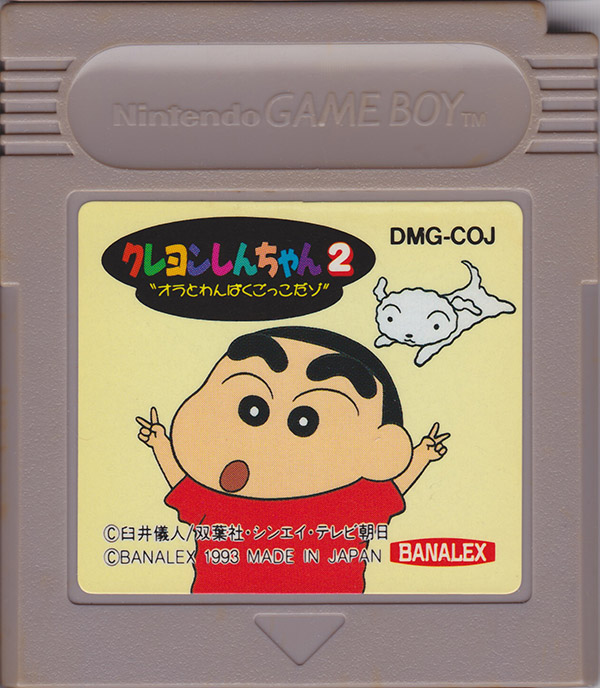
But it's not rare. Rime on 2, Animal Wakusei Densetsu, look for DMG-DMJ. Crayon Shin-Chan 2, Ora to One Paku, Gokko Dazo, was released in Japan only in October of 1993. It was published by Banner X. It is a sequel to Crayon Shin-Chan, which I reviewed in episode number 28. The name means Ora to One Paku, Ora is myself, like Watashi, except like a little kid might say it, and One Paku is an active boy, Gokko Dazo is kind of, let's go, let's get him.
So like the first game, it's a platform game, you play the main character, Crayon Shin-Chan, you are going to be hopping and bopping in this platform game. Not only can you hop on benches and soft drink machines and houses, you can also climb telephone poles. You can hide behind telephone poles to hide from enemies, and you can climb up.
Use A to jump, and then push on the D-pad, you'll see you can grab onto those telephone poles and trees. B is your bubble attack, now in this game you can't switch weapons, you always just have the bubbles. You can also go into some buildings, into stores, so you have to figure out what a store is, if you know the kanji for store it helps, or just push up on something that looks like a store.
There's no buying stuff, there's no inventory, it's really just to hit certain story points to move the game along. As for power-ups, there is a Shin-Chan doll that looks like you, that gives you an extra life. There are canisters all over the place, you collect 20 of those, you get an extra life. There's a bottle that almost never shows up that lets you jump higher, and there's a mask, you pick that up, you'll turn into an invincible super-character.
It stays for quite a long time, and you won't take any damage, you can shoot this blast ray thing. There are little smiley faces hidden all over the place, sometimes you find them behind a tree, sometimes they're just in the sky, you just kind of jump in mid-air and you'll get one. In every level there are five of these to find, if you can find all five, at the end of the level they kind of tally up how many you got, you are congratulated.
You'll see these smileys at the bottom of the screen, sometimes when things hit you, you're going to lose one of those smileys. At the end of each level you're going to get a mini-game, just like in the first game, they're super lame, and if you don't win this mini-game it won't affect your progression in the game.
And at the main menu, you have a chance to practice these mini-games, you don't have to unlock them or anything, they're right there. Pretty sad little mini-games. In the first game there were four levels, it was very short. In this game it was a major improvement, there are five levels, okay, not a major improvement.
In the last game there was a lot of danger of falling to your death. In this game, not a lot of danger of falling to your death. It does happen in the later levels, for the most part you're just trying to find those canisters and try to get to the hard to reach stuff. This involves doing a lot of climbing, there are some very hard to time jumps on moving platforms, rail cars and stuff like that, but there's no time limit, so you can just sit there all day and try to make these jumps and collect these power-ups and stuff.
Knock yourself out. If you find all the canisters, you don't lose any, there's some kind of special ending, which I didn't get, I just got the regular ending. I got almost all of them. The dialogue is all in Japanese. If you're a student of Japanese, it might not even help you because Crayon Shin-Chan talks like a little kid, so it's improper grammar and kind of little kid words that you'd know if you grew up in Japan, but if you're a student you don't learn those words, so look, I tried reading the dialogue, it was super dumb anyway, you're not missing anything.
Although you might get confused on one level, you'll get to the end of the level, you'll find this Charlie Brown-looking kid that won't let you go past, you gotta go back to the store and talk to the cashier. Even if you've already been there, go back to the store, hit up, then go to the end. Stage 5 was actually okay.
It's kind of an interesting, kind of tough level design, but overall, this game is a big dud. I'm gonna keep reviewing these Shin-Chan games, hopefully I'll find a good one. Luckily it's cheap, cheap, cheap, and easy to find. Search for DMG-COJ. Xenon 2 by Teenyweeny Games was released in late 92 in the US, Japan, and Europe.
Xenon 2 is a top-down space shoot-em-up. You fly a spaceship, and you shoot other spaceships, and weird alien monsters. It has all the features of a standard shooter, except one big difference. You have the ability to go backwards. You know how most shooters that scroll and keep coming and you can't stop it?
Well, you'd think if they had the technology to make a spaceship that can shoot lasers and missiles and all kinds of stuff, you'd think they'd build in reverse. The other difference between this and your average shooter is, the scrolling is pretty slow. This is not a fast, fast game. This is a port of Xenon 2, which originally came out on the Commodore Amiga and Atari ST, was also ported to the PC, Sega Master System, and Genesis Mega Drive, Acorn Archimedes, and the Sharp X68000.
The original Xenon was made by the Bitmap Brothers. Xenon 2 was designed by the Bitmap Brothers, but coded by assembly line. The Bitmap Brothers weren't that big in the console world, but they were really big in the computer gaming world, especially on the Amiga. The original Xenon was a big hit on the Amiga.
If you had an Amiga, you probably played Xenon at some point. It had this amazing music, and everything was really slick and chrome. It really took advantage of what the Commodore Amiga could do. The Bitmap Brothers were UK developers. They started in 1987, and the original Xenon came out in 1988. They were kind of considered rock stars, partly because they had a publicity photo where they were standing next to a helicopter, and they had cool sunglasses on, and they really, you know, the press kind of went with that.
It's like, hey look, these aren't just dweebs making video games. These guys are actually cool. When I was a young fella wanting to make video games, I really looked up to these guys. Like, I always looked at Bitmap Brothers games, and I just wanted to emulate the way they… They just made pixels look so amazing, and they really took advantage of the Amiga color palette.
The original Xenon was a top-down shooter, except the difference was you could switch from plane to tank. When you were a tank, the scrolling stopped. This was part of the non-mandatory scrolling thing that followed through to Xenon 2. They also made a game called Speedball, and Speedball 2 Brutal Deluxe, which came out which is, as you know, I'm not big on sports games, but it's probably my favorite sports game.
They also made Zed, a real-time strategy game, and Chaos Engine. When Xenon 2 came out in the Amiga, it was just amazing. The music. Everything had this amazing, crisp, shiny look. The Game Boy version? Not so crisp, not so shiny. Obviously, they're taking a game that's got a lot of detail and putting it onto the Game Boy.
It suffers quite a bit, but still looks cool. The music, however? Not cool. In fact, it's remarkably bad, but on the main menu, you have an option to turn off the music. I suggest you take that option. Use your D-pad to move around, use either button to shoot. Anytime it gets a little crazy, just back up to the bottom of the screen, the whole screen will start scrolling the other way.
This is why it's important to get a rear gun. Very early in the game, you're going to see a power-up, which is a rear gun. If you don't get it, you can buy it. Once in a while, you'll end up in a store. The shopkeeper asks you if you want to sell some weapons, and then offers weapons for sale. Don't try to keep any money left over.
You don't keep money from level to level. So spend everything. To earn money, you can pick up coins. They look like little copyright symbols. Once in a while, you'll see an S-power-up. That makes you go a little faster. Once in a while, you'll see a Z-power-up. That zaps everything on the screen. There's also a P-power-up.
I don't know what it does. I grabbed them. They didn't seem to do anything. There are little hearts and big hearts. The big hearts fill your health up all the way. That's right, a health bar. And you can touch the sides. For some reason, this has a reputation of being a very, very hard game, but based on the Game Boy version, it's not that hard at all.
And you have easy, medium, and hard levels to choose from at the beginning. In the shop, you're going to find all kinds of weapons to choose from, and you don't lose those weapons when you die. They stay with you. However, watch out, because there's some comedy booby trap weapons. They're not booby traps.
They're just a waste of money. They last a few seconds. But beware, there are a few items in the store that are kind of joke items. So probably the first time you play, you'll be tempted to try some of these. I don't want to tell you to ruin the fun, but some of them are a big waste of money. And when you buy some weapons, they actually stick on the outside of your ship.
So when you buy the laser and the missile, it actually puts a little block physically on the outside of your ship, making your ship wider. But like I said, you don't have to worry about touching the sides. There are situations where you have to go into reverse and scroll back, because there are forks in the level, and there's some places where there's a fork in the level where you have to go back and then go back up again.
There's no time limit, so take your time. And don't forget to use the reverse when you're fighting bosses. Sometimes you're kind of forced into it, but a lot of times you can just get the boss on the edge of the screen and take out what you need to take out and just back up. It's cowardly. It takes a lot of time, but it works.
There are six levels. They're pretty long levels. If you actually play this game all the way through on easy, with a little bit of backing up, I played it, it took me about an hour and a half. Just maybe I did a little too much backing up, because backing up is really slow. It does eat up a lot of time.
The game ending is kind of ridiculous. You'll have to see it for yourself. Xenon 2 is good, but it didn't really get my heart racing at any point. It was a little bit like whittling wood. I'm shooting enemies, but I'm not really that afraid at any point. There are bullets all over the screen. Sometimes I can't really tell what's hitting me, so there's no sense of shock when something's hitting me.
I just kind of notice, oh, my health bar went down, because you can't even hear the damage. The enemy bullets look like your bullets, so when you have your ship all decked out, you really can't see what's coming at you. You have to kind of stop shooting once in a while just to see if there's anything shooting at you.
There are much on the surface seemingly lame top-down shoot-em-ups that I've played that have really got my blood pressure up. This one just is kind of a cruise, and this game is expensive, at least in Japan. For some reason, the US and European versions aren't called Xenon 2 Mega Blast. Only the Japanese version is Xenon 2 Mega Blast.
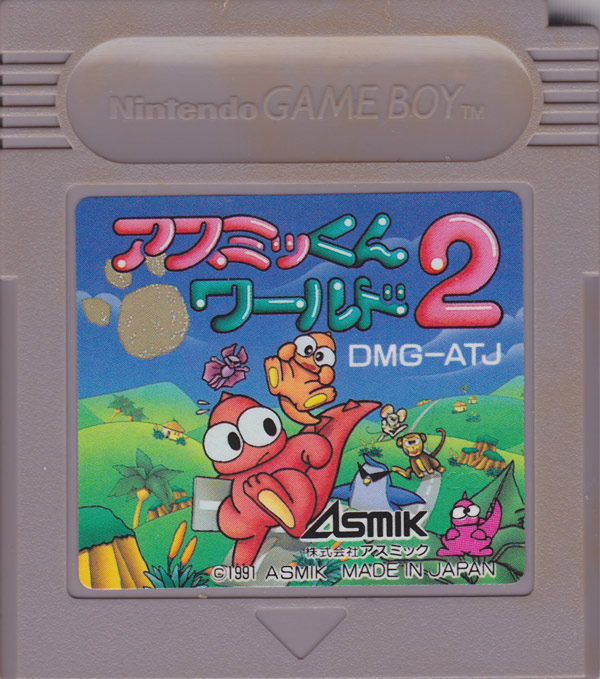
But on the Miga and the Atari ST, it was called Xenon 2 Mega Blast. Why no Mega Blast? I don't know. If you're looking for the US version DMG-X2, Japanese version DMG-X2J, European version DMG-X2-NOE. Asmikkun World 2, developed by Cyclone Systems, published by Asmik Ace Entertainment, was released in Japan only in May of 1991.
This is a sequel to Teke-Teke Asmikkun World, which was released in December of 89, then in April 1990 as Boomer's Adventure in Asmik World, which I reviewed in episode 10 of Game Boy Grammar. If you'll recall, the original was a trap-em-up game, it was a maze game where you set traps on the ground, creatures would fall in, you'd bury the creatures, and there was all kinds of power-ups.
There's a similar play mechanic to Heian Kyo Alien. While this game does star Boomer, the kangaroo, it's a different type of game. Like the first game, it's a top-down maze game. Boomer will come out of a tunnel entrance and is required to build a road that leads to an exit. To build this road, you have several pieces to choose from.
With the D-pad, you can switch which type of road piece you want to put down. You'll see them at the bottom of the screen, horizontal, vertical, and four corners. Press A to put the piece down and go to the next piece. Now each piece at the bottom of the screen has a number below it, that's how many pieces you have of that particular type.
So it's a puzzle game. You have to figure out how to make the path with the limited number of pieces you have. There's 16 levels, but in each level there can be several screens. Sometimes there's a tunnel going in and a tunnel going out on the same level. Other times there'll be an arrow that you have to go to, and that'll lead you to another level where you'll have to join and make it to the exit.
There's no time limit for finishing this road. However, one of your little kangaroo babies will come out of the tunnel and run down the road, and it's in danger of these monster things. I don't know what they are. Evil construction workers, I guess. These things will attack your baby and will hear a pathetic squealing sound, so stop building the road, hit B to stop the construction mode, and run back and save your baby.
When you reach the baby being attacked, you're going to go to a battle mode, a simplified bomber man. You'll have a whole bunch of animals chasing after you, and you just have to drop bombs to hit them. Once you kill them all, you go back and that enemy will run away, basically. If you like murdering bunches of monkeys, your thirst for monkey blood will be satisfied, and penguin blood.
I think it was pretty daring of these game designers to make the enemies penguins. If you make a mistake and run out of road pieces and you can't make it to the exit, you gotta go all the way back to the beginning of the tunnel, hit A, the road will roll back up and you start all over again. Once you do reach the exit, you'll get a password and you'll go on to the next stage.
In addition to fighting the regular enemies, you're going to encounter some bosses, too. At the beginning and the end of each level, there's a digitized voice, which is pretty cool for 1991, I guess. I gotta say, I'm pretty disappointed, because the first game was so good, I was expecting this one to be more of the same or something better, and it's a puzzle game where something interrupts you once in a while, you have to go and do something and then come back and try to remember what you're doing.
I don't think being constantly interrupted with a kind of lame battle mode really enhances the puzzle side of the game. I'm disappointed, and I understand why they didn't make an English version of this. This thing is totally playable in Japanese, there's nothing to read, and it's password saved so you won't have to replace the battery.
If you're looking for this game, search for DMG-ATJ. Takahashi Meijin no Bokken Jima 3 by Hudson was released in Japan, U.S. and Europe in early 1993. The European version was called Adventure Island 2, U.S. version, Adventure Island 2 Aliens in Paradise. Just be careful if you're visiting Japan, you go to a game store, don't get excited when you see a third Adventure Island.
Number 3 is actually number 2 in the English version. Adventure Island 2 is a platform game. I recommend listening to episode 6 of Game Boy Kramer, that's where you'll hear a review of the original Adventure Island, because this one is almost the same. You're gonna be doing the same kind of thing you did in the first game, you've got basically the same weapons, enemies are almost the same, there's an overworld between levels, but it's all linear anyway, so it's just kind of a visual trick.
You're just doing one level after another. There are a lot of levels in this game, there are 8 levels with 6 each, which comes to 48? Yeah, 48. Just like in the first game, your girlfriend has been kidnapped and you have to rescue her. Where do they come up with these ideas? You play Higgins, just like the last game, Higgins has some kind of diabetes issue where he has to constantly eat food or he'll die.
So you always want to be getting fruit, there's a power bar at the bottom, keep loading up on fruit. Meat, even better, restores your health all the way to full. If you care about points, the flowers will double the amount of points you get for fruit for the rest of the level. For weapons, you got the hammer and you got the boomerang.
The boomerang is terrible, try to get the hammer as much as you can. Skateboard shows up once in a while, not really useful, but it does allow you to take one hit of damage. You got the fairy in this one that makes you invulnerable for a few seconds. And there's the Nasu, the eggplant. Looks like a little pickle.
This is like the opposite of the fairy, when you get this thing it depletes your energy very quickly. If you can avoid it, avoid it. If you have one of these things on your back, just try to get as many fruit as you can to survive. This game has the hidden eggs just like the last one, if you just keep firing into the air you'll see your hammers or boomerangs are kind of hitting something invisible.
That's a hidden egg. Some of them take you to secret areas. There's one secret area that has a choice of three eggs to choose from and you can choose one of the eggs that has a three up in it. There's a surfing minigame you can get in one of these bonus levels and it's actually really hard. There's a wave that looks like a hand coming up out of the water and you have to jump from wave to wave, but it's a really tough jump.
There's another bonus game that's like a warp whistle in Mario, but I never found it. You're going to have some helpful monsters to ride just like in the last game. There's Blue Tailor, he's got like a tail whip action. Red Tailor can walk in lava, shoots fireballs and goes pretty fast. You got Polly, it looks like a rhinoceros and has a roll action.
If you keep hitting your button really fast, you're going to be pretty much invulnerable. You can take out certain bosses really easy with this thing. Classy is sort of a Loch Ness monster type of deal. It swims a lot faster than just Higgins on his own. Don Don is a pterodactyl, so you can just fly right over the level.
Now, if you do that, you're not going to be collecting fruits. You need to drop down and get fruit and you're going to miss out on lots of bonus eggs and stuff like that. Save these up, they're really handy. Don't use one of these on the crab boss, you'll be there forever. I did that. Like the first game, these levels are very, very short, but I'm not going to say it's not challenging because around level five or six, it gets pretty tough, actually.
Around that part of the game, you're going to find one level that's really hard to get across. There's a lot of really tough jumps. That's where you want to save up those birds, I mean the Don Don, so you can just fly over those tough levels. The graphics are similar to the first game, music's kind of catchy, you can save your game with a password.
If you like the first game and you just want a little more, you can't go wrong. For the Japanese version, DMG-GQJ. US and Europe, DMG-GQ.