Game Boy Crammer · Episode 26
Kirby’s Block Ball, Janken Man, Ganso! Yancha Maru, Zoids Jashin Fukkatsu
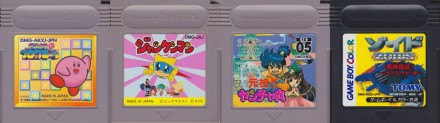
Reviews of Kirby’s Block Ball, Janken Man, Ganso! Yancha Maru & Zoids Jashin Fukkatsu! Genobreaker Hen.
My name is Ray Larabie and I'm talking to you from Nagoya, Japan. Welcome to episode 26 of Game Boy Crammer. Today I'll be reviewing Kirby's Block Ball, a strange platformer called Janken Man, another strange platformer called Gansou Yanchamaru, and a dubious RPG called Zoids Jashin Fukkatsu! Genobreaker Hen..
To all you people who've been mentioning my podcast on Twitter, I really appreciate it. And to all you people who've been just walking up to people on the street and shaking them and telling them about my podcast, I thank you too. But be careful. Let's start the show. Kirby's Block Ball was released in December of 1995 in Japan, Europe, and Australia, and May of 96 in the US.
Kirby's Block Ball is a breakout type of game. Breakout came out in 1976. It was a sequel, sort of, to Pong. It was actually built by Steve Wozniak and Steve Jobs, and this thing was on every game console. In the late 80s, Taito released Arkanoid, which was the same idea as Breakout. You had a paddle at the bottom of the screen, and you were bouncing a ball to knock down bricks on the top.
Except with Arkanoid, you had power-ups dropping down and enemies bopping around. And Arkanoid was so popular, there was tons of Arkanoid clones on computers and arcade games too, but there really wasn't a big improvement in gameplay until Kirby's Block Ball came out. Kirby's Block Ball, to this day, is the most creative variation of Breakout.
It's a little reminiscent of Atari Warlords. So instead of moving a paddle just on the bottom of the screen, you're also moving paddles on the sides and the top, all with the same controller. And in this game, you're not just bouncing a ball, you're bouncing Kirby. This game was by HAL Laboratory, so needless to say, it's got great music, it's got the Kirby cute little animations, the graphics are great, and it has that wonderful Kirby personality.
And lots of enemies you'll remember from other Kirby games. Now the buttons in this game do something. The A button, if you time it right, you can do a Kirby power bounce. So normally the ball is just a regular little ball, but if you time it and you hit the button just as it's hitting your paddle, it'll turn into Kirby, and bounce around a couple of times and then turn back into a ball.
Now in normal Breakout types of games, if you miss the ball, that's it, you lose a life. But in this one, some walls have spikes, in fact most of them, but some walls don't. So really it's about hitting the spikes. If Kirby hits those spikes, it's okay, he turns back into a ball. But if the plain ball hits the spikes, you lose a life.
The B button is used to activate a special ability, I'll get to those later. Now at the top of the screen you can see some information. You'll see the number of balls you have left, when you run out, it's the end of the game. And the more you have in your inventory, the more points you get at the end of a stage.
It also shows you the number of star blocks you have. Now these star blocks really help you out in the boss area, that's what covers the spikes. If you don't get any star blocks, the spikes are exposed right off the bat, and it's a little more difficult. And also in the corner you'll see which ability you have, if any.
And you know, this game is about points, there is a par you have to reach called borderline, and you'll find out what that is in each stage. If you pass the borderline for every stage, you get a bonus level at the end of the game. There are ten stages with five areas each, and the fifth area is a boss.
There's an overall world map that shows you all the levels you've done, so you can actually go back and do older levels if you want to pass those borderlines. The abilities. Now I don't have to explain exactly how these abilities work, because it'll actually show there's a little animation when you get these abilities, or when they become available, that shows you how they're used.
There's no reading you have to do in this game, it's all visual, so it doesn't matter if you get the Japanese version or whatever version, no reading. The spark ability will make your ball spark, so you hit the B button and you'll start sparking all over the place, and that'll knock out blocks that normally take a lot of hits to knock out.
And you can use it on enemies, you can use it on bosses. When you use these abilities, you can't be Kirby, so you can't bounce a ball and turn them into Kirby and then use the ability. You have to send just a plain ball out, or wait till Kirby turns back into a ball, and then activate the ability with the B button.
There's the stone. If you can get the ball up near the top of the level, the stone will drop down really hard and knock out everything in its place. Not everything, but most blocks. There's the needle. This is like a porcupine spike. So you hit the button and a bunch of spikes come out. It's not as useful as spark, but there's one really good thing about it.
If you can use this spike thing while it's touching your paddle, you'll grab the ball, and then you can go wherever you want and release the ball. Just like you can at the beginning of the level. The burn ability is just like the stone, except it goes up. Now there are different types of blocks, too.
Apart from the regular blocks, there are switch blocks. These have stars on them. When you get the switch block, you'll get a bonus round. All the blocks turn into like jelly or something, and then you can bounce the ball straight through them. However, if you try this and you miss any of the blocks, then you don't get any points.
So you end up losing a lot of points because you would have got more points destroying them in a conventional way. There are these kind of pinball bumpers with a happy face on them that knock your ball really fast, but you can't destroy them. And you got the warp star. You've seen these in other Kirby games.
This will take you to bonus stages. There are four bonus stages. I'll tell you about those later. And enemies. There are so many enemies, I'm not going to tell you about all of them. But objects? You've got cakes, candies, apple. You get a bunch of points from those. There's a bomb that'll knock out a bunch of pieces.
Oh, there's one that'll let you choose what ability you want. You get these in the later levels. It'll actually cycle through all the different abilities, and you just hit your B button when you see the one you want. There's a flip. What it does is it makes the blocks opposite. So all the blocks that take a lot of hits or are indestructible become destructible.
All the ones that weren't. So it switches them around. The bonus rounds. You get these from the warp stars. They're not available on every level. In fact, I think it's only once per stage. And the point of these bonus games is to get 1-ups. Or 2-ups. Or 3-ups. The up cloud game has a bunch of clouds.
The 1-up one is up near the top. The 2-up one is kind of in the middle, and the 3-1 is low. You want to try to get the 3, obviously, to get up to the top first. But it's hard because the ball will always hit the 1-up. I almost always get 1-up or 2-up. I've never gotten the 3. There's another game called Up Down.
You bounce the ball around and you try to match tiles. You know, so if you can match a whole bunch of Kirby's in a row, you get 3-up. I always screw it up and I end up with 1-up. There's air hockey that's just like hockey. Kind of fun. Starcatcher is really hard. It's almost like a boss level. This thing in the middle is shooting out stars and bombs.
You have to catch the stars with your paddles and miss the bombs. It's not that hard, but it's hard to do it perfectly, and if you don't do it perfectly, you're probably better off trying one of the other games because you have a better chance. This game does have a save on it, so if you bought the cartridge, you'll have to replace the battery.
And 10 levels. It's a long game, actually. Even if you don't even worry about the borderline thing, you just try to plow through it, there's just a lot of levels and it takes a long time to get through. I was never really bored during this game. It's always fun. The difficulty doesn't get ridiculous.
Like really by about the third stage, that's about as hard as it gets. It's not like, well, if you've played Arkanoid or Arkanoid 2, they get really, really fast. Like the speed goes higher and higher. In this one, the game never really speeds up. They're just more stuff. In my day, I've played a lot of breakout types of games, and so far this is my favorite.
The only thing that would make it perfect is like an analog controller of some type, like a hook-up a little trackball or something like that. This is one of those games that should really do an update for modern controllers, modern devices. There's another very popular breakout game on the Game Boy called Alleyway, the launch title.
Alleyway was there first, but it really looks pathetic compared to this thing. This is the Rolls Royce of breakout games. You should get this. Look for DMG-AKXP for the European version, AKXJ for the Japanese version, AKXE for the U.S. version. It's also available on 3DS Virtual Console. Janken Man was released in Japan in late 1991.
It's a platform game with elements of rock, paper, scissors. It was made by NCS. This is the company that made Afterburst, Prince of Persia for Game Boy, Battletoads for Game Boy. There are a lot of these Japanese-only games that are heavy on the rock, paper, scissors. Now, rock, paper, scissors has a very special kind of Japan connection.
I mean, it's a game that originally came from China about five centuries ago. In China, it's a snail-snake-frog. In Japan, it's rock, paper, scissors, jankenpon, but the hand signs are the same, and they represent the same thing, rock, paper, scissors. Rock breaks the scissors, scissors cut paper, paper covers the rock.
When you start the game, you're presented with a choice of four different characters you can rescue. One looks like a ball, one looks kind of like a tooth, one looks like the guy from Snow Brothers, and one that looks like the little green sprout in the green giant commercials. When you start the game, on the top of the screen, you'll see a high score and a best time.
Below that, you'll have your score and your time. The time limit is constantly running down. To increase your score, you jump around in platforms and collect little prizes. Cherries, hands on the rock, paper, scissors, symbols, stuff like that. Enemies are bouncing around. They don't kill you, but they slow you down, and the goal is to rescue someone at the end.
Now, along the way, as you're jumping on these platforms, the control is very easy. You have a little bit of air control, and the platforms are pretty easy to land on. You're going to go to these little doorways. When you go in the doorway, you're going to do a rock, paper, scissors competition with someone.
So, you can move up and down to choose whether you will choose rock, paper, or scissors, and do battle. Now, the timer's running down the whole time, so you don't have a lot of time to think. Unlike some other rock, paper, scissors games, there seems to be some AI to this one. You can't just pick the same thing over and over and expect to win.
You have to kind of mix it up. I find I have the most success by just picking two of everything. Just you do everything twice, it seems, to fool the AI, but I don't know. It seems to be a little bit of strategy involved. Maybe not. I haven't graphed it out. If you do beat the opponent, there's a spinner.
Numbers will start spinning, three digits, and then you can choose, you know, if you stop it on 999, you'll get 999 added to your time limit. When you reach the end of this rather short level, you'll do another rock, paper, scissors competition against an enemy to rescue the damsel, or the snowman head, or the little ball, or whatever it is in distress.
After that, back to the main screen where you started, and choose a different character to rescue, and do it all over again. So essentially, this game has four levels, and you don't have to progress through them like in a traditional kind of platform game. So really, it's all about getting the high score and the best time.
I played through all four levels in my first try. Like it really is not made for gamers. This is something for little kids. It's not rare, but I haven't seen it around very much. I've only seen it once on Yahoo Auctions, and I bought it right away. And it's got a great-looking label. If you're looking for this game, search for D-N-G-J-A-J.
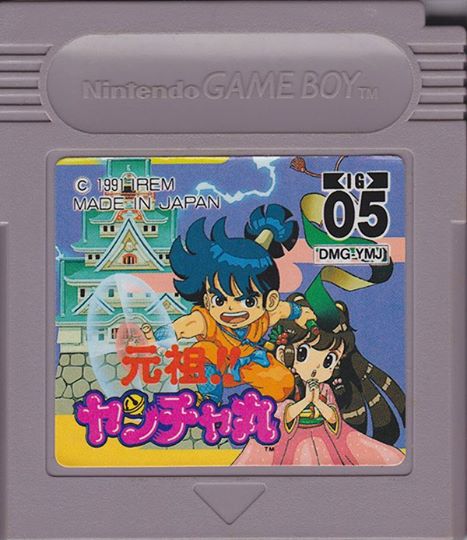
Janken Man. Gensou Yanchameru from I-RAM came out in the summer of 1991 in Japan only. It's kind of a port of an arcade game that came out in 1986 from I-RAM called Gensou Yanchameru. It came out in 87 by Data East in the arcades as Kid Niki Radical Ninja, and a port of that game was released on the NES, and it was very popular.
However, the port doesn't really resemble the arcade game very much. It's the same type of game, but very different. There are also two sequels on the NES, or the Famicom, that came out in Japan only. This version is a little bit more like the arcade game than the Famicom versions, but still quite different.
It's a side-scrolling platform game, very much in the Super Mario style. You're a ninja, and you have to rescue a princess. You jump, but you don't kill enemies by jumping on them. You have a blade that shoots out. It only shoots out about one character length in front of you. It looks like a little plus sign that shoots out.
I guess it's a four-pointed blade. Occasionally, you can fire little tiny shurikens. You can pick these up as power-ups, and you have a limited supply. Controls are really simple. You use that pay jump button and a shoot button. To get power-ups, you break blocks. You can break blocks with your blade.
Power-ups only remain for a few seconds. You have to grab them quickly. For most of the game, enemies take one hit. It's only in later stages they take multiple hits. Most of the blocks contain gold. At the end of the level, they'll count how much gold you have. If you have over 100, you will get an extra life.
Occasionally, you'll find a scroll. This is like the star in Super Mario, make it invisible for a few seconds, and give you a break from the regular music loop. You can also find doors in some of these blocks. These will lead you to an underground level with bonus blocks that you can hit. Unlike Mario, where you just collect the coins, in this one you have to actually break all the little blocks.
There's not really much of a puzzle element to these underground levels. You're really just breaking blocks and collecting coins. Then you jump on a ladder, and back to the main level you go. Apart from the bosses, I'd say there's about, hmm, maybe eight or nine enemies that you'll encounter during this game.
Visually, the levels are all pretty much the same. These are all pretty much platforms you're jumping on. Later, you'll have moving platforms and clouds that you can fall through, but mostly you're just breaking blocks and killing enemies. The controls are actually pretty good. You have a lot of air control when you jump.
You jump very high. I find it's very easy to land on platforms, especially that you get these really tiny moving platforms that you'd think would be very hard to land on, but the collisions are very forgiving. You can hang right on the edge of a block and not fall off. There are only four levels with three stages each.
At the end of each stage is a boss. They're pretty easy to figure out. You shouldn't have much trouble with them. You die from one hit in this game, and you can run out of lives pretty quickly. To get more lives, you've got to collect the coins. At the end of each level, instead of jumping out of flag like you would in Mario, you just jump on a little platform, like a little set of stairs.
But just before you jump on it, a bee will come out of, not a bee, the insect, the letter bee will fly out, and if you grab it really quickly, you'll get a bonus stage where you have a chance to get a two up. Most of the time, these are pretty easy to grab, and in a couple of later stages, it's pretty tricky.
The music is pretty repetitive, and the sound effects are nothing to write home about. Not bad for 1991, I guess. While it is a very short game, and not a very challenging game, it's also not a very frustrating game. You might find on the third and fourth level, there are a few things that are kind of annoying, and a little bit tricky parts.
There's nothing that's going to make you want to throw the cartridge out the window. There are about three points in the third and fourth level that you'll find where, yeah, it's pretty tricky. It's kind of timing and luck. There's a part where you have to drop down on a platform that's opening and closing, and your timing has to be perfect.
You'll see what I mean when you get there. And also another one where you're jumping from rooftop to rooftop, and there's a guy shooting up at you, there's snakes shooting across at you, and there's a moving platform at the bottom. You have to drop down on that platform and go underneath, and then knock out some blocks.
Of course, in these later areas, sometimes when you knock out a block, a filthy, verminous raccoon will pop out. That part was hard, but it feels good when you get past it. The bosses seem much easier in some of these difficult snake situations. You just have to run up to them and kill them right away before they start shooting.
I wouldn't break the bank to try to get this game, but if you do see it and it's a decent price, I wouldn't hesitate to grab it. It's kind of a fun one just to play for a little while. It's also a good one if you're not really super great at these games. If you find yourself getting frustrated at stuff like Mega Man, this one will be kind of a breeze.
To find it, search for DMG-YMJ. Zoids Jashin Fukkatsu! Genobreaker Hen. was released in August 2000 in Japan and re-released in December of the same year. This was a Japan-only RPG. It was a limited edition of this game that came with a Zoid's toy in the package. If you're wondering what Zoids are, it's not related to Zoidberg from Futurama.
There might be. Zoids was a toy line that was released by Tomi, now Takara Tomi. It came out in 1982 in Japan. It was called Mecha Bonica. It was not successful. In late 82, they released it in the US and Europe and it was called Zoids. It was successful. I remember the commercials for these things, they were kind of robot animals, kind of exoskeleton animals.
You'd wind them up, or maybe they were battery powered, but anyway, they moved around like these were walking little robot toys. They were so successful, they ended up releasing them again in Japan as Zoids and they were successful. By the late 80s, you didn't really hear of Zoids. I mean, I don't remember seeing the commercials of the toys, but then in 1999, Tomi really released them in Japan and then I remember seeing them in the stores in the early 2000s.
And there was an anime that came out and there's a manga and they introduced a new story line and a whole bunch of new toys. So there's kind of an old story line and a new story line. This is where this game takes place. It's kind of right between the old story line and the new story line. By 2004, they had quit the whole Zoids thing.
I think they're still around in some small form, but the second coming of the Zoids was a pretty short run. So on the planet Zeke, Earth's spaceship crashed, they ended up getting the technology for the Zoids to improve somehow with weapons and now they're having a big battle. So in this story, Van, Zeke and Dophine are returning to the colony for the first time in a long time after doing a big battle and there's like a weird rustling in a bush and out pops this wild Zoid.
So you do this little battle and the story begins. It seems to be a very thin story. The point of this thing is you have to attack a lot of robot monsters and collect them. The stats system is instead of collecting objects, you're more collecting abilities and you're able to modify your Zoids with improved abilities.
For example, lasers, missiles, bite. You start off with this kind of a regular strike and you've got an aim strike and then as you defeat enemies, you get extra abilities that use SP, which I think means strike points. Your strike points will regenerate slowly as you battle. If you keep using some of the big attacks, you'll run out of strike points and won't be able to do anything.
They do recover on their own. When you go into the dungeons, they're not really dungeons, but you know what I mean. The encounter rate is very high, like you just walk a few steps and battle. And they tend to be pretty long. It's not like in Final Fantasy where, you know, at the beginning of the game you're just fighting really easy enemies and it's over in a few seconds.
No, these are three or four minute battles. Most of the time you're just hammering the A button. So you have to remember what direction you're going. You don't want to do any backtracking because, you know, every few steps you're in a battle. These dungeons have randomized maps. That's right, they couldn't even be bothered to store the maps in memory.
They're just generated randomly, which means memorization doesn't help. Like, especially if you, you know, you fail and you have to go back and you go back in. Everything's different. It also gives you the feeling that they didn't bother to put any effort into game design. It's just generating random maps.
You know, when your party's health is low, you're going to be stressing out trying to find that staircase, which is randomly placed somewhere. To me, that's the worst part of the game. I mean, you don't feel like anything is designed. There's also a bug in the game where, you know, you're supposed to fight these creatures and you kind of collect them, kind of like the Pokédex, you know, you keep a list of all the things you've beaten.
I guess one of the goals of the game, besides beating the game, is to fill up this index of these creatures. Sometimes they don't save. Sometimes you have to pick them up twice to get them to save in the book. So you'll come back, you'll load your game, and then the things you thought you put in that little book are not there. ARE NOT THERE! That is super lame, and I'm wondering if the second release of this game fixed that bug or not. No. There is a save game in this, so you will have to replace the battery. The music is very boring, like a little arpeggio thing, and there's no option to turn it off. Zoids is one of those games that will probably never get a fan translation.
It's particularly lousy, and, you know, I've read some of the reviews in Japanese, and people call it a Masougei and a Kusougei. Masougei, masochist game, Kusougei, is a crap game. I guess one good thing about this game is the Japanese is very easy. It's all hiragana and katakana, and they don't use any complicated terms.
So even if you know basic Japanese and you have access to a dictionary, you can actually get through this game. Every minute I played this game was torture. I played this game so you won't have to. So don't get Zoids. But if you're going to, DMG-BGZJ-JPN.