Game Boy Crammer · Episode 4
Afterburst, Puyo Puyo & Yoshi’s Cookie
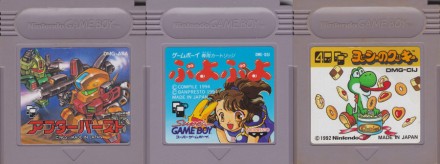
Reviews of the artillery puzzler Afterburst, the problematic Puyo Puyo and the sublime Yoshi’s Cookie.
In this episode, I'll be reviewing Afterburst, Puyo Puyo, and Yoshi's Cookie, but first a quick little hardware tip. If you find an original Game Boy and it's got some lines missing on the screen, usually vertical lines that show up blank, it's actually a really easy fix. You need a soldering iron where you can turn the temperature down, or a wood burner.
I'm not going to give you all the details on this because it's kind of a visual thing. Look up Game Boy vertical lines on Google, and you'll find some YouTube videos showing you exactly what to do. Look up a few videos because people have different techniques, but you'll see it's actually not a huge job to fix.
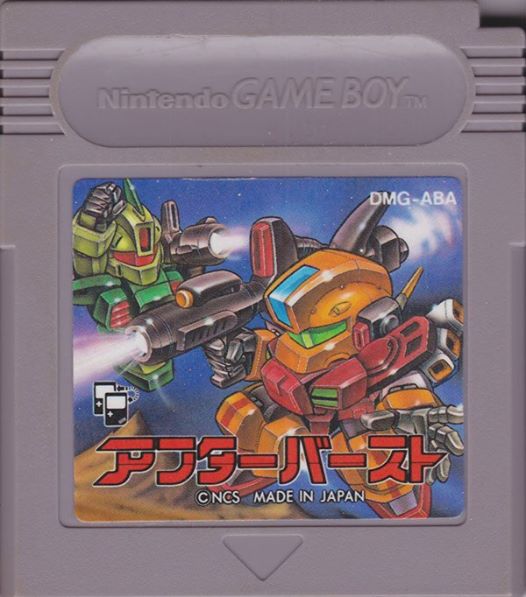
And now, Afterburst. This is a Japan-only game. If you're looking it up, you might have trouble finding it because it's listed in the katakana as well as the Fumeji Afterburst with a space. So look up DMG-ABA, and you should be able to find it. It was developed by Duel and published by NCS. Came out in 1990.
It's a single-player game. It's an action-platformer puzzle game. So what you're trying to do is destroy some robots, maybe a plane that's dropping bombs on you, and then you have to destroy this orb. We don't really know the storyline. Probably a princess got kidnapped. So you're piloting this mech, like a Gundam kind of mech thing, with a gun, and you aim up and down to change the angle of the gun, and you jump and move sideways to move around the level.
Very easy to figure out the basics. Like, it'll take you the first two seconds, you'll figure out what the game is about. So you don't need, and you don't need to read any Japanese in this game, so it's all in English. And it's basically game start, you know, score, that kind of stuff. So it is very much a puzzle game.
At the first couple of levels, it's a little bit of an arcade game. You're just jumping and shooting, but then it gets really complicated. You're going to discover, oh, this level can only be finished by shooting things in a certain order, by timing your jumps and shots a certain way. Like all great games, there's not just one way to finish the game.
You can be creative and, you know, try to finish a different way. You have a time limit. However, you can kill those robots and kill the orb. It's up to you. So it makes it a little more fun, and you get to use your brains a little bit more than just trying to figure out the one way to finish the level.
Although, some of these levels must be only one slight chance of finishing the level, because they get really hard. Now, when you turn on this game, if you've got a Game Boy Color, hold left when you're turning the game on, and you'll get a nicer looking game palette. I recommend that. I highly recommend this game.
This is one of my favorites. I'll always go back to this and play, and I still, ah, I think I'm on level 20, I think I got to. I'm just level 20. And there's some really hard levels that took me a long time, so to get to level 30 might take me the rest of my life. Savor the wonder, savor the splendor of Afterburst.
And oh, by the way, Afterburst is not a rare game. I've seen it in Japanese stores for around, generally about eight bucks, and they're not super rare. Go find yourself an Afterburst somewhere and burst some robots and save a princess or something. Oh, and the music is great. The music was composed by Atsuhiro Motoyama, and it sounds wonderful.
Like it's, to me anyway, I mean, there's a lot of bad Game Boy music, but this is good. Afterburst, totally worth it. Before I get to Puyo Puyo, I just want to remind you, anything you can do to help to get the word out on this podcast would really help me out a lot. I do this thing for free. I've been paying for ads to get the word out there, and it's still really early on in the series, so not too many people have heard of it.
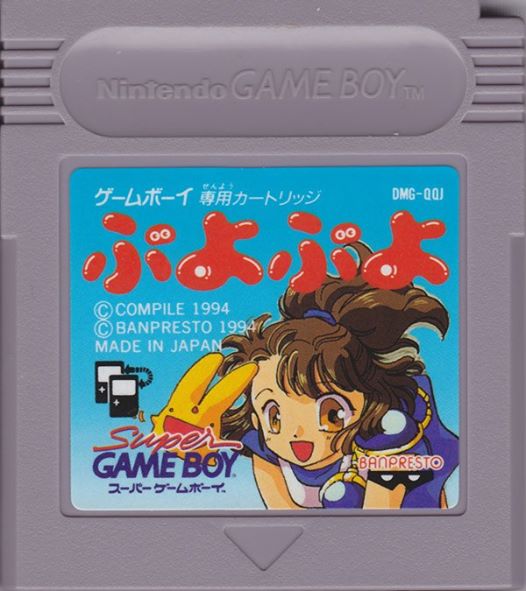
And I'm not one to plug on forums and stuff like that. So if you could mention anywhere there's some kind of Game Boy or retro gaming forum, it would really help me out. Anyway, I'm with Puyo Puyo. Puyo Puyo by Banpresto came out in 1994 for the Game Boy, featuring characters from an RPG called Mado Monogatari.
It's a block puzzle game, so blocks are falling from the top and you're matching shapes and trying to join four or more together. It came out in the arcade in 1992 and was quickly followed by lots of different versions for various platforms, so it was available on everything. You may know it as Dr. Robotnik's Mean Bean Machine for Sega Genesis or Mega Drive, and it was on the Game Gear and on Sega Master System too.
And then on Super Nintendo, you might remember something called Kirby's Avalanche or Kirby's Ghost Trap. They're all Puyo Puyo, where they just replaced the characters. And there was a game called Quirks with a Q released for Windows and Mac in 1995. You may have played Puyo Puyo in a different form or maybe you played it as Puyo Puyo.
You can play it in sort of a one player versus computer mode. This is kind of like you've seen in Tetris, where you have a CPU player on the right playing and you're playing on the left. And when you play well, bad things happen to the player on the right and vice versa. Or you can also play in just a single player, you in the middle of the screen and with increasing speed.
And one great thing about Puyo Puyo was sort of random things would happen to you. You know, things start piling up and you think the end is near and all of a sudden a little bunny will come out and eat a bunch of pieces for you or a giant blob will come down and knock a big column for you. So, you know, the odd Deus Ex machina saves you from the brink once in a while.
There's a problem with the Game Boy version, maybe one of the reasons it was Japan only. It's really hard to tell which piece is which in black and white. When things are going slow, it's easy to see which piece is which. I mean, you know, the characters and the blocks are these little blob characters, kind of like the little blob in Dragon Quest.
Think Hershey's Kisses with eyes. So these little blobs come down, but the problem is they all look like blobs. They're just slightly different blobs. Some are a little darker, some are thin. So when things are going slow, you have time to kind of comprehend what each one is and then figure out where you're going to put the thing.
Even if you know Tetris games, you know, you're always looking at the block ahead when things get really wild. So any kind of delay in recognition of what the piece is, is going to be fatal at later stages. If you were to run this game on a Super Game Boy, this is something that plugged into your Super Nintendo and you could plug a Game Boy cartridge in.
A lot of games were programmed to work on Super Game Boy with extra color information. So if you run this thing in an emulator, which I have tried, it's lots of fun. It's as good as any Puyo Puyo game. You know, things get really fast, you can really see the colors and recognize what's going on. But on black and white on the Game Boy, it's hard.
I mean, I can't even get halfway to where I get on the color version. And another problem is by default, when you turn it on on the color Game Boy, you get that kind of artificial palette instead of monochrome. So what happens is the moving pieces are in color and the pieces that are stationary are not in color or they're green and the pieces moving are pink.
So it makes it really confusing because your brain is seeing colors that don't really mean anything and you're connecting it to green pieces that it's just even more distracting. So you want to play this thing in monochrome by holding B and up when you turn on your Game Boy Color and then it's slightly more playable.
Had they made a Game Boy Color specific version which had actual proper colors on it, it might be a lot of fun. But as it is, unless you have a Super Game Boy, there's really no point to playing this. There's so many other versions of Puyo Puyo on every conceivable platform. Why would you play it on a Game Boy?
There's just no point and really no point getting this unless you are into collecting every Puyo Puyo cartridge there is. If you're looking for this thing, it's DMG-QQJ. Back in the mid-90s when someone gave me a Game Boy, I went to the game store and I thought, oh, I'll try some of the used Game Boy games out and one of them that was always there was called Yoshi's Cookie and it was about five bucks.
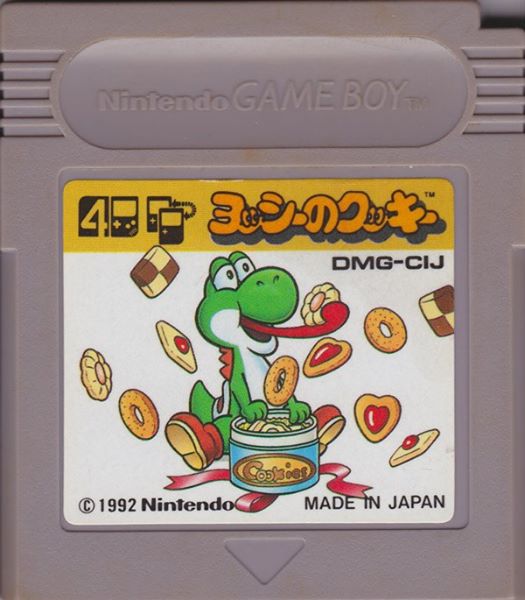
I was always tempted to get it. I didn't know what it was. I knew it started Yoshi so it probably wasn't going to be cool and it dealt with cookies which didn't sound that fun. If it was called Yoshi's Skull or something like that, I probably would have picked it Anyway, recently I picked up Yoshi no Cookie for 300 yen and I'm going to tell you all about this wonderful game.
Yoshi's Cookie is a puzzle game. It's a little bit like a Rubik's Cube in that you can slide things around. So what you're trying to do is just line up rows of stuff. So you've got different types of cookies, you've got hearts and little abstract shapes and you shift the rows around until things line up and then when you line up a row they all disappear and you get, the more you line up, the more points you get until everything is gone.
So it's not one of these games where you have to read a tutorial. You can just figure it out. From the top and from the right, new cookies are coming in. So it's a constant, it's not like Tetris where everything is falling from the top. You've got things coming from the top, dropped by Yoshi, you've got things coming from the side, dropped by Mario.
Mario and Yoshi have very little to do with this game. They're the ones pumping out the cookies. I don't know why they're doing it. I'm not quite sure about the storyline because it's in Japanese. I could probably read it but I don't think I should. I really don't want to ruin it with the storyline. One thing I really like about this game is it's just not that frustrating.
I mean it gets fast, it gets really fast. There are ten levels and actually you can kind of cheat your way and get into even more levels. There's a cheat menu I'll tell you about later. This game was shown by Bulletproof at a consumer electronics show and Nintendo saw it and just slap Yoshi and Mario on here and make a million.
And they did. They bought it and just rebranded it with the Nintendo brand. So it's just a wonderful game. I love it. It's so simple. I think it's one of those games like Tetris you can just keep coming back to it and playing it to blow off some steam. It's just so fun. And they're funny little intermission, I don't know funny, gut slappingly, side wrenchingly funny intermissions.
Okay, here's what I love about it. When you play Tetris and you're waiting for that straight piece to come down, you feel like the world is against you. Why me? Why aren't you sending me a... Always feel... I mean, I'm sure it's not. I'm sure it's totally random, but always feels like you're not getting that straight piece because of something you did.
But in this game, Mario and Yoshi try to give you the best possible cookies. They don't make it too easy for you, but so many times I'm sure it's designed that way. You need certain cookies to finish it and those exact cookies come out exactly, it can't be a coincidence. Mario and Yoshi are your friends.
They're benevolent little sweethearts, not like the invisible malevolent jerk in Tetris. If you play Tetris, it might make you more angry than you are. But if you have anger management issues, then play Yoshi's Cookie, it's going to chill you out. And the nice thing about playing this in the Color Game Boy is the Color Game Boy has some pre-programmed palettes, so if you put certain games in, it knows to put a certain palette on.
Whereas some games it just gives you the default green and red palette. This one has a custom palette, I believe it's custom, I don't know if you can normally get this palette. It's kind of an orange and red palette, and it almost feels like a full color game. Like the hearts are red and it just feels like a very nice color game, even though it's not.
But you never feel like it's totally monochromatic. Then you can change the music type. The music, I don't know, I mean, I don't know if I'm qualified to be a Game Boy music critic, but it's not like Tetris, and it's not like some of the later games which had these beautiful music scores. It's kind of binky, but you know what, you can turn the music off if you want.
Here's the trick. Set the music type to off, set the speed to high, and you highlight round and hold up and press select. Now you can access 99 levels. I tried 60 something just to see what it was like. It gets ridiculous, but you know what, it's not impossible. But if you get bored with 10 levels, it gets very fast even at 10, you can ratchet this thing up to ridiculously difficult levels.
I'm guilty of this. Sometimes I'll pick up a Game Boy game and not even try the versus mode. It's hard enough to find anyone with a Game Boy these days, but to find someone who has exactly the same game and wants to play with a link cable, I don't even try. But you know what? If someone has a versus mode, if you turn it on, it gives you an option to play against the computer and it's a completely different game.
You're basically playing against, who you got, you got Peach, you got Yoshi, and you got Koopa. Or what are you calling, Bowser. So you can play against them. There are different skill levels, I guess. They don't seem to be different to me, but you play against them and you kind of mess up their game and they mess up your game depending how well they're doing.
Like the screen, there's like a blind mode where there's a big box over part of the screen so you can't really see what you're doing. Sometimes it'll scramble everything up on you. But you can't really see why that's happening and you can't really see what you're doing to the other guy. But you know what?
You don't need to know. All you know is it's a different, much harder, much faster game, even at the basic level. So that gives the game a little more longevity, it's just a different kind of mode you can play in. It's very easy to find Yoshi's Cookie. This is one you won't regret having in your Game Boy collection.