Reviews of Iron Leaguer, Amazing Penguin, Boulder Dash, Q-Billion & Monster Truck.
My name is Ray Larabie, and I’m talking to you from Nagoya, Japan. Welcome to episode number 41 of Game Boy Crammer. Today I’ll be reviewing Iron Leaguer, Amazing Penguin, Boulder Dash, Q-Billion, and Monster Truck. Let’s start the show.
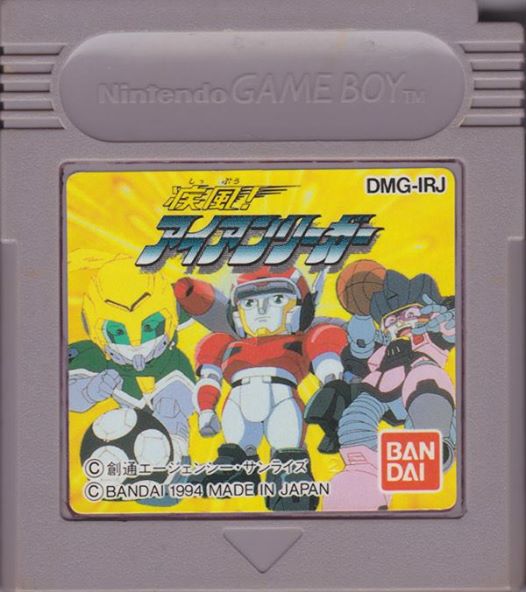
Let’s do a great review. Shippu, Iron Leaguer, developed by Sun-El, published by Bandai, was released in Japan only in March of 1994. This is a side-scrolling platform game. You could call it a run-and-gun, but not all characters shoot. It’s based on an anime television series. It ran for 52 episodes around 1994-95.
Shippu means like a windstorm or a gale. It’s the future. Sports are so violent that they had to replace every player with robots for every sport. These robots are intelligent. Someone found out about this kind of a shutdown thing, a little bit like Blade Runner, except you can kind of shock them. They’re not supposed to know about that, someone found out, and trouble ensued.
So all the players that are friends, and there’s like a hockey player, a basketball player, baseball, etc. They’re all together as pals on this show. But for some reason, they all got brainwashed, and you need to get your team back together. You start off with two guys, baseball and karate. So you move around the level like a normal platform game.
Left and right, jump, shoot. There’s no crouch. To switch characters, you can press select. You can see a character select screen, or just hit start, and it’ll cycle through the characters. So at the beginning, you just have two characters to choose from. The baseball guy throws baseballs, but he can’t really do anything else. He can jump.
The karate guy can’t shoot, but he can kick, and do kind of an upward punch, and a really high jump. You’re going to be fighting robots, and kind of sports-related things. Like really early on, there’s going to be one of those practice things that throws baseballs. I think they’re baseballs, maybe tennis balls. No, they’re baseballs.
Your first boss is a kendo player. Just get your karate guy in really close, and do a whole bunch of karate chops on his neck. That’ll take care of him. And then, you’ll realize, oh, I’ve been brainwashed, or whatever. Now I’m your pal. Now you have another character to choose from. And this kendo guy uses his kendo staff to stick into walls. So you can actually climb walls by slashing at the wall, and jumping, and slashing at the wall, and jumping.
So now you can climb any wall. And you’re going to get a soccer player, basketball player, American football, and they all have different abilities. What I like about the puzzles in this game, some of them you can solve in different ways. You don’t have to use certain characters. There isn’t just one solution.
You’ve got a big health bar. If a character you’re playing runs out of health, he’s not dead. He’s just a robot, so you get to pick another character. But when you’re on that character select screen, you can actually go left and right, and you can take power from one character, and it’ll store it up on top in a reservoir.
And then you can go down to another character and give that character the power. You can even up everyone’s health bar if you want, or you can give one character all the health. And that’s something really different about this game. This isn’t the kind of thing you usually see in a game like this. I wouldn’t go as far to say it’s an RPG element, but it makes things interesting. The controls in this game are pretty good. The music seems nice.
The graphics are great. Everything’s really big, and there’s lots of animation. The level design is a little sparse, but not bad. Now, since this is a Japan-only game, there will be some reading to do. However, it doesn’t affect the gameplay at all. You can play this game without reading anything. I read some of the storyline. It seems to go along with the storyline of the TV series. It’s the same characters and the same settings.
Oh, and once in a while, you’re going to get a bonus level where you actually get to do sports. Like, you’re going to be shooting hoops, except there’s a big robot firing back at you. There’s actually a soccer, or football, match right in the game. It’s incredible how much they put into this game. I really was expecting this to be kind of lame, considering it was a game that never got translated to English, and I’d never heard of this character before.
Turns out it’s great. This is one you should get, and it’s not rare at all. I see it all the time, so it shouldn’t be hard to find. Almost forgot to mention, there are continues and password saves, too. Go get it! Oh, and once in a while, you’re going to get a bonus level where you actually get to do sports. Like, you’re going to be shooting hoops, except there’s a big robot firing back at you.
There’s actually a code for this game. It seems to go along with the storyline. It’s the same characters and the same settings. I really was expecting this to be lame, considering it was a game that never got translated to English, and I’d never heard of this character before. I really was expecting this to be lame, considering it was a game that never got translated to English, and I’d never heard of this character before.
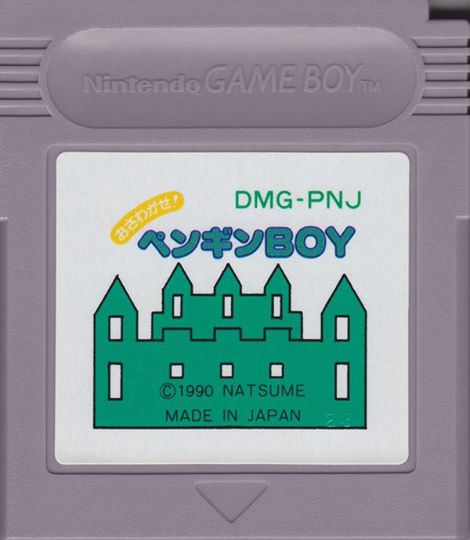
Osawagase, Penguin Boy, was released in Japan in the summer of 1990, December of 1990 in the U.S., and early 1991 in Europe. In the U.S. and Europe, it was called Amazing Penguin. Osawagase, I couldn’t figure out what it means. I think it means Our Chief Penguin Boy. This game was made by Natsume. It’s one of the first Game Boy games. This came out in 1990. It’s an action maze arcade game, kind of in the style of Pac-Man.
It mostly resembles a game called Amidar. Amidar was a game by Konami that came out in 1981. In Amidar, you had a lattice, which looks like a bunch of fields, and you would move around, kind of like Pac-Man, but you’re moving on lines, and you’d kind of close in boxes and they’d fill in. Anything touching the thing that gets filled in gets knocked out. In a way, it’s a little bit like Kix.
Although in Kix, you can freely move around, in this one you’re moving along preset lines. Where this differs from Amidar is, first of all, there was no Penguin in Amidar. In Amazing Penguin, you have to collect all the dots on the board. But it’s not a whole bunch of dots like Pac-Man. There’s just a few of them.
There are two kinds of dots. There are black ones and there are ones with a minus sign on them. The minus ones and the black ones you can clear by holding down your A button. If you stand beside one of these black ones and you hold B and point in the direction of the ball, you’ll kick it and it’ll go flying, hopefully taking out enemies.
And that’s it. You just have to clear the level. If enemies are touching a rectangle when it gets filled in, they get knocked out. So there’s two ways of killing enemies. You can hit them with a black ball or you can fill in a sheep. The enemies are ghosts, just like in Pac-Man. They can’t turn 180 degrees. They actually have to go around.
So they only go in one direction. They’re never going to turn back on you. The more enemies you get, it’s kind of like Pac-Man. If you kill a whole bunch of ghosts with one pill, you get more points. Same thing here. You get 100 points for one, 200 points for two, 400 for three, 1,000 for four. You get 100 points for filling in a rectangle and 10 points per dot.
After you finish a few levels, you’re going to get passwords. This game goes up to 40 levels. The difficulty ramps up nicely. It’s really not that hard at the beginning and it’s pretty easy to get to about 10 without dying. Then it starts to get pretty tough. The AI, I don’t think there’s any AI. I think everything wanders around randomly.
There’s a lot of situations where they could easily get you and they just kind of wander off in a dumb direction. My only complaint about this game is the controls. In Pac-Man, you point where you want to go and you continue in that direction. In Amazing Penguin, you have to hold in the direction you want to go.
And actually, if you push in the direction that it’s impossible to go, you’ll stop. They should have made it so you lock into those tracks. You get used to it, but it does cause you to get trapped on the corners a little bit. It’s hard to make a really smooth corner without getting a little bit stuck, especially when you’re in a bit of a panic.
What I do love about this game is kicking the black dots because they don’t have to follow the maze. They can just go right through. So you’re going to get these mazes later where there are several screens tall. And you can kick it and it’ll go right across and take out lots of enemies. The enemies do come back. You’ll see them flash on the screen. It’s not like Pac-Man. They don’t come back in a very specific location.
It’s a very cheap game. This one is often seen in bargain bins and stuff like that for less than a buck. Because of the nicely ramped up difficulty, I’d recommend this game. If you’re looking for this game, look for DMG-PN. Okay, let’s see. It’s up, up, down, down, left, right, left, right, left, left, right, left, right, left, right, left, left, left.
B.A. Secret level! secret level. Palimedes by Natsu Systems was released in Japan in October of 1990, in Europe sometime in 1991, never released in America. Palimedes is a block puzzle game. It was a Taito game that came out in the arcades in 1990, also came out on the MSX computer and on the Famicom.
The Famicom version did come out in the US. This Game Boy version is basically the same as the arcade and the Famicom version. You are at the bottom of the screen, and you have a die, and there are dice coming down on the top of the screen. If the dice reach the bottom, it’s game over. Now as the dice are coming down, you can choose, you can shuffle your die, so you can go 1, 2, 3, 4, 5, 6, and then you can shoot it.
So you press B to switch your dice, and A to shoot, and you try to match the dice, and if you, let’s say you shoot a 1 at a 1, it’ll disappear. When you take out a block, at the bottom of the screen, under your player, there’s a row of dice down there, and you’re gonna collect them. So let’s say you shoot 4 threes in a row.
Right under where you are, you’re gonna have 4 threes down there. You’re gonna need to pay attention to this part a little bit, because this is the only way you can beat this game. You can’t move fast enough, well maybe you can, but I sure can’t, to actually shoot all the dice fast enough as they come down, because you have to shuffle your die exactly to the number you want, and it cycles through.
Like if you’re at 6 and you need a 5, you have to go 1, 2, 3, 4, 5, so you have to hit B a whole bunch of times just to be able to throw that one die. So what you do is press down. Now, if you have in your hand 3 of the same number, boom, you get rid of 1 line. If you get 4 of the same number, 2 lines, 5, 3 lines, 6, 4 lines.
If you have a run of consecutive numbers like 1, 2, 3, or 4, 5, 6, that’ll take out 1 line. If you have 4 consecutive numbers, you take out 2 lines, if you have 5, you take out 3 lines, if you have 6, if you have a full row of consecutive numbers, you take out 5 lines. When I first played this game, I didn’t quite get that part, I thought, oh, you just have to shoot these dice.
This won’t be that hard. And I just could not get past level 1, stage 1. It’s just everything happens so quickly. If you take time to think, even for a split second, it’s over. Like those things come down so fast. And they don’t actually have to touch the bottom of the screen, they just have to touch where you are.
So because you can’t really take your eyes off what’s going on, you have to be kind of conscious of what is going on in the bottom of the screen. Like if you shoot 5 ones in a row, don’t hesitate, just press down. Even if you think you might have something, just press down, because nothing bad happens if you don’t.
And also, try to time it. If you know you have a 1, 2, 3, 4, 5, 6, you just shot a 1, and you’ve done a nice row like that, and you know it’s there, that’s going to take out 5 lines. So kind of wait for the 5th line to come down so you can just wipe them all out in one shot. Although I wish this game had a less of a steep learning curve, like I was almost going to give up on it at the beginning, but because I am a game reviewer, I stuck with it.
It is actually really good, and it’s really intense. I just wish there was like a slightly less hard level just to get into it and get into the practice a bit before it starts getting really hard. And it actually doesn’t ramp up that hard. The difference between level 1 and level 4 is really not that much.
The music is really annoying. I wish they actually had a sound for the dice that made an actual doot doot doot doot doot when you went up with the numbers, because I find with the black and white screen and the way they’ve rendered the pips on the dice, they kind of tried to do like a 3D shadow thing.
I played it on an actual LCD Game Boy Pocket, and it’s really hard to see. On the Game Boy Advance, it wasn’t so bad because I could see what I was doing a little bit more, but still, pretty hard to see. In the Famicom version, the dice are colored, which I think would really help. So if you really are into this game, you might want to try that version instead if you’ve got an emulator, or if you can find a cartridge.
It’s not a super common cartridge. I haven’t seen it around that much. But if you do want to find it, the Japanese version is DMG-PXA-JPM. European version DMG-PXA-NOE. Boulder Dash, by Beam Software, was released in Japan in October of 1990, and around the same time in Europe, not released in North America.
Boulder Dash was a game that was out on every system, and continues to come out for systems today. Back in 82, there was a video game called The Pit. A guy I used to work for, Chris Gray, saw this game and thought, oh, I’m going to make a game kind of like it. Meanwhile, in another part of Canada, you had Peter Lippa.
Peter Lippa also wanted to make a game. He tried to get in contact with a game publisher, ended up getting in contact with Chris, and they decided to make a game together. Although it was difficult because it was a long distance kind of thing, they had to drive really far to see each other. So what happened was, Chris wanted this game to be like The Pit.
Now The Pit is kind of like Dig Dug, and came out around the same time as Dig Dug. You’re digging through the ground, and you dig under boulders, and those boulders can fall. Just like Dig Dug. If you look up The Pit by Senshuri, or Taito in Japan, you can see what I’m talking about. So anyway, Chris didn’t really get to have much input on the game because Peter kind of went in his own direction and made kind of a deeper game than The Pit.
After a legal clash, Chris ended up getting most of the money and fame, and Peter Lippa really didn’t get much, and he never made another game again. The rights to Boulder Dash got sold to First Star Software, and it came out on everything. The original version they made came out on Atari 800, but it was a big hit on the Commodore 64.
It was an arcade game, it was just everywhere. In fact, if you remember Boulder Dash and the Game Boy, you might be thinking of the Game Boy Advance version. What you do in this game is you dig underground, trying to find jewels. When you get enough jewels, you can exit the level. You gotta exit the level before the timer runs out.
And the biggest danger in this game are boulders. Boulders that you cause to collapse by your digging. Boulders can actually roll down off other boulders. After you play it for a few seconds, you’ll get used to the physics of these boulders. There’s a big risk reward thing because sometimes you can just run really fast and dodge everything.
When you start the game, there are four different worlds with different themes to choose from, and you can start on different levels on those. There’s no save game, but you can just choose whatever level you want to start on. Now initially, you might think, this is a very claustrophobic game. If you’ve played any other versions of Boulder Dash, usually you can see pretty far, and your character is really small.
In this one, your character is huge. The boulders are really big, which looks great, but it’s really hard to see anything. However, you just press select, you get the zoom out view, and it’s not just a zoom out look at the map view, you can actually play it in that view, and I ended up just playing it mostly in that view.
At least that way you can see where the exit is, because otherwise it’s really hard to find the exit in some of these levels, and you can see exactly how many jewels you need to collect. I really recommend zooming out. The music is not the same as the original, but it’s still really nice. All in all, it’s a decent version of Boulder Dash.
If you want to play the Commodore 64 version, which is kind of the classic version, you can get it on Wii Virtual Console. And the credits for this game, they don’t credit Peter Lippa or Chris Gray, just First Star Software and whoever developed this one. There’s no reason not to get the Japanese version, as there is no reading whatsoever to do.
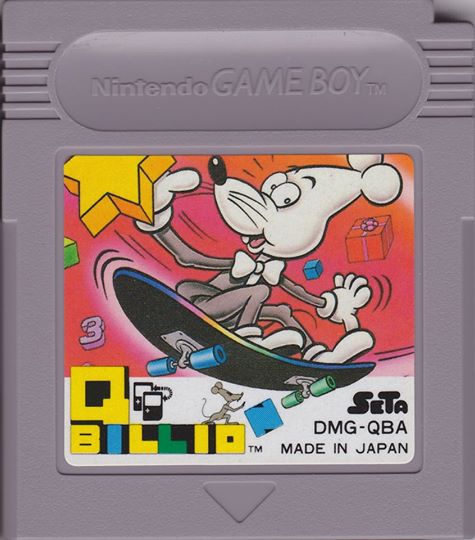
It seems to be identical to the European version. In fact, the product ID is the same. Look for DMG-BDA for the European or Japanese version. Q-Billion from SETA Corporation was released in December 89 in Japan, April 1990 in the U.S., so this is one of the very first Game Boy games. SETA Corporation, you may not have heard of these guys, they’re the ones that did Tom Sawyer.
You might have seen it on Angry Video Game Nerd, it’s just a really bizarre platform game. And this game was made just right after that. After they did Q-Billion, they didn’t do a lot of other Game Boy games. They did one RPG called Ayakashi no Shiro, Battle Bull, and Torpedo Range, and that was it for Game Boy for these guys.
And like a lot of these companies, they ended up doing lots of Magon games. Q-Billion is a board puzzle game. It’s played on a 10×9 grid. You play a mouse. Now the character on the cartridge, it shows a mouse with a bow tie riding a skateboard. And then just below that, you see this other little gray naked mouse.
When you play the game, on the menu screen you’ll see that other little naked mouse. The skateboarding super cool mouse never really shows up. I don’t know if that guy’s name is Q-Billion. They don’t explain any of that stuff. So you can move your mouse around the grid. It’s basically a cursor. It looks like maybe a race car or something.
Doesn’t really look like a mouse. When you move from tile to tile, it doesn’t animate. It just kind of pops into each tile and there’s a little cycling animation. You can use your A button to push blocks. Blocks have numbers on them, 1, 2, 3, etc. You can push these blocks onto other blocks sometimes.
Everything really explains what you’re supposed to do, so it took me a long time to even figure out that I could take a 1 block, push it over a 2, and it would kind of come out the other side as two 1s. And the idea is to get all the blocks and turn them into one. It took me a half an hour just to figure that part out.
On the second level there’s a 3. There’s a 2 and a 3. I can get rid of the 2. I still have not figured out a way to get rid of the 3. I tried. I’ve read FAQs online. There’s nothing. I just can’t figure it out. This game is… I know it sounds like a really lazy review, but this is what this game is like.
I spent probably 45 minutes just trying to figure out how this game even works. I still don’t get it, and from what I’ve read, it doesn’t really seem to be that interesting. I’ve tried a few levels here and there that I could figure out, because you can start on any level you want. There are 41 levels, and from the looks of it, they get really, really complicated.
There’s another game. There’s game B, which is kind of like a tic-tac-toe thing, and there’s a level editor. I always wondered why, in the 90s, when I went to a video game store, a used video game You’d always see Qbillion there, and it was always the cheapest game. I was reluctant to get it because, well, there was a mouse on it, and why is it so cheap?
Why are there three copies of it, never sold? Now I know why. It’s just not even a game. Can you imagine someone that bought a Game Boy, and this is the only game they bought? They would have just thrown the Game Boy right into a drawer and never played it again. Don’t get Qbillion, whatever you do. I hate Qbillion!
Monster Truck, developed by another, published by Varia, was released in Japan only in October of 1990. Monster Truck is kind of a racing game, but you can’t really steer. You can just accelerate and brake, and then tilt forward and backwards. Think of it as Excitebike without the excitement. The company that made this is the only Game Boy game they ever made, and it was the last game they ever made.
So you’re driving down this straight track, and you’re going to find obstacles like logs and ramps. Now, the ramps you can drive over, but there are some ramps that are stepped, and some that are just a big, square, hard edge that you need to slow down and tilt your wheels to get up. You kind of have to get used to the speed some of these things will take.
Like, for example, the logs, you can’t be going very fast when you go over them, or you’ll do this flip. When I say flip, it’s this weird four-frame loop-de-loop that your truck does. If the player is beside you in another lane, you can knock them out of that lane by hitting up. And you really have to, because they’ll do that to you.
Be careful when you start the race, don’t just lean on the accelerator, or you’ll spin out. After you finish the level, you get some points if you win, and you can spend that in a store. You can enhance your truck body. Now, I think on actual monster trucks, the body is just a fiberglass shell. But in this one, it’s your armor rating.
And usually, most of the damage is caused by slamming into other vehicles. You can enhance your tires. This means you don’t have to slow down as much when you climb up stuff, and you’ll climb a little quicker. And the engine just makes you go faster and accelerate faster. Be careful not to buy the same item twice, it can happen, and you don’t get a refund for it.
The graphics in Monster Truck are not very good. It’s about as simple as you can get. It seems there’s very little effort put into it. The music is just crazy. After this review, I’m actually, for the first time, gonna let the music run a little bit, just so you can appreciate the non-musical madness.
I don’t know if it’s the worst Game Boy music, but it’s just mind-boggling. Well, you know, there was a Monster Truck craze in the 80s. I mean, really, until about the mid-80s, you never really heard about monster trucks. So there were all the rage, and, you know, someone had to be the first to make a monster truck game on Game Boy.
Generally, monster truck games are lousy. There’s a few exceptions, but usually those games are more like an off-road vehicle game that just happens to look like a monster truck. But really, monster trucks aren’t that fun to race. I mean, maybe they are if you’re actually driving one, but in a game, they just don’t handle that well, and they’re just a little bit slow, you know?
There’s no save game in this, there’s no reading you have to do, so there’s no problem that it’s Japanese. The car continues, and you do get to keep all the enhancements you’ve made to your truck, like the engine, tires, and body. The thing that I don’t really get, and I kind of figured out, is in maybe level three or four, you’re going to have vehicles in your lane, and if you just keep slamming into them, you’re going to lose your health and game over.
What it seems like you have to do is you have to kind of tilt back and forth. You have to kind of tilt your truck forward and kind of flip it, flip the truck over, and it’s gone. Like it’s not even in the race anymore. So you have to kind of use your truck like a spatula and flip that truck. I can’t get it to work predictably, like I just kind of rock back and forth and hit the guy and sometimes it flips.
This is not a game I would seek out, but it is rare, like I haven’t seen it around much. The box art for this game is just weird. It’s the goofiest looking truck. To find this game, look for DMG-MTA.