Game Boy Crammer · Episode 42
Castlevania, Final Reverse, Spot, Super Chinese Fighter & X
Reviews of Castlevania: The Adventure, Final Reverse, Spot: The Cool Adventure, Super Chinese Fighter & X.
My name is Ray Larabie, and I'm talking to you from Nagoya, Japan. Welcome to episode number 42 of Game Boy Crammer. Today I'll be reviewing Castlevania the Adventure, Final Reverse, Spot the Cool Adventure, Super Chinese Fighter, and X.
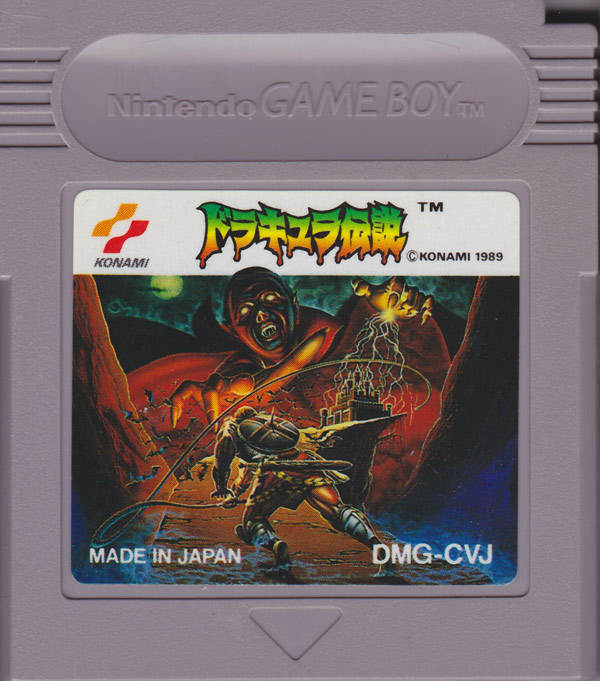
Thanks for all the retweets and tweets on Twitter. I really appreciate it. OK, let's start the show. Next to a game review. Konami's Castlevania the Adventure, a Nintendo's Game Boy. The maze of vampire crypts and unearthly evil. It is about to sink its fangs into you. Dracula Densetsu by Konami was released in October 2018.
Dracula Densetsu by Konami was released in October of 89 in Japan, December 89 in the US, and early 1990 in Europe. The US and Europe version was called Castlevania the Adventure. You've no doubt heard of Castlevania. When this game came out, Castlevania was still kind of new. Castlevania, the original one, came out in 1986.
You had Vampire Killer, Castlevania 2, Simon's Quest, Haunted Castle, and then this one. So it's a platform game like almost all the Castlevania games. You can play Simon Belmont, although it doesn't indicate that in the manual or in the game. I don't think Konami was taking the storyline of Castlevania very seriously.
It really was just a guy beating up monsters. In other Castlevania games, you have different weapons. In this game, you just have a whip. If you have full health and you use the whip, it'll actually shoot a little fireball at the end. That almost never happens. So you have a health bar, you have three lives.
You can earn extra lives with points, but you need a lot of points to get those lives. Gaining extra lives in this game is very difficult. You'll be walking through levels whipping monsters, walking very, very slowly through these levels. Even though there are so few monsters on the screen, the game actually slows down when there's a lot of enemies.
Maybe the slow scrolling was to de-emphasize the motion blur on the game board. It feels very slow. Your character can't jump very far. The enemy collisions are all over the place. Sometimes they just come near you and they do damage. There's no real sense of where the outline of your character is. There's a four-frame animation of your character, which makes it really difficult to figure out where you need to go on a platform to get the minimum number of pixels that you need to jump, because your jump is so short, you need to be able to edge exactly to the pixel.
In something like Mega Man, when you're standing still, you can actually count the pixels on your feet and move exactly to that point. In this one, it's kind of a guess. A lot of times you think you're close and you fall off. Most of the enemies are very easy to kill. They just take one or two whips.
Even the bosses aren't that tough. What is tough in this game is falling off things. You're going to be falling off platforms, falling to your death all the time. It's got a lot of those platforms that drop off when you jump on them. And because you move so slowly, there's not much time to be able to walk.
You know, sometimes when you have these dropping platforms, you can still get a couple of steps and then get a jump off it. Well, in this one, the platform starts dropping, but you move so slowly, you can't even get a step in. So when you jump on the next platform, you're a little bit further back, and you jump on the... and you jump on one after that, and you miss it.
For a game with one weapon, that one weapon is pretty bad. It's very hard to do the timing on the whip. There's a time delay in the whip, so you have to kind of hit it ahead of time to get it to work. Let's say there's a candle in the air, and you want to whip it. You have to jump and then hit the whip before you hit the top of your jump.
Then by the time you get to the top of your jump, the whip will come out and hit the candle. Even by the end of the game, I still didn't get used to that. And you can only whip horizontally. There's no diagonal shots or vertical shots. Forget about that. There's a very small variety of enemies. You're going to be seeing bats, these little kind of dog-monster things, big rolling eyeballs, these kind of mud creatures.
Maybe a couple other things. That's about it. If you haven't played any Castlevania before Symphony of the Night, old Castlevania games didn't have that kind of Metroid-style, you know, single level that you can open up. This is just straight point A to point B, go to the next level. You're going to find coin power-ups all over the place.
Now in most Castlevania games, you can find hearts all over the place. In this one, the hearts are very rare. Occasionally, you'll get a cross power-up. This will make you invulnerable for a few seconds. There are only four levels in this game, but it'll seem like a much longer game because you're going to have to keep going back to the beginning of the level to try again because you fell off some platform or something.
If it doesn't sound that bad, maybe I'm not getting across how boring the parts in between the frustrating parts are. You really are just walking down hallways and whipping things. They just walk in front of your whip. There's no challenge to it. The music and the sounds are pretty good. I like the graphics.
They could have used a little more animation, but everything looks pretty good. I got to the end of the game, but I didn't finish the final boss. There was kind of a second stage where he turns into a bat. I couldn't figure out the pattern on that one. And by that point in the game, I was pretty exasperated.
If I could rate games on how frustrating the bats are, this one would be a 10. You'll get bats flying in your face, and you'll be almost helpless to do anything about it with this whip. While I'd like to take it easy on this game because it did come out in the fall of 89, so I can forgive the technical problems like the slowdowns, but it's really obvious that this thing was rushed out the door.
You shouldn't get this game unless you're just trying to round out your Castlevania collection. For the Japanese version, DMG-CVJ. U.S. and Europe, DMG-CV. DRACULA DENSONS A masterpiece in a clear graphic. On sale to great acclaim. Konami Game Boy Software K-BOYS FINALE REVERSE, developed by Shoei, published by Toei Animation, was released in April of 1991 in Japan only.
Final Reverse is a shooting game. I'm not sure why it's called Final Reverse because you don't really do any reversing in it, you're just moving from side to side. When I saw the cartridge, I assumed it was some kind of racing game where you drive in reverse at the end or something. A long time ago, I guess in the 70s, when they were just developing video games, someone thought, hey, wouldn't it be cool if you just had two guys shooting at each other?
And then after they made a few of those, I think it was universally decided in game design that that's a bad idea. You need something more than just two things shooting at each other. Now, if you'll remember, back in episode 33, there was a game called Volley Fire, which was exactly this. Two players shooting at each other.
That one was borderline acceptable because they added enough elements to make it more interesting. With Final Reverse, the elements that they added are so superficial that it's actually worthwhile checking out just for how absurd it is. Now, if you've never heard of Showae, that's because they hardly made any Game Boy games.
They made Scotland Yard for Game Boy, Navy Blue 98, and some Pachinko game. Not such a stellar lineup. When you start the game, you have a choice. One player mode, scroll mode, or one versus one mode. The only difference between these modes is, one player mode is just you and an opponent going back and forth on the screen shooting at each other.
Scroll mode makes the screen a little bit wider. You can actually scroll. It doesn't really give you anything more because you're still only shooting against one opponent. And then one versus one is just the way the tournament works. Instead of having to beat five different opponents, you just have to beat one opponent and it's game over.
So there's no point picking scroll mode. Let's pick one player mode. Now you can select your skill level, one to five. This game is so easy, I recommend only picking five. Now you can select your roster of fighters. There are nine different ships to choose from, and you can select one, two, three, four, or five.
And that's so that'll be the order. Once the first one is defeated, the second one gets to fight till you're down to your last one. Except I've never gotten past my first one. This game is so easy that you really can't lose. Then you get to choose if you want the game to be vertical or horizontal. You can shoot side to side or up and down.
Makes no difference to the game because the Game Boy screen is pretty much square, right? So then the game starts. It's you versus some opponent in some kind of futuristic sports arena. In the middle of the screen, there is a mirror bouncing back and forth. Just like in the game Volley Fire, if your bullets hit the mirror, they bounce back at you.
Of course, the AI is not very good at avoiding its own shots. And once in a while, a little satellite thing will come out and shoot out a couple little circles. If you shoot those, it'll turn into a power up. But if you shoot it on the other guy's side, it'll turn into a power up for him. So you want to wait till it's on your side.
Press A to fire. It's unlimited shots, but only two on the screen at a time. When you move on the screen, you don't get to move around freely. You create a trail behind you and then you have to follow that trail, kind of like kicks or goal feed. There's no real advantage to putting yourself close to the opponent because you're just putting yourself close to the mirror.
If you stay far away, it's harder for the opponent to hit you and you're safer from the mirror and you actually have a little extra time to shoot those power ups. Whoever has the most complicated line has a disadvantage because you can't move as fast. I mean, you don't want to be moving towards or away from the player because you can't dodge shots.
That's what the skill level is to me, because if I play in level one, the enemy has a very curvy line. If I play in level five, the enemy has a straight line and I have a curvy line. It really is just two guys shooting at each other, but they put in this little track thing to try to give it some element of something.
Okay, the power ups. At the bottom of the screen, you'll see N, which is your normal shot, and you can switch to all the different other kinds of shots with the B button, if you've collected the power ups. T is a twin shot, B is a bomb, D makes you invincible, and S is a blocker. If you shoot this thing at the enemy's track, it puts a little S down and the enemy's stuck. It can't go past.
Sometimes when you start a level, there'll already be one of those there. Just now, when I was recording the sound for this review, it started me on a level where both me and the enemy were blocked. We couldn't shoot at each other. I just waited until I walked out of the room and came back until the enemy had shot the mirror enough times to kill itself.
And I wish I could tell you there's more to this game, but that's it. Each round is two out of three and there are five rounds. After that, game over and the credits roll and you have to sit through the credits or reset your cartridge. There's really no fun to be had in this game. I like a bad game once in a while, but there has to be some kind of challenge.
This thing is so easy to beat. If you're gonna get this game, get it for educational purposes only. Final Reverse. Search for DMG-FIJ. Spot the Cool Adventure from Virgin Interactive was released in the U.S. in January of 93, Japan in February of 94, and in Europe in 1992. This came out in Europe first, but in Europe, it wasn't called Spot the Cool Adventure.
It was called McDonaldland. McDonaldland. So this game is a European game based on MC Kids. This was a McDonald's-themed game that came out of the NES. It was actually kind of brilliant. It was bad but good at the same time. Very strange. And this is kind of a game based on that. It's a port of that game.
And they took that game and licensed it as the 7-Up Cool Spot. It's exactly the same game with the graphics changed and not much graphics changed. Actually, the enemies seem to be the same enemies. Just the main characters change and there's a little introduction in the McDonald's version. You get a little intro where Ronald McDonald says, Hey, the hamburglar stole my magic bag.
You know, clowns. Clowns need to relax. And at the beginning of McDonaldland, there's a flower pot. If you hit your head on that flower pot, you change characters. But in the Cool Spot version, there's only one character, so you can't switch. The Cool Spot was a mascot for 7-Up. 7-Up in America had a red circle as part of its logo, but it didn't have that in Europe.
So I'm not sure if that's why they never released it as Cool Spot in Europe. I'm not sure why McDonaldland didn't come out. Like, was the 7-Up Cool Spot much more popular than the McDonaldland characters? Little history on 7-Up. It was sold as a hangover cure and it had something called lithium citrate, which is...
They use it now to treat bipolar disorder. This thing came out in 1929 and then all the way up to 1950 it had this drug in it. If you ever wondered why it's called 7-Up, it's a hangover cure. In the 80s, I think it had something to do with maybe Risky Business or the Blues Brothers, but... For, you know, during the 70s, 1960s-looking Ray-Ban shades were not really in style.
But in the late 70s and the 80s, they became the cool thing. Around the mid-80s, the Ray-Ban Wayfarers were the symbol of cool. And they would just put them on things to make them hip and cool. Like, you could buy these Coke can radios. Looks like a Coke can, but it's got sunglasses on, so it's kind of cool.
McDonald's had a campaign with Mack Tonight. It was this moon character and they put the Ray-Ban Wayfarers on it, which made it instantly cool. Spuds McKenzie was a mascot. Bull Terrier, I think, for the Budweiser beer company. They put the shades on them. So, that was 7-Up. You know, they just put shades on the dot for the 7-Up campaign and became this kind of cool, hip character.
I think Chester the Cheetah has those glasses, too. Refer to the Simpsons episode about Poochy, and you'll get an idea of the personality of these characters. They're just kind of hip and cool. I guess they couldn't put a cigarette hanging out his mouth, but the shades were enough. You might remember a game that came out for the Sega Genesis with the Cool Spot character, and it was actually really good.
The animation was really smooth. I remember at the time, it looked really impressive. This is not that. There's another Game Boy game that came out a little bit later, based on this character. This is not the same thing. This is MC Kids with the graphics changed. It's a platform game. You're going to be doing a lot of running and jumping.
There are 30 levels and 7 worlds. You have to collect these spots, or if you're playing the McDonald's version, M's. And you have a health meter. You can collect hearts to build up your health meter. Enemies are kind of random and weird. They're snails and there's a thing that looks like a spring that looks like you can jump on it, but no, it's just an enemy that hurts you.
There doesn't really seem to be a theme with the enemies. Like, even in the McDonald's version, it's not a lot of recognizable McDonald's characters or even items. You'd think there'd be milkshakes trying to kill you or something, but they're just kind of random items. At the end of the level, there's a high section and a low section.
It's more challenging to get to the top one, or you can just cakewalk through the bottom door. If you exit by the top, once in a while you're going to get this bonus level, where there's a bunch of hearts bouncing around, and you can control two little force fields by going left and right. The idea is to trap all the hearts in the top.
If you can do that, you get a lot of points and you get points for any leftover time. Those bonus stages don't change. There's one bonus stage for the whole game. There's an overworld, but it's linear. You're just going from one level to another. It's kind of pointless. You can pick up these blocks. Now, in the NES version, you remember you had to collect cards.
In this version, I mean, I picked up every block. I didn't find anything, so I think you can just pick them up and throw them. You can use them to jump off, but you can't place the blocks to jump on. But there are some platforms you can pick up and move, and that's something I haven't seen in a lot of games.
So there's some levels that seem like they're impossible to do, but it means you probably had to go back and carry something with you. And be careful, because I don't know if they didn't test this thing properly. There are situations where you can get near the end of the level, and what you need to finish the level is back before your character generates.
So if you die, it's going to put you back not quite far enough to grab the item that you need to finish that level. So it's game over. And when I say game over, I mean game over. There are no continues in this game. The character controls are pretty lousy. You can hold down to do a really high jump. Once per life, per level, you can hit select and do a really, really high jump.
Well, I shouldn't say really, really high. Slightly higher than your regular high jump. You'll figure out the jumping, but it's not intuitive. The character control is not that bad. You get a little bit of air control. But there are a lot of jumps that you have to make where you're jumping off the top of the screen, so you can't really see where you are.
The only way to land those things reliably is to keep playing the game and get used to the movement of the character. So you can kind of play it blind and know where to land it. There's not much good I can say about this game. I think it's just plain bad. At least if you could continue, if there was a password save, you could just keep working away at these really difficult levels.
Because a little bit later, it gets kind of interesting, I guess. I mean, there are these platforms that move along rails. You can jump on switches to switch the rail. So there's that kind of puzzle thing going on. However, it's way too easy to fall to your death. If you really put some effort into playing, you're not going to lose a lot of hearts on the enemies.
They're not smart, and they can be killed with one block. And there's plenty of blocks around to throw at them. The problem is just falling to your death. It's really hard to time the jumps. And if you touch anything, you drop straight down. So it's really hard to make any kind of jump. This game is only for the serious 7-up spot collector, or McDonald's collector.
DMG-CU for the cool spot. Actually, the same product ID for the McDonaldland version. And then DMG-CUA for the Japanese version. Put some un in your life. Super Chinese Fighter GB by Culture Brain was released in December of 1996 in Japan only. This game is a fighting game. It's a port of Super Chinese Fighter for the Super Famicom, which came out in January of 1995.
It's based on the Super Chinese series. Back in episode 7, I reviewed Super Chinese Land 1, 2, and 3. That was two arcade action games and an RPG. But this one's a fighting game. It's kind of a standard fighting game format. You start off in the main menu. You can choose Circuit, Taisen, or Option. Now Circuit is your, like, the story mode.
Taisen is battle mode. You have 12 characters to choose from. I believe it has a few less than the Super Famicom version, but I haven't tried the Super Famicom version, so I can't confirm. Then you're presented with a screen that's kind of unfamiliar. You have three slots for this character, and you're gonna choose special moves.
Now, unless you can read Japanese, you won't know what those moves are, but you can see what the controls are at the bottom. You'll see, you know, a up-down left or something like that. So you can experiment and see what they do. The only one that might not be self-explanatory is there's a kanji for the close symbol, chikai.
Looks like a little hacksaw. One of the moves is that little hacksaw symbol and B. That means stand next to the enemy and hit B. So it means close and B. That's the only Japanese you're gonna need to read in this game, is that part. Once the game starts, it's like a fighting game. You'll be sent to a random location.
Each location has its own music theme, and the music is great in this game. And then you fight, like in a normal fighting game. The animation is incredible in this game. The number of frames they use in it. The characters aren't really big, but their personality really comes out, and it's not just the same character with a different outfit.
They have very different physical abilities, and it really takes advantage of the small Game Boy screen. There's like a little robot character, and the hands just turn really huge and cartoony, so you're not gonna miss anything. There are bombs and traps and stuff like that. Like, they really put a lot into this.
It's kind of like those Dreamcast fighting games. You know those really weird fighting games that you only saw on the Dreamcast, where crazy stuff happens all the time? That's what this is like. You won't believe what they can put into a Game Boy cartridge. You know, with games like Outburst and Fist of the North Star, you had to kind of, you know, Game Boy pity pretend to like it.
That's about the only way you could play it. This one is, honest to goodness, a good fighter. And with two buttons, it's incredible. I haven't played every fighter on the Game Boy, but so far this puts all of them to shame. It's just the best. The only flaw is, well, you know, a lot of fighting games in the 90s, the AI wasn't that great, and you can kind of nail the opponent in the corner and just keep them cornered and keep wailing on them.
Uh, this kind of has that. In the options menu on the main screen, you can choose a higher difficulty, or pick a character that doesn't have that advantage. Being able to choose the different abilities for each character just gives it so much replay value, because you can play the same character in so many different ways by enabling different moves.
There's no save game in this, so there's no battery, but they did come out with a Game Boy Color version. In December of 1999, Super Chinese Fighter EX came out, also Japan only. It's not exactly the same. I don't actually have it, but from what I've seen, instead of that choose a move kind of screen, you have something with items.
And then you can save the game. On the main screen, there's a third option, data. So there's something with these items and being able to save it. And it looks really good. The graphics seem to be about the same, but it's in color, so hey, it looks great. That one's not as easy to find. I can find the black and white one pretty cheap.
The EX one is usually a little more pricey. Oh, and here's a cheat. It doesn't work on the Game Boy Color version, only on the black and white. When you're on the title screen, hold A and down, then press start, you'll hear a weird sound. When you're equipping your character, you have five slots to put special moves in.
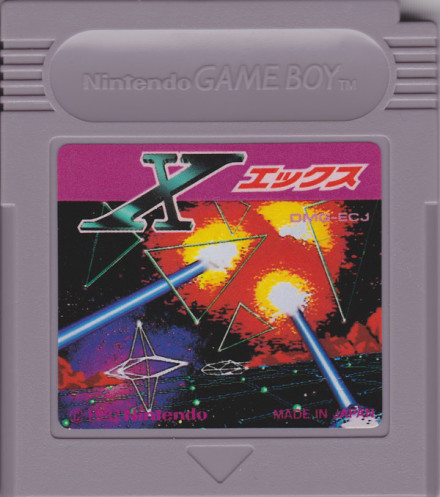
If you're looking for the original Super Chinese Fighter GB, DMG-AFFJ. If you want the Game Boy Color version, CGB-A66J. What will be world's next to a game review? X, published by Nintendo, was released in Japan only in May of 1992. X is a Vector-based first-person shooter. It was developed by Nintendo with Argonaut Software.
Argonaut Software made a game called Starglider in 1986. It came out on the Amiga and Atari ST, and it was a Vector 3D game, a lot like the old coin-op Star Wars. I remember playing this game in the Amiga, and it was just light years ahead of stuff you'd see on consoles and stuff. Like, it really was a 3D Vector flying game, and it was smooth.
Now, originally, they were going to publish this as Eclipse or Lunar Chase, but Nintendo saw it, and they were really interested in it, and they wanted to have a 3D Vector game on the Game Boy. In 1992, this was kind of a big deal. The president of Nintendo renamed this game X just before it was released.
Now, this game was only released in Japanese. There doesn't seem to be any translations of it available as a ROM, so you're going to have to read a lot of Japanese to play this game. If you're just beginning Japanese, you can probably figure out what's going on by just reading the katakana words. As long as you know up and down and the katakana words, you can probably guess what they're trying to get you to do.
It's not one of these games where you can just play it and figure out what you're supposed to do. It's not obvious in the game. You really have to read what the text says before the mission. So, this game is in the future. Humans are settling this planet called Tetimus II. They're mining these power crystals.
They use these nuclear silos to convert this power crystal into energy. But then a whole bunch of aliens came and ruined it. So, they made this amazing tank called the Vixiv, which is you, to go and destroy these aliens and collect these crystals for energy. So, you're going to be driving a tank, a flying tank, and it's a first-person view.
You're actually inside the tank. Front and back controls your speed. You can actually go in reverse, too. If you want to stop, you just have to slow down. At the bottom of the screen, you're going to see your speed and a little radar dish. So, you can actually see what's around you. If it's an enemy, you'll see a flashing dot.
On the right side of the screen, you have missiles and a larger map. And this map wraps around. When you hit the edge, you pop out the other side. A button shoots a laser. There's no ammo for this thing. It doesn't affect your fuel or anything. You'll hear a different sound if it's something that can't be destroyed.
If it doesn't make that can't-being-destroyed sound, it means you can destroy it. Keep shooting. B button fires your alternate weapon. Now, you pick these up at these radar stations, but I'll get to that later. If you hit start, you get a map, and it pauses the game while you do this. All around the map, you're going to see these really low pyramids.
If you hit those when you're full speed, it'll say turbo at the bottom. You'll actually launch, and you can fly. Don't worry about slamming into the ground. It'll just land automatically. The only disadvantage is it uses up fuel. So, that's what the fuel thing is on the bottom left of the screen. If you look at the left side of your viewport, you'll see a little meter thing.
That is your altitude. On the right side of your view screen is your shield. When that gets down to zero, it's game over. You don't have any lives. And on top is a timer. In some of these missions, you're going to have to travel to a very specific area. If you don't want to drive around the world and get attacked by things, you can actually use these underground tunnels.
So, you're going to see a little thing. It looks like a little ramp, but on one side of it, there's a little door. You want to slow down your tank and go into that door. You'll see an arrow show up when you're on the right track. You go in there, and then you get kind of a 3D, almost like the trench sequence in the Star Wars arcade game.
You can't control your speed by going up and down, because now you're in flight mode. So, you can change your altitude and move from side to side. Try not to hit the walls. But if you scrape against the floor a bit, you'll speed up. If you scrape against the ceiling, you'll slow down. So, if you do need to slow down, just kind of bump against the ceiling.
Now, some of the objects you're going to find around the level, these shield mushrooms. They look like mushrooms. They replenish your shield. You get these a lot when you destroy enemies. You can actually shoot the mushroom, and it'll turn into a different type of item. Usually, missiles are fuel. So, if you're low on those and you have enough shields, just keep shooting the mushroom.
You'll get something else. Fuel looks like kind of a square, and missiles look like missiles. There's also a coin thing, which rarely shows up, and it restores everything. Your fuel, your missiles, your health. There are giant trees in the game. It seems like you can't destroy them, but keep shooting them.
They'll blow up, and you'll get something. Must destroy trees. There are these floating, flying saucer things. They look kind of like a flower in the air. Those are good for getting fuel, but they're really hard to shoot, because you can't control your speed while you're flying, and you can't shoot it from the ground.
Sometimes you get lucky, and there's one in your sights, and just shoot it and grab the fuel. But I find if I'm trying to refuel, I'm hunting for these things, I end up running out of fuel, circling around trying to shoot them. It's kind of hard to dogfight something that's not moving. There are little beacons once in a while.
They're usually handy for getting shields or fuel. Once in a while, you'll see this cube. There's only a few of them around, and when you shoot them with a laser, it actually increases your health. If you shoot it too many times, it blows up, but it leaves a shield mushroom behind. So if you're low on shields, try to remember where one of these cubes are.
There are four different weapons. To equip one of these weapons, you have to go to one of these radar bases. So it's a little radar base, so you have to make sure you go in where there's the door, and don't go full blast. You'll slow down a bit, and you'll see the arrow. When you go into this radar base, you'll see on the right side of the screen, there's a choice of weapons.
First one, lock-on. This equips your missiles. You can still have missiles and not have your lock-on. This lets you use them. So when you see a target, you hit B just once, and then you kind of go into a strafe mode. You'll actually be following the target instead of the way you normally move around.
So then you can get right behind the target to shoot it. It's hard to explain. You just have to try it. The bomb is needed for a specific mission, so you don't need to get these right at the beginning. Now, jetpack. Jetpack lets you launch into aerial mode without needing one of those little pyramids.
You go full turbo speed. You hit B, and you'll just launch right into the air. And finally, Hi-X. This is some mega missile that you'll need for the last mission, so don't worry about it for now. I told you about the radar bases. That's where you get equipment. There's also the tunnel entrances that let you zip to different parts of the level.
There's something called a junction. When you do go into a tunnel, you end up at the junction. Once you're there, you can choose which tunnel you want to go out, and you can also restore either your health, your missiles, or your fuel. You can only do that once per mission. You can't just keep going back there and refueling and getting new shields.
The nuclear silo is for specific missions, but you'll see there's a little door and you can enter it, but there's no point unless you need to do it for a mission. And there are lots of different enemies, but generally you just shoot them. But just watch out for the spiders. They drop bombs. They're easy to kill with missiles.
Hard to kill with lasers. Watch out for those. The music in this game is excellent. Graphics? Well, I mean, what kind of framerate can you really expect from an original Game Boy? It's pretty good considering. When you look at Star Fox and the Super Nintendo, which these programmers later worked on, the framerate was about the same.
And there was actually some times, like when you go into those tunnels with the framerates, we're going at a pretty good clip. So maybe you'll like this game. Personally, I didn't because to me, this represents a lot of what went wrong with games in the 90s. The long training missions, which aren't very fun.
And then when the game begins, you get these really long missions that if you fail, you go back and you have to keep trying these really long missions. With the worst thing of all, timers. So you got timer missions. You got complicated controls. Training that's not very fun. It reminds me of a lot of early PlayStation games, early 3DO games.
Just not my kind of thing. But if you like that kind of thing, you'll probably like this. And it's worth it, at least just as a crazy tech demo. Especially when you see it on the old LCD screen with the motion blur. It's really kind of haunting to see 3D graphics coming out of your Game Boy. This game is not expensive.
I bought this in the box in the original Shrink Rabbit. It had never been open for 10 bucks. And I see it around all the time, so it shouldn't be hard to track down. But the language barrier is a thing because these missions have very specific goals. I recommend going to There's a walkthrough there that has all the things you'll need to do for the missions.
It doesn't really help you out with the training. Most of the training stuff is self-explanatory, but not all of it. There's a part where you have to go between the towers. Make sure you go at low speed. Turn around, do it again, and then keep going at low speed right into that building. But once you finish the training, next time you start the game, it'll give you the option of skipping the training.
If you're looking for this cartridge, look for DMG-ECJ.