Reviews of Rockman World 4 (Megaman IV), Chalvo 55, Ultraman, Snoopy’s Magic Show & Metafight EX.
My name is Ray Larabie, and I'm talking to you from Nagoya, Japan. Welcome to episode number 43 of Game Boy Crammer. Today I'll be reviewing Rockman World 4, Chalvo 55, Ultraman, Snoopy's Magic Show, and Metafight EX. But first, a contest.
The nice folks at the Pokémon Company sent me Pokémon Y. This is the North America, South America version for 3DS. If you missed the original 1990s Game Boy Pokémon, you're gonna like this. It's got a lot of the Generation 1 stuff in it, and it looks great. It looks like the anime. To win this game, you have to tweet.
You can only tweet once per day. No multiple accounts are cheating. You have to include Game Boy Crammer podcast or a link to GameboyCrammer.com. Nothing spammy. You know, I hate these contests where you have to mention the contest. Don't mention the contest. Try to make it sound natural so your followers don't think you're a dork.
Make sure you include @typodermic, T-Y-P-O-D-E-R-M-I-C. Otherwise, I won't be able to tally them up. If your Twitter account has less than 50 followers, include the hashtag RetroGaming. On June 18th, 2014, I'm gonna tally up all the results, put them all in a hat, and I'll take a video picking one of those, and that'll be the winner.
So the more tweets you make, the more chances you have. Alright, let's start the show. Rockman World 4 from Capcom was released in Japan in October 1993. December 1993 in the US, it was called Mega Man 4, sometime in 1994 in Europe. At the time of this recording, it was available in Japan on Virtual Console 3DS.
I'm not sure if it's available anywhere else. I'm not gonna go into every detail about Mega Man because, you know, this isn't my first time playing it. So if you don't know anything about Mega Man, you should go back and listen to some of my older reviews. Mega Man 4 is a mix of Mega Man 3 and Mega Man 4 on the NES. Not an exact port, but that's where a lot of the Robot Masters come from.
And since we already saw some of the Robot Masters in Mega Man 3 for Game Boy, this time we're gonna see some of those Robot Masters again. They're gonna make… You've already fought some of these guys. They're gonna be back. One of the big changes in this game is now there's a shopping system. You collect money.
They're called P-chips. You got a little letter P on them. You get big ones, little ones. In between levels, you'll have a chance to go to a store and buy different items. You can buy E-tanks to restore your health. You can buy W-tanks to restore your weapons. You can even buy a quarter of an E-tank.
If you've collected three of those little tiny E-tanks, you need four to make a full one where you can kind of top it up. And that introduces grinding into the game because now there are a lot of situations where an enemy… For example, there's a hen that shoots little birds at you. You can keep shooting those birds and try not to shoot the hen.
You can just keep using it to gain more and more points. You can actually use that to grind and get more points and buy more E-tanks and W-tanks and other stuff. There's one device that you can buy that will automatically restore whatever weapon needs it the most. So let's say you've got a whole bunch of weapons you've collected from Robot Masters, and one of them is really low.
But whatever weapon you're using right now is already fully charged. When you pick up some energy for that, it's gonna automatically go to the weapon that needs it the most. It just saves you time having to go to the menu screen before you pick up each power-up. It's really worth getting this thing early on if you can.
I didn't know what it was, and I got it near the end of the game. It's like, wow, that would have been handy. The weapons in this game, there's a lot of weapons. It pretty much fills up the whole screen. Now, the Mega Buster's a little bit different now. Now, when you do the charge blast, it kicks you back a little bit.
So be careful if you're on the edge of a platform you shoot. It's gonna knock you back sometimes. I killed myself a couple of times just shooting at stuff. By the end of the game, I was used to it, but it was kind of a surprise, especially since I'd played the first games and never had that kind of thing happen.
Rush. Your little dog is here to help you out with the same kind of things. You got the Rush Coil that bounces you up and the Rush Jet that lets you travel forward. You've got a Flash Stopper, which is marked with BR. You're gonna get this from Bright Man. You can freeze certain enemies on the screen and then shoot at them.
The Pharaoh Shot you get from Pharaoh Man. It's a bit like a Mega Buster shot when you do kind of a half-charge, but you can shoot it on an angle. Very important for shooting stuff in the air. And for the final boss, you're gonna need something that fires… Any weapon that fires upwards, you're gonna need.
Pharaoh Shot is a good one. Boomerang. This thing is not that powerful. It's just a ring. It looks like the rings in Sonic the Hedgehog. The thing about this is it's used just like a boomerang in Zelda. You can use it to grab things. A lot of times, you're gonna see a power-up that's inside a wall or just seems to be impossible to get at.
That's when you need to use your boomerang. It's gonna go right through the wall and grab those power-ups for you. Most of the game, I just used this to grab power-ups. I didn't really use that on enemies much. Beat. This thing's interesting. When you defeat the first four Robot Masters, on those levels, you're gonna find a letter B, E, A, and T.
If you get all four of them, you're gonna get this little bird. It looks like the bird in Flappy Bird. Kinda. This thing flies around and kills enemies. It doesn't do a ton of damage, but it's really great when you… You know, you've got your hands full, especially when you're… You've got a boss or something and you're sliding underneath.
This bird's gonna attack while you're sliding underneath. And while you have it, you can still use your regular Buster. The Balad Cracker. I think I'm saying that right. Balade. Balad. B-A-L-L-A-D-E. Cracker. Symbol is B-A. This thing is just like that Pharaoh Shot I told you about. It'll go on an angle.
But this thing is like a bomb that shoots out. It's very, very powerful. I'm gonna tell you now, you need this to defeat the final boss. Make sure that thing is always powered up. The Crystal Eye shoots out a ball that splits into little ones. Like, there's three balls that come out of it. Very useful. Um, you know, these bosses, I think on the NES version, you have these big rooms to fight in.
In this game, the same bosses on the NES version, I guess it's the same with all these Game Boy games, are crammed in this really small little screen. So, this is really good when things are getting really claustrophobic. You can just kind of fire it at the wall and let the balls bounce around and hit the boss.
Napalm Bomb shoots a little grenade. You can bounce it off walls and stuff like that. You kind of want to time it where, if you're using it on a boss, where you think they're gonna land, you shoot one. You don't need to shoot a bunch. Shoot one at a time and it does a lot of damage. You get that from Napalm Man.
Power Stone makes these three rocks fly out of you. It's really hard to hit what you want, but it's very, very powerful. I always tried these in bosses and some of them are really susceptible to it. Charge Kick is very useful. When I first got it, I thought, oh, this is not gonna be much use- it's just a- you do your slide while you have this thing on and your foot lights up and you can blast through stuff.
It really does a lot of damage to enemies. Like the other games, this one has a password save, except I found it was really hard to put the passwords in with this one. I don't know, just something about the interface is kind of confusing. Oh, before I forget, in this store, there's something called an S-Tank.
This thing gives you all your life energy and all your weapons energy. It's expensive, but, you know, it can really help you out right near the end of the game. And you can charge up your weapons and buy 1-ups in this store, too. So this is gonna be the same kind of deal where you choose which robot master you want to fight first.
There's gonna be four to choose from. You get a different kind of interface. You can see their whole body instead of just their faces when you're flipping through. And then you're gonna go to another stage, just kind of a mini stage between, and then you go to this really cool cutscene. Then you're gonna defeat the other four bosses and then you're gonna have a boss rush, beat all the bosses again, and then the big boss fight. You'll probably find the first four bosses aren't that crazy, although the guy with the rings, that is tough.
There's so little room to move, and this thing is firing at 45. He's like jumping up and shooting down at you at 45. It's very hard to dodge. You want to keep going under him. I would do that one last because you'll have a chance to buy some E-Tanks. I had to use them on that guy. But then it gets crazy hard. When you're doing the next four robot masters, some of them are just so difficult. In general, the game isn't that difficult. I was a little disappointed because the last one was really kind of interesting and colorful. Not literally colorful, but there were a lot of different environments and textures. This one has a lot of techno hallways.
There's a lot of really predictable stuff going on. Most of the time, you're gonna drop down a hole. You might as well charge up your buster shot because there's gonna be a guy right exactly where you expect him to be. Very, very predictable. They kind of cut down on the really ridiculous, tricky stuff. You do have the equivalent of those vanishing platforms that drive you crazy in the other games, except these ones you can actually see. They kind of rotate. Hard to explain, but you can actually predict what they're gonna do and plan for it. They're still really hard. The timing's really tough on them, but it's more fair. You actually have a chance of doing it on your first try. You gotta play this game with headphones on. It just sounds so great.
Now, this isn't a bad Mega Man game, but it's not… it's not the best one. And I wouldn't start off with this one. The one thing that is good about it, I guess, if you're a beginner, is the first few bosses. If you don't pick the ring guy first, you don't have to be an expert player to get through those. You don't really have to do anything in a particular order. I didn't do Ring Man last. It's just… I just kind of picked any old order. When you get to the next set of Robot Masters, you should probably look up what their weaknesses are, because it's really tough to get through, and you don't want to, you know…
Even the levels are pretty hard there, so… Now, I had a little peek ahead at the next games. I know the money system is gonna get better. You're pretty much just gonna buy the E-Tanks, but it does… This is the first game where you can really grind, and you know, with the other games you had to find the E-Tanks, and this one, you can just find one of these enemies, like the hen, where the birds keep coming up, and just keep shooting the birds, and getting points. It's really easy to get a full set of E-Tanks.
Just watch out right near the end of the game, because there's a point where you can't go back to the store anymore. There's no reason not to get the Japanese version, although it's a little tricky in the store to get through the interface. You'll get used to it after a while. If you just keep hitting the button without reading anything, you're just gonna get into a loop and not be able to read the store.
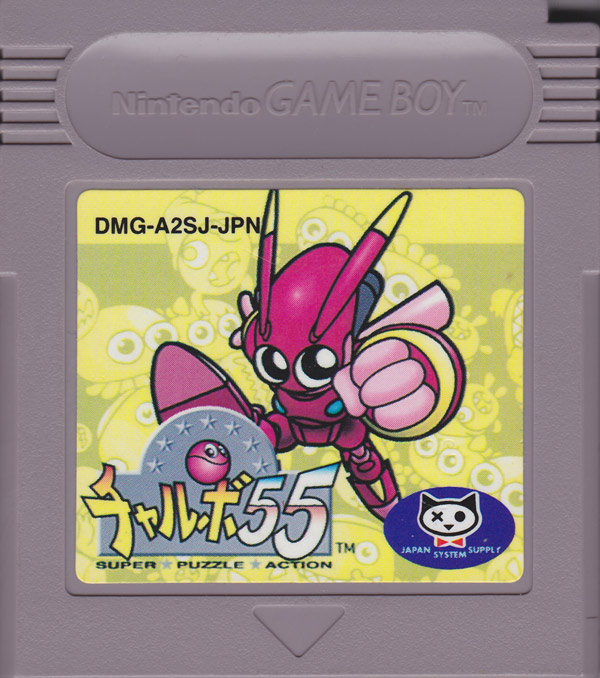
Other than that, there's nothing else to read. So, the Japanese version, look for DMG-R4J-JPM. US version DMG-R4, European DMG-R4EUR. Chalvo 55, developed and published by Japan System Supply, was released in February of 1997. This game started off as a game on the Virtual Boy that got cancelled. It was called Bound High, and it had this really cool looking robot called Chalvo that could turn into a ball. On the screen, or I guess through the goggles, you'd see a transparent ball with a face on it, just an outline, like a cartoon, and there was a grid of squares that was bouncing away from you, so it's like you're looking from above, watching this ball, and tracking it with a camera, bouncing up and down on a grid. Probably by the time they finished this game, the console was obviously not doing well. In 2010, a Virtual Boy fansite, Planet Virtual Boy, put together this great looking replica cartridge, and box, and manual. I'm not sure if they even have any left, but it looks great. Guessing by the timing, Bound High was finished and cancelled in 1996, Chalvo 55 came out in 97.
So most likely they said, well, we've got this great character, and a bouncing thing going on, let's make a game with this character bouncing. While there is bouncing in Chalvo 55, it's not the same kind of game. Chalvo 55 is a platform puzzle game. You control Chalvo, the robot. Hit the B button, you can turn into a ball, or back into a robot.
The robot can't really do much. It can punch through breakable walls, a couple other things, but you can't really fight enemies. Most of the time, the reason you want to turn back into a robot is because you don't want to bounce, like there's spikes on the ceiling, or some kind of puzzle you need to solve by not bouncing.
Otherwise, you're a bouncing ball. You don't have to push a button to bounce, it always bounces. Each level is composed of lots of rooms. You need to go through these rooms to find crystals. Once you've collected five crystals, you can check your map screen by hitting start to see how many crystals you need.
That'll give you access to a boss, you defeat the boss, and then you open up another level. There are eight levels. After each level, you get a password. So there's no battery in this game, but you do get a password state. In addition to the map that you get when you hit start, you can also access a map of the full game, so you can actually see all the levels together.
There is a ninth level, too. You need a secret password to get it, and I didn't actually get that far, so I'm not sure what that's all about. So in addition to bouncing around, you're going to be breaking blocks. There are breakable blocks you just need to bounce against. There are movable blocks you'll need to solve puzzles, spikes everywhere, and there are springs that'll bounce your ball really high, and some of these are movable.
You can actually push them around. There are three kinds of enemies, and one of them has spikes, so you're not going to want to bounce on those. If you hold select, you can pan around the level with the d-pad. It's very important because there's a lot of places where you need to break through a floor, and you might fall on some spikes if you don't know they're there, so you need to look down often, and it pauses the game while you do it.
The graphics in this game look great. I mean, I love the character design, and there's a nice opening scene. The boss rooms are kind of cool. Sound is not that great. Instead of having any kind of bounce sound effect or anything, you just get this not very moody music loop going on. It changes for each level, but it's not like Metroid, where it just sets up kind of a creepy atmosphere. It's just kind of bouncy, fun music. Here's the weird thing. In the game manual, the screenshots are red. It's like they've been playing the Virtual Boy version so long, all they can see is red. In the back of the box, you can see the Super Game Boy version, and it's red as well.
The level designs are quite good. I like when they have these levels where you can see part of the level you can't get to, but it kind of hints that you're going to be able to get to it from another room or something. It's really well thought out. As for me, I don't have a lot of fun with these kind of games because I'm really bad with directions. I end up going around in circles, but that's just my hangup. If you like Metroid and stuff like that, you'll like this.
There's no reading to do in this game, so there's no problem with it being Japanese. And another nice thing about this game, it's not that uncommon. It shouldn't be that expensive to find. I wouldn't call it common, but it's not one of those games that they crank up the price because you can't find it that often, although I don't see it often in the box. To get this game, search for DMG-A2SJ.
ULTRAMAN Ultraman, developed and published by BEC, BEC, or Interbec, came out in Japan only in December of 91. Ultraman is a fighting game. It's very similar to the version that came out on Super Nintendo, Super Famicom, and Genesis Mega Drive. You play Ultraman, the superhero from space, and you're going to be fighting monsters, monsters from the original series. So it's like a typical fighting game style. You've got two characters facing off. On the bottom of the screen, you've got your health bar and you've got the enemy's health bar, and something else in the middle.
There are four special powers. You've got SL, the slash ray, AT, beam attack, US, ultra slash, and SP, finishing move. You press A and up to use this power. The ones on the left take less energy to use. The ones on the right take a lot more. And if you want to use the ones on the right, like the finishing move, you have to make sure it's fully charged up. You'll see it charging from left to right. So if it's only a little bit charged, you can use the slash attack. But for the other ones, you have to wait until it's charged up. You have to move your cursor to choose which one of these attacks you're going to use.
The reason this is very important is when the enemy is all out of health, you're going to see the enemy's health bar turn into the word finish. That doesn't mean you can just keep wailing on him. You have to use a special finishing move. So you have to move your cursor over to the finishing move, the SP. Then as soon as you've got it, press A and up. If you wait too long, the enemy's health will recover and you have to hit him a few more times and get the finish thing to show up again. To move your cursor, you hit up and right, or up and left, depending on what side you're on.
It took me a while to figure it out. Just kind of mash the buttons and you'll get it. As for the controls, A is kick, B is punch. If you hit down and away from the enemy, you'll do a backflip. If you're close to the enemy, you can pick up the enemy and throw him, but you know this is not like Street Fighter. The moves are not that complicated. There are no sweeps or anything like that. It's just try A and B in every direction and you'll have all your moves. But what about jumping?
You have to use the start button to jump. And jumping doesn't give you a really good fighting advantage, like you can't do a flying, kicking the head kind of move like you can do in most fighting games. It's really just an evasion move, or a way to get in close. At the end of the level, they'll count how much health you have left, how much time was left, and rack up the points that way. And there's actually a high score board at the end. In the Super Nintendo version, I believe there were ten enemies to fight and in this one you have eight. If you know your Ultraman monsters, Space Monster Vemura, Space Ninja Baltan, The Red King, The Four-Dimensional Monster Briton, Jamira, Gomora, am I saying these right?
Mephiras Alien and Zekton. I couldn't figure out how to beat the Four-Dimensional Monster. There must be a trick to it. When I try to get in there and hit it, it just does damage to me. You can continue twice after that, game over. In the Super Nintendo version, you can get extra lives depending on how many points you get. I'm not sure about the Game Boy version. I didn't rack up that many points.
From reading the reviews in Japanese for this whole series, it's not a well-loved game. I mean, people love the monsters and people love Ultraman, but as far as this game goes, the controls are pretty bad and maybe it would have been acceptable in the 80s to have this kind of fighting game, but it's just a little too crude for 1991. The animation is really stiff. The graphics aren't really well drawn, like it's not, I'm not just talking about the number of frames they use, it just looks pretty amateurish. There are a lot better fighting games on the Game Boy. If you're looking for this game, search for DMG-UNJ.
DMG-UNJ DMG-UNJ DMG-UNJ DMG-UNJ DMG-UNJ DMG-UNJ DMG-UNJ What's this about a magic show, Charlie Brown? Snoopy found a book about magic at the library. And now he's going to give us a show? That's right. He's built a stage and everything. Snoopy's Magic Show was released in Japan in April of 1990, a very early Game Boy game. It came out later in 1990 in the US and Europe. In Japan it's called Snoopy No Magic Show, but it means Snoopy's Magic Show.
It was developed by Chemco. Remember them? They made Bugs Bunny Crazy Castle series, also known as Mickey Mouse. They also made that clown game, Sorayuke Kid, which is essentially the same as those Bugs Bunny games. Here we have a maze game. There's no scrolling, you're just on a grid, you're controlling Snoopy.
Your goal is to collect all the woodstocks, the little bird. But it's not like Pac-Man, there's not like a hundred woodstocks, there's usually about four. To stop you from doing this task, there is a malevolent ball. This ball bounces off the walls like in a breakout kind of situation. But it's not totally random.
I wouldn't call it intelligent, there's kind of a randomness to the angle at which it bounces at, which isn't completely random. It will actually come towards you. Not directly, but if you hang around on one side of the screen, there's a good chance it's going to come over to the side you're on. You have to beat a timer. Now I really like this, this is innovative.
Instead of the typical kind of countdown timer, a numerical countdown timer, or a bar, you have a bar that goes around the screen. So it starts on the top, wraps around the right, goes under, and then goes up the left side of the screen. It ends up using only a few pixels on the edge of the screen, and visually it's really easy to see. At the end of the level, it will tally up how much time was left on the timer, you'll get points, sometimes you'll get an extra life. Then it's on to the next level.
There are sixty levels altogether, and after level sixty, you start back at level one, but now Snoopy's brother, Spike, one of Snoopy's brothers, is intent on murdering Snoopy. They don't explain why. In fact, the whole storyline really is about some magician is trying to stop Snoopy. Are you saving Woodstock? Is that Woodstock's siblings? Are they just the same kind of bird?
None of this is explained, even in the manual it's really vague. There are some tiles on the floor with an arrow, you can only go one direction. Some other tiles will teleport. Not only will you teleport, enemies will teleport too. You can move blocks. Some blocks, you don't know which ones you can move, you just have to try it. But it's essential for solving a lot of these puzzles.
Move up to a block, hit your A button, and push. There are some destroyable blocks. While you're pushing and moving these blocks, sometimes you'll reveal a power-up. One of them is a timer. This will stop the ball or other enemies from moving, but they'll still hurt you. It's a very, very short pause, and it doesn't pause the timer. Kind of useless, don't go out of your way to get it. There's a power-up that's a P with a circle. That will make you invincible for a few seconds, and if you run into the enemy, you'll destroy it, and it'll be gone for the rest of the level. So when you get past level sixty, Spike is going to be running around.
The ball is still bouncing around, the levels are the same, except now you have Spike. Spike is not bouncing, he's just walking around. The difficulty of this game ramps up very slowly, but you're going to have a password for each level. You can grind through this game for a long time and get through it.
The music is repetitive. I think there's six different songs. There are cartoon interstitials that happen every few levels. This one's actually okay. I wouldn't rush out to get it, but if you happen upon it, I wouldn't turn it down. It's one of Chemco's better games, and pretty good for early 1990. Snoopy's Magic Show, for the Japanese version DMG-SNJ, for the other versions, DMG-SN.
Metafight EX for Game Boy Color was released in Japan in February of 2000. It was released in the fall of 2000 in US and Europe, but it was called Blaster Master, Enemy Below. It's also out everywhere for 3DS Virtual Console. Metafight was a Famicom game, Chou Wakusei Senki Metafight. It came out in the summer of 1998, and it was a big flop in Japan. It just didn't really sell as well as they thought it would. It did very well in the US and Europe. The plot is a little bit different in the Japanese version, the English version, but basically, you control Jason, and you have to defeat some sort of bad guy. There was actually a book written about this, like a novelization of this story. It's a run-and-gun platformer, but instead of just running around on foot, you ride a tank. You can get in and out of this tank. This tank can shoot forward, it can shoot up, and it can jump.
The physics of the tank is really fun. The little wheels roll around. It's got a nice bounce to it when it jumps. It's got a really good grip, too. If it kind of almost misses the platform, the wheel will just catch it and pull you onto it. There's a bit of a coast to it. You know, it's not like a regular run-and-gun where you can just stop dead. There's a little bit of momentum happening there, but you can't shoot on a 45-degree angle, just up and straight across, horizontal.
There are two modes of gameplay. You've got your regular side-scroller tank version, and you can actually exit the vehicle, and there's a little tiny you, except you're very vulnerable to attack. You're not going to want to get out of your tank too often, only when you need to. You press select to get in and out of your tank.
So when you do get out of your tank, you're going to find some areas where there's a little ladder or a little tiny doorway to go into. When you're out of your tank, press down, and you'll go into one of these doorways. Now you're in a top-down view where you're running around, shooting enemies, picking up power-ups. The health of your character is separate from the health of your tank, so even if you're down to your last bit of health on the tank, when you're running around these worlds, you're back to full health. So you and your tank have separate health levels. The reason for going into these top-down stages is to collect power-ups, and to collect keys, items that you'll need to complete the game. Now back to tank mode. While you're driving around in this tank, you're going to find a lot of enemies running around, enemies that can be dispatched with your gun.
But then later, there are enemies that you can't shoot. That's where homing missiles come in, Thunderbolt, three-way missile. You can select those by hitting start, and you can go to a select screen, and you can choose which one you want. To use these things, while you're in the tank, push down and fire. So down and B.
When you're in these top-down levels, you're going to find bosses. When you beat these bosses, you'll get items. One of the first items you get is a high jump. Now you can get to parts of the level you couldn't get to. This is not a totally linear game. This is a little bit like, or I should say, a lot like Metroid. In fact, it was inspired by Metroid. You can get a hover ability for your tank. You can get something that'll let you go underwater. Then you'll get something that'll let you go up walls, and then eventually up ceilings. So you can actually roll right up the ceiling. A lot like the spider ball in Metroid. You can get upgrades for your gun in the top-down mode.
Oh, also, when you get out of your tank and you're the little Jason, you can get an upgrade for that gun that'll let you shoot through certain blocks. You're going to see these blocks that look breakable that you can't break. That's what you need to break. You need some power-up that'll let you upgrade that gun, that tiny, tiny little gun. The homing missiles are very important, and you usually find those inside those top-down levels. So if you do get a whole bunch of different weapons, try to conserve those homing missiles.
The thunderbolt is really handy because it shoots down. Normally you can't shoot down, so if there's something below you, it actually shoots right through the platform, too. The fact that your tank has a separate energy level than you, Jason, can be really useful because if your tank's almost dead, you can jump out as little, tiny you, and really be careful and take out that enemy.
Don't forget, you can duck, too, so you can avoid a lot of damage. Take out that enemy, get back in the tank really quickly, and collect the power-up. The power-ups disappear fast, and then you can kind of, you know, get yourself on your feet again, so to speak. Something really strange in the top-down section is, unlike most games where you're running around shooting, your gun, you hold your gun in your right hand, it's off-center. You can use this to your advantage. Let's say there's an enemy in front of you, and he's shooting at you, and his bullets come right out from the middle of him. You can kind of offset a little bit to the left, so you can keep shooting the enemy, and his bullets will go right past you. It's annoying in a way, but sometimes really useful to have this off-center gun. You'll also see from a side view, sometimes it looks like bullets are going through your head, it's kind of a perspective thing, I guess. When you're in those top-down views, you have a regular gun, and you have a grenade. You can pick up these power-ups that look like a gun, that will enhance your gun, but that stuff gets used up, so you'd want to try to use the gun as little as possible.
If you can get to the boss with that gun at full, it'll really help you deal a lot of damage to that enemy. There are save games, not a battery save, but it is a password save. It's a pretty long game, and as you open up more and more areas, the world gets bigger and bigger, and frankly, more confusing. You know, when I'm playing Metroid, it is a very big world that I'm opening up. I found that in those worlds, there was enough personality to them, and differences that I could tell where I was. In this one, I'm always lost. Everything kind of looks the same. It doesn't technically look the same.
At least you have different colors to differentiate the different areas you're in, but it's really hard to tell where, you know, did I already go into this door? Is this the same door? I can't tell if I'm going in a loop. I really felt disoriented most of the time, especially in those top-down things. Identical room after identical room with doors facing in different directions, and I just didn't have a lot of fun with this game because of that. Yes, the physics of the tank are really fun. It's fun driving that little tank around. The problem is, all the rest of the stuff you have to do, the same, the identical enemies to shoot. The action never really changes. The boss fights aren't really that good. People speak really highly of this game, so it's very well loved.
Blaster Master was a huge hit on the NES. I just didn't find myself having that much fun with this game. It wasn't exceptionally hard because, well, at least you have a big health meter, and it's pretty easy to replenish it if you need to. You can always go back and grind and just keep entering a room and coming back and shooting an easy enemy over and over to get more health.
But fun? I'm not sure. There's a Game Boy game called Blaster Master Boy, which seems to be tied in with Blaster Master, but it really isn't. There was a Japanese game called Bomber King Scenario 2. They just rebranded that in the US and Europe as Blaster Master Junior and Blaster Master Boy, but they really just wrapped a Blaster Master storyline basically around Bomberman. Blaster Master Enemy Below is not a very common game.
However, the Japanese version? Not uncommon. I got it for 15 bucks. I got it in the box, unopened. I think maybe it's because Metafight was never really a big game here, or not like Blaster Master was. There's no reason not to get the Japanese version because there's not a lot of reading to do. There's just the storyline stuff at the beginning, basically.
If you want the Japanese version, look for cgb-a5mj-jpn for the US version, dmg-aehe-usa or dmg-aehp-eur for the European version, or get it on a virtual console.