Game Boy Crammer · Episode 7
Revenge of the Gator, Super Chinese Land 1, 2, 3 & Game Boy History
Reviews of Revenge of the Gator Pinball, all 3 Super Chinese Land games plus a brief history of Game Boy, part 1 of 2.
Welcome to episode 7 of Game Boy Crammer. Today I'll be reviewing Revenge of the Gator Pinball, Super Chinese Land 1, 2, and 3, and the history of the Game Boy, part 1.
Revenge of the Gator, also known as Pinball: Revenge of the Gator.
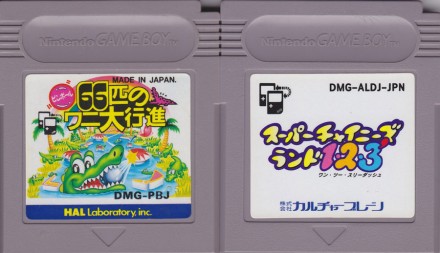
In Japan we call it Pinball: 66 Hiki no Wani Daikoushin...66 Alligators Road. And it's a pinball game, so you know how to play it. You have two flippers, you flip the ball around. This was made by HAL Laboratory. This came out in 1989, so this is like a really early HAL Laboratories game. And a really early Game Boy game.
It's one of the first, and to me, one of the best Game Boy games ever made. One of the best pinball games. I wish they'd make a real version of this thing. I play a lot of video pinball. I play pinball arcade on the iPad. I pretty much pick up any video pinball game I see. I pick up all the Game Boy ones, for sure.
This is the best one. Kirby Pinball is just behind it, and I do love Pokémon Pinball a lot. In fact, of all Game Boy games, if there's one I couldn't live without, if I had to have only one Game Boy game, it would be this one. Now this isn't just the typical kind of pinball game where there's one screen.
There are several screens, and it's not a scrolling kind of thing either, so you don't have to deal with scrolling. Everything you see is on the screen. The ball will pop up through the top of the screen. There'll be another screen up there, or it'll go down, and there's another screen down there. And eventually, if you go too far down, it'll go straight into an alligator's mouth.
And these gators are super cute, and they just want to eat pinball, that's all. The music is just repetitive, it's super catchy, and it really feels great when you get to these bonus levels and you hear a different song. So you start off in screen C. There's four screens, A, B, C, and D, and there's a whole bunch of bonus stages.
So this starting screen, it's not like regular pinball, because usually in regular pinball, when the ball goes down the drain, that's the end. This one, there's a screen below you, so you still have a chance. You're going to spend most of your time on this screen. You kind of get stuck on here, and you basically have to knock out the lane targets on the top, and then it opens up a little gate on the side, and you have to pound the ball through there.
But it's pretty hard to get it through there. There's a little slot machine, it's more trouble than it's worth, because you can lose your little side protectors. You don't want to lose your side savers, so it's not worth it. Now below that, it's panic time, because that ball goes down the bottom, and goes straight into a gator's mouth.
There's a whole bunch of little gators that give you budget bumpers. They're actually gators that open their mouths, and you shoot the ball into the mouth, and if you're lucky, you get into the right one, you're going to go straight up to one of the bonus stages. So it's kind of risky to be down on this lower screen, but it's kind of worth it sometimes, because it's a shortcut to one of the bonus levels, which saves you a lot of time trying to fight your way up there.
But risky, because you could lose the ball on one of the side screens. So that starting screen, if you go up from that, screen B is the one above the one you start with, and there's a whole bunch of blocks, kind of like Arkanoid or Breakout, where you have to knock out tons of little blocks. It's so unique, and this is something you're never going to see in a real pinball game.
I mean, it's really fun to knock down targets. You're just knocking down fields of targets, and you can kind of lock the ball up there, just like in the old Breakout game. And it's tough. It's easy to lose the ball on this level, because it's kind of set up in a way where the ball bounces into the side screen very easily.
Once you clear those out, you can get the ball into a hole. There's a hole on the left. If you get it in there, you get to go to bonus stage two. Whee! And if you get it to the right, you get to go up to screen A. So this is kind of the top of the game. So now you're at the top. There's a gator and a cage, and then there's a bunch of fish, and you have to kind of feed the...
You have to hit the fish on these little loops, and then that's going to make the gator bust out of the cage, and then you get a chance to hit the gator for an extra ball. So, as far as I know, this is the only way to get an extra ball in this game. So, you know, you want to get up to that screen A as often as possible.
These games can go a long time, because when you're up on screen A, that drain at the bottom is three screens down. I mean, you're... It's not like right... This is not like hardcore 1960s, 1970s pinball games where you hit the ball and it's gone in one second. You can go through the whole game in 30 seconds.
When you're playing this game, it can go a long, long time. So you want to make sure you have a fresh battery, because you're going to probably leave it on pause and come back to it. There's no save game in this, and there's no saving high scores, and no battery in it. Um, these can be very, very... Sometimes it can be a very short game.
I've had some... I've had games go an hour and a half where I'm just getting extra ball after extra ball. Um, what a lot of fun. One cool thing about this game is you can play a two-player shared game. So you can find someone else who has this game, a person with exquisite taste, and you get the link cable.
You can play head-to-head pinball. There was an old pinball game called Joust Pinball, based on the old Joust video game, where it was... The table was kind of like a rooftop shape, where it slants up like a regular pinball game, and then slants back down, and it was a cocktail table game. So you'd play against another player, kind of like hockey, where you can kind of shoot the ball back and forth and try to get it to drain on the other guy's side, so it's kind of like a goal post.
This is kind of like that, so you're fighting against each other. I've never tried it. Sounds like it's a lot of fun. I would say this game is essential. If you're just starting Game Boy Collection, this is definitely one you're gonna love. Even if you don't like pinball that much, I've given it to people who don't really like pinball, and they like it just because it's so forgiving.
I mean, you know, if you keep the ball out of that bottom screen, you're never gonna lose the ball, and you don't get that disappointing feeling where, you know, so many pinball games seem so unfair. The ball just goes straight into the drain two seconds after you get it onto the field. You don't need to read any Japanese for the Japanese version, so if you see the Japanese one for cheaper, go get it!
It's got a big 66 and a crocodile on the cover. Yeah, I can't miss it. I wish HAL Laboratories had kept making pinball games, because I think some of the best pinball games ever made are not even real pinball games. They're digital pinball games made by HAL. Go get it. Next to a game review. Super Chinese Land 1-2-3 Dash by Culture Brain.
Look up a cartridge called DMG-ALDJ. This game came out in 1996 in Japan. It was not released in any other country. It's a combination multi-cart. It comes with three games, Super Chinese Land 1, 2, and 3. You can easily get Super Chinese Land 1. It's called Ninja Boy in North America and Europe, and it came out in 1990.
So Super Chinese Land 1 came out in 1990 in Japan as well. But it's a port of a game called Kung Fu Heroes, which was released in Japan in 1986. Yeah, I know there's a mix of kung fu and ninja, it seems like. Well, when you see the graphics, you'll realize it doesn't matter if he's doing kung fu or a ninja.
It's very abstract. It's an overhead action game where you have to fight your way through eight levels of four stages each, and each stage has four screens. So you scroll across four screens. You kill a certain number of enemies, and then the exit starts flashing. The exit's at the top of the screen, and then you have to run through the exit.
It starts flashing and bleeping really loud, so you're not going to miss it. And it's one of these games where you die from one hit. You can switch weapons, and a lot of times the weapons don't do anything to certain enemies, so it's a lot of dying in this game. One thing that would have made it a lot better is to have some sort of health meter or something.
You have a punch and a jump, but you also have these weird moves after jumping while still holding the jump button, and then it does a crazy miracle kick. It's hard to pull off sometimes when you're in a panic, but sometimes it'll help you get out of a group. If a bunch of enemies are ganging up on you, you can kind of jump out of danger by using that.
And another thing is to change weapons. You can pick up these weapons. To change them, it's not very intuitive. You have to press attack and jump at the same time. So you're holding A and B, and then you're tapping the D-pad in any direction, and then you can switch the weapon. Yeah, it's something that you would never find.
I kind of poked around and eventually figured it out, but it's not obvious how you change your weapon. There's lots of power-ups and weapons you can collect. Throwing weapons and swords. And if you collect money bags, you can make a power-up that makes you invincible. But not for very long. I just don't find it that useful.
It's one of these games that's really frustrating because of the one-hit-kill thing. A lot of times, enemies will gang up on you, and you respawn exactly where you got killed. However, you are invincible only for a very, very short time, so you can get these situations where you have a lot of enemies around you, and you can lose one, two, three, four, five lives really quickly.
It feels really unfair. Just be prepared for that kind of thing. One thing I really love about this game is it's full of quirky, weird surprises. You break a rock, and then there's a stairway going down, and you're collecting fruit for a while. And just strange, bizarre things happening all the time.
The graphics make no sense, but it has that really cute mid-'80s Japanese style where nothing really makes sense. All the characters have two-frame animations. That's part of the charm of it. I really like that kind of look, and I think nowadays, if people try to make retro-looking games, they actually, on purpose, try to get that kind of look.
To me, I love the graphics. They're just so weird and charming. The music is pretty terrible, and as I mentioned before, when you go through the exit, the sound is just ear-splitting. You want to make sure you have headphones so that you drive everyone crazy. It sounds like a cell phone ringing or a fire alarm.
Now, I've found this game, if you don't play it with any kind of cheats, it gets really frustrating, because you'll build up a whole bunch of lives and just lose them so quickly. There's a cheat. If you go to the title screen when you start a new game, you go up, up, down, down, A, B, A, B, then hold the A button and press start, and you have to kind of do it really quick, and then you will start with 80 fighters.
And even then, I mean, you can lose 15 on one level. It gets really hard later on in the game. I still recommend getting it. I mean, you can pay a lot of money for it, but if you see a ninja boy, that's not too expensive. It's fun. I don't know if it's rewarding to beat the thing, because I'm probably never going to.
With that cheat, it's a lot of silliness, and it's just, plus the name is really funny. If you can get the one called Super Chinese Land, I mean, that is one of the funniest names for a video game of all time, I think. Well, I saw it on Game Center CX. Arino-san was playing it. I thought, well, I really, when I saw that it was available on Game Boy, I thought, well, that's got to be fun.
I already know how frustrating it's going to be. Oh, and by the way, to continue your game, hold A and B on the title screen. You can continue as many times as you want. And if you want the colors to look a little better on Game Boy Color, hold up when you turn on your Game Boy, and you'll get a nicer Super Chinese Land type of palette.
And that's the end of part one. Part two is Super Chinese Land 2. This came out in 1991, also by Culture Brain, and it was released in Europe and the US in 1993, called Ninja Boy 2. This is a completely different type of game than the first Super Chinese Land. This is an action RPG. Is it an action RPG?
I think it's an RPG with some action. So you have the same characters from the first game traveling through space, and space pirates crash their ship into a planet. And it's just like any RPG at first. You move around on the map and buy equipment and talk to townspeople and stuff like that. You have magic spells and boss battles.
When you fight regular enemies, let's say you're just on the map and you're fighting typical kind of enemies you fight. Not the bosses, but the regular enemies. You're actually playing an action game. It kicks into an action mode very similar to the first game. You're running and punching and throwing things. So you actually get to have something to do instead of just watching the dice roll, which I think is kind of fun. So when you're in the battle mode, it's a little simpler than playing the first Super Chinese Land. The controls are a little more intuitive. Double tap the left or right to run. A button picks up stuff. B does a jump. You can use B and an arrow for a flip jump. If you hold A and B and then an arrow, you can do some crazy kind of kick.
Press B and up, then you get a really high kick. The big crazy kick and the high kick, they use up M power. So you have this M power that you have to collect. So you can't just do them all you want. Power-ups, there's these little boxes with a P on them on these battle levels. So you can just punch those and different things come out. You get question marks. You get M power.
You get skulls, which reduce your M power. And there's bombs. There's wings that give you energy. And there's swords. And they're all the same, it seems like. I didn't get too far into the game, but it seems like all these levels have these same, very similar P boxes. And you can knock the boxes into people too. When you fight a boss, it's not an action sequence. So it's more like a typical RPG where you're picking spells and stuff like that. Attacks and spells. And the graphics look very similar to the first game, but definitely more refined.
You can tell they put a little more effort into it. Things actually look like real things. Yeah, it's not bad. In fact, I think I'm going to play this. I might try to get the English version because when I'm playing, I can read some Japanese, but with a lot of these Game Boy RPGs, the text is all in hiragana, which means there's no kanji symbols. Now a lot of times, like me, I'm kind of an intermediate Japanese student, so I'm lacking in vocabulary. But a lot of times when I'm reading a book, sometimes the simple kanji will help me understand what something is. If I don't know the word, well, I can figure out from the kanji the meaning of the word, still get through the story. Even though I don't know how to say the word, I can figure out the meaning.
When you're playing these kind of games, in fact, a lot of Game Boy games are like this. You know, unless you have a big vocabulary, you don't know what anything is. There's not a lot of clues. It makes it really hard to play these things, so I'll probably end up getting Ninja Boy 2 in English. Now finally, Super Chinese Land 3.
This is almost the same as Super Chinese Land 2. The one thing I can say that is improved is the action levels are much more interesting. You're climbing up on things, there's platforms to jump over, and it's just a lot more interesting doing the action parts. Other than that, it seems to be the same type of game.
However, you can't get that in English, so while it was sold separately, it would have been called Super Chinese Land 3, I don't think it's available in English. Too bad. So if you're looking for the Japanese version, look for a cartridge, search for DMG-ALDJ, and you'll find Super Chinese Land 123-. The title is not printed in English, so you'll have to read some katakana or just look for that cartridge code. So I don't know if I recommend getting Super Chinese Land 123- unless you can read Japanese. Otherwise, get either Super Chinese Land or Ninja Boy on its own, because you don't need to do any reading in either of those, and then getting Ninja Boy 2 in English so you can figure out what the hell's going on. And there you have it, Super Chinese Land 123-.
And the olden days. Back when the first Batman film came out, the Game Boy was released. Now this was not the first handheld game system. There were certainly some before, but it was really the first popular one where you could change cartridges, and it was the first one that really felt like the same console you hooked up to your TV.
There were a lot of handheld games before that, but they weren't really like being in your living room. This was like a game system that had proper games on it. You could play Super Mario on it and stuff like that. It was the first time you could take a game system with you. August, North America, August 89, this thing came out, but it was a little earlier in Japan. It was on April 21st, 1989.
And then, yeah, Europe got it a little bit later, 1990. This is the original Game Boy. This is the big brick Game Boy everybody's seen. It's kind of the iconic Game Boy with a green and darker green screen. This was not high technology at the time. There were certainly color screens already. There were backlit screens.
Lots of LED things had nice to high contrast screens on them, but this thing was cheap. I mean, this was not a very expensive toy. One of the things that really sold it was it came with Tetris. People were just crazy about Tetris at the time. That was the first time a lot of people played it, and a lot of people just bought it because it was like, that's the Tetris machine.
So even though the Game Boy can only display black and white and a few shades of gray, it still had a lot of advantages over some competing systems that soon came out after. There was the Atari Lynx and the Sega Game Gear. Now, these are wonderful systems, but they just didn't have the same game library and they would just chomp up batteries. You could go for days on Game Boy batteries. Maybe not days, but a very long time.
These other systems, you could only go for a few hours. Maybe four or five hours? I don't know. Not very much. They were still great, but Game Boy was the one that everybody knew. Now, quite a bit later, in 1996, the Game Boy Pocket came out. This was in September 96 and July 96 in Japan. This was a smaller, kind of a lighter version of the original, and you could fit it in your pocket. I mean, the other one, you could fit in your pocket, but not in a pants pocket.
This new Game Boy was really small. And instead of four AA batteries, you only needed two AAA batteries. So it was very small, and you could go for ten hours on those little batteries. The screen looked better. Not only did it look better, it was higher contrast, but you didn't get the same blurring as the original. The original had a lot of motion blurring. If you had a Super Mario where the landscape is scrolling, there was a lot of comet tail effect.
And it was really hard in shooting games where the bullets, there was a little bit of lag before you could even see them. And you'd have these big streaks on the screen. This Game Boy Pocket was very clear. It still had no backlight. The original ones didn't even have an LED, so you didn't really know how much power you had left. The other thing about Game Boy Pocket was it just wasn't as durable.
That, to me, Game Boy Pocket was the low point of the Game Boy line in that the quality wasn't there. Battery covers would break, the plastic felt a little thinner, the buttons felt a little cheap. It just, it was better than some competing handhelds, but it wasn't the same quality and build as the original Game Boy. So, a lot of people were disappointed. I ended up buying one at the time and, mmm, I liked it.
I really liked being able to see the screen, but it just didn't feel like quality. Essentially, it was the same hardware, as far as it would run the same games as the original version. So, you didn't really get anything new that way. However, it came out in lots of different colors. Now, the original one did come out in different colors just before Game Boy Pocket came out, I think 1995.
They had this Play It Loud series and you could get, there was a whole bunch of commercials of advertising. Oh, you can get Game Boys in different colors, which were yellow, black, green, white, red, and transparent. And the transparent thing was really in at the time. I remember that was the one to get. And they still look really cool. So, Game Boy Pocket also came in a lot of colors. I think it initially, I remember only seeing a silver version, and then, you could get the same colors, I think.
Black, green, yellow, red, transparent, and there was a pink version. And there was some limited editions you could find. I still see them in Japan. There are some branded versions, like Pokémon and stuff like that. But they were pretty good. Now, the Game Boy Lite was only available in Japan. I see them for sale once in a while. They go for about $50, $60, that kind of area.
It had like an Indie Glow kind of backlight, the kind of thing you'd find on digital watches at the time, like an electro-luminescent ghostly glowing green. Like Slimer on the Ghostbusters. It was AA batteries. So, and it would go even longer. Like, I think it went 20, yeah, it was 20 hours with the light off 12 with it on.
And it was not the same dimension. A lot of people just think, oh, it's just like a Game Boy Pocket. But if you look at them side by side, they're different game systems. I believe it was slightly thicker, but definitely the proportions were different. And it just, I don't know why they didn't release it outside of Japan. I think maybe the timing, because it came out in 98, and I think Game Boy Pocket had already been out for a couple years.
I don't know why. I mean, definitely the lack of a light was one huge problem with Game Boys. You know, and one reason I don't like playing the older systems is that, you know, you definitely have to have some good lighting in the room to be able to see anything. I'm actually thinking of picking one of these up. They look like a lot of fun. I've read that you can't really play them much in the dark. Like that backlight doesn't make a really high contrast display. Like the black isn't really black-black. It's like kind of dark green on light green.