Reviews of Pokémon Red, Final Fantasy Legend, Blodia, Dr. Franken & Go Go Ackman.
My name is Ray Larabie, and I'm talking to you from Nagoya, Japan. Welcome to episode number 46 of Game Boy Crammer. Today I'll be reviewing Pokémon Red, and Blue, and Green, and Yellow, Final Fantasy Legend, Blodia, Dr. Franken, and Go Go Ackman. Pokémon Red is something I've been dreading since I started this podcast, because how can a guy who's never played Pokémon have a podcast about Game Boy games?
It doesn't make any sense. So I put it off as long as I could, I finally got through it. I know there's whole podcasts about Pokémon, and I feel like everyone else knows more about Pokémon than me. I'd really like to hear from you if you were, just like me, someone who never played Pokémon. So I'd love to hear from both of you.
Let's start the show! Pokémon Red, and Green, and Blue, and Yellow was developed by Game Freak. Before I get into this, I imagine almost everyone listening to this has already played Pokémon at some point. Somehow I managed to go through my whole life without until recently playing it. When it first became popular in 98 or 99, I was in my late 20s, and Pokémon was marketed for kids.
It was a thing that kids played, nobody I knew my age was playing it. I thought it was something only of interest to kids. Through the years, I held on to that and never actually tried it. Oh sure, I played Pokémon Pinball and Pokémon Snap, but the actual Pokémon was kind of intimidating, because anyone I heard talking about Pokémon made it sound like you had to have this encyclopedic knowledge of the Pokémon universe to even play this thing.
I saw people playing those card games, I still don't know what's going on with that. I'm gonna skip over a lot of details because I think most people listening already know everything about Pokémon, but this is really for the one or two people listening that, like me, hadn't actually played Pokémon. And maybe I can convince you to give it a try.
Satoshi Tajiri created Pokémon. He worked on Legend of Zelda, Pulse Man, he also worked on one of my favorite games, Mendel Palace. The original Japanese name for that is Quinty. If you haven't played that game, I really encourage you to give it a try. It's a little bit like Funny Field in a way. Satoshi-san saw people playing Game Boy with a link cable, back when it first came out, and then got the idea of using these things for more than just multiplayer games, but some kind of trading system.
As a kid he liked collecting bugs, you know in Japan they collect these pet bugs? I just saw some at the pet store today, they're kind of adorable and horrifying at the same time. This game was developed for six years, it almost put Game Freak out of business. They were pretty much out of money. They got some financial help from Creatures Inc.
They're the ones that made Mother Earthbound. Pokémon Red and Green was finally released in February of 1996, and quickly became a hit. Yeah, it was heavily marketed, but people really got into it, and it actually helped revive Nintendo. Nintendo sales were kind of waning at the time. This is around the time where the Nintendo 64 was coming out and not doing so well.
PlayStation and Saturn were pretty huge, so it was a real boost for Nintendo. So why Red and Green? They're basically the same game, with a different selection of creatures you can collect. As you probably know, there's something called a Pokédex. The goal of the game is to fill out the Pokédex as much as possible.
And there's a main storyline of the game that you can follow to get to the end credits. The gameplay in Pokémon is basically like any RPG. You walk around the overworld, you get into battles, you level up characters. The difference between Pokémon and a regular, standard RPG is pretty minor. The main difference is that you're leveling up characters and then saving them, trying to collect as many as you can.
And the ability to be able to capture enemies, which is something that's not in every game. I don't think there's a lot of RPGs where you can just capture any character and add it to your group. None that I've played anyway. You don't need to know a lot to play this game. Like a lot of RPGs, what you lack in knowledge you can make up for in grinding.
You can level up these characters very easily. There are patches of grass all over the game where you can find wild Pokémon. Whatever Pokémon you have, you can just go there and just keep grinding and grinding, going back to the Pokémon Center or home to heal. And even an unskilled player can get pretty far into the game.
There are classes of Pokémon. It's good to know what class your Pokemons are. But by trial and error, you're going to get a feel for it. You're going to get a feel for, well, this is a water Pokémon. So fire and grass reacts with it in a certain way. You just learn by doing. I looked at charts and stuff like that, but it's like, I can't remember all that stuff.
I just I can just remember the last time I used this attack against a certain character. I knew what happened. So no knowledge or guides need to be read to play this game. If you want to capture every Pokémon, then, yeah, you're probably going to need some kind of guide or something, because some of it is not obvious.
Or at least you'll have to play through it once to get the idea. Because there are some places where you'll find a really rare Pokémon and you can very easily blow it. And it's not going to come back again. Only a few months later, in October 1996, Pokémon Blue came out. Yet again, another selection of characters.
And they ironed out some of the bugs in Pokémon Red and Green. There were some glitches that you could exploit to get your character levels higher and, you know, cheats and general bugs, graphic glitches, stuff like that. They fixed a lot of that up. Pokémon Stadium came out in 1998. So there was two years with not a lot of Pokémon stuff coming out in Japan.
Pokémon Stadium is kind of a limited selection of creatures, but that's for Nintendo 64, so I won't get into it. Pokémon Yellow came out in September 12, 1998. At this point, Pokémon still hadn't come out in the rest of the world. Pokémon Yellow is basically the same game. There was a Pokémon cartoon.
They used some of the plotline stuff to change the story a very little bit. If you played Red, Green, or Blue, you would notice that a few things are a little different, but it's basically the same thing, except you get Pikachu right at the start, whereas in the other games, it's kind of hard to get.
And they did some more work on the engine, fixed more bugs, made the graphics look better. On the overworld, Pikachu will actually follow behind your player, but other than that, it's pretty much the same game again. Finally, Pokémon comes out in America in September 1998, a little later in Australia, and almost a year later in Europe.
Pokémon Red and Blue is essentially Pokémon Red and Green, except it's based on the Pokémon Yellow engine, so you're seeing the improved graphics, bugs and glitches removed. A better experience than the original Pokémon in Red and Green. As you know, if you were alive during this time, this thing was heavily, heavily marketed.
Pokémon was everywhere. About a year later, in October 99, Pokémon Yellow came out in the US, slightly earlier in Australia, and then finally in Europe in the summer of 2000. The next year, you get Pokémon Pinball, in November 99, Pokémon Gold and Silver. I'm gonna get to those someday, Pokémon Crystal.
I'm gonna stick with this first generation group of three. So I played Pokémon Red. I didn't fill out the whole Pokédex, but I got through the game. I got to the end credits. I got hundreds of other games to review, so I can't spend that much time on it, but I can tell you, it was all consuming. When I was playing that game, after I shut it off, I would just keep thinking about it.
While it doesn't require encyclopedic knowledge to play, you end up gaining encyclopedic knowledge, because the relationships between all these monsters, not just the classes, but each individual monster and how they react to each other, what they can evolve to, what they can learn, it just fills up a big chunk of your brain.
I think it's the part of my brain that would be normally reserved for sports, but was just sitting there empty, has finally been filled up with Pokémon data. On the surface, it is a very tedious RPG, but what makes it not tedious is the collection aspect. People naturally like collecting and completing.
So even though you're just grinding the same character over and over, when you see that one you haven't seen in a long time, or one you've never seen before, it's exciting. This game is not a fluke, it's a well-designed psychological trick to just hook you right in. And it doesn't hurt that the music is so good, the graphics are incredible.
The monster designs are flawless, they're just really great designs. Depending what device you play on it, there's palette information, so it's actually in color. If you play it on a Super Game Boy, it just comes alive, like it looks like a full-color game. When you move to different areas, the palette will swap, so you can tell which city you're in just by the color.
Now, of course, if you do want to fill out the whole Pokédex, there are ways to cheat, of course, but if you want to do it legitimately, it's pretty hard. There's some that you can't really get without cheating, so I'm told. I mean, I never actually got that far. But most of them you can get just by trading.
If you have someone else playing Pokémon Green and you're playing Pokémon Red, you can trade creatures with each other to help fill out each other's Pokédex. Pokémon Blue, the Japanese Pokémon Blue, the third game. It was intended to be more of a solo play type of thing, but you still needed to trade with Red and Green if you wanted to complete the set.
Same goes with Pokémon Yellow. None of them will let you just collect everything. If you intend to make a career out of this, you probably want to start in the Game Boy Advance world, because with these Pokémon games, the characters are stuck in there. Like, you can't transfer up to Game Boy Advance or DS or 3DS.
This is the end of the line. You can do Pokémon battles over the Game Link, but since I don't hang around in a schoolyard in the late 90s, I didn't get a chance to try that. If you've already played Pokémon Red, Blue or Yellow in English and you want to play the Japanese version, you can probably get through it because you know the storyline.
All the character names are in Katakana, so you're going to learn all the alternate names. Some of them have the same name as Japanese. A lot of them have different names. So it could be kind of fun to play the Japanese version just to see what the differences are. But there's no real differences in the gameplay itself.
Nothing significant. As far as the glitchiness goes, I think you probably have to go out of your way to try to cheat to find those things. A big advantage of playing the Japanese Pokémon games is that they are cheap. If you try to buy English Pokémon games on eBay, there's high demand. But in Japan, Pokémon Red and Green are not that highly regarded.
You'll see them in junk bins all the time. I see them for 50 yen, which is like 50 cents a buck. Like, they really do go for cheap. Pokémon Blue and Yellow are usually a little more expensive. With all this generation of Pokémon games, you will have to replace the batteries. For some reason, Pokémon games are kind of hard on the batteries because they always seem to run out early.
I remember Pokémon games dying like 10 years ago. But if you can buy one with a dead battery, you'll get a better price. So if you're listening to this and you haven't played Pokémon, just go do it. Don't read any guides or anything like that. Just pick it up and play it. It'll pull you right in. And for a change, I'm not going to bore you with the product numbers of all these because there's so many of them.
The Final Fantasy Legend, developed by Squaresoft, was released in Japan in December of 1989, in the US, September 1990. This was one of the first Game Boy games, and it was the first Game Boy RPG. In Japan, the game was called Makai Toshi Saga, or Saga. There's a dot between the Sa and the Ga. In the US, it was sold as a Final Fantasy side story, but it doesn't really relate.
But it's still from Squaresoft. So basically, the same people worked on it. And this was around the time where the Final Fantasy storyline was pretty loose. If you ever played Final Fantasy 1, 2, and 3, the link between those games is almost nonexistent. I don't even remember it. I remember picking up two, and it didn't seem to relate to one.
It probably did, but I didn't see it. There would be two more games in the Saga series on the Game Boy, and they were also released as Final Fantasy Legend 2, Final Fantasy Legend 3. And there's another Squaresoft game that they branded with the Final Fantasy name, Final Fantasy Adventure, which was a Zelda type of action RPG.
But I'll review those later. Saga is very much like the original Final Fantasy. You might find it closer to Final Fantasy 2, maybe somewhere between 2 and 3, in that they were still experimenting with some of the things we now accept as standard RPG things. If you've ever played Final Fantasy 3, it's weird.
It's not the typical get-a-character-power-them-up kind of thing. This game is like that, too, in that it's weird. You start the game as a human, and right away, you're going to recruit three other characters. You can choose from humans, male-female, mutants, male-female, and various monsters. In the Japanese version, the mutants are called espers, so they're really psychics, ESP espers.
Humans can carry a lot of items, and you're going to need them, because items break in this game. If you have a sword, and you use that sword a whole bunch of times, it's going to break, and you've got to go buy a new sword. If you want to level up your human, you have to buy those level-ups. You don't just gain experience and level up.
It's going to cost you money. Mutants, on the other hand, the espers, they gain ability, and they gain stats just once in a while, randomly. You never know. You'll do a whole bunch of battles and get nothing, and then suddenly you'll get something, or you'll get two in a row. Sometimes you'll gain abilities, sometimes you'll lose abilities, and you don't really have control over it.
Monsters don't need weapons. They have attacks based on what type of monster they are. They can only do that attack so many times, but then when they go and rest at an inn, they're fully recharged. Sometimes when you defeat an enemy, there'll be meat left behind. You can feed that meat to your monster, and sometimes they'll change you into a different type of monster, and you never really know what you're going to turn into.
Well, I guess you could if you looked it up on a chart, but that's part of the fun, is just trying different kinds of meat and seeing what happens. Sometimes you get a really powerful monster and you accidentally eat some meat, and then you just keep eating different kinds of meat trying to get that monster back that you had.
That's a weird thing. And it was around the time when Square was experimenting with this kind of stuff, so it makes it more interesting. But you don't have to use monsters, you don't have to use mutants. It's up to you. If one of your characters dies, you can just go recruit another one. It's possible to revive your characters after death, but you can only do it so many times, unless you buy these really expensive hearts.
The story premise? There's a tower. A tower that leads to paradise. You're not trying to fix the world. You're just trying to get to paradise. Not your typical RPG, Rid the World of Evil type of plot. You can save your game anywhere, but be careful, you can kind of paint yourself into a corner. Because of the economy of this game, the way the weapons break all the time, you can't just do the usual walk out of the town and grind to get your levels up.
It doesn't work in this game. You have to pay very close attention to money, because weapons wear out. I found money-wise, I did a lot better if I had a lot of mutants on my team. If I was just a human and the rest mutants, I did a lot better than having a lot of humans on the team. It seems like humans are kind of expensive to keep around.
And monsters? Later in the game, it's… I mean, you can get through the game with anything, but unless you want to make it hard on yourself, you better keep some of those mutants around. This was the first Japanese RPG I ever played. Back in the early 90s, I didn't have anything else to compare it to.
And I almost got to the end. I got to the final boss, but you got to be careful, because if you save just before the final boss, you don't have a chance to go back to level up. So I got to the point where I was at the final boss with my final save. I couldn't defeat the boss no matter what I did. Like, I tried so many times. Basically, I was stuck.
So be careful with the save games in this thing. I played it again. I found that I started playing it for a few hours, and then I realized, you know, I should go back to the start, pay a little more attention to which characters I choose, and be a lot more careful with my money and the way I level up, and try to push myself through the storyline at the beginning of the game, because you really have to go through it.
You can't just grind like a normal RPG. The music's pretty good. Graphics are so-so. They reuse a lot of characters, but they did in the original Final Fantasy, too, so… It was the first RPG in Game Boy. You gotta cut it some slack. This game is old and takes a battery, so you will have to replace the battery to play this.
The Japanese version is exactly the same game. It's just the same thing translated, with very, very minor story differences, and the graphics are exactly the same. If you're not sure which Final Fantasy Legend game to start with, one, two, or three, honestly, start with two. It's the best one. For the Japanese version, Makai Toshi Saga, look for DMG-SAJ, or the Final Fantasy Legend, DMG-SA.
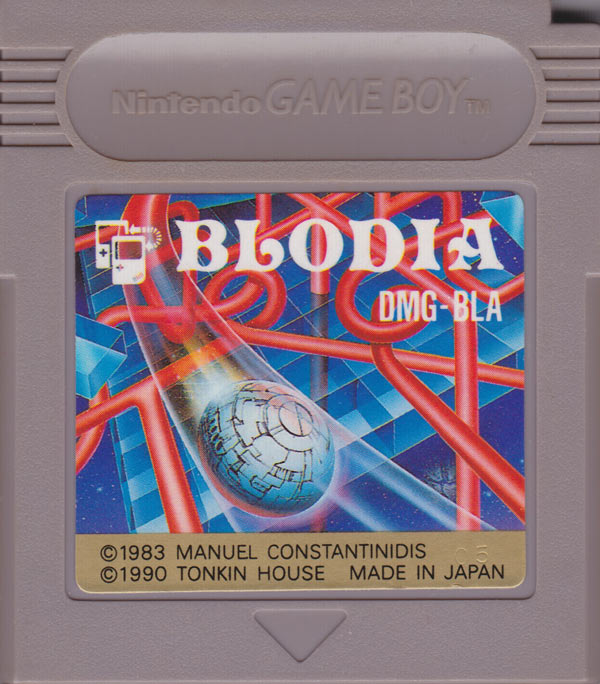
Blodia by Tonkin House was released in Japan only in April of 1990. Blodia is a puzzle action game. A ball travels through pipes on a board made of tiles. You control a black hole. You can move this black hole around, kind of like how when you play one of those sliding tile puzzles, you're actually moving a hole around.
Same idea. You put your cursor where you want the black hole to go, and it'll slide over to it. But it can only slide horizontally or vertically, and not across any obstacles. All this ball has to do is travel along all the pipe in the board. There's no actual destination you need to get to. That's why it was confusing for me when I started.
I couldn't figure out where am I supposed to go with this ball. No, you're just supposed to make sure it rolls through all the pipe. When you get near the edge of the screen, you'll see arrows appear. That means you can warp through, so you can actually warp. Let's say you hit the right side of the screen, you'll pop out the left, top, bottom. Same idea.
So what does this name Blodia mean? Well, it's actually just Diablo shifted over. Diablo was a game that was made by Manuel Constantinides. The history of this game is kind of confusing. I'm not sure what platform it came out on first. It might be the Sharp X1 or the Sharp X68000. It was definitely around on the Amiga, because I remember this thing.
I think it was called Diablo on the Amiga. Not the same as the Diablo PC game. This thing came out on the Commodore 64, the MSX, Atari ST, PC-88, PC-98, Texas Instruments, and the TurboGrafx-16. So on the TurboGrafx-16, it was called Blodia, and it was pretty much just like this Game Boy version, but it came out in English as Time Ball.
I looked at a package of the original Japanese one for the Sharp. It was 6,800 yen. That's like 120, 150 bucks nowadays. There's no reading to do in this game, so the Japanese thing is not an issue. Instead of music, they're just kind of a clicking TikTok sound. Now, they actually made this Blodia ball thing into a character.
When the ball gets to the end of the tube, you'll see the ball falling down the screen, and then, if you're lucky, a parachute will open up. If you missed any pipes, a parachute won't open up, and you'll fall to your death, and, well, you won't fall to your death, but I think he gives you the finger. I'm sure he flips you the bird.
But if you land him safely, he gives you a little V for victory sign. You'll see right near the beginning, one of the first levels, there's a level where, in order to move all the pieces to get the ball to the end, there's just not enough time. You just can't move your cursor that fast. So what you have to do is move the pipes while the ball's still in it to get it to shift up to the next pipe.
This game comes with a level editor. You can make your own bloaty levels. As for the number of levels, I think there are 100 levels in this game, but I'm not sure because I didn't really get that far. I'm not really good at these types of games. If you have the mental capacity to handle tile puzzles and you like games where a ball moves through a pipe really slowly, then this game might be for you.
To find this cartridge, search for DMD-BLA. Dr. Franken, developed by Motive Time Limited, was released in Japan, US, and Europe in December of 1992. In Japan, it was published by Kotobuki Systems, in the US by Kemco, in Europe by Elite. You may not have heard of Motive Time Limited. They did Dragon's Lair The Legend on Game Boy, which is legendarily bad.
And in 1997, they would make Dr. Franken 2, and that's the only Game Boy games they made. It was actually a sequel. I wouldn't call it a port of this game because it looked so different. That came out in 1993 for the Super Nintendo. It was also called Dr. Franken. It had a different look. I'm not sure if the gameplay was the same.
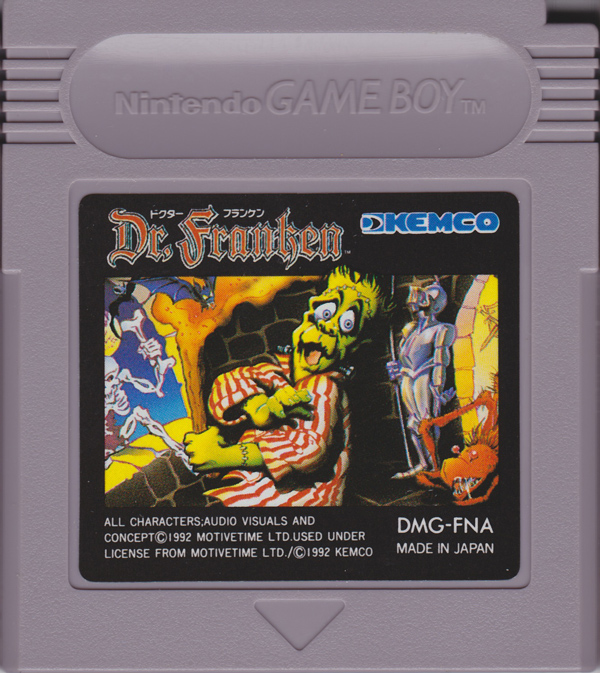
Dr. Franken is a platform game. You play Frankenstein's monster, and instead of the typical damsel-in-distress kind of thing where you have to rescue the damsel, in this one, you have to reassemble her from body parts. So it loses a point for being unoriginal, but gains a point for being gross. Unlike most platformers where you're just going from left to right to get to the end of the level, in this one, there's actually a map.
If you hit start, you'll see a map. To access rooms to the left or right, you can exit a door on the left or right side of the level. But to go up or down, you're going to see sometimes there's a door in the middle of the level, usually obvious door, or an icon that says exit. I guess that means there's a door on the wall facing away from you that you can't see.
Those will let you travel up and down on the map. Sometimes, it's not really clear where you should go, and it doesn't indicate if doors are locked or not. You just have to try it. I think part of the challenge of this game is just navigating. The rooms are incredibly detailed. These are not just plain, boring levels.
These are highly detailed rooms. They may not be the most beautiful things you've ever seen in the Game Boy, but highly detailed. They really go in like a bathroom looks like a bathroom. It's got a sink, and it's got accessories. If you hit Select, you're going to see a place where you can select Inventory, Save Game.
You can see your health and your lantern level. Lantern, you'll need later. Health is indicated as energy. When you pick up icons that look like lightning bolts, that replenishes your energy, because it's Frankenstein. It needs electricity or something. When you go to the Inventory screen, after the Inventory screen, you'll see a woman's body on an operating table all in pieces.
Those are the pieces you need to collect to make her a whole woman. Now, the items in your inventory, most of this stuff is just key and lock kind of stuff. Like, right at the beginning, you're going to have to find a book. If you look at the map, it's going to show you a question mark. If you can make your way to that room, you're going to get a key.
Nobody gives you this key, it just kind of happens. Now, you can jump in this game with the A button. If you stand still and jump, you'll jump a little higher, which is important for getting some power-ups and jumping up to some platforms. B is Attack. B will shoot lightning bolts, but it doesn't look like a cool Ghostbusters-style stream of electricity.
It shoots little lightning bolt icons. Back to the Select menu, you can also save your game. Be careful, because when you save your game, you quit. It gives you a big password. Only do that when you're really finished playing and you have a pencil and paper around, because it's a big one. You can turn off the music, too, which you'll probably want to do because it's the same loop over and over.
You're going to be encountering weird, weird enemies. Eyeballs and angels and ghosts and rats, slimes. Some of them can be killed, some of them can't be killed. You just got to try it. For the most part, you can avoid enemies. On the fourth floor of the mansion, there is a room where you can replenish your health as many times as you want.
And that's around the point where you start needing health a lot more. If you play it safe, you can get to that point in the game without dying. There's enough health power-ups around to keep you going. I was surprised, this was actually a pretty long game. I guess if you know where all the objects are and you have a map, it could go pretty quickly.
But I just found I was lost most of the time and just was running around shooting stuff and jumping on shelves. You can't really tell what's a platform and what's not sometimes. You just have to try it. You'll see a bookshelf, and sometimes it's made of platforms. Some other bookshelves aren't. Stairways, you can't just walk up the stairs.
You have to jump on them. Sometimes you just kind of fall through. And that's what's bad about this game. There's a sloppiness to it. The way the jump works, the way you run and jump, just doesn't feel right. And the frame rate is really, really low. It's very jerky. This is the kind of game you probably want to play in an emulator because you really need to be able to save any time, because those passwords are just killer.
They're just… For a relatively simple game like this, this is not an RPG, you'd think the password would be relatively short. Only get this game if you have a high tolerance for games that are kind of lousy, but weird enough to be interesting and keep you going. I found I had to kind of force myself to continue about halfway through because I just had completely lost interest.
I don't want to mention the weirdness too much because I had a look at Dr. Frank in 2, and that is extremely weird. It moves a lot quicker, and the animation is better, but I'll get to that someday. There's no reason not to get the Japanese version because the Japanese version is in English anyway. Japanese version is DMG-FNJ, US and Europe, DMG-FN.
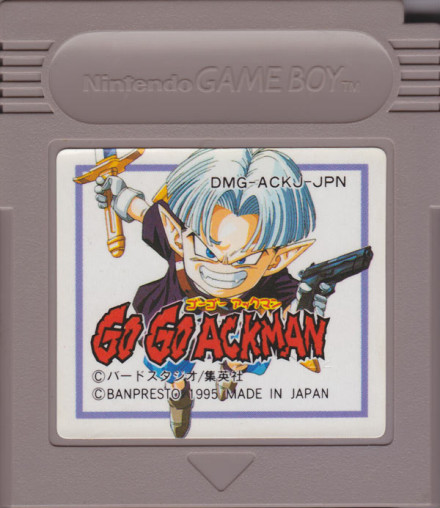
Go Go Ackman by Banpresto was released in August of 1995 in Japan only. This game is based on a manga series that ran from 1993 to 1994. It's about a 200-year-old demon child, goes by the name of Ackman, A-C-K-M-A-N. He's a soul harvester, he works for the Dark Devil Lord. This is a dark comedy, this character is evil, but that's kind of the point.
His friend is a red bat, Godon. He hangs around with Ackman and helps him gather the souls of the dead. Ackman's nemesis, Tenshi, an angel. Tenshi tries to stop Ackman, but ends up killing a lot of other people in hilarious ways. So Go Go Ackman on the Game Boy is a maze chase game in the style of Pac-Man.
In December of 94, there was a Super Famicom game called Go Go Ackman, but it was a platform game, and there were two sequels to that. Before you start the game, move left or right, and you can choose a skill level. The default is the lowest setting. Difficulty settings are represented by stars. When you start the game, you'll be in a maze of sorts.
It's a larger maze that you scroll around on. You play the titular character Ackman with your friendly bat in tow. You walk through the maze and gather souls. They look like little flames, and various creatures try to stop you. Now, since you're evil, all the creatures are good creatures. There are little kitty cats.
They're easy to kill. Flamenco dancers, women in bikinis, some guy in a fedora with sunglasses, some guy with spiky hair, and Tenshi, the angel. You can use A to punch. This will let you defeat any enemy except for Tenshi, the angel. Turtles are a special kind of enemy because they drop power-ups. If you do want to kill them, it takes a long time, but if you just want to get past one, you can just hit it once and walk right through.
Occasionally, you'll see a square with a flame on it. That is worth 50 souls. They're not required to finish the level. To finish the level, you have to gather all of the souls, those little flames, before the timer runs out. Those souls kind of act as health. When you run into enemies, you'll lose some of those souls.
If you get down to zero and take a lot of hits, you'll die. That doesn't really come up that much in this game because it's more about beating the timer. There's kind of a jump, but I didn't find it that useful. But your punch is also useful for breaking down walls. Not literally walls, but there are some things like sometimes a tree or a rock or even hospitals can be destroyed in order to access certain power-ups or sometimes there are areas that are blocked off.
There's no way to know except just try punching some and see what happens. Once you've collected all of the souls on the level, you'll have a meeting with the Dark Lord Satan. If you've done a perfect job, you've collected all the souls, you didn't take one hit, Satan will be very happy. He'll be there with a martini and congratulate you.
If you lose a lot of souls, he'll look very disappointed. If you get most of the souls, maybe you took one little hit, he'll be okay with it. It's all about helping Satan. I wonder why this didn't get translated to English. We'll never know. Speaking of translation, there is absolutely no reading in this game.
If you let the timer run out, don't worry because you can continue your game. However, your score resets to zero if you care about scores. There are 20 levels altogether. After level 20, it starts back at one with a higher difficulty setting. Although you can continue as many times as you like, there are no password saves.
You gotta play this in one sitting. Enemies regenerate when they scroll off the screen. So let's say there's a corner you want to get into and there's an enemy in there kind of blocking the way. If you kind of walk away and come back, with any luck, that enemy will be gone. Occasionally, you'll see an object that looks like…
It kind of looks like a bull, but it's supposed to be the bat, your bat buddy's face. If you'd pick that up, that bat will pick up all the souls on the screen. So if you see that icon, go straight for it and get it first so you don't waste your time collecting souls that you don't need to. There are little timer objects all over the place.
You grab these timers, the timer stops and the enemies freeze. But the enemies will still hurt you, so you can't just run into them. But you can punch them. When you defeat enemies, they just reappear very nearby anyway. So don't waste your time trying to beat up a lot of enemies because you're just wasting time.
You're really… this is really about beating the timer. Another object you'll find, something that looks like Ackman's face. That will make you invincible for a short amount of time. A few levels in, you're gonna get to a level that looks sort of like a beach area with palm trees. When you get there, try double tapping the D-pad.
Now you've got a dash. This is critical to gameplay because later on, the time limits are gonna be really, really tight. So you're gonna need this dash thing all the time. I had a very sore thumb playing this game because I was just dashing everywhere as just double tapping madness. A little bit later, now I wish I could explain how this works.
It's like when I play fighting games, I don't really know how I'm doing the moves. I'm just kind of doing it. There's something you can do with the punch button and the double dash that makes you do kind of a slide. You can slide right through enemies and damage them. Like if you slide through the cats, it'll kill them.
Nice. There are later levels where you just get these long lines and you just have to keep dashing, dashing, dashing. If you time it right, you can keep doing that slide as far as you can go. Well, I just kind of hit the button repeatedly and the slide just kept going. You'll just have to try it to see how it works.
I just can't explain it. I really enjoy this game. There are so many situations where games that were released in Japan only are really not that great and that's the reason they didn't bring it to the rest of the world. But in this case, I think it's just the demonic content is the reason it stayed in Japan.
American kids just weren't ready for this sort of thing. This game is not really common, but it's also not rare. If you like arcade action games like Pac-Man, this is a must-get for the Game Boy. Go, go, Ackman! Search for DMG-ACKJ.