The final episode of Game Boy Crammer with reviews of Nemesis, Robocop 2, Duck Tales, Master Karateka, Karakuri Kengou Den Musashi Lord, The Empire Strikes Back, Judge Dredd, Rubble Saver 2, Lolo, Final Fantasy Legend 3, The Lost World – Jurassic Park, 1942, Nemesis 2, Lucky Monkey and Maru’s Mission.
My name is Ray Larabie and I’m talking to you from Nagoya, Japan. Welcome to the 51st and final episode of Game Boy Cramor. In this episode I’ll be reviewing Nemesis, Robocop 2, Duck Tales, Master Karateka, Katakuri Kengouden, Musashi Lord, The Empire Strikes Back, Judge Dredd, Rubble Saver 2, Lolo, Final Fantasy 3, The Lost World Jurassic Park, 1942, Nemesis 2, Lucky Monkey, and finally Maru’s Mission.
We’ve got a long show, so let’s get it started. Nemesis, developed by Konami, was released in Japan in February of 1990, April 1990 in the US, and 1991 in Europe. Nemesis is a side-scrolling shooter. You’re flying a spaceship through caves, shooting, collecting power-ups, destroying bosses. This series is better known as Gradius, but you can trace it all the way back to Scramble from 1981.
Scramble was the game that inspired all these games. You were dropping bombs, shooting, it’s the spiritual predecessor. A lot of the Gradius games are not really connected story-wise. For example, Salamander from 1986. It’s kind of in the Gradius universe, but it’s not a Gradius game. On MSX Gradius 2, also known as Nemesis 2, the ship you’re controlling is not Vic Viper, it’s something called Metallion, and then there was another Gradius 2, so all through the series Nemesis and Gradius are used interchangeably and in strange ways.
So this came out in 1990, this is a very early Game Boy game, and the first thing you’ll notice when you start playing is, it’s smooth. The graphics look good, there’s a little sprite blanking, but not much. Very little in the way of slowdowns, even though there’s a lot going on on screen. As is typical in these Gradius games, you have a fire button and a weapon select button.
As you collect power-ups, you’re able to select different weapons at the bottom of the screen, including, starting at the bottom you have S, which is your speed, M is missile, D is double shot, L is laser, O is option, and F is shield. You can’t have double shot and laser at the same time, they’re both exclusive.
So pick one or the other. Personally, I’d pick laser because the laser is very powerful and will go through a line of enemies. But the trade-off is, the sound is really irritating. An option is a floating orb that floats around outside your ship, it can be used as a shield, and it also doubles your firepower.
Whatever weapon you have, those options will have. And the shield, I’m not sure how many hits it’ll take, it’ll take a lot of hits. I found the best strategy was to get the missile first, because then you’re going to hit a lot of ground targets, which will let you get more power-ups, then get either the option or the shield.
If you get hit once, you’ll lose a life and you’ll lose all your power-ups, you start from the beginning. So there’s no point loading up all the power-ups and then dying. Go for that shield, then work on everything else. I don’t bother with the speed, because I kind of like going slow, I need a little bit more precision in this game, and there’s not a lot of stuff you need to navigate quickly.
At the beginning of the game, you have an option which level you want to start on, and you can load up as many lives as you want, up to 99. You can choose auto-shot or turn that off if you like pressing the button fast. And you have two difficulty settings at the beginning. After each level, there’s a boss, and there’s kind of sub-bosses in between.
Usually before you get to the boss, there’s going to be a sub-boss. For example, at the beginning, the first boss, you’re going to have a volcano that is just kind of hassling you. You can’t do anything to it, but you have to survive it, and then take out the boss. There are only five levels in this game.
Or are there? Somewhere in this game, there’s a secret level. You can access it through stage four, I won’t tell you where it is, you can easily look it up, or you can just try to figure it out on your own. I wouldn’t call it a secret level, but it’s a stage. There are no continues in this game, and no save game, but you don’t need it because you can start on any level you want, and start with as many lives as you want.
If you’re a veteran of Gradius games, you’re not going to find this game super challenging. Actually, I think it’s the easiest Gradius game I’ve played. If you’re not that good at shooters, you’ll probably like this one. It’s not really frustrating, and the bosses are pretty easy to figure out. You don’t need to know any tricks to defeat the bosses.
The music in this game is wonderful, it’s just Gradius music. If you play it, I think you’ll agree, this is an amazing game for 1990, and it makes a lot of other side-scrolling shooters from that era look pretty bad. It doesn’t matter if you get Japanese, US, or European version, they’re all the same.
For the Japanese version, DMG-NMA, for the US and Europe, DMG-NM. Robocop 2 was developed by Painting by Numbers. It was released in the US in November of 1991, and Japan in March of 1992. It was published by Ocean in the US, which usually means it’s going to be lousy. So Painting by Numbers, who is Painting by Numbers?
This is a very short-lived company, it was around from 1991 to 1992. They made Robocop 2 and Hook for Game Boy. They also made the NES version of Robocop 2 and the Commodore 64 version of Robocop 2. Robocop 2 is a run-and-gun platform game, or rather a walk-and-gun platform game. Other than that, it doesn’t really relate to the first game at all.
First game had pretty good platforming parts, and kind of mini-games where you have a targeting reticle and all kinds of stuff. In this one, you’re going to be walking across platforms and doing a lot of jumping. It’s a strange choice for Robocop, because Robocop doesn’t do a lot of jumping in any of the movies, although it does fly in Robocop 3.
Robocop can shoot, but he can’t shoot on an angle or straight up. Now this was kind of the point of Robocop, is Robocop is really good at targeting. He’s got a gun that shoots in kind of a spectacular way in the movie, and in the first game it does too. It has this really satisfying, fun gunplay. In this one, Robocop can only shoot straight ahead, and there’s kind of a time delay when you press the fire button.
The bullets just look like little dog feces, and you can only shoot two shots at a time, which can be a problem when you end up shooting these nuke sellers. I’ll get to that in a minute. So jump and shoot, get to the end of the platform, but there’s a little more to it than that. You’re required to arrest a bunch of these nuke, that’s the drug in Robocop 2, nuke dealers.
They’re basically your typical hostage character with a two-frame, don’t shoot me, don’t shoot me animation. Well don’t shoot them, because you have to arrest a certain percentage of them. As for shooting other enemies, you don’t really need to. When they say other enemies, I mean other enemy. Well I guess there’s two.
There are enemies that are firing at you from windows, with a one-frame animation of them popping through the window and popping back out. A really simple timing element. There are guys who come up through a trap door in the sidewalk. Another timing element, they’re just on and off. And you get some guys that walk back and forth, sometimes jumping from platform to platform.
There doesn’t seem to be any AI with these characters, they just kind of follow a path. That may not sound so bad, but with the bad shooting and the lack of good targeting, the really difficult timing of the shots. Like I mentioned, these guys in the window are shooting at you. Well you can’t shoot at a diagonal in this game, so what you have to do is jump and shoot.
Which in some games isn’t that hard. But in this one, because of the delay on the bullets, it’s tricky to get the timing right. And Robocop moves so sluggishly, and the jumps are so slow, that it’s really hard to dodge any kind of bullets. You basically just walk into them. Luckily, it’s not a one-hit depth, you do have a health bar, you pick up cans of spinach or something.
In the movie it’s this nuke drug, I don’t know if it’s related to that, I think it’s just baby food. There are weapon power-ups once in a while with ridiculous weapons. Actually kind of funny. There’s one that kind of shoots three ways, and the animation is comically bad. The art work in this game is terrible.
It looks like it was drawn by, I hate to say programmers, but it was definitely not drawn by anyone who had any kind of art training. You’re going through a city that’s full of kind of white picket, criss-cross fences. White crates with no outlines. It’s hard to tell what’s in the foreground and what’s in the background.
And these crates have terrible collision boxes. You’re constantly, like if you kind of, the front of them seems to be okay, but the back it’s really easy to fall off. There are platforms where the collision doesn’t work and sometimes you just fall right through. It happens rarely, but it happens. There’s a health indicator on the screen and a number of nuke dealers you’ve captured, and a score.
Eventually you’ll come to a boss, which is the ED-209 robot. It basically just fires different projectiles at you, you just have to jump up and down, shoot it in the legs is the trick. The first one isn’t that hard, later in the game you’re going to get one that is practically impossible. Every level, once in a while, you’ll get a sliding tile puzzle, a four by four sliding tile puzzle.
They show you the picture, then they scramble it up. Now I’m not good at these puzzles, and there’s a time limit. So what I did was I drew a little grid on a piece of paper, waited for it to come up, and then I, when they actually scramble it up, I followed the line and traced it with a pen. And then I could kind of work it in reverse, and when I solved the puzzle, nothing happened.
I mean maybe something hidden happened, but there was no bonus, there was no sound or anything, it was just done and on to the next level. It is among the worst Game Boy games I’ve ever played. Avoid DMG-R2-USA or DMG-R2J-JPN. Disney’s DuckTales by Capcom was released in the fall of 1990 in Japan, US, and Europe.
It was re-released in the US by THQ in 1992. DuckTales is a platform game based on the animated series that ran for four years from 1987 to 1990, and there was a movie, The Treasure of the Lost Lamp. It was hugely popular. This was Disney’s return to animation on TV. Except for a few Disney specials, it had been decades since there was much original Disney animation on TV.
Like, pretty much from my entire childhood, all I saw from Disney was old cartoons. And it was around the time of a big comeback for Disney. Disney had been lagging behind, you had the Black Cauldron, Oliver & Company. This was around the time The Little Mermaid came out, and their animated films are really starting to shine.
This game was also on the NES. The NES version came out a year before. It’s pretty much the same thing. It’s not exactly the same, but it’s basically the same game. You’ll be playing Scrooge McDuck. It’s a platform game. You’re going to be jumping around and collecting things. When you start the game, you have a choice of three different skill levels.
Then you can choose between five stages. Amazon, Transylvania, African Mines, Himalayas, and the Moon. If you complete all these levels, you’re going to go back to one of these levels. I won’t tell you which, and then you’ll have a final boss battle. There’s no save game in this. You’re going to have to do it in one shot.
But since you can play any level you want, you can practice each one so you can just do them all in one run. You’re going to be collecting treasure in this game. There are different types of diamonds worth different amounts of money. Doesn’t matter. You’re going to collect them all anyway. There’s some hidden treasures worth a lot of money.
Sometimes you just jump around and they just appear out of nowhere. Sometimes they’re hidden in statues. You never know. You just have to try stuff. Now this is not an instant death game. You have a health bar. If you find a star, this will extend your life energy by one unit. You start off with three.
If you find an ice cream cone, this will restore one health unit. If you find cake, it will restore the whole thing. If you find a little U, little Scrooge McDuck, that’s a one-up. If you find a medallion, that will make you invincible for a few seconds. A is jump. B is golf swing or pogo jump. If you walk up to an object like a chest or a boulder, hold B down, you’re going to do a golf swing and hit that object.
You can use this to launch objects at enemies. But don’t just tap B, you have to hold it down. If you jump and then hit B, you’ll do a pogo jump. This is how you defeat enemies. You’re going to be jumping and doing that B pogo jump, not only to destroy enemies, to destroy objects like boulders or chests, and you can use it to get across difficult terrain.
For example, spikes. You can pogo across that. But there’s some places your pogo won’t work. For example, in the Himalayas, there’s snow and you just get stuck in the snow if you try to pogo in it. Pogo also lets you jump higher, so there’s a lot of areas you can’t get to unless you pogo. The levels are not completely linear.
The boss is not at the end of the level. That gives the game a little longevity because this gives the game a little more longevity because you need to practice these levels, if you don’t have a map, to figure out where everything is. There’s some key lock stuff that happens. If you start with the African Mines level, you’re going to find out right away that you need a key and it’ll send you back to Transylvania to get the key.
That’s the only time that happens. Other than that, you can start on any level you want. The music in this game is pretty good, especially for such an early game. The animation is top notch. Everything just looks really great. They really did a good job with the characters. Like it all looks like Disney stuff.
The only thing is, if you’re a hardcore platform gamer, you might find this one a little too easy. If you’ve never played it before, you probably won’t finish it in a half hour or anything like that because, like I said, the levels are not that linear so you still have to explore. But it’s probably not the kind of game you’re going to pick up and keep playing for years and years.
It’s kind of a short ride. But all around a good solid game, and there was a sequel to this game too. If you get the Japanese version, the story text is in Japanese and there’s a lot of stuff where you kind of want to hear the hints from the characters. But on the other hand, the Japanese version is kind of cheap.
For the US and European version, look for DMG-DT. For the Japanese version, DMG-DTJ. Yes! Awesome! You have exciting adventures helping Scrooge McDuck escape danger and become the richest duck in the world. Cool! Totally hot! Way radical, man! Excellent! It’s a quacko! Oh! Disney’s DuckTales game for your Nintendo Entertainment System by Capcom.
Master Karataka, developed by Tose, published by Bandai, was released in Japan-only in December of 1989. It might have been the first beat-em-up on the Game Boy. I’m not sure if Double Dragon came out first, but it’s an early one for sure. This is a port of Karataka that came out first on the Apple II in 1984, and then was ported to the Amstrad, the Atari 8-bit, Atari 7800, Atari ST, C64, DOS, Famicom, ZX Spectrum, and MSX.
It was developed by Jordan Mechner, who later went on to make Prince of Persia. It was kind of unique at the time, because it was a fighting game. I mean, you just didn’t see that kind of game in 1984 much, but it certainly wasn’t the first beat-em-up. What was remarkable about it at the time was the graphics.
They had this very realistic-looking animation, and the bodies weren’t just cartoony. They were… they looked realistic. I mean, the shading wasn’t realistic, but the forms were realistic. Karataka is a very short game. There are only four levels, but they’re very, very difficult. You’re not going to be running around, you’re not going to be jumping, you’re not going to be doing combo moves.
Here’s all you can do. You have a normal stance and a fighting stance. Your normal stance, you’re basically just running around. You can use the B button to bow to your enemy. That seemed to have a purpose in the original version, and this version doesn’t really seem to do anything. If you push down, you go into a fighting stance.
So really, the only time you’re going to use normal stance is for running. So in your fighting stance, you can move left and right. You can push up to go back into your normal stance. However, if you are engaged with an enemy, it does a high block. If you’re engaged with an enemy and you push down, you get a low block.
B button is punch. Punching doesn’t really seem to do much in this game, except for a couple of very specific instances where you had to hit something other than a human, hint, kicks seem to be a lot more effective. So you push D pad and up for a high kick, D pad and down for a low kick, with your A button, or just A button to kick.
You don’t have to press diagonals. You may have heard of a famous thing about this game, which is at the end of the game, when you rescue Princess Madiko, in the original game, if you didn’t go out of your fighting stance, it was game over. Out of your fighting stance and actually walk up to her. This one, you can just walk up during your fighting pose, no problem.
At the beginning of the game, you can distribute power for different abilities. You have power, life, and speed. I don’t recommend putting a lot of points into speed. It doesn’t really help you with fighting. I’m not saying don’t put any points into speed, but I tried playing the game by putting a lot of points into speed, and it really didn’t help me at all.
There are no lives in this game. When you die, it’s game over. There are no fancy power-ups, there are no continues, there’s no save games. It’s one of these games that’s not that long, but incredibly difficult. So you just have to play it over and over until you get it right, and there’s a few things where you have to memorize.
There are some projectiles that will come at you that you can’t really predict and don’t have enough time to react to. This game is not for everybody. If you’re into fighting games, you’re going to find this character so limited. This game is really more for people that are interested in the history of Karataka, or for people that are nostalgic for Karataka.
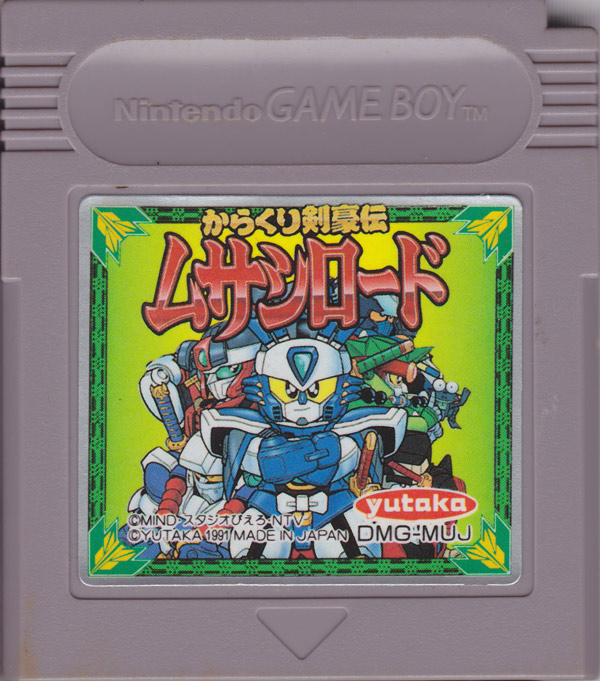
Master Karataka, Japan only, DMG-KRA. Katakuri Kengo Den Musashi Lord, developed by Tose, published by Yutaka, was released in Japan only in April of 1991. This game is based on an anime that ran for a year from October 90 to September 91. It takes place in a samurai world with robots. You play the main character, Musashi, the samurai robot lord.
You might see the title of this game written with road instead of lord, because the katakana for road is the same as lord, but it really is lord. This is a top-down maze game. I guess more of an action-adventure game, but it’s very maze-like. Before you start the game, you’ll have an option to put in a password.
The password is all in hiragana, and kind of long passwords, so you’ll have to write these passwords out in hiragana. So off you go on an adventure. Start walking to the right. That’s what you’re doing most of the time, is moving to the right. The map will scroll a bit until you get to the edge, and then it’ll load a new section.
So it’s a partial scroller. Use your B button to attack with your katana. The hit detection on your katana is very, very generous. You can swing that thing and not even be close to the target and still destroy it. At the beginning, you’ll encounter some wild pigs. They will hurt you. Kill those and get money.
If you see some random people walking around, just kill them. This game is all about murdering everybody. But who knows, they might just be robot pigs and robot people, so it’s okay. You’re gonna come to a village pretty soon, a village that looks a little bit like a maze. In this village, you’ll see two kinds of houses that you can enter.
One of them will give you a choice of food to eat, and you’ll see one of them will regain your health. It doesn’t seem to do anything at this point in the game. When you get to another type of building, you’ll just get some storyline, and then it’ll go away, and then you can’t enter it anymore. You have to enter those buildings in order to finish the level.
If you just skip past those and go to the end, you’ll find that it’s locked. I’m not sure if you have to get every single one. I did, just to be sure, but I think you have to get every single one of those. You’ll notice some of the walls look different. The lines on the roof tiles are a little closer together.
They look kind of darker. Those walls are destroyable. Sometimes randomly, when you destroy a wall, a card will show up. Be careful not to hit the card with your sword, it’ll just fly off the screen. This card will give you some kind of good fortune. Sometimes it’s an old man who gives you a map of the level.
It’s not really a useful kind of map that doesn’t actually show you how to get through the maze, but it does show you if you’ve missed any of those houses that are required to complete the level. Sometimes when you get a card, you’ll encounter a fella who wants you to chop a log. Not really chop it, just hit it.
Sometimes he just wants you to hit it 50 times, so just whack that B button as fast as you can. Other times you’ll see a finger pointing to different parts of the log. You have to point in the opposite direction of the finger and hit your B button really fast. If you succeed, something good happens, I guess.
I wasn’t really paying attention. And some other things will happen when you pick up these cards. I assume they’re all good things. You’re going to find some heavy blocks that can be moved. After you move them, those blocks are destroyed and can’t be moved anymore. So this is a sliding the blocks kind of puzzle sort of thing.
That’s mostly what this game is all about, is getting through mazes and sliding blocks around. Because the enemy fighting never changes, basically the enemies that you fight in this first level are basically what you’re going to be fighting for the rest of the game. Oh sure, they’ll be a little harder to beat.
Later on they’re going to shoot guns at you at close range. Very, very minor differences. Even the bosses are basically those guys moving a little faster and jumping. When you do manage to get all the way to the end of this level and you’ve gone into all the houses, you can exit the level and you’ll encounter a boss.
When you’re fighting the boss, you can use the A button to jump. That might be useful towards the end of the game, fighting some of the more irritating bosses. But with this guy, and the one after that, basically you just stand there and let them run into you and hit your sword really fast. There’s no point really moving and chasing after him, he’ll just run into your sword.
On the next level, you’ll have a few pigs to fight, a few people to fight, you’ll cross a bridge, you’ll find another town with all the same stuff. Once you clear that level, you’re going to fight a boss and then you’ll get another level that’s the same thing. Oh, there’s some arrows firing at you at the next one.
After that, more of the same and more of the same until you finish the game. Basically nothing changes, except at one point you’re going to have a friend that’s going to join your party. So you can switch between yourself and this other character. This other character has its own health bar. As you’ve been playing the game, you’ve been getting a longer health bar.
So having this other character isn’t really a big advantage, but at the end of the game, it’s just handy to have an extra character to give you a better chance at defeating the final boss. All in all, this game was painful to play. It was completely monotonous, the battles were just a matter of pushing a button a few times, the AI of the enemies was non-existent, and everything was just the same, same, same.
Oh, and some of these sliding block puzzles, you can actually lock yourself in, you have to reset the game. It happens a lot, so be very careful if you do play this, but I don’t recommend that you do. In Japan, this game is really cheap, it’s usually in the bargain bins. I recommend avoiding it, but if you do want it, look for Katakuri Kengo Dan Musashi Lord, DMG-MUJ.
Star Wars, The Empire Strikes Back, developed by NMS Software, published by Ubisoft, was released in January 1993 in the US, late 92, early 93 in Europe, was not released in Japan. NMS Software is the same developers that made Star Wars, and there are a lot of similarities. For one, there was an NES version of this game.
It’s not exactly the same as the Game Boy version, but it’s very similar. This game is for the most part a platforming game. In this game, you’re playing Luke Skywalker, and it follows more or less the order of the movie, although not the exact storyline. The game starts off on Snowy Hoth. You’re riding a tauntaun.
You can jump and fire your blaster. The blaster fires in eight directions. Shooting on 45-degree angles is difficult because you can’t stop yourself from moving. Right at the beginning, you’ll have these probe droids attacking you. There’s no real need to tangle with most enemies in this game. You need to destroy some of them to move the story along, but a lot of them you can just bypass.
So let’s say you want to fight this thing. If you want to shoot upwards and on an angle, you’ll keep moving in that direction as you’re firing. So you have to kind of fire a shot, move back, fire a shot. Sometimes you can get a couple of shots off on a diagonal, but it’s very difficult. Your blaster has unlimited ammo, so press the button really fast.
A lot of enemies in this game take a lot of hits. I didn’t count, but I’m sure it’s over 100 hits for some of these guys. You’ll find with almost all the enemies in this game, there’s a place you can hide where you can just kind of scroll off the edge of the screen and cheaply pick them off. The enemies in this game have no AI.
They just walk back and forth in a pattern. As you move forward on Hoth, you’re going to find a hole in the ground. When you go down in the hole, you’re going to find enemies that you can tangle with. If you want to get off your seed, hit select. To get back on, just jump on his back. It dies pretty easily and you can’t replace it, but you can complete the level without it.
As you’re exploring these levels, you’ll find some walls are breakable. Some of them look like ice cubes. Other walls are just nondescript. You just find out by attacking them. Apart from health power-ups, which look like hearts, you’re also going to find force power-ups. After you pick these up, you can access them by hitting the start menu, selecting and hitting A.
These will do various things. Make you run fast, make you jump higher, make you levitate. They’ll give your blaster more power, your lightsaber more power, and all kinds of stuff. Once you pick these things up, they stay with you for the rest of the game. But there’s a limit. At the bottom of the screen, you’ll see a force bar to the right of your health bar.
That can be replenished by grabbing items with an F on it or dying. Speaking of dying, you don’t get lives in this game. You do get continues. When you’re out of continues, you’re out of luck. There’s no save in this game. You’ve got to play it all the way through in one shot. I didn’t read any FAQs or anything about this game.
I just kind of jumped right into it. And I got really lost on the first level. I just kept going around and around in circles. At the bottom of the level, there’s a pit with acid or something. You fall into it, you die pretty quickly. And there are moving platforms on that. Well, if I went all the way to the left, I found a force power-up.
That’s okay. If I went all the way to the right, it just kind of ended and there was no platform anymore. I just kind of ran around the level. I stayed on there for a couple of hours, just going around in circles, exploring everything. So I did something. I don’t know what I did, but it activated that platform and the acid.
Then I got to the end and there was nothing. So I ran around the level a few more times. Finally ended up back there. I thought, oh, I think I’ll shoot at the wall. The wall is destroyable. And I got some force thing that I never ended up using anyway. You’re going to be doing a lot of jumping in this game.
There’s a trick to jumping higher. Push down and your character will start flashing. Now you can do a super jump. If you’re crouching and you super jump, not as high as if you’re standing and you super jump. If you’re running a super jump, even higher. So a lot of really high jumps, you need to push down sphere flashing and then do a run and jump.
Next thing you know, you’re piloting a snow speeder fighting at ads. It’s a side shooter. It functions a little bit like defender. You’ve got a radar thing at the bottom, just like defender, and you have to take out these at ads. Use your select or is it start? Maybe it’s start. Maybe it’s select. I forget.
That’ll launch a harpoon. Don’t waste any of those. You only have a few. Launch those at the at ads legs and it immediately takes them down. It’s not like some of these Star Wars games. You know the one on Nintendo 64 where it’s super difficult to wrap the harpoon around the legs. This one’s very easy.
If you crash or just land on the ground, you can get out and then you can run along the ground and shoot storm troopers if you want. Sorry, snow troopers. When you’re under an at ad, hit A and up. You’ll run all the way back into the distance via a grappling hook and take it down. But there’s no skill involved.
You’re just pushing up and A. You would think at ads would be the hardest thing to kill in this game since everything else takes a thousand shots. These things just take them out in one shot. Is this how difficult the enemies are going to be in this game? Am I just going to go up to Darth Vader and sue him?
After some more jumping and shooting, you’re going to meet some scout walkers. A.T.S.T. It takes a lot to take them out. Usually you can find a little spot to hide and just shoot at them a lot. Or you can use your lightsaber if you do have a lightsaber, right? You pick that up in the ice caves. I hope so.
You can use that to take them out pretty quickly. Now once you take them out, you can jump into them and ride them just like the Tauntaun, except this thing fires big laser blasts. However, if you get out of it, you can’t get back in. It just self-destructs. You’re going to need this to cross some difficult terrain.
There’s some kind of zappy electrical terrain that you can’t cross, but the A.T.S.D. can. You’re going to go to the Dagobah system to, of course, have a little chat with Yoda. And this level is where it finally starts to get really hard. The enemies are kind of difficult here, and it’s pretty hard to survive.
And it’s a big, big level. You’re never quite sure if you’ve been here before, if you’re going the right way. You see Yoda once in a while, but I just saw Yoda back there. How do you get over here? It’s like the characters at Disney. It’s like the characters at Disneyland. You know, you never see two at the same time.
If you can get through that, you’re going to be piloting an X-Wing on Bespin. You have to shoot a bunch of cloud cars and TIE fighters. It’s really easy, and you don’t usually see the enemies, you just see bullets coming in from offscreen. It’s neither difficult nor fun, but it actually looks pretty good.
When you get to Cloud City, it gets really difficult. You’ve got these big electrical beams. The only way you can get through them at the beginning is to walk exactly at the same time as R2-D2. He doesn’t shut them off. For some reason, these beams don’t hurt you when you’re walking beside R2-D2. I think because his head is reflective or something.
This is a level where you’re going to have to borrow one of these AT-STs to get through it. And, of course, battle Boba Fett, but isn’t actually that difficult if you can find a little spot to hide and just keep hitting him on an angle with your blazers. Not actually that hard. Back to more X-Wing action, except now you’re pursuing Boba Fett’s Slave I ship.
Just fly around a bit. Go near the Cloud City building, you’ll see his ship. Just follow behind it. Not to get hit by the bombs being dropped out the back. And that’s it. Boba Fett is doomed. I don’t remember that part of the movie. Hmm. Now, you go back to Cloud City and you’re going to get to a wall that you can’t jump up because it’s too high.
And then you realize, oh, there’s no way to get up this wall. So you go online, you look at an FAQ and you realize, oh, I guess I had to go get the levitation force power on Dagobah. But Yoda didn’t tell me that. Nobody told me that. I wasn’t required to complete the level. Now I’m completely stuck. Now, look, I don’t mind hard games, but one thing I can’t stand is hard and boring and confusing.
Why couldn’t Yoda tell me to get the levitation thing? I don’t know. The level is so huge, you don’t know if you’ve seen everything unless you have a map or something. Most of the other power-ups seem to be optional. Like the high jumping one doesn’t really help. It just saves you having to hit the charge on the jump.
And the running fast one was useful a couple of times, but optional. I really don’t see any redeeming qualities in this game except the graphics are pretty good. I guess the music is okay. To not even have saves on such a difficult game. Other games in 1993 had saves. I’m not even talking about battery saves, even just password saves.
And the enemies are so dumb and it’s so boring. And why would you make an enemy that takes a hundred shots and then make ad-ats die like flies? This game is just plain rotten, and honestly, it’s one of the worst games I’ve played on this system. And I love Vampire Strikes Back. It’s one of my favorite movies and definitely my favorite Star Wars movie.
But man, is this bad. And in Japan, this game is really expensive because it wasn’t released in Japan. Don’t spend any money on this poor excuse for a game. But the box does look cool, so if you want it for your shelf, look for DMG-EB. Judge Dread, developed by Probe Entertainment Limited, published by Acclaim, was released in the US in June of 1995, late 1995 in Japan and Europe.
Judge Dread is a run-and-gun platformer based on the 1995 video game Judge Dread for the Super Nintendo, Sega Genesis. This also came out in the Game Gear. Judge Dread is one of the UK’s most famous comic characters. It debuted in 1977. It’s about a totalitarian, dystopic future where dirty, hairy-like cops are also empowered as judges and executioners.
This game was based on the Sylvester Stallone movie that came out in the same year. In this game, you play Judge Dread, and as you can imagine, you’re going to be wielding firearms, shooting bad guys. Occasionally, you’ll be able to arrest a bad guy, but mostly just shooting and killing. On each level, you have a goal that you need to complete, after which you go to the exit, which is marked with exit, and push up, and you’ll finish the level.
There are primary goals and secondary goals. At the end of the level, it’ll tally them up and give you some points, and depending on your performance, it’ll give you a password. Now, I’m not sure about the password thing. Sometimes you get them, sometimes you don’t. But that’s your save game, and this game has passwords.
It seems like, potentially, you could play this game and do poorly and not get any passwords. But I couldn’t ascertain what the system was for passwords. A is jump, B is shoot, start is pause, select will cycle through different weapons. If you tap down while you’re not shooting, you’ll crouch. If you hold the A button, you’ll continue to fire, so you don’t have to keep pressing the button.
And you can fire in different directions. For some reason, you can’t fire in directions while you’re jumping. So you can’t, if you’re shooting upwards, and then you jump, you’ll start shooting horizontally, and then when you land back down, you’ll start shooting upwards again. I’m not sure why they did that.
It doesn’t really make sense why, I mean, if you can jump and shoot, why can’t you jump and shoot upwards? Seems like an oversight. Your regular bullets have unlimited ammo. You also have ricochet bullets, explosives. Now the explosives are important for destroying certain targets. Certain targets you can’t kill with regular bullets, and some of these targets are necessary to finish the level.
You have incendiary bullets, armor piercing, and heat seeking. These will actually auto-track enemies. And you’ll find these power-ups all over the place. Sometimes you get power-ups by destroying things, sometimes they’re just lying there on the ground. There are health power-ups that look like little hearts and bigger hearts.
On the top right side of the screen, you’ll see what type of weapon you have, and you’ll have a health bar. It’s a little hard to see the health bar, especially if you’re playing on a Game Boy in black and white. A little tough to see. In the Game Boy Color, it’s a little bit easier to see because it’s on the sprite layer, so it shows up in a different color.
There’s hand-to-hand combat. If you run into an enemy and hold your A button down, you’ll start punching and kicking automatically. But it’s really tricky because if you put yourself on top of a character, sometimes you’ll pull out your gun, sometimes you’ll punch and kick, but it seems like if you’re completely aligned with a character, you can’t really do much.
You have to kind of walk away and get out of alignment and then try to attack again. The character is very difficult to control. When you press left and right, your character doesn’t move immediately. It kind of has to accelerate and get into it, which makes it really hard. You know, I mentioned the hand-to-hand combat.
When you’re trying to align yourself with an enemy, your movement is so sluggish that it’s hard to get exactly where you want to go. There is a run. You just keep walking, and you’ll eventually start running, which helps you with jumps and makes the game a little bit faster. So double tapping down to crouch.
The problem with that is it’s just not quick enough. So if you’re trying to dodge an enemy’s shots, let’s say there’s a barrel or something in front of you and you want to kind of duck down, avoid some shots and pop back up, popping back up is really slow. So sometimes it’s just easier to just take the shots and just keep firing at the enemy than try to dodge it.
It makes the crouch not that useful. There are ladders on these levels. You’re looking at the side view of a ladder, so they’re a little hard to spot. Once you start playing it, you’ll get to spot them a little easier, but they just look like a one-pixel vertical line with one-pixel rungs going up, and you have to align yourself with them a certain way.
It’s not that hard. And you can shoot while you’re on the ladders. That’s nice. Once in a while, you’ll see a computer console. These are used to check your status. So you’ll have your primary goal and a percentage complete, secondary goal, percentage complete, and you can check your health and ammo, as well as how many lives you have left.
Some of these computer terminals are used to turn off switches or you need to deactivate them. The reason you want to deactivate them is to satisfy the primary goals of whatever level you’re on. The switches are used to turn off gates. These are like electrical fields or something, and you need to turn them off.
When you’re switching gates on and off, you can’t see which gate it’s turning on and off. And actually, there’s one level where it’s a pretty big level, and you’re turning off switches and opening gates, and of course, the other gate is as far as could possibly be on the opposite end of the level, so you’re constantly, it was just the most tedious level of running back and forth and guessing which gate.
The enemies take a lot of shots. They’re not difficult in that their AI is difficult, because they’re basically just walking back and forth, but some enemies require a lot of hits to kill, so you will need to use some of those alternate weapons to take them out, or just sit there and fire at them forever.
Jumping can be difficult because the platforms are kind of nebulous, and they’re kind of low contrast. They really tried to do a port of the Super Nintendo version, and sometimes when that happens with a lot of these games, Super Nintendo ported games didn’t have their own graphic style to them, so they actually tried to use the same look as the Super Nintendo version, make it black and white, reduce the colors, and then expect it to be playable on a little blurry screen.
I tried to play this game on a Game Boy. I tried to play it on a Game Boy Color. I eventually had to play it on an emulator, because I couldn’t see what was going on. Especially some of the power-ups. You’ll see these heart power-ups that are just meshed in gray pixels. So many times I just found power-ups by just walking into them, it’s like, oh, I guess I stepped on a power-up.
Nice. There is a shield power-up that makes you invincible for a few seconds, but most of the time I found those by accident, and I just didn’t see them. There are some games that are bad because they’re unplayable or really frustrating, and you just can’t get through them, and there are other games that are just playable enough that you can just keep continuing to play, yet the gameplay is completely monotonous.
This is one of those games. It’s not that hard, although it does get ridiculous near the end. It’s just kind of the same level of boring all the way through. There are very few enemies. There’s a lot of backtracking through levels, running around, trying to figure out what thing you missed. There’s nothing to indicate where these primary objectives are at any point.
You just have to kind of run everywhere and try to guess. The jumping is pretty frustrating. There is a jetpack once in a while, but it’s so rare, and it runs out pretty quickly. The graphics are very detailed, but to its detriment, and the animation is really chunky. There are very few enemies in the game.
You’re going to be seeing the same enemies all the time, the same few objects, and mostly the same sets. The Japanese version of the game is exactly the same as the English version. Everything’s in English anyway. I recommend avoiding this game. By playing the first couple of levels, you might be fooled into thinking it’s getting good, but it’s such a watered-down version of the Super Nintendo version that absolutely no enjoyment can be obtained from this game.
It’s only for serious Judge Dredd collectors. For the US version, DMG-AJDE, European, DMG-AJDP, Japanese, DMG-AJDJ. Rubble Saver 2, developed by A-Wave, was released in Japan in March of 1992. It was released in Europe as Max later in 1992. It was not released in the US. This is a sequel of Rubble Saver.
Rubble Saver came out in Japan in 1991. It was called The Adventures of Star Saver in the US and Europe. So for some reason, the name changed in Europe and no US release. This is a lot like the original Rubble Saver. It’s just you running around in a robot suit. When the robot suit is destroyed, it’s just you running around.
Next time you take a hit, you’re dead. Except in this case, you have three levels of damage. The first time you get hit, it just knocks the canopy off your robot. Then the next time you’re running around, so you got a little bit of extra leeway there. In the original game, you had a jet pack and a grappling hook.
In this one, you get to use them a lot more. You’re going to see power-ups that look like little rocket packs, and you’ll see at the bottom of the screen, it’ll indicate how many you have. When you fall off the screen or fall into some water, your jet pack will kick in and you’ll just fire right across the level.
Sometimes you can actually use this to kind of cheat your way across difficult parts of the level, Kirby style, which I guess was a new thing in 1992. And the grappling hooks. In the first game, grappling hooks were kind of a last-ditch effort that sometimes didn’t really kick in when you wanted them to.
In this game, you’re going to be using these grappling hooks all the time. All you do is you press up and the grappling hook is used, and you can use it as many times as you like. It’s a little bit like Bionic Commando in that you’re going to be using it a lot to solve problems, like if there is a bee flying around and you can’t get the right angle, jump a little bit, get your grappling hook into the ceiling, wind your way up, and then shoot it from that angle.
And what would a platform shooter be without different weapon power-ups? In this one, you have your regular gun. There’s no ammo in this game. Shoot as much as you want. You have the regular gun. You have a regular gun that shoots on an angle and straight ahead, so it shoots straight ahead and on a diagonal.
Very useful, and it lets you defeat some of the puzzles that normally you would have to use a grappling hook to shoot something. Well, this way you can kind of just get underneath it and kind of beam it on an angle. I think there are eight stages in this game. When you start the game, you can choose from three, and you have a limited number of lives.
On the level select screen, it looks like a solar system. If you finish all those, you’ll get to go to a different level. It’s not indicated on that map, which you’ll need to defeat to finish the game. At the end of each of these stages is a boss. There’s no big mystery to him. You just have to shoot him a bunch of times.
If you fail, it sends you pretty far back, but it gives you a chance to power up your weapons and try again. The music is excellent, maybe better than the first game. There’s no save game. There are continues. When you run out of continues, it throws a bonus continue at you. I’m not sure if you get that automatically or you have to do something to get that.
This game is a lot less frustrating than the original. In the original one, it was very easy to die. In this one, you can just keep going and going. I wouldn’t call it super easy because it does ramp up, but it’s just more fun. You’re not going to find yourself wanting to crack the cartridge in half as much as you did with the first game.
The original game’s frame rate was not so great. It was a little choppy, and the graphics were a lot more dark and less detailed. I think the robot’s a little bigger in this one. I didn’t compare them side by side, but it just looks better. There’s no Japanese to read in this game, so there’s no reason not to get the Japanese version or any other language.
The only problem with this game is it’s not that cheap. It’s not a really common game. I’m really surprised this thing never came out in the US, because for 1992, it’s a really good game. If it had come out, it would have been one of the top platform games for the system. Maybe it was just the unappealing game didn’t do well in meetings.
I still don’t know what kind of rubble you’re saving. It’s a must-have. Rubble Saver 2. Look for DMG-KVA and for the European version, MAX DMG-KV. Lolo No Daibouken, developed by HAL Laboratories, was released in Japan in March of 1994. In Europe, it was called The Adventures of Lolo and was released in 1995.
Lolo was HAL Laboratories’ mascot before Kirby. It goes all the way back to the Egerland series. It was a game called Egerland Mystery. The star of the game was Lolo, a blue ball. He had to rescue the eldest daughter of the royal family, Lala. His rescuing was done by clearing levels consisting of pushing blocks around.
This is a puzzle game where you push blocks around. To clear each level, you have to access a key and then go through a door. Egerland Mystery came out on the MSX. In 86, there was Egerland 2. In Japan, it was called Meikyuu Shinwa, The Labyrinth Myth. In 87, Egerland came out on the Famicom and two sequels to that in 1988.
Adventures of Lolo came out in 89 for the NES, then Adventures of Lolo 2, Adventures of Lolo 3. Confusingly, Adventures of Lolo in Japan is Adventures of Lolo 2 in the rest of the world. Adventures of Lolo 2 in Japan was Adventures of Lolo 3 in the rest of the world. And then we get to this one, Lolo no Daibouken, or Lolo’s Great Adventure.
This is not a port of the NES version. Adventures of Lolo has nine stages with various themes. Each stage has five levels. You get a password save and there’s a little storyline at the beginning. Use your D-pad to move around. Use your A to push objects. Certain objects can be pushed and you can actually shoot them.
Right near the beginning you’ll find these little seahorse things. You can use your A button to turn them into a ball and then you can shoot that ball. I won’t explain all the elements because they’re introduced gradually as you go through the game, but the difficulty ramps up a lot. Once you do the first five levels, it starts to get hard.
There’s no time limit to complete the level. There’s no limit to how many times you can try. There are no lives in this game. If you hit the B button, you can give up and try again. Or hit select and you can get a hint. It’s not just pure strategy, there’s a little bit of action involved because sometimes there are parts where enemies are moving back and forth and you can time your move so you don’t get shot by them.
The first level of the second stage, you’ll see what I mean. There are two enemies on either side of the screen and if you are aligned with them, they will whip a stiletto at your head. That’s about all I can say about this game. It’s a very good push the blocks kind of game. It’s a type of game that there’s no shortage of on the Game Boy, but this is Howl Laboratories.
You can’t go wrong with Howl. The quality is top notch. If you get the Japanese version, you will miss out on the wonderful storyline and you might not be able to read the hints. For the Japanese version, Lolo no Daibouken, DMG-LOJ. For the European version, Adventures of Lolo, DMG-LO-EUR. Final Fantasy Legend III.
In Japan, this was called Saga 3, Jikku no Hasha. It was released in December of 1991. In the US, it was called Final Fantasy Legend III, not the Final Fantasy Legend III, and it was released in September of 1993. Like the first two games, it was re-released in 1998 by Sunsoft. Like the first two games, this is not really a Final Fantasy game.
It was made by Square, but it’s a rebranded version of Saga. This is not completely different from the first two games. You’ve got the same classes of the last game. Human male, human female, mutant male, mutant female, robots, and a bunch of monsters. You can actually tell that around the time this game came out, it’s a little bit like Final Fantasy III, a little bit like Final Fantasy IV.
You can really feel the era that this game came from. Here’s something unique. On the overall map, you can jump. You can jump over holes in the floor. The holes will usually take you down to another level in a dungeon, but also, if you want to reduce random encounters, you can just hop all over the place.
And here’s something different. The health that your character has affects its speed. Lower health characters are slower. A huge difference in this game compared to the first two is your weapons don’t wear out. In addition to armor, you have these two extra slots, which I guess is a little bit like Final Fantasy IV, where you can have like a belt or a feather or something, and it just affects your stats.
In the first couple of games, monsters could eat meat to turn into different monsters. Still true in this game, but now anybody can eat meat, and you can install robot parts, which is basically like eating robot meat, and you can turn into different types of robot. You can be a human that turns into a monster that turns into a robot that turns back into a human.
It’s all over the place. I found that that was a problem in this game because it’s really easy to accidentally say yes when it asks you, do you want to eat this meat? And you’re a human that you’ve been playing the whole game, all of a sudden turns into some kind of creature, losing all of the stats and you can’t use the weapons you’ve got.
It’s really easy for this game to go completely out of control, and you just got all kinds of monsters and robots happening, which is kind of fun, but frustrating too. Another thing that they added is auto. You can set your supporting characters, not your main character, but your supporting ones can be set to auto, so they’ll automatically attack or use items or use magic whenever they feel like it.
This is really handy if you want to set up a healer kind of at the end of your party just to heal everything and you don’t really want to have to go through the motions of healing all the time. You can give them a lot of healing abilities and just set them on auto and just let them auto heal everybody.
They actually do a pretty good job of auto healing, but this auto thing kind of makes it too easy. It’s very tempting to just set everything on auto and grind. That’s what happened when I first played this game back in the 90s. I turned off my brain, put everybody on auto and just ran around beating up monsters.
In fact, there’s a part right in the beginning of the game where there’s a simulation room where you can go and fight monsters consequence-free and just keep leveling up your characters, no risk. When I recently played this thing, I leveled up my characters like crazy, just watching TV and just playing on auto, just going, fighting monsters, going back to the inn over and over.
The amount of money I had was ridiculous, it was like I could buy almost anything in the game. This kind of cheap grinding is something you really couldn’t do in the first game. I did like the storyline in this one because it reminded me a bit of Chrono Trigger. You have the ability to go from present to past to future.
I always like that kind of thing, but I do recommend getting a world map or something because I really got lost in this one. The artwork is really good in this game. They really improved it. You can actually see your characters in battle. They got these cool little battle animation things. It’s pretty impressive for a game that came out in late 1991 in Japan.
The Japanese version is the same. Apparently the storyline is different and there’s actually a translation of the original saga ROM for Final Fantasy Legend III, if you really care about that kind of authenticity. You can save anywhere in this game. Of course it’s an old game, the battery will be dead, you’ll have to replace it.
I did like this game, but I would play Final Fantasy Legend II first, because I do think it’s the better game. If you want the Japanese version, Saga III Jikku no Hasha, DMG-OSJ. For Final Fantasy Legend III, the original or the 1998 re-release, DMG-OS. The Lost World Jurassic Park. The Lost World Jurassic Park, developed by Taurus Games, published by THQ, was released in December of 1997 in the US and Europe.
It was not released in Japan. This is of course based on the sequel to Jurassic Park, The Lost World. This is a platform shooter, it’s a run-and-gun game. You can use various weapons or hand-to-hand combat, or hand-to-dinosaur combat. And when you jump up to a ledge, you can grab the edge of it and pull yourself up.
There are eight levels in this game. To complete each level, you have to collect a certain number of items. Eggs. If you look in the bottom right corner of the screen, you’ll see an egg and a number. That’s how many eggs you have to collect. When you collect the last egg, everything just freezes and you’re on to the next level.
There’s an intro and some storyline, but it doesn’t seem to relate to the movie, not as far as I remember it. I mean, there are dinosaurs and people to shoot, but it doesn’t really seem to relate to the plot of the movie. In order to pick up these eggs and some power-ups, you have to crouch down to pick them up.
Use your select button to switch weapons. Now, there are not a lot of different weapons in this game. You have your hands, a handgun, a grenade launcher, and that’s it. You have limited ammo, and they’re not that generous with the ammo, so you’re going to want to use your hand-to-hand combat whenever you can.
There are crates to bust open. There’s a shield, which doesn’t last very long, and there are health power-ups, little ones and big ones. There are a lot of health power-ups. When you kill enemies, they usually drop a health power-up, so it makes this game very easy. The enemies don’t seem to have any AI, so they’re very easy to outsmart.
Strangely, you can’t jump and shoot at the same time. There are some situations where it would be really easy to hit an enemy if you could just jump and shoot, but no, you have to have your feet firmly on the ground. The first couple of levels, you’re just jumping on platforms, but later you’re going to be entering doorways and using elevators.
And later on, you’re going to be swimming. In swimming mode, you’re going to have another weapon, a harpoon, and you’ll have to pick up special ammo for that. There’s no battery in this game. There’s a password save. The music is okay. Sound effects are almost non-existent. The artwork and enemy designs are not that great, but at least you can see what’s going on.
You can see the edges of the platforms. Some of the dinosaurs are comically small or look like weird dogs. Apart from the very, very low difficulty level, the problem I have with this game is the movement of the character. Instead of having a zippy left and right when you move, you have this really slow acceleration.
Now, if you hold your B button down, you can run, so that helps a lot, because this game is very slow. While it’s not my favorite game, I can’t really fault it, because it does what it’s supposed to do. It’s not glitchy. There are no places that I got stuck. Everything just worked kind of nicely. It just wasn’t a huge thrill.
I think the kind of person who likes this game is the kind of person who’s not that good at games. If Mega Man is your idea of a good time, don’t even touch this game. The Lost World Jurassic Park for the US version, DMG-ALWE for European, DMG-ALWP. 1942, developed by Digital Eclipse, was published by Capcom in the US in May of 2000, and Europe in August of 2001.
It was not released in Japan. This is a port of the NES port of 1942. 1942 started off in 1984. It was made by Capcom. It was a coin-op game. It wasn’t the first top-down scrolling shooter they’d done. They made a game called Vulgus. But this 1942 was a huge hit. And yeah, it’s weird, a Japanese company making a game where you play a US pilot wiping out the entire Japanese air fleet to reach Tokyo.
In 1984, the pilots of those enemy planes would have been the age of the average player’s grandparents. I imagine a lot of people thought it was too soon, but there was a whole series of games. 1943, the Battle of Midway, or Midway Kaisen, came out in 1987. In 1943, you had ground targets, you had ships that you could fire, ships that would fire back at you, big boss planes, you had clouds to fly through, a health bar, more variety of weapons.
Having the boats involved really emphasized the naval aspect of the game, as opposed to 1942, which could be in space. It really doesn’t matter because you’re not interacting with anything on the ground. In 1942, you pilot a Lockheed P-38 Lightning called the Super Ace, you whack your fire button to shoot guns, and you have another button, in this case the A button, which is used for loops.
When you hit the loop button, your plane does a loop-de-loop and is invulnerable for a second or so. And these are in limited supply. You can see your supply at the top of the screen. A port of this game came out on the NES, which came out in 1987. That port was made by Micronix. Micronix made a lot of lousy ports.
They were not known for doing good arcade-quality ports to the NES. So somehow, this port of 1942, instead of being a port of the arcade game, is, I think, a port of the NES version. It might not be, but it really seems like that. One thing you’ll notice if you compare the NES version of 1942 to the arcade version is, well, the screen aspect, of course, is different.
1942 was a tall screen aspect, and your TV is wide, but the scale is quite different. In the arcade, 1942, you’re piloting a fairly small plane on a big screen. There’s a lot of room to move around, and the NES version, a little more claustrophobic. On the Game Boy Color, they really crammed it down, like it’s a joke when you see this version compared to the arcade version, how big your plane is.
And there are situations where you’re going to have a hard time squeezing around things coming behind you, some of the bigger planes. There’s just no room to move. But in a way, that’s good, because it makes it easy to see what’s going on on the screen. Apart from just shooting down planes, this game throws a few little goodies at you.
Once in a while, you’ll see a formation of red planes. If you shoot all those planes, you’ll get a POW power-up. These power-ups come in different colors. Sometimes if you pick them up, it’ll wipe out all the enemies on the screen. Sometimes it’ll power up your weapon, so instead of two shots, you’ll get four shots.
This doesn’t make a big difference until you’re shooting down some of the larger planes, because most of the planes take one hit anyway. Sometimes you’ll get extra rolls, so if you used up all your rolls, you can actually collect more that way. Once in a while, you’ll get a power-up that’ll give you two companion planes that’ll fly with you.
They can be destroyed and you won’t be hurt. It just gives you a really wide swath of firepower. When you do a loop with these planes at your side, they won’t actually loop, but they’ll be invulnerable while you’re looping. They could’ve spared a couple of frames of animation to make those little planes loop.
To clear a level, you basically just have to survive to the end of the level. You’re not really required to kill anything. It’ll total up your score, there’s an accuracy score too, and off you go to the next stage. Every four stages, you will get a password. There are 32 stages altogether. Once in a while, you’ll get kind of a boss.
All the other planes will go away, and if you have two companion planes, they’ll take off for a while. They’ll come back later, don’t worry. And then you can fight this boss plane. There’s no trick to this boss. You can just shoot it anywhere a certain number of times and destroy it. Really, if you hit the fire button fast enough, it’ll take a couple of seconds.
It won’t even get a shot out at you if you do it fast enough. This boss will occur a few times during the game, but it’s exactly the same. There’s no variation in the boss. It’s the same big plane once in a while. That’s not very challenging. Once in a while, you’ll see a plane that comes from the bottom of the screen that zips up the side.
It’s a different looking plane. It looks kind of narrow. Don’t miss that plane, because if you shoot it, it’ll spin around, turn into a power-up that’s worth 5,000 points. Points will earn you extra life. I think it’s 100,000 points for an extra life. Enemy planes shoot at you, but they don’t shoot at you as soon as they show up on the screen.
They kind of have to hang around a little bit, so if you shoot things as soon as they screen, they probably won’t be able to shoot at you. So you’ve heard of bullet hell shooters. This is not that. You almost don’t see any bullets. Here’s the problem with this game. There’s nothing new. Once you’ve played a few levels, you’ve basically seen everything in the game.
Around stage 12, you start to see different background tiles, so that’s exciting. Wow. You really stop seeing new planes really early into the game. The difficulty never really gets that high. After about stage 12, that’s about as hard as it gets. The challenge in this game is staying awake. It’s really boring.
I mean, luckily you have the passwords every few levels, so you can just play it in smaller stints, but I don’t know. Functionally, it works, but it’s just not fun. The music is terrible, but it was terrible in the original, so… 1943 was the one with the good music. 1942 just had kind of a military march that sounds like a 70s drum machine.
This is one of the first Digital Eclipse games. Digital Eclipse would go on to make a ton of Game Boy Color games. Some of those might be good, but this one isn’t. I suggest you completely ignore this one. 1942. US version, CGB-AQ4E. European CGB-AQ4P. Nemesis 2 was released in Japan in August of 1991, about a year after the first game.
In the US, it was called Gradius the Interstellar Assault, and was released in January of 1992. In Europe, it was released later in 1992, and it was called Nemesis 2 the Return of the Hero. In the Gradius series, it’s best not to think about the story too much. It’s a side-scrolling shoot-em-up. You’re flying through caverns with a spaceship, shooting lasers, dropping missiles.
At the bottom of the screen, you’ve got the same power-ups set up as the last game. When you pick up power-ups, you’re going to see the thing on the bottom advancing, and you can use your alternate button to choose a power-up. I say alternate button instead of A and B because in the option screen, you can swap A and B. So your power-ups are Speed, Missile, Double Shot, Laser, Option.
Those are those floating orbs that fire along with you and shield you. There’s also a bomb power-up you get once in a while. I forgot to mention that in the Nemesis review. This just wipes everything out on the screen. In the first game, they seemed to be more frequent than in this game. I found they were kind of rare.
And like the first game, you can’t have Double or Laser at the same time. It’s one or the other. A big difference in this game is at the beginning of the game, you’re given a choice of different types of power-ups. So when you power-up your laser, you might get a double shot. You might be able to shoot in front and behind.
You can get the double shot instead of the double laser, or you can shoot rings if you like. There’s all kinds of options you can try. This gives this game a lot more longevity than the first game, because you can just try it with different types of ship. Some of them make the game easier, some of them make the game harder.
And they’re all self-explanatory because they show you a picture of what the ship does. One thing this has that the original game didn’t have is some really beautiful transitions between levels. Instead of just fading out the screen and fading into a new screen after bosses, you get a variety of interesting chases and spaceship stuff.
I don’t want to give away too much. There’s a bigger variety of enemies in this game. You’ve got these worm things, which I think you’re supposed to shoot in the head, but it’s really hard to get a shot. The music in this game is, I think, even better than the first one. I don’t think this music was in any other Gradius game.
It seems to be peculiar to this particular game, and I really like the music in this game. It might be some of my favorite music that’s ever been in a Game Boy game. I really enjoyed it. In this game, you can continue, but you can’t just start on whatever level you want. You’ve got to play it from the start.
There are continues in this game. I don’t think you can run out of continues. Can you? I don’t think so. There’s also a skill level setting in the options menu before you start the game. Easy, medium, or hard. If you’ve never played this before, you better start on easy. This game is harder than the original.
There are a lot of things you need to memorize. Like right at the beginning of the game, you’re in a chase through an asteroid belt. And if you make it through the first try, I’d be really impressed. The bosses in this game are really, really hard. None of the bosses in the first game even come close to the difficulty of these bosses.
I found the second boss to be the hardest one in the game, maybe the second hardest one in the game. It’s really punishing. Sometimes you can find a sweet spot, you know, in these games. Sometimes there’s just a little place you can go, but not always. The second boss has a magnet that pulls you towards it, so you can’t even go close to it.
Forget about finding a hiding place under the guns or anything like that, because it’ll just start pulling you in. The graphics in this game are even better than the first one, I think. However, because of the added complexity, you’re going to get a lot more sprite blanking. I found a few times I got killed by invisible bullets because it was just too much on one row, which I’d never seen happen much in the first game.
Other than the name, there’s no difference between the Japanese version, US, or European versions. This game is part of the Konami GB Collection. In Japan, look for Konami GB Collection number 3. In Europe, GB Collection volume 4, and you’ll find a color version of Gradius II Return of the Hero. Which is a strange name, because even though it came out in Europe only, why didn’t they call it Nemesis II Return of the Hero?
Because that was the European name of the Game Boy version. Who knows? It’s a great game, but don’t play this game before playing the original Gradius, because you’ll find the original Gradius to be too easy and short compared to this game. This game has 6 levels, it takes a lot more time to get through this game.
If you’re a fan of the Gradius series and you haven’t played this one, I think it’s a must play, because it is different from anything else in the series. For the Japanese version, look for Nemesis II DMG-NEA, for the US version, Gradius the Interstellar Assault DMG-NE, for the European version, Nemesis II the Return of the Hero, also DMG-NE.
Lucky Monkey was released in Japan in April of 1991, it was released in the US and it was called Spanky’s Quest in July of 1992, and it was released in Europe also as Spanky’s Quest in 1992. Spanky’s Quest started off as a Game Boy game by Natsume. There was a Super Famicom version that was released at the end of 1991, but it’s not exactly the same thing.
Spanky’s Quest is an action platform game in the style of Bubble Bobble. In this game you play a monkey, you press B to shoot a bubble, A to jump, but unlike Bubble Bobble, you’re shooting bubbles up into the air. The bubbles shoot upwards, but they don’t shoot straight upwards, so you have to kind of catch it on your head and keep bouncing it.
The more times you bounce the bubble, you’ll see your points going up, and you’ll also see the bubble get bigger. If you hold B while the bubble is landing on you, you’ll pop the bubble. If you pop the bubble after only one bounce, it turns into a little black pellet. That black pellet can damage enemies.
The more you bounce, the more powerful the attack is, so if you let the bubble bounce to maximum size, it’ll rain large black bubbles down. To clear the level, you just have to defeat all the enemies. In the Super Nintendo version, you have to get a key to finish the level, and this one just destroys all the enemies.
If you touch an enemy, you lose a life, but the collision detective is pretty forgiving. Unlike Bubble Bobble, you can’t ride bubbles, but you’ll find different elements that’ll help you get up higher in the levels. For example, some blocks have a boxing glove that’ll punch you upwards, there are clouds that move up and down like elevators.
As the game goes on, they introduce a lot of different elements. What would one of these games be without power-ups? In this game, you have B power-ups. Those give you bonus points. There’s a potion marked with a P that’ll let you shoot black bubbles, but it doesn’t last very long. However, if you get at the end of a level, you’ll have it for a few seconds at the beginning of the next level.
And you have the letters M-O-N-K-E-Y. If you can spell out the word monkey, you get to go to a bonus stage. But when you lose a life, it clears out all the letters. These letter bubbles cycle, so you can actually time it right and get the letter you want. There are five stages with 16 levels each. You can start on stage 1, 2, 3, or 4.
To get to the fifth one, you have to clear out all four. And there’s a password save. I’m not sure how it works with a password save, because sometimes it gives you a password of 0000, which means no password, and sometimes you get a password. You also have infinite continues. There’s a time limit on the level, but it’s very long.
If you fool around too long, a crow will come out and attack you, kind of like the skeleton ghost in Bubble Ball. The levels have been designed for Game Boy, so there is a bit of scrolling in the levels, but they tend to be pretty small scale. A lot of them are very vertically oriented. The screen scrolls along with your character, and the bubbles will cause damage below where you are, but only a certain distance.
So let’s say you know there’s some enemies below you off the screen. If they’re not too far down, you can still take them out, and you’ll find some levels that have a hole going straight down the middle. In these levels, you can make a maximum size bubble, pop it, and jump down the hole, and you can kind of ride down with your bubbles and just rain death on all the enemies.
When you get to level 16 on any of these stages, you will encounter a boss. It’s a large piece of fruit with some kind of attack, and you just have to hit them as many times as you can. The most obvious strategy is to try to get the maximum bubble and have it rain bubbles on it. The Super Nintendo version is quite different from the Game Boy version.
For one thing, you don’t have the M-O-N-K-E-Y bonus thing. Enemies carry a key. You have to retrieve the key and then open a door to finish the level. The level design is different, and the enemies are different. Most of the balls, when you bounce them, turn into actual sports balls, baseballs, basketballs, etc.
The Japanese version is all in English. There’s no storyline. However, they did add a little storyline in the Super Nintendo version. I think this is a really great Game Boy game. There’s a lot of fun to be had in this game. I really enjoyed it a lot more than something like Parasol Stars, which was kind of a bubble-bobble type of game, but not as good.
This is actually a really different play mechanic, and it’s a lot of fun. Definitely less frustrating than Bubble Bobble. The time limits for the levels are very generous. There’s some tricky things you have to do, like pop a bubble while you’re jumping, so you’ll have to use a really tricky A and B timing thing.
If you’re trying to play this on an emulator with a glass screen, you’re going to find it really hard to hit those A-B combos. You’re going to want to play this on a real Game Boy, or at least an emulator that has real buttons. So in Japan, it’s called Lucky Monkey DMG-LMJ. In the U.S. and Europe, Spanky’s Quest DMG-LM.
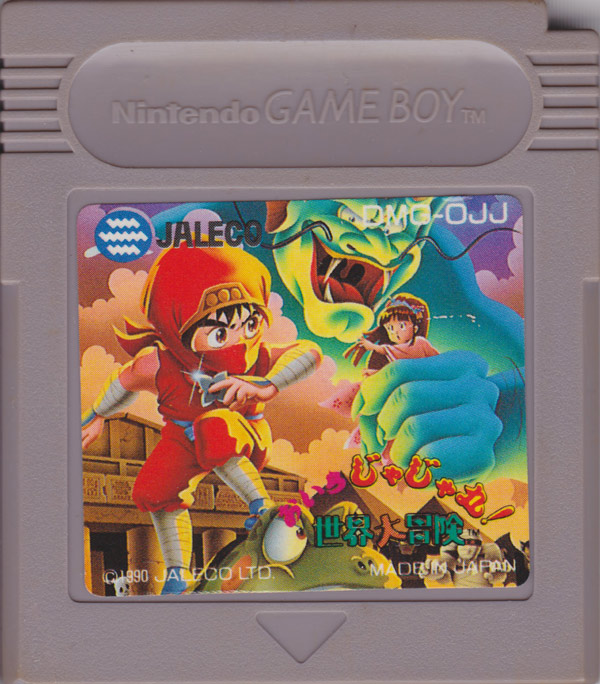
Oira! Jajamaru Sekai Daibouken by Jalico Entertainment, developed by Tose, was released in Japan in September 1990. It was released in the U.S. in March of 1991, but it was called Maru’s Mission. Jajamaru Ninja-kun is a ninja, but on the box art for Maru’s Mission, the U.S. version, he looks like some 80s kid with a backwards baseball cap, a walkman, sneakers, and jeans with the knees ripped.
But rest assured, this is a ninja game. Ninja Jajamaru-kun was a series of games that started in the mid-80s, and were pretty much all Japan only. The first game is really iconic. You might remember it from the Retro Game Challenge CX on DS. It was a ninja game with five platforms, and you could break through the floors and shoot shurikens.
That was based on a game called Ninja Jajamaru-kun. That actually came out on the DS Virtual Console in 2007. That was the first official release of any of these games outside of Japan, except for this Game Boy game. In this game you play Maru, and you have to rescue Kori, your girlfriend. Now this was still 1990, so the whole idea of rescuing a girl had only been used in a few hundred games, so it was still pretty original.
But don’t you worry too much about the story in this thing. This is a platform game, a scrolling platform game, you’re gonna start on the left, you’re gonna move to the right, jumping and shooting ninja stars. There’s no ammo count, you can fire as fast as you want. There’s no time limit on these levels.
Take your time. Suppose there’s no score, all there is is a health meter. That health meter can go all the way up to 999. You lose health very slowly. When things hit you, you just lose a little bit off your health. When you destroy enemies, a spirit will come out. You can collect those to get more health.
The only other way you can die is by falling through the bottom of the level, which will happen from time to time. It doesn’t show you how many lives you have, so you can do that a few times and your luck will just run out and you’ll get a game over. I’m not sure how many lives you really have, just try not to fall through the world.
Until you have an insanely long jump to keep you from doing that. If you hold the jump button down, you just float all the way up off the screen. As you go through these levels, about halfway through, you’ll meet your midway boss. When you defeat that midway boss, it will give you a weapon which will help you defeat the final boss of that level.
You start in North America, you’ll be going to Romania, Greece, Egypt, Brazil, and finally Japan. When you travel overseas, you’re gonna have to swim there. There’s a mini-game involving spearfishing sharks. You don’t really have to get anywhere, you just have to kill sharks and a manta ray. They really like that spearfishing thing in Japan.
A lot of times on TV, you’ll see celebrities stabbing fish. As you destroy these enemies, you’ll get power-ups. There’s a little black power-up, looks like a bomb. That is a bomb. You throw these things and the explosion will destroy enemies and it lasts quite a long time. There’s a wagon that you can get.
Once you get this wagon, it flickers like crazy. You are invincible for a short time. It doesn’t really make you go faster, I mean you pretty much are going the same speed you’re going anyway, but it makes you invincible for a short time. There’s a little bag that you can get that will just flash, kill everything on the screen.
There’s another one where meteors will rain down. Another little bag you get will change your shurikens into bouncing balls. Another kind of bag will just create a wall of lightning in front of you. You can just run through the level and this wall of lightning will take out enemies in front of you. There’s another bag that looks a little different.
It’ll make you shoot out copies of yourself. There’s some that are pretty rare, it seems, because I’ve only seen them a couple of times. There’s one of them that makes you zoom all the way to the end of the level, like the whole game goes and fast-forward and zip, you go right to the end of the level.
I’ve seen one that makes… I think it’s your brother or something, it’s mentioned in one of the other games. I haven’t really played the Famicom games, I know he has like a brother or a friend or something that helps out. They don’t really explain it, but at the end this helper will explode and help take out enemies too.
It’s a good lesson for kids. The dialogue isn’t really important because the storyline is just, every boss basically says, oh yeah, Cory’s not here, Cory’s at the next place, and every mid-boss says, oh but here I’ll help you defeat the boss at the end, like, take this weapon. You’ll see a picture of a weapon or something, for example, garlic.
At the end of the level when you get to the boss, hit select, it’ll change your weapon to whatever weapon you need to destroy the boss. There’s no save game in this, but it’s not a problem, because this game is very easy and it doesn’t take that long to get through. The ending text is so ridiculous, I’ll let you see it for yourself, I don’t want to spoil it.
This whole game seems like a little kid made it, I assume they did this on purpose. I don’t think this game is silly by accident. This game is not to be taken seriously. I think if you go into this game expecting something really silly and dumb, then you’re going to have a good time. I love the sound effects in this game, they’re weird, it really is like one of those weird Japanese Famicom games from the 80s.
This game is not expensive in Japan, but familiarize yourself with the label because it’s really hard to read the writing on it, it’s very low contrast. If there’s a red ninja on the front and it’s cheap, it’s probably this game. I recommend this game, but only if you like games that are weird and dumb.
Boy, Jajoumaru Sekai Daibouken. Sekai Daibouken is world adventure. Look for DMG-OJJ for the US version Maru’s Mission with the terrible cover art DMG-OJ. Thanks for listening to Game Boy Crammer. Special thanks to everybody who tweeted about it or mentioned it on Facebook or whatever. I really appreciate that.
The reason I’m finishing this show, you know, I went to my video game shelf a few days ago and it was just covered in dust. I’ve got like a PC Engine and a Super Famicom, Sega Saturn, Dreamcast, Atari, PlayStation One. I haven’t touched these things in two years since I started this show. Pretty much the only games I’ve been playing have been Game Boy games, so it’s on to new and different things.
If you haven’t visited my font site, please give it a visit, typodermicfonts.com. This is Ray Larabie saying goodbye from Nagoya, Japan.