Game Boy Crammer · Episode 50
FF Legend 2, Rubble Saver, Hollywood Pinball, Wario Land 2 & Doraemon Aruke Aruke Labyrinth
Reviews of Final Fantasy Legend 2, Rubble Saver, Hollywood Pinball, Wario Land 2 & Doraemon Aruke Aruke Labyrinth.
My name is Ray Larabie, and I'm talking to you from Nagoya, Japan, where it's very hot. But you know, after about six years here, I'm starting to get used to it. It was a little hard to get any reviews done this week because my cousin gave me his Wii U, so I've been playing a lot of Shovel Knight. That game is amazing.
And Just Dance 4. In this episode, I'll be reviewing Final Fantasy Legend 2, Rubble Saver, Hollywood Pinball, Wario Land 2, and Doraemon Aruke Aruke Labyrinth. Let's go. Let's do a game review. Final Fantasy Legend 2, in Japan it was called Saga 2, Hiho Densetsu, and it was released in December of 1990, about a year after the first game.
In the US, it was released in November of 1991 as Final Fantasy Legend 2. Now the first one was called The Final Fantasy Legend, this is just Final Fantasy Legend 2. It was re-released in 1998 by Sunsoft. So like the first Final Fantasy Legend game, this is a rebranded Saga game. So it's made by the same people as Final Fantasy, but it's not actually really Final Fantasy.
Like it doesn't really relate to any of the other Final Fantasy stuff. While the first Final Fantasy Legend game was pretty much a standard Japanese RPG game, this one's even more of a standard Japanese RPG. They took out some of the annoying stuff from the first game and really polished it up, but still left some of the original weirdness that made the first game so unique.
You start this game by choosing your character class. So in this one you've got humans, male, female, mutants, or espers in the Japanese version, male, female, robots, and various types of monster. Just like in the first game, monsters can eat monster meat and turn into different types of monsters. Monsters can't use weapons, and their abilities get replenished when you go back to an inn.
What makes the robots different from the humans and monsters is that their weapons get replenished when you go back to an inn. In the first game, you had this thing where you had to buy experience points for humans, but then the mutants would gain experience randomly. In this one, everybody gets random.
So if you're the kind of person who likes to really pay attention in these games to how many experience points you need before you level up, it doesn't work that way. You just fight a lot of monsters and eventually you level up. Same goes with abilities. Sometimes you just gain them. Just don't think about it too much.
If you do, it's kind of frustrating. If you just kind of go with it and fight monsters and don't think about the technical stuff too much, it all balances out pretty well. And it balances out a lot better than the first game. I found the first game, the economy of leveling up at the beginning was a little bit tricky.
And this one is just kind of fun, fun, fun. And if you die, they bring you back to life. There's no big consequence. The battle illustrations look better than the first game. The overall backgrounds are nicer. The music is top notch. It fits right in with any of the other early Final Fantasy games. You know, even though you're not really playing a real Final Fantasy game, it's not that big a stretch.
It's not completely different from Final Fantasy, at least that era of Final Fantasy game. It's not a really, really long RPG. But what makes it fun is you can play this game over again with a different party and it's very different. You can play the whole game without monsters, and it's a different kind of game than if you play with monsters.
Yeah, you still have the weapons wearing out, which is kind of frustrating, but now you got robots that heal their weapons. Everything just balances out really nicely. Of all the three Final Fantasy Legend games, this one to me is the best. This game is old, you're going to have to replace the battery so you can save.
You can get the Japanese version, but you'll miss out on the story. There's really nothing different in the Japanese version, it's exactly the same. Maybe some things don't translate exactly the same, but it's the same game, it looks the same. For the Japanese version, Saga 2 Hiho Densetsu, look for DMG S2J.
For the US version, Final Fantasy Legend 2, DMG-S2. The Sunsoft reprint version is also DMG-S2. Rubble Saver, developed by A-Wave, was released in May of 1991 in Japan. It was released in early 1992 in the US and Europe, but in the US and Europe it was called the Adventures of Star Saver. In Japan it was published by King Records, in the US and Europe it was published by Taito Corporation.
So if you see the box, it may look like it's a Taito game, but it's not. It's an A-Wave game. They did a game called Coro Dice, which I've reviewed, they did Mini Putt, also Rubble Saver 2 in 1992, which in English is called Max. You may not have heard of King Records before, they didn't release a lot of Game Boy games you've probably heard of.
They did release Coro Dice, Rubble Saver 1 and 2, and a whole bunch of fishing and mahjong games. This game is kind of a port, I guess you could say. Do you still call it a port when you completely change the name of the game and everything and try to get away with releasing it as a new game? It's close enough that I'd call it a port.
There was a game that came out for Famicom, Japan only, in 1987, called Miracle Rope Pit 2100 Toshino Daibouken, developed by Micronix, but published by King Records, so there's a connection there. If you compare both games, look it up on YouTube, Miracle Rope Pit 2100, that should do it. It's basically the same thing.
The levels have been simplified compared to that game. I'd say the difficulty is a little bit less on this Game Boy version because the levels are shorter. So let's get to the game. It's a scrolling platform game in a nonsensical, surreal world. You play Anne in the Japanese version. In the English version, you play Tony.
They actually switch the sex of the character. In Japan, you're a sister trying to rescue your brother, but sadly, in the English version, it's the standard rescue-the-girl deal. The intro to the game just shows them being abducted, taken away by a flying saucer, and put into this weird world. You have a robot called Max, at least he's called Max in the Japanese version.
It's not really a robot. It's more like a mech suit. You're going to be running around in this mech suit, shooting lasers and jumping. You're going to be moving from left to right, trying not to die, killing a boss, and going to the next level. If an enemy hits you, it destroys your robot, and you're just the girl on her own, or the guy in the English version.
At that point, if you take one more hit, you lose a life. The only way you can get your robot back is to find a power-up. It's a square with a letter P on it. They just kind of appear out of nowhere. In this game, always be shooting, because there are hidden items all over the place, hidden bonus levels all over the place, and there's no ammo limits, so just keep firing.
Apart from all the pretty random enemies, you're going to find weapon power-ups, there's gun It makes your gun shoot faster when you're not a robot, or it makes your robot do a triple shot, a spread shot. There's a wing power-up, makes it go a little faster. Once in a while, you'll see a triangle just bopping around.
I managed to get through almost the whole game avoiding these things, thinking I'm really smart. Turns out, those are power-ups. I thought they were enemies. They make you invincible for a short time. Once in a while, you'll find a lion head. That will make you invincible, but for a longer time. You use A to jump, B to fire, but if you hold B down, you can run.
While you're jumping, hit A again, and your thrusters will activate, so that you can jump across longer distances. Once in a while, you'll see a power-up that looks like a bow and arrow. That's a life arrow. This was not in the original NES version. If you press A and B together, you'll shoot a life arrow upward.
I only tried the Japanese version, and the Japanese version, if you fall into a pit, that life arrow shoots up on its own. As long as you have enough of them, it's like a grappling hook that pulls you out of the pit. So there's not as much falling to your death as you might find in other games, and you can take an infinitely long fall without hurting yourself.
Right near the end of the first level, you're going to be jumping off Saturn's rings and stuff like that. And you can avoid a whole bunch of trouble if you just kind of fall down that whole level to the boss. You will be fighting Music Notes. You're going to be fighting what looks like a Scottish Terrier.
He's completely harmless at first. You can jump on his head. As soon as you walk past it, it turns vicious and tries to kill you. Yeah, I know, you're in a robot suit. Why would a Scottish Terrier be a problem? I don't know, but you can kill it if you want to and get lots of points. There are items that will help you with your thrusters.
You'll find them. Even areas are found just by shooting randomly and just discovering little tricks and stuff like that. It's just all random craziness. I read that you can't finish level 7 unless you find the secret area. I didn't know that until after I beat the boss. You can beat that boss. It seems indestructible, it just takes a long time.
I like the music in this game and the sound effects are cute. The collisions are pretty good and the jumping is actually pretty decent. There are no continues and there's no saves, so you gotta do this all in one shot. It's not really, really long, but it is hard to get all the way to the end. As one robot boss you'll get to, it's very hard not to get hit.
It's not a common game. I haven't seen it a lot. It might be common in English, I don't know. If this sounds like your kind of thing, Rubble Saver, DMG-KSJ, or the Adventures of Starsaver, DMG-KS. Hooray for Hollywood! Let's all make it fun on the Hollywood! Where any office for your young mechanic can be a panic With just a good-looking panel Get a nanny barmaid and be a starmaid If she dances with or without a mask Hooray for Hollywood!
You may be lonely in your neighborhood Hollywood Pinball by Tarantula Studios was released in Japan and Europe only, not in North America. In Japan it was published by Starfish, in Europe it was published by Take-Two Interactive. Tarantula Studios also made the Grand Theft Auto and Grand Theft Auto 2 games for Game Boy Color.
Star Pinball is a set of seven pinball games. As the name would suggest, they're based on Hollywood themes. Shark is based on Jaws. Terror Dactyl, Jurassic Park. Double Agent, James Bond. Robin Hood, Robin Hood. Galaxy Wars, even though they kind of imitate the Star Wars logo, it's more Star Trek. Ancient Temple of the Aztecs with a very clear Indiana Jones influence, and Motel Hell based on Psycho.
The first thing you'll notice about these games is that they're all very, very similar. Not only do they use the same elements, a lot of them have a very similar layout. You have three balls, there's a skillshot, some of the games have an extra flipper, you always have two slingshots down near your flippers, it's pretty standard pinball fare.
The actual game layouts feel more like early to mid 70s pinball, in that you don't really have game modes, you're basically just hitting jet bumpers, increasing your bonus multiplier, trying to get a free ball, all of them have a lane shift, there are loops but no ramps. The board scrolls up and down, so the board is the full width of the screen and then it scrolls up about one screen high.
The indicators on the board are really tiny, it's really tiny pixel writing and it's really hard to tell what game mode you're in or anything like that. There's movie related graphics in the background, for example the shark game, you've got a big shark, but it doesn't animate and there's nothing really going on except for really small indicators turning on and off.
And they don't really look like lights because everything's really bright, if the game boards were darker maybe the lights would be more obvious. The jet bumpers don't seem to be very cleverly placed because the ball can go into loops and stuff like that, and they don't animate when they bump. Since they use the same jet bumper for every game you'd think they would have one frame of animation just to make it look like it's doing something, but you can hear the sound of the ball hitting it.
Whoever designed these tables really didn't know much about pinball, obviously a pinball designer was never consulted in this because they just don't have the flow. Some of the games have a little bit of flow but I think it's probably just by accident. The third flipper seems to be always in an arbitrary location, like when you think of some classic pinball games that third or fourth flipper is usually in a location where if you time it right you can knock the ball through a loop or up a ramp.
This one sometimes is just hanging in the middle of nowhere, sometimes you're meant to knock targets down with that. The boards are very similar and just not very ambitious, it feels like the kind of thing that someone will slap together really quickly. Luckily there's an option to turn off the music before you start the level because the music in this game will drive you crazy.
Each level has music that's based on the movie except it seems like instead of having a music designer do it they had a lawyer change every third note so it was legally ok to use. For example Galaxy Wars is based on the Star Trek theme with every third note changed and it just drives you nuts, it just gets under your skin.
The James Bond one is just completely maddening, I mean you just have to hear it, you will not believe they even included music in this game. The ball is way too small for the size of these boards. If you actually tried to make this board in real life it would be huge because you know a pinball is a set size and this thing is really tiny.
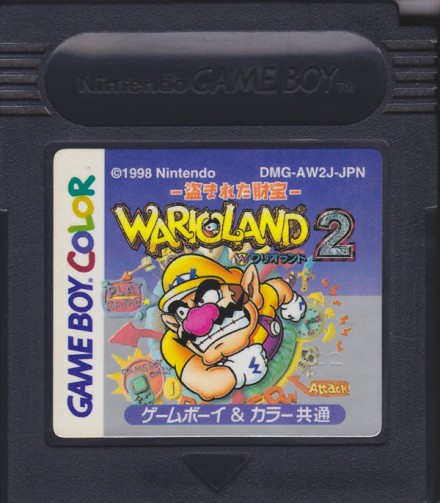
When the ball goes down the side lanes they're just cavernous, there's really no reason you'd ever want to play this game, it's just plain lousy. But you might want to get it just to hear the ridiculous music, for the Japanese version DMG-AHNJ-JPN for the European version DMG-AHLP-EUR. Wario Land 2, developed by Nintendo, was released in Japan in October of 1998.
In Japan it was called Wario Land 2 Nusumareta Zaio, Stolen Treasure. It was released in early 1999 in the US and Europe. In 2012 it came out on Virtual Console 3DS everywhere. This is a black Game Boy Color cart which means it will play on the Game Boy Color or the original Game Boy. Wario Land 2 is a lot like Wario Land, it's the same idea as Wario Land but just done so much better.
First of all it's in full color, it looks and sounds beautiful. You can do the same kind of stuff, you got the crouching, you got the butt slams, shoulder charge, power throw, you can pick enemies up and throw them, you can throw things upwards. The game is divided into 5 stories, each with several stages, and there's about a dozen bosses.
But the ending isn't necessarily the ending, there are different endings depending how well you do. It's not just about getting through the game, it's about getting 100%. In between levels you've got a number quiz, a number shows up on the screen, a piece at a time, you have to guess what it is. There are also bonus games, like a memory game where you have to, it'll flash a picture on the screen really quickly and you have to choose which one it was.
The level design is just beautiful. While it was good in the first game, this is just perfection. There are visual cues once in a while that are really subtle. After a while you just get into the rhythm of it, you can just kind of guess where they put a secret room, but then it just keeps surprising you.
One of my favorite things is movable objects, you can shoulder charge these objects to move them and use them to get up on platforms. It's not a hard hard game, but it's not that easy either, like later on it gets a little bit tough, I got stuck a few times. When you get hit by enemies you lose coins, so that takes a lot of the frustration out of you.
You're not constantly dying in this game. I think this game is for everybody. If you're a hardcore platform gamer, try to get 100% on it. If you're not that good at Mario games, you're going to have a good time with this one. This game saves automatically after every stage, so of course you will have to replace the battery.
When it came out in 1999 there's a chance that battery might still be good, but probably not. Or if you got a 3DS, play it on that. There's no reason not to get the Japanese version because you're not really missing out on anything. The story is told mainly through actions. The animated interstitials are just really really entertaining.
Wario Land 2 Nusumareta Zaihou. Japanese version DMG-AW2J, the US version DMG-AWLE, European DMG-AWLP. Okay, let's see, it's up, up, down, down, left, right, left, right, B, A. Huh, secret level! A 3-in-1 game review, Ms. Pac-Man, Ms. Pac-Man Special Color Edition, and Pac-Man Special Color Edition. Developed by Namco, Ms. Pac-Man was released in October 1993.
Ms. Pac-Man Special Color Edition was released in 1999 in Europe only. Pac-Man Special Color Edition was released in the US and Europe in August of 1999. The Special Color Editions are Game Boy Color black cartridges, so they'll play in an old Game Boy or Game Boy Color. I already reviewed Pac-Man in Game Boy Crammer episode number 6, so this way I'll get all the other Pac-Mans out of the way.
Ms. Pac-Man, the black and white version from 1993, is going to be pretty much the same review as Pac-Man. In the title screen you have a choice of start game or two-player game. In another two-player game, you don't need a link cable, you just take turns. And there's a choice of easy or hard. Hard is a little bit more like the arcade game.
And before you start, if you hit left and right on the controller, you can change to half-size mode. So if you play regular mode, you're going to see a part of the screen, and it's going to scroll around, because half the screen is used for the score and which power-up is available lives. If you play half-size mode, everything's really shrunk down, and you can actually play on a shrunken down little screen.
Of course, Pac-Man is vertically oriented, the picture tube is turned sideways in the game, so it actually is suited to squeezing down at that size. Unlike the original Pac-Man, this one doesn't seem to be buggy in half-size mode. You can actually play and it plays okay, whereas the original Pac-Man, sometimes you'd go through the...
There were some problems. Anyway, this one, the sound is okay. The intermissions are there, just like the arcade, but the music doesn't change during the intermissions. I'm no Ms. Pac-Man expert, but I do know the intermission music, and something's not right. And just like the original Game Boy Pac-Man, when you go through the side tunnels, you can't see what's on the other side.
The ghosts all look the same, so you can't tell the personalities apart, but the personalities are definitely there. You get tailed sometimes by a certain ghost, and other ones will run away when you get near the power pellet. You just can't see what color they are. Ms. Pac-Man Special Color Edition is the same, but in color, so you get to see the different colored ghosts.
It actually looks pretty good in mini-mode, however, they throw in Super Pac-Man. I love Super Pac-Man. It's one of these games that you... some people really love, and some people really hate it. It's basically Pac-Man with keys to open doors. Instead of just power pellets, you have another pellet that makes you giant and invincible.
However, Super Pac-Man is no fun in mini-mode. In the arcade, Super Pac-Man scrolled, and it was on a square screen, so when you shrink that down, it's really, really tiny. So tiny that you can't even make the turns properly. Pac-Man Color Edition seems like the original Pac-Man on Game Boy. I didn't find any bugs in the mini-mode, so maybe they fixed that stuff.
And they throw in an extra game, which is kind of like Tetris. I think it was called Pac-Attack. It's a different name in Europe. It's basically Tetris with Pac-Man. None of these games have save games on them, so there's no batteries to replace. Of course, Ms. Pac-Man is an American thing. It is not a Japanese thing, so this did not come out in Japan.
For the US or European version of Ms. Pac-Man, DMG-N4. For the Ms. Pac-Man Special Color Edition, apparently came out only in Europe. I couldn't find an American version. DMG-AQCP-EUR. And the Pac-Man Special Color Edition, DMG-AACE-USA for the US version, for the European version, DMG-AACP-EUR. If you thought Atari Pac-Man was great, wait till you play his big system, Ms. Pac-Man from Atari, with larger-than-life graphics, floating fruit, and hungry ghosts.
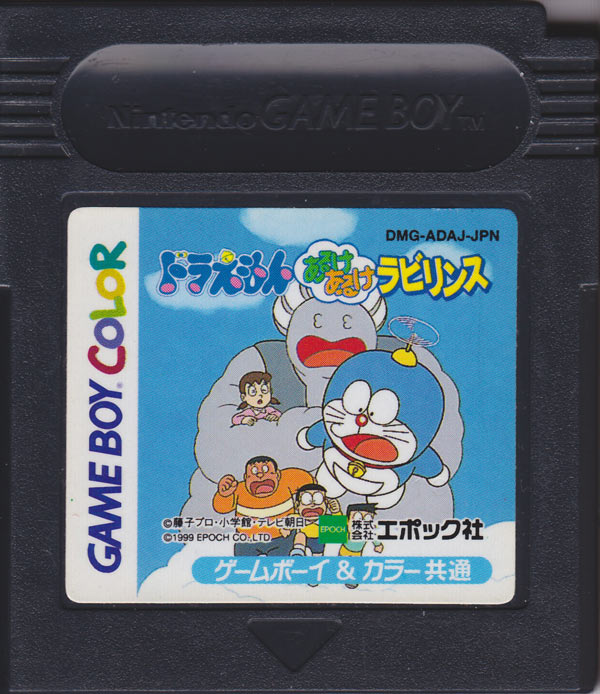
If you've got an Atari, you can play Ms. Pac-Man at home. If you haven't, you can't. Let's do a game review. Doraemon, Aruke Aruke Labyrinth, by Epic, was released in Japan only in July of 1999. Aruke Aruke means Walk Walk, so Walk Walk Labyrinth. It's a Game Boy Color cartridge. It's a black cartridge, so you can play it in a Game Boy Color or original Game Boy.
This is a dumb walker game, also known as a Lemmings type of game. It's a type of real-time strategy game, kind of. A dumb character will walk across the screen. You can use your cursor to tell the character to turn around with the A button, or use the B button to give him a little burst of speed, and you have to get your character to the goal without getting killed.
In this story, Nobita enrages a genie somehow. I thought this was tied in with a movie or something, but it's not. Once you get past the story stuff and the tutorial, you'll have three characters to choose from. You can choose Suniel, who is fast, Nobita, who's kind of in between, and Jyan, who's slow.
Now, of course, your character can't just walk to the goal. There are obstacles and objects that'll help. There are various types of clouds that are used as platforms. If your character walks into a cloud, it'll turn back the other way, or your character can stand on the cloud. You move your cursor to the cloud and hit A, and you can toggle it on and off.
There are some clouds that are timed, so they'll only stay on for about five seconds, and then you have to hit them again. There are clouds that are just timed on their own, they're just turning on and off, so you're going to need to delay your character somehow, make him walk back and forth until it's ready to walk over, because there's no pause.
You can't make your character stop. There are clouds that bounce you upwards. There are dark clouds and lightning clouds that you need to avoid. There are also creatures walking around. Little blue creatures. It looks a little bit like not me from the Family Circus comics. You can easily murder those things by moving your cursor over them and hitting the A button.
There are some bigger ones, where you have to hit them a whole bunch of times. There are rolling rocks, flying enemies, and there are some enemies, flying saucers. The only way you can destroy them is with some kind of scepter of power. You pick up this shepherd's hook thing, and lightning just destroys all the enemies.
Not every level has you walking to a goal. There are some levels where, even if you can't read it, you'll see there's a different set of instructions on the screen. That means you have to do something different. Usually it's pretty obvious, but trial and error will do the trick. There are different themed worlds, with lots of different levels on them to clear.
Once you clear all those worlds, you're going to unlock some characters. You're going to unlock Shizuka, the girl, and Doraemon. I was really surprised how fun this game was, because up until now, the Doraemon games have been so-so. But this one's a real gem. This has a battery, so you'll have to replace the battery.
It's most likely dead by now. You can save three different games on the cartridge. The graphics are wonderful. The colors are really good. The cursor moves pretty well. I mean, it's pretty much as good as you can get, considering there's no mouse or trackball or anything. You can pretty much get it where you want to put it.
Despite this game's simplicity, the clever level design is what keeps it going. It's always full of surprises. New gameplay mechanisms are introduced a little bit at a time, so you can get used to it. The music is sufficiently weird. Even though this isn't in English, I wouldn't really worry about it, because you're really not missing anything story-wise, and it's very easy to figure out how everything works.
Most of the mechanisms are visually self-evident. So Doraemon, Aruke, Aruke, Labyrinth, highly recommended. Look for DMG-ADAJ-JPN. I've also seen listings for CGB-ADAJ-JPN, which could indicate that there is a Game Boy Color Only version of it, so not a black cartridge. That wraps up another episode of Game Boy Crammer.