Game Boy Crammer · Episode 28
Super Mario Land 2, Crayon Shin Chan, Dirty Racing, Qix

Reviews of Super Mario Land 2: the Land of 6 Golden Coins, Crayon Shin Chan, Dirty Racing & Qix.
My name is Ray Larabie, and I'm talking to you from Nagoya, Japan. Welcome to episode 28 of Game Boy Crammer. Today I'll be reviewing Super Mario Land 2: The Land of Six Golden Coins, Crayon Shin-Chan, Dirty Racing, and Qix.
Last Friday I took a trip to Osaka. It's only about 90 minutes on the bullet train. And I did some Game Boy shopping while I was there. If you're going to Osaka, turn on your Google Maps and look for a place called Game Tantei. T-A-N-T-E-I. Just search Game Tantei Osaka in Google Maps and you'll find it.
That place is really nice. You may have heard of a game store called Super Potato. There's a whole bunch of them in Tokyo. We don't have them in Nagoya. They closed down their location that used to be across the street from Game Tantei. They're kind of known for their higher prices. They actually move closer to Namba Station.
If you do want to check them out, I didn't really find anything that great for Game Boy there, but if you do want to check them out, just search for Super Potato Osaka in Google Maps, you'll find it. So just a little bit further up the road from Game Tantei, there's a place called A2, A-T-O-O. It's on the opposite side of the road as Game Tantei.
And that was the best place I've seen in Osaka for games. And a quick rundown, if you're going to Nagoya, K-House, Meikoya, it's right beside K-House. There's also a place called Mandarake, M-A-N-D-A-R-A-K-E. Just a few steps away from K-House and Meikoya. Really fancy place, they've got original Game Boy games in the box.
There's one of these stores in Osaka, too, but I haven't been. But if you want the real game deals, games for 100 yen or less, in any Japanese city, you'll find a recycling store, kind of like a pawn shop, and it's called Hard Off. Yeah, I know. They have all kinds of games, but their Super Famicom and Game Boy games are considered junk, so you can't get any money for them if you're selling them there, and they'll just put them in the junk pile.
They're pretty picked over, so you have to be really lucky to get in there on the right day. The show, it begins right now. Let's do a big review! Oh, be me, Wario! I am your master, Mario, which I gave you! The wicked imposter, Wario, has cast an evil spell over Mario Land! Don't let Mario get the six golden coins!
Don't let Mario reach the palace! This is the biggest, most dangerous, most challenging Game Boy adventure yet! Obey Wario! Destroy Mario! Don't fall under Wario's evil spell in Super Mario Land 2, only on Game Boy! Super Mario Land 2, Six Golden Coins, or as it's called in Japanese, Super Mario Land 2 Roku Tsunokinka, was released in October 1992 in Japan, November 1992 in the US, and January 1993 in Europe.
This game was kind of a big deal when it came out. It was a huge cartridge compared to the previous Super Mario Land. By huge, I mean a lot of memory. Eight times more memory, to be exact. And it had a save game too, so you will have to replace the battery on this one. It's actually the second Super Mario game on any console to have a save feature.
If you played previous Super Mario Land, you'll remember it takes place in kind of a different place than the other Super Mario games. It's in Sarasara Land, Mario travels by flying saucer, it's a little bit different, and the enemies are different. Well, this same land has been taken over by Wario. He's put an evil spell over this world, and he's renamed the whole area Wario Land.
Wario's motivation is money, but he also, ever since he was a little kid, has been really jealous of Mario. And he's taken over Mario's castle. To get this castle back, he's gonna have to collect six golden coins. To get these golden coins, he's gonna have to conquer six different areas. Each area has several levels and a boss.
When the boss is conquered, you get a coin. But there's a catch. If you run out of lives, all the coins go back. You have to defeat those bosses again to get those coins back. Now, in addition to these golden coins, they're the regular type of Mario coins, you know, normal coins. But in this game, 100 coins doesn't get you a life.
You can collect up to 999 coins. You can use those coins to gamble for extra lives and various power-ups. The way you get lives in normal gameplay is by collecting hearts. And they're not that rare. Often, they're in kind of secret areas. So if you explore, you're gonna find more hearts. And you may notice on the screen, there's a little symbol.
It looks like a little bug or a monster and has a number beside it. That indicates how many enemies you've killed. Once you've gotten to 100, a star comes down. And you're invincible for a while. You can actually find the star in other parts of the game in blocks, but they're not as common as they are in some other Mario games.
After you get the star and you're invincible, try to run into as many enemies as you can. It'll actually show a number after each enemy you hit. And once you get to five, you get an extra life. And then each enemy after that, you get an extra life. Something that's really nice about this game compared to the previous Super Mario Land is that you can go back.
You're not forced to go from left to right. You can actually go back in a level. And you can go back and replay levels if you want. Instead of jumping for a flag or something, at the end of the level, you just have to go through a door. There's a bell that you can ring, usually on a higher part. If you can ring that bell and then go through the door, you get to play a little mini-game.
Altogether, there are 32 levels. Now, when you go into the six zones, it may not look like there's 32 levels. That's because they're secret levels. If you explore around, you're going to find them by accident or you can look it up. So what happens is you go into a pipe or something and you discover this secret level.
You finish the whole level and then you end up going back to the level where you left off. And some of these levels are not very challenging. They're just a big coin grab. After you've collected all the coins, you get to go to Wario's Castle and it's one long level that you go through, not a bunch of levels.
And then you'll have a boss battle at the end. Now, apart from the hearts and the coins, you also have carrots. If you eat a carrot, you turn into a bunny. When you jump, hit the A button repeatedly and you can glide. And if you press it really, really fast, you can glide straight across, like completely horizontally.
The fire flower lets you shoot fireballs, much like a lot of other Mario games. There's the mushroom. Be careful not to pick these up when you have a fireball or bunny ears because you'll go back to regular mushroom power. Once in a while, you'll see a little bag with an M on it. That's a 50 coin bag.
And about halfway through every level, there's a bell. That's your checkpoint. So if you die after that, you're going to go back to that point. This is kind of an open world game. You can do this game in any order you want. Most of the bosses are a jump on the head three times type of deal. I find the one that's the hardest, the one you'll probably want to get out of the way at the beginning because you can end up losing a lot of lives to finish it.
That's the pig bosses. They're at the end of the macro zone. This is a zone where you go into a giant Mario. So you're inside a Mario and there's like a kind of a Lego level. Is it a giant Mario or are you miniaturized? I'm not sure, but there are three pigs. The first one bounces up and down slowly.
The second one pretty fast. And the third one really, really fast. And it's easy to lose all three lives in that last one. If you can get to that boss with a fire flower, it's no problem. You can just wail on them with a fire flower. But it's hard to bring the fire flower there because you have to get it much further back and then bring it in.
And be careful when you're fighting the witch. There's a boss where there's a witch with a bunch of cauldrons. The pot lids will hurt you. It looks like you can just stand on them, but no, you don't want to stand on those things. There is a one-up exploit in this game. I'm not going to tell you where it is.
You don't really need it because I find with this game, if you collect enough coins, they give you enough hearts. And along with the extra lives you can get with the star invincibility, there's plenty of lives to be found. It's really not a problem. And hey, if you do run out of lives, you just have to go back and fight the bosses again.
If you've never played this game before and you're kind of a Super Mario fan, you really owe it to yourself to play this. This is not just for Game Boy people. This is for anybody who likes Mario. It really feels like a Mario game, and it feels like almost a continuation of Super Mario 3. I never found myself overly frustrated with it.
It's just good fun. You should get this. There's no reading in this game. There's no reason not to get the Japanese version if it's cheaper. Look for DMG-L6J for the Japanese version, or DMG-MQ for all the other versions. In the six worlds of that country, there are hidden treasures. The brave young people go on a journey to collect the six treasures to save the country from the bad guys.
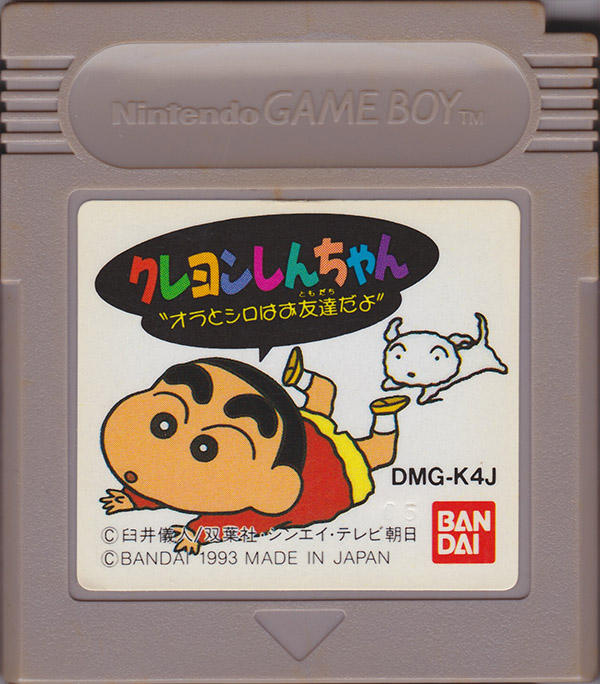
Game Boy Software Mario Land 2 Six Treasures Now, who's the bad guy? It's me! It's Mario! Crayon Shin-Chan オラトシロハ オトマダチデイ was released by Bandai in the spring of 1993. This is a platform game, and there are lots of them. I've got three others to review, and they're very common. If you buy a sort of a grab bag of games, you're gonna find one of these in there.
Crayon Shin-Chan was a manga series that ran all the way through the 90s. It's this five-year-old kid, Shinosuke Shin-Nohara. His parents, he's got a little sister, he's got a dog, and it's set in Saitama, Japan. A couple years after the manga started, there was an anime, and it's still on TV today. You can actually get these in English, too, in all kinds of languages.
Part of what makes this character popular is he's kind of inappropriate. He's a little kid, but he'll say the wrong thing at the wrong time. You probably don't want to learn Japanese by imitating the way this guy talks. And if you're really into these Shin-Chan games, you can get something called Shin-Chan Oda no Gokiken Collection, where you can get one, two, three, and four all in one shot.
This is a platform hop-and-bop game. Your A button jumps, and you can jump down off things, too, and you can jump onto telephone poles, and you can bounce as well on bouncing springs and awnings and stuff like that. B is a fire. You can shoot a bubble, or there's like a ray gun you get later that shoots eggs or something.
And you can actually hide behind pillars and telephone poles. You just walk up to them and press up without jumping, and you'll actually sneak behind, so you can actually protect yourself from enemies that way. And there is a crouch that you'll need a little bit later. You'll find these little health canisters.
If you get ten of those, you get an extra life. And sometimes you'll see a little version of yourself. If you grab that, you'll get an extra life. At the end of each level, you'll have a little mini-game. In the first game, you get a Whack-a-Mole. There's some kind of superhero guy who challenges you to a game of Whack-a-Mole.
You just have to make sure in this game you don't hit that guy. You lose ten points. You want to hit the monsters and not him. After the next level, it's a game of red light, green light. I couldn't figure it out at the beginning, so I thought I'd better read the instructions and translate it. So I was like, oh, okay.
So you have to watch what the other kid's doing. When the other kid turns around, you have to stop. When the kid turns the other way, you hit the A button really fast to go forward. A little bit later, you'll get to a cycling mini-game. It's like a typical racing game. You can change lanes by hitting up and down.
To move your bike forward, you just whack the A button really fast and avoid obstacles. And there's a little speed boost once in a while. You're going to have four chances to call, so you call for your dog and the characters will give you some hints. So far, I have never found the dog. This game is very, very short.
To compensate for its brevity, when you die, you go all the way back to the beginning. And you don't get a lot of extra lives, even if you catch all those canisters and stuff. There's no continue. You go all the way back to the beginning. But if they didn't do that, the game would be over way too quickly.
I played through it a few times and I can get through the whole thing in a pout. It's about 20 minutes to get right through the game. But you won't get through in your first try. There's some really frustrating jumps. You'll get to a level where you have to jump on telephone poles and jump from pole to pole.
You know, you learn from trial and error where you have to, exactly where you have to be to jump. And then you have to kind of jump onto these little pulleys that are going back and forth on wires, like a zipline. The timing has to be very, very precise. You will fall to your death a lot. If you see this game for almost nothing, you can pick it up, but don't go out of your way to get it.
Now, I don't know, I haven't played the later Crayon Shin-Chan games, so I'm not sure, I can't judge all of those. But judging by the first one, not so good. If you're looking for this game on purpose, DMG-K4J. And if you're not looking for it on purpose, just buy a stack of cheap games in Japan and you will get this one in that stack, guaranteed.
Dirty Racing, developed by Gremlin Interactive, released by Jalco Entertainment, was released in early 1993 in Japan only. It's a top-down racing game in the style of Micro Machines or Roadster, Super Sprint. The world is scrolling around, and you're in the middle of the road, and you're in the middle of the road, and you're in the middle of the road, and you're in the middle of the road, and you're in the middle of the road, and you're in the middle of the road, the world is scrolling around, and you're moving your car on the track.
Your car stays more or less in the center of the screen. You turn left and right with the D-pad, you hit A to accelerate, and B to activate a Nitro. There's an overworld map which will let you select local races. Once you beat those local races, you can play main races, and then open up other parts of the level.
Eventually, you're going to get to a final race. It's like a big cup with a 1 on it, and that's the end of the game. You're racing against a few other cars, which you'll get to spend on upgrading your acceleration, which you'll get to spend on upgrading your acceleration, repair damage, you can get new tires, etc.
And what makes this racing dirty is once in a while you'll see one of the wall panels on the side of the road flashing black and white. If you smack into that, you get kind of a power up that will harm your opponents in some way. Sometimes you get just a little electrical zap. You're not sure what it does.
Sometimes it knocks out your opponents. Their engines go dead, and you can zip past them. If you can manage to squeeze by, sometimes they just block the whole track. Other times it makes your car super powerful. Sparks will shoot out of your car, and you'll go really fast. The control in the car is really squirrely.
It doesn't feel anything like a car. There's no sliding or anything going on. The angles of the car are very limited, so it's always popping into different angles and stuff. It just feels really binky. The AI of the cars is pretty much non-existent. The way they win the race is by being much faster than you are.
The AI of the cars is pretty much non-existent. You're given a certain amount of nitro. It's not quite enough to win the race. That's why you have to do that dirty stuff to win the race. You know, stop all the cars, that kind of stuff. And that's the gameplay balance, I guess. If you can remember the location of those flashing panels, it'll still be there in the next lap.
The more you can remember where those panels are, that gives you some advantage. The sound effects are pretty lousy. There's no music during the game, but it's just kind of an engine roar. There's no sense of damage from the vehicles. You can't really tell if your crashing is just pushing the other car along or actually damaging your car.
Most of the time I just kind of looked at the end of the race to see what my damage was. The nitro doesn't really give you a nice nitro blast. Like, if you think of F1 Race on the Game Boy, one of the launch titles, it had that great whining sound when you used the nitros. And this thing, it just makes you go fast.
All the cars look the same, except yours is slightly lighter. In between the levels, you're treated to some gross-looking, sexy women that are supposed to look sexy, I guess, but are really poorly drawn. It's really embarrassing. You don't want anyone seeing you play this game. It's a really awkward anime thing with this girl kind of floating in front of a car with her arms twisted backwards.
Everything about this game just makes me uncomfortable. It's just a whole lot of yuck in one cartridge. And there is no fun to be had in this. If you're still curious about dirty racing, DMG-RIJ is what you want to look for. Oh, hey, what's up? I'm Glutton, he's Russell. Kick, this new Game Boy game?
Hey, cool box. I mean, he doesn't get it, but here's what you do. You've got to keep thinking, right, because you've got to box him. And they make this little box, and then you close it in. Whoa, level five! Yes! This doesn't even have any eyes. I know it's weird, but it sees you, right? Duck! This little audio guy comes out and he starts singing to you.
Weird. Nintendo! Qix, spelled Q-I-X from Nintendo, was released in the spring of 1990 in Japan, US, Europe, and Australia. Qix is kind of its own game category. I remember this game came out in the arcades in fall of 1981, and at the time, every game you'd seen was pretty much something you'd never played before.
You know, the genres of games hadn't really been defined yet. For example, when Donkey Kong came out, it wasn't just a platform game, it was just Donkey Kong. There was nothing like it. Qix was kind of like that. It's just its own thing. In Qix, you've got a screen. Nothing moves around. On this screen is the Qix.
The Qix is this weird energy thing that just kind of bounces around. You control a little diamond-shaped cursor that draws rectangles. It's kind of like the bikes in Tron, except when you close your shape, it fills in. The Qix normally can't hurt you, but when you're drawing a line, you're not grounded electrically or something like that.
And if that Qix touches you at that point, you lose a life. So the Qix can actually touch your cursor as long as you're not drawing a line at the time. The goal is to fill in X percent of the screen. Now, at the beginning, it's 75 percent. As you keep playing, it goes up and up. Now, the higher percentage you go over that, the more points you get.
You get a lot of bonus points for that. So, yeah, you can just keep making little squares and finishing 75 percent of the screen, but if you really want to get a lot of points, you want to finish more than 75 percent. The bigger the shape you draw, the bigger the risk that the Qix is going to come at you.
Sometimes it seems to be out to get you, but I think it's pretty random. While all this is going on, there's little sparks moving around the screen. They will make you lose a life as well. The sparks aren't really hard to deal with. You can just kind of loop around them. You don't have to keep running away from them, but sometimes if you're kind of working on something, you're trying to corral the Qix into a little square and you've got these things annoying you, it can kind of throw you off.
There's a time limit. At the bottom of the screen, this is going to tell you when those sparks are going to get raging mad. You've seen this in other title games like Bubble Bobble. The sparks turn into super sparks. They're angry and they're out to get you. They're not that hard to deal with. You can still kind of loop around them, but they're just, they're mad.
To make a line, you use your A button. You can also use your B button. When you use the A button, you draw a fast line. Really handy if you don't want that Qix to come and get you. If you're willing to take more of a risk, if you draw a line, it'll fill in slowly and you'll get a lot of points for that.
If you're going around making little squares to try to corral the Qix into a little box, there's no point using the B button. It's kind of too risky and you don't get a lot of points for it. You want to use the B button to make a shape when it's a big scoring shape. You're filling in a big area or it's the final one.
If you can afford the time and the Qix isn't riding you, you can just do that B thing and get a lot of points. Once in a while, you're going to find a level that's got two Qix in it. You can do something called a split Qix. I found it by accident. If you cut those Qix off from each other, like split the screen in half and they can't get back to each other, it says split Qix and you don't get a bonus, but I think your multiplier, your bonus multiplier goes up on the next level.
The bonus multiplier can go up to five times. That's really where your big scores come in. If you can kind of overkill, you know, if you're required to do 75% and you do 95% and really box that thing in and you finish with the B, you really crank up your points. If you've got a multiplier and you go way over the percentage and you use B, it really makes a huge difference to your score.
Qix is really cheap when it comes to extra lives. You get one of 50,000 points. Now, that's a chore just to get to 50,000 points when you're first starting to play. Then you get another one at 100,000 points. Then, what do you think, 150? No, 200,000 points. Then 500,000 points. That's how video games were back then.
There were a lot of games where you'd get three lives like that and after a certain point, you think it's going to do at the same interval? No, no more free lives. You're on your own. When you're making a line, you kind of have to start the line and then finish it. Don't just kind of hang around with the line half done because then a fuse comes out.
It'll just start burning down the end of the line and you better hurry up and finish it because it'll catch up to you. Finishing the line is the only way to get rid of it. The best strategy I found in this game, I've been playing so many different versions of Qix since it first came out. It's a sequel of Qix.
The gameplay is pretty much the same except there's fancy graphics. I've been playing this for years and I don't know if there's an official best way to play but I find, for me, I try to make kind of a question mark shape. I'll start off by making a line at the middle and you want to try to make really narrow little lines.
You don't want to waste a lot of time. Try to keep it as smooth as possible because there are situations where you have to zip back down that line but don't worry about it too much. You kind of go up halfway up the screen making a really thin line and, you know, you don't have to make it in one shot.
You can do lots of little boxes. Those little boxes are low risk. If that Qix starts coming at you, you can just complete the box and kind of wait a few seconds if there's not a lot of sparks around you can kind of hang out for a second and continue making the line. Once you get to the middle, you want to start making that line go to the left or the right so you're going to make a question mark kind of shape or reverse question mark.
The reason I like the question mark shape is there's a chance before you finish the question mark you can go to the left of it or to the right of it. You don't really know. If you're trying to make a sort of spiral sometimes it just doesn't work out. The Qix will decide to go out of the spiral and it's like, oh man, you've got to go and figure out another shape.
But the question mark is not so bad because if the Qix go on the outside ideally you want to kind of wrap it in and curl around but sometimes the Qix want to go on the outside of it in which case you can kind of box it in the corner. You can wait until it goes to the corner and then try to box it in there.
There's also a technique where it's hard to explain but if you kind of instead of just making box after box aligned with each other to create a line if the Qix is kind of close and harassing you you can kind of wrap around the back so you're kind of building the box around the back of the line and curling it to the front and as you curl it to the front you can kind of pause a little bit if you don't pause too long the spark won't come out and then wait until it's safe and then kind of curl around the front because it's really hard for the kicks to get around to the back of that line.
The way it moves it can't, if you're unlucky it can get back there but you can kind of protect yourself by wrapping boxes around the back. Very hard to explain. I think when it happens to you you'll just know oh, that's what he's talking about. I've played a lot of different versions of kicks. This is one of the best versions.
I think I've had the most fun with this version. The arcade version is very hard. The resolution is really high so I found it was really hard to get those lines really straight. And the Game Boy version, you know the low resolution of the screen in these games that pans around, the whole screen is the screen it's really easy to make boxes.
You can make like a really thin solid line of boxes to make that question mark shape. Oh, one more strategy thing. When you're finishing the question mark and trying to corral the kicks in if you kind of make like a little lump at the end of the question mark, kind of like a little serif it'll kind of help the AI of the kicks bounce into the box.
So you kind of add a little tooth on the inside of the curve and it'll help kind of reflect it back in. And you can take that tooth and kind of use it to extend the curl and then curl right in on it really tight. I've gotten to 99% a few times just by curling and curling and taking these low risks and then as you're curling in then you want to really start doing those backwards wrapped loops around the line.
If I could draw this, it would be easier to explain. But you'll figure it out. Just don't start off by making big boxes. That's how, you know, when I first started playing Qix as a kid that's what I would do, just try to make the big boxes. There's really no need, it doesn't give you any advantage.
Obviously, I'm into Qix. It's not everyone's thing. It is a very weird game. There's no ending to the game. You just keep going until you die. Oh, and every few stages there is a fireworks display and after you die you get a little intermission with Nintendo characters. And one of them features Mario with a sombrero playing a song on a guitar to a vulture on a cactus.
Really cute. There's no difference between the Japanese version and any of the other versions. There's no reading in this game. There's no save game. This game did come out on virtual console everywhere. So, Qix: search for DMG-QXA for the Japanese version or DMG-QX for all the other versions.