Game Boy Crammer · Episode 30
Contra, Gargoyle's Quest, Solar Striker & Sumo Fighter
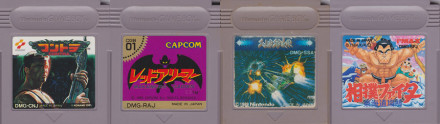
Reviews of Contra (Operation Super C/Probotector), Gargoyle's Quest, Solar Striker & Sumo Fighter.
My name is Ray Larabie, and I'm talking to you from Nagoya, Japan. Welcome to episode 30 of Game Boy Crammer. This is the last episode of the year, so happy 2014. That means I've been doing this podcast for one solid year. This podcast started on January 4th, 2013. Hayden Scott Barron, Doki on Twitter, tweeted, Love your Game Boy Crammer podcast. Keep up the good work.
Which is your favorite Game Boy hardware for these reviews? Well, my favorite hardware is the Game Boy Color. In a much earlier episode, I kind of detailed about how I added a front light to it. So it's a front light from Game Boy Advance SP on the Game Boy Color. The screen isn't as clear as a Game Boy Advance SP. Game Boy Advance SP has a nicer screen, but I just like the feel of the Game Boy Color in my hands.
I feel like my hands get really cramped on the Game Boy Advance SP. Also, I like the AA battery thing, because if I'm traveling, I can just throw a couple extra AA's in there, and I don't have to worry about running out of a charge and trying to find a place to charge it. The other thing I play on is the YINLIPs. Look up YINLIPs. Y-I-N-L-I-P-S.
They're constantly coming out with new models. I got one from a couple years ago. I think it's one of the first ones where they had the analog controller. The screen is really big, and the controller's nice because the original controller was lousy, the D-pad. So my cousin and I ripped it out when we put in a controller from PlayStation 1.
Save states are cheating. There are some really terrible games that I've reviewed where I just couldn't handle playing them anymore, and I just kind of save-stated my way through them just to see what the ending is. But for games like Mega Man, I really want to feel the pain, so I'll play those on the Game Boy Color.
When I'm recording the sound, I use an emulator on the PC called Visual Boy Advance. When I take those screenshots and record the sound, I've already played the game on the Game Boy. Usually, I just play the first few levels over again. That's why you don't really see too many levels in most of the time.
Last weekend, I traveled to Tokyo, and I went to Akihabara to check out Super Potato, the retro video game store. So when you get to Akihabara Station, you kind of head for the main drag, and it's not really that obvious. You should kind of be familiar with the Super Potato logo before you get there, because it's kind of hard to see the sign.
It's not out on the main drag. You actually have to go behind one of the buildings. It's just tucked behind there, a little stairway, really easy to miss. And I'd actually been around that area a few times and never noticed it. Their selection of Game Boy games is really good. The one in Osaka, not so great. I didn't buy anything there.
This one, I bought a whole bunch. Some of the games are cheaper than Nagoya prices, and they all seem to be cheaper than Osaka prices. For a lot of the basic games, they have multiple copies. So they're kind of must-have games. They have these little tie wraps around each cartridge, so you can't just grab what you want and throw it in a basket.
You have to kind of remember which ones you want, maybe write them down, and then you have to ask a clerk to come over, and they'll take a pair of scissors and get them down for you. Unlike most game stores, you can use a credit card there, so that's nice. In this episode, I'll be reviewing Contra. Also known as Operation Super C, or Probotector.
Gargoyle's Quest, Solar Striker, and Sumo Fighter. Let's start the show. Contra, developed by Konami, was released in January of 1991 in Japan. In February of 1991, in the US, but it was called Operation C, and the summer of 92 in Europe, as Probotector. In the US, it was published by Ultra, and in Europe, it was published by Metal, and in Japan, by Konami.
This game also came out on the Konami GB Collection Volume 1 for Game Boy and Game Boy Color. The Contra series wasn't the first run-and-gun game, but it was the gold standard of run-and-gun games. It might even be the best-known run-and-gun game of all time. The reason for the name change? Contras are what they called some of the rebel forces opposing the Sandinista Junta of the National Reconstruction Government in Nicaragua all through the 80s.
It was a really tragic part of history, and kind of strange that they used that right in the middle of it. By the 90s, I guess they were a little more sensitive about it, so they called it Operation C. The game doesn't actually involve the Contras at all. It takes place in the future, not even related.
So Contra was really big in the arcades in 1987, a huge hit. It came out on NES and Famicom one year later, 1988. Contra is well-known as a cooperative game, and in Game Boy, it's a one-player game. There are five levels. They're pretty long, but overall, it's a pretty short game. You start off in a side-scroller level with a machine gun.
You can shoot in eight directions. You have to jump up to shoot down. It's one of those games where you have to fire on angles a lot. They often place enemies on exactly where your 45-degree shot is gonna hit. There's no ammo limitation, and you can keep that button held down. It'll just keep auto-firing. Easy on the phones.
The weapon you start off with? A machine gun, a rifle, and it's really good for a starting weapon. After you die, you lose your weapon power-ups and you end up with this machine gun, but it's not half bad. The enemies are soldiers or robots or turrets. The enemy soldiers aren't really firing that much. They really do take it easy on you in this game.
I'm not saying it's easy, but at least it's not an overload of bullets. Now, when I first played this, I played it on the original Game Boy in the 90s, and the LCD lag made it a lot harder than it is playing it on Game Boy Color. Maybe that's one reason they didn't have too many bullets. Now, in the NES game, you kind of had these 3D sections where you were in third-person mode behind your character shooting forward into the screen.
You don't really have that in this game, but you do have some top-down sections, where you're behind the character moving upward. Pretty soon, you're gonna get some power-ups. You'll see a little flying saucer flying over the screen. You shoot that, a power-up drops down. Everybody knows about the Spread Shot in Contra, but you get that right away in this game.
In fact, it's the most common power-up. The Spread Shot has two levels. You can pick up a Spread Shot, pick up another one, and you fire even more bullets. Another weapon you're gonna see is the Flamethrower. It shoots balls of fire, but not just balls of fire, balls of fire that explode into other balls of fire.
It's really effective, but my favorite weapon in this game, and it's one that was not in the original Contra, is the Homing Shot. This shoots a whole bunch of bullets that automatically seek a target. You don't have to aim. You can kind of just fire it up in the air, and the bullets will just rain down.
In fact, this weapon is so good, it's almost unfair, and it's really sad when you lose it. Right near the beginning of the game, you're gonna be over the water, walking across a dock. You'll get the Homing Shot, and then there'll be an opportunity for another power-up. Skip that one, it's the Fireball.
The Fireball's nice, but you want to keep this Homing Shot. And then whatever you do after this, don't get killed. Because pretty soon, you're gonna have a Submarine Boss. And this Submarine Boss, without the homing thing, is no fun. It's below you, and it's not that easy to shoot straight down, so you're kind of shooting down in angles and jumping around.
With the Homing Shot, you just kind of run back and forth, avoid getting shot, and the bullets will take care of the rest. In fact, one of the bosses, it's sort of a big tank with three guns. I just went in the top corner, turned myself on an angle, and then just held that button down, and I didn't have to do anything, it just took everything out.
In the Japanese version of the game, you can start on any level you want. In the European and U.S. versions, you need to do an up-up, down-down, left-right, left-right, B-A-B-A start, and then you can choose what stage you start on. That's the only difference between the Japanese and U.S. and European version, as far as I know.
You can duck in this game, and many times when I get killed, it's because I forget to duck. Speaking of ducking, there's one level just near the end where you're going up an elevator really slowly, and these aliens are coming at you, and these weird little lightsaber things are shooting out. You have to do a lot of crouching, and while you're crouching, you're prone to attack.
The final boss is pretty tough. It took me a lot of tries to get through this, and I never made it to the end with a secondary weapon. Getting up that part I told you about with the lightsaber things and the elevator and the aliens coming at you, getting through that without getting hit once, I couldn't do it.
So this boss fires a whole bunch of rockets at you. Rockets which arc, and when they hit the ground, they explode, and that explosion will kill you, so you have to not only avoid the rockets, you have to avoid the explosions of the rockets. It's really hard. And then his hands shoot out and loop around and stuff like that.
Now, those you can duck on, and there's really no trick to killing him. You just have to shoot him a lot. The music in this game is just incredible. Testosterone oozes out of the Game Boy speaker. The machine gun sounds and everything just... it's all perfect. The only flaw I could find in this game is, sometimes after you die, it'll bring you back on the screen and send you to your death.
You know, I told you about that dock where you go to the submarine? Well, there are certain places if you die by falling in, it'll bring your character back and send you straight into the water again. And it's game over. It just happens one, two, three, and around. Even though it's a short game, it's the kind of game you have to play over and over to get good at.
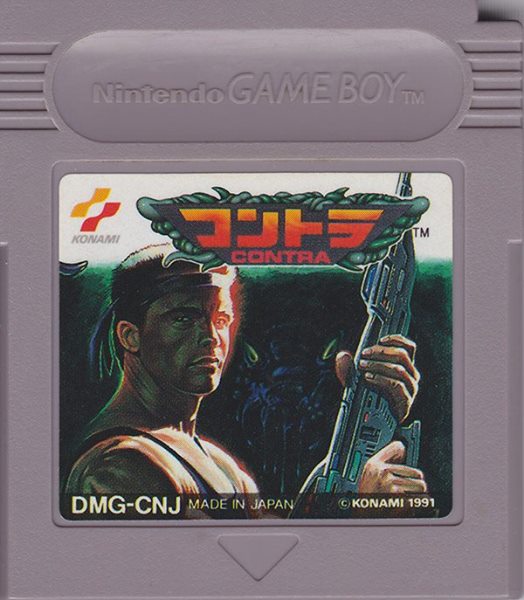
And even though you can play all the levels separately, you kind of want to get to those levels with one of those power-ups. This is kind of a classic, must-have game for the Game Boy. You can buy the Operation Super C version, but if you buy the Japanese version, Contra, it's got a way cooler cover. It's got the main dude standing there.
A little bit like the poster for the movie Commando. A lot like the poster for the movie Commando. This game is never that cheap. No matter what condition it's in, you never see it for less than ten bucks. If you want a copy in the box, it's in the thirty dollar range sometimes. And since it's a Konami game, there are Konami codes.
If you want to start the game with ten lives, up four times, down four times, left four times, right four times, B, A, start. If you're looking for Contra, the Japanese version, DMG-CNJ. If you're looking for Operation C, the American version, DMG-CN-USA. If you're looking for Probotector, the European version, DMG-CN.
Gargoyle's Quest by Capcom was released in the summer of 1990 in the U.S. and Japan. The Japanese version was called Red Aramer, Makimura Gaiden. This game came out in Europe and Australia in 1991. In the summer of 2011, it came out on 3DS Virtual Console. This game stars Firebrand, Red Aramer in the Japanese version.
Firebrand was the red demon guy that showed up in a little game you might know called Ghosts and Goblins. Although, he wasn't a playable character. In fact, I think he was a bad guy. Not that I ever got that far in that game. That's hard. This game is a side-scrolling platform game with an RPG. Kind of a rudimentary RPG, but I'm not talking about just RPG elements.
I mean, it's an actual RPG. You're walking around an overworld, talking to people, picking up objects. But it's a very simplified RPG. You'll probably find that there's not that much challenge in the RPG part of it. It's just a lot of fun. It's a more interesting way to get to levels. You know, when you're on the overworld, outside of towns, instead of having random roll-the-dice turn-based battles, you're playing little side-scroll levels.
A lot of times, it's the same little levels over and over. It's more fun than fighting rats in your typical RPG. This game doesn't take place on Earth. It takes place in the ghoul realm. It's all very dark and satanic. Now, the cover of this game, in the American version, he's not red. You know, I think it looks a little bit too satanic, and, you know, probably the fundamentalist Christian families freak out if their kids brought this thing home, so...
Instead, you got this cute little green guy. He looks totally harmless. He is wearing a red vest, but in the Japanese version, he's a red dude. When you're out on the overworld, it's pretty typical RPG stuff. You're gonna be talking to characters and collecting objects. Now, when you're in the platform sections, Firebrand has a few different things you can do.
First of all, if you hit the pause, you can select a different weapon. At the beginning of the game, you don't really have a choice, but later on, you'll be able to choose different weapons. And they're all just different types of projectiles. So you can jump and shoot, but not only can you jump, if you tap your jump a second time, you will hover in the air.
Now, the hover is limited. You'll see a little bar shrink down, so you can actually see how much flight time you've got left before you have to jump again. Later in the game, you'll be able to improve your character and extend that a little bit, until eventually you have infinite flying ability. Now, you can't fly up. You can kind of jump up and then hover.
And there's no wings. Like, pressing your button to flap your wings is not gonna help. You just want to tap that button and hold it. Firebrand can stick to walls and jump off walls. And when you're hanging on a wall, when you fire, it fires behind you. It's really handy. You don't actually have to turn around to fire.
Like, he's not gonna fire into the wall. He's always gonna fire behind you. Apart from more powerful weapons, a little bit later on, you're gonna get a weapon that will kind of make a glue that temporarily sticks to spikes. And what you can do with that is shoot, if there's a spiked wall and you don't want to hurt yourself by jumping into it, you can shoot this weapon on the wall. It'll make, like, a little splotch.
You can jump on that splotch, then jump off it. You can use this technique to climb spiked walls. Normally, to climb walls, you don't just push up to climb. You actually have to kind of jump off and jump a little higher to get up the wall. The controls in this game are flawless. Everything feels right.
There's never any point where you're frustrated by the controls. There are boss fights all over the place. They're kind of interesting boss fights. You're not just doing the same thing all the time. Each boss has an interesting kind of twist. I don't want to tell you about all the bosses because it's kind of fun to just discover them on your own.
Once in a while on the overworld and in the levels, you'll find vials. If you're on the overworld, use the check command to pick it up. If you're using the Japanese version, you can't read what it is. It's talk, use, level, and check. Level is just to check your current levels. Use is to use an item.
The only time you use an item is when you're having a conversation with someone or you need to give a special item to someone. It's not used very often in the game. These vials are essentially money. You use them to buy Talismans of the Cyclone, also known as a one-up. A little bit later in the game, you're going to get this thing called an Essence of the Soul Stream.
When you hit the pause menu, you're going to see this little bottle with a heart. If you use that, it refills all your energy. Great, but you only get to use it once per level. Sometimes in the platform sections, you can find a heart. You won't find them in the overworld. This thing just restores a little bit of your health.
In the towns, there's always a building where you can talk to someone and they'll give you a password. So that's your save system, basically. The sound effects and music are really nice in this game, and the graphics are, I think, incredible. It's amazing this game came out in 1990, considering how good it is.
You know, in 1990, it might have been the best-looking, best-playing game there was. It's not a really long game, but the difficulty is pretty high. There's no time limit, so you can really take your time and go through these levels, and that's kind of how you have to get through the game. If you just kind of plow your way through, you're not going to make it very far.
For the first while, it doesn't seem like it's going to be that hard, but later on, there are some really tough situations with spikes, and a few leap-of-faith situations where you just have to play it a few times and memorize it. If you're playing the Japanese version and you can't read it, most of the time, you're just going to the villages and talking to people.
There's always going to be, like, a big guy in a chair that you're going to talk to, and he's either going to want an object or give you an object. So you can use the use command if you're not sure, and just say yes to everything. If that doesn't work, say no. Right at the end of the game, a character is going to ask you if you want to fight him or not, or you want to join him.
You have to say no, and it's at a point in the game where you have to kind of go pretty far back if you make the mistake, so don't answer that question. Gargoyle's Quest, highly recommended. If you're looking for the Japanese version, search for DMG-RAJ, or just DMG-RA for the U.S. version, DMG-RA-NOE for the European version, or just get it on the 3DS Virtual Console.
Solar Striker was released in January 1990 in Japan, February 1990 in the U.S., a little later 1990 in Europe. I don't know if this was a launch title, but it was pretty close to the launch of the Game Boy. This is a top-down shooter. You're at the bottom of the screen, you move back and forth and up and down, and you're firing upwards.
You hit A or B for fire, you don't have to keep hitting the button, you can just hold it down. And there are six stages. Spaceships will come from the top of the screen and shoot at you, and you will shoot them with your lasers to destroy them. Most of them take one hit to kill. Once in a while, you'll see a power-up.
This will power up your laser to make it more powerful. It doesn't really make the shots wider or anything like that, it just makes them more powerful and look different. At the end of every stage, there is a boss. It's a bigger ship that moves around and shoots at you, and you have to shoot back at it until it is destroyed.
The enemy ships don't animate or anything like that, they're just still sprites that move around. The sounds are pretty subpar, the explosions are not very exciting. There are no other types of weapon upgrades, there are no bombs, there are no other types of weapons you can switch to. The music is probably the most interesting part of the game, although it's not remarkable.
What's good about this game? Well, the controls are good, the collisions are good, like the bullets seem to hit stuff and it seems pretty fair. The difficulty level is pretty even all the way through. The name Solar Stryker is really cool. Solar Stryker. And the logo is really angular. I like that. Don't get Solar Stryker. If you're into shooters, you're gonna have about four minutes of fun with this.
Even though it was such an early title, I still can't cut it that much slack, because they could have done a lot more. Or they could have done a little more, they could have done something. It really feels like this game was developed in about a week, and it probably was. There's no reading in this game, you can get the Japanese version if you want.
It's very cheap, it's like Aliway, it's one of those ones you see all the time. DMG-SS for the US version, DMG-SSJ for the Japanese version, and DMG-SS-NOE for the elusive European version. Sumo Fighter Tokaido Basho was released in April 1991 in Japan, and March 93 in the US. A big two-year gap there.
And the US version was just called Sumo Fighter. For those of you who didn't grow up watching Super Duper Sumo, Sumo is a wrestling sport. Sumo is the name of the sport, it's not the name of the guy. That's a wrestler. In Japanese, they call it rikishi. And the ring is the do-hyo. It's a Japanese sport, it's really only done professionally in Japan, although there's a lot of foreign wrestlers.
There's a lot of tradition involved. There's like a Shinto ceremony where they do the salt thing, and they have to wear like Edo-style hairstyles and live in these communes. They're called heiya, like a training stable for humans. They're not allowed to drive. There's all these really strict rules. They can't even wash their pants.
There's something about those diapers they wear. They get really stinky, like if you wash it, it's bad luck. And there's a... Where I used to live, there was a sumo stable nearby. You could smell it walking by. They were pretty strong. Once in a while, I'll see a rikishi on a subway or something like that, and yeah, they're kind of...
You can smell the kind of diaper-y thing. Although I've seen them in formal wear, like in Aksaka in Tokyo, I've seen. They look like kind of stars or retired stars. This is a platform game. You play a rikishi. You're not really wrestling. It's not a wrestling game. Here's the storyline. A ninja has captured a damsel in distress, and you need to rescue this damsel from the ninja.
Now, we don't really know. Maybe this ninja is a good guy or something. Maybe she tricked him to capturing her, and she's the bad guy. We don't really know. It doesn't explain any of this stuff. She might be a female impersonator. There's no way of knowing. And you really don't need to get the English or Japanese version.
It doesn't matter. There's no reading to do. It's all pretty straightforward. And you're walking from left to right, generally. The A button is jump, and you can hold it down to go a little longer. The B button is your hit. That's an open palm attack. In this game, it's very much about the timing of those attacks.
You're a very, very sensitive sumo fighter. If anything touches you or even comes near you, it causes damage. You want to time those strikes so you hit things exactly at the right time, so they don't damage you and you damage them. If you jump and then strike, it has a little bit different effect. If you double tap left or right, you'll run.
For some situations where you need to jump really far, you'll have to double tap and then jump. If you double tap and hit B, your attack button, it does a headbutt. If you hit up and B, a flying hand will shoot out of you and damage your enemies. Now, these flying hands are not free. There are barrel power-ups that you have to collect.
And you'll see at the bottom of the screen, there's little triangles showing you how many of these attacks you have. Not super useful. What is really useful is down and A does a shiko. Shiko is that leg-stomp thing. You know when at the beginning of a sumo round, they'll stomp their legs and do a little thing.
Well, that, in this game, will stun the enemies. At the bottom of the screen, you'll see your health, which starts off as three. You'll see experience points, slash, and another number. That number is how many experience points you need to be able to level up. And every time you level up, this number will get higher and higher.
Like later in the game, you'll have to get 100 just to get one little level up. And there's like a little triangle, like an arrow pointing down. That is how many lives you have left. And then you have your score. Now, there is kind of an RPG element to it. There are three different things you can power up, and they all have five levels.
The hand, this is your attack power, but it also affects what kind of blocks you can break. If you fail to power this thing up and you get to later levels, you're not gonna be able to break open blocks, and breaking the blocks is how you get food, it's how you get experience, and all kinds of stuff. So you'll kind of paint yourself in the corner in this game if you don't keep powering up that hand thing.
There's the foot. This affects your stomp power. It's not super, super useful. There are later bosses where the stomp is really gonna help you out. For most of the game, just the regular stomp with no upgrades is enough to knock out most enemies. At the most, you have to do it twice. But just with bosses, you don't really do enough damage with the stomp, so you'll need to power that up later.
And then you have the heart. That's your health power-up. In this game, I recommend powering up your hand first, at least up to four, then start powering up the heart, and then, depending how far you are in the game, maybe start giving the foot a little bit of power. But definitely at the beginning, power up those hands, because the first couple of bosses you can beat just by locking up to them and hitting them as fast as you can, and you'll hopefully defeat them before they leave you.
There are five areas, each with three stages and a boss, and an extra boss at the end, just for kids. The feel of the jumping is actually pretty good, especially for a game that came out so early in the Game Boy's life. A lot of those early games had really lousy controls. It's very forgiving. Like, if you jump up to a platform and you're not even gonna make it, it just kinda pops you up onto the platform. It's very helpful.
And you can really edge yourself over to the edge of the platform without falling off. And I've found there's very few situations where the jumps are really that critical. Like, you don't really have to go that close to the edge to do a double-tap jump. It's not like Rockman, where you have to, you know, go to the last pixel before you jump.
The enemies are very, very strange. You're gonna see all kinds of weird stuff. The timing is critical. The first few times I played this game, I didn't really like it, because I didn't really get the timing. I just found that every time I hit someone, they did damage to me. And it feels like that for a long time, but after you've played a few times, you kinda get used to the timing, where you have to hit certain enemies, and which ones you shouldn't even bother hitting.
I'd say anything that shoots a projectile at you, as soon as you see them, as soon as you see their pixels on the edge of the screen, stop, do your stomp. It'll save you a lot of headaches. And a lot with the projectile throwers don't give you prizes anyway. Break all the blocks you can, because you need to level up your abilities.
And the key to leveling up the abilities is to pay attention to the experience meter. Now, there's a number slash another number. Once you reach that number, you're gonna see the experience meter flashing. As soon as you see that, hit start and level up your ability. The worst thing you can do is keep going and then die, and every time you die, you lose all of that experience.
That's the most frustrating part of the game, especially later on in the game, where you need 150 experience points to level up anything. I was at 149 once and I died, I was so mad. You can play this game on Easy, and you can play this game on Hard. I find the big difference with Hard is there's just more enemies.
Birds that fly down and annoy you. But I find the bosses are just as difficult with Easy mode or Hard mode. But it might be the case that on the Hard mode, you need a certain amount of hand power to break the blocks. I'm not sure, because I played it on Hard first, and then went back and tried it on Easy, and I learned my lesson and powered up my hand, so I don't know if having weak hands will limit you in any way in the Easy mode.
I assume it will, but it might not. There are power-ups all over the place. Generally, they come from hitting enemies or kicking blocks. Sometimes, bamboo shoots. I'm not sure what they are. Bowls of rice give you one experience point. And all these things give you a few points, if you care about points.
Dango is these little rice balls on a stick. You see them in lots of games. That gives you one health point. There's a thing that looks like a four-leaf clover. That gives you five experience points. There's a barrel. That gives you a lot of points, and it also gives you that flying hand power-up thing.
That's the one where you hit up and B at the same time, when you shoot that hand. There's a card with a skull on it. That makes you invincible for a short amount of time. There's a little box with a star on it. When you have that, do the stomp thing, and it'll clear out all the enemies on the screen.
It seems like a big deal, but there's never that many enemies on the screen at the same time. And usually, the regular stomp will just clear out a ring out anyway. And once in a while, you see a little one-up. It looks like a tiny version of you. Food bowls are pretty rare, but they give you a full health restore.
And then once in a while, you see a skull. Well, that's not a good sign. It's supposed to be worth a lot of points, but it also reduces your experience down to zero. And you lose a little bit of health. Most of this game isn't really that hard, but what is hard? The bosses. The first one's not bad, and this is why you want to power up that hand.
You can actually beat him without powering up your hand, but it's not pretty. If your hand is on level two, hopefully three, but even if it's just at two, you should be able to just run into the guy and just keep hitting with the hand really fast. And if you're lucky, he'll run out of health before you do.
In area two, this boss shoots dogs or wolves at you. I found this one pretty hard. I couldn't really figure out the pattern. I just tried to fight the wolves off as best I could and try to get a stomp in. The problem was, I didn't power up my stomp very much, and my stomp was pretty slow and not very effective.
And you'll find with the bosses, the stomp doesn't really knock him out for very long. Number three, it seemed pretty hard, but there's a trick to it. In number three, when you're fighting this boss, there's a little platform. What you want to do is jump up on that platform. He's going to run back and forth under you.
You still have to jump over his head and make sure he doesn't hurt you. Jump over the head, do the stomp, and you'll have just enough time to jump over his head again. You keep doing the cycle. Now, if your stomp isn't powered up, it'll take a lot of cycles, but as long as you just keep not hitting him and jump over him, uh, you practically don't have to touch him the whole time.
Now, the area four boss, I couldn't beat. So I actually haven't been to the end of the game. I couldn't get this guy. This guy burrows under the ground and pops up under you, but you really can't move that fast, and, you know, you're kind of a big guy, and there's not a lot of room on that screen to move around.
And then he flies up in the air and shoots Isaac, and any time you want to hit him, you pretty much take damage. I found even with my hands powered up to full and my health powered up to full and a little bit of stomp, I couldn't do it. So maybe the key is having really high stomp. I don't know. You might want to check on YouTube on how to beat this thing.
Now, luckily, this game has continued, so you can keep playing this level over and over. If you haven't powered up your abilities enough, by that point, you're really stuck, so that's why you want to make sure. You probably want to play this game a couple of times and get used to it, and then really play through and concentrate on that, uh, experience thing.
Okay, so once in a while when you're running around these levels, you're going to see these little tiny gates, like a little folding stool. Once you get that, you're going to see three cards. Pick one of the three cards, and if you're lucky, you will play a mini-game. If you're not, you'll pick a card, and it just says, oh my god, and you don't get to play.
Now, these mini-games are all about timing. You've got a sumo match, and you've got, like, a timing thing on the bottom of the screen, and you want to stomp that thing in the middle. And don't let it keep bouncing back and forth. That means the other guy's winning. You want to hit the middle on every cycle.
If you play this game on an emulator, you'll find it a lot harder to do this. I had a lot of trouble with this on emulators, and when I was taking screenshots, I had a lot of trouble. On an actual Game Boy, there's no lag or anything, so it's really easy to get the timing. These things are going to give you a lot of experience, so if you want to level up your character, you want to get a lot of these.
There's an arm-wrestling game. It's very much like the sumo game. It's a timing, back-and-forth thing. Thumb wrestling is a little weird, because you're kind of playing against an AI, and the AI is... it's how close you get to the middle, not how many times you hit the middle. When the enemy gets the cursor close to the middle, you have to be closer to the middle than the enemy.
I found in later levels, the speed of this thing got too crazy, and I just tried to avoid going to those bonus levels at all, because I couldn't win anything. It gets really, really fast. Unless your timing is really perfect, it's hard to... The arm-wrestling, I swear, I played for over 15 minutes once.
It was just back-and-forth, just one round, not the three rounds. Just one round of arm-wrestling, because, you know, you can easily be winning 90% and then miss a couple, and you're back down to 60% again, and I just kept going and going. Eventually, it wore me out. The music in this game is good and bad sometimes, but in the bonus rounds, it'll drive you crazy.
It's like this weird droning, repeating, not even music. But then other times, there's really great background music, really catchy stuff. And the graphics, I think, are really nice, especially for a 1991 game. You know, there's a variety of characters, the animation is good enough for what you need to do, and the backgrounds are interesting.
Don't get me wrong, this is not a great, great game. It's not bad, and it's very cheap. At least in Japan, this thing is like almost a throwaway game. I see these for 50 yen to 100 yen, so 50 cents or a buck. There's no save game on this, so you won't have to replace the battery. Look for DNG-SFJ for the Japanese version, or DNG-SF for the U.S. version.