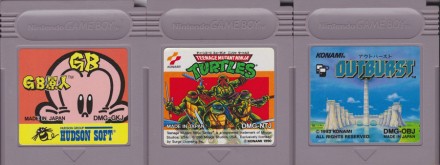
Reviews of Bonk’s Adventure, Teenage Mutant Ninja Turtles – Fall of the Foot Clan & Outburst.
Welcome to episode 8 of Game Boy Crammer. Today I’ll be reviewing Bonk’s Adventure, also known as GB Kid, Teenage Mutant Ninja Turtles, Fall of the Foot Clan, and Outburst. I just got a letter from Rafael Aguilar Jr. and he let me know that he just got into the art of collecting Game Boy Games’ first import title, King of Fighters 96. Today I’ll be reviewing a fighting game and I’ve got a few more fighting games to come. I’ll definitely keep an eye out for King of Fighters 96. Thanks Rafael. Also thanks to Ceylonika Shen who recommended Bonk’s Adventure today. Head over to the Facebook page if you haven’t already seen it, Game Boy Crammer, on Facebook. Also check out my Pinterest page. I know, I’m a granny. Check out my Pinterest, it’s called Plywood 747, or look up Retro Nerd Fever. First up, Bonk’s Adventure.
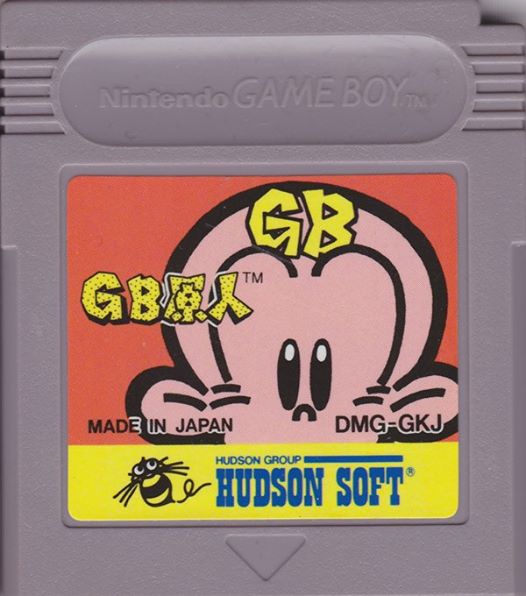
Bonk’s Adventure by Hudson. This game was called GB Genjin in Japan, in Europe, BC Kid, in the US. Bonk’s Adventure. And it came out in late 1992. It’s basically a port of the TurboGrafx-16 or PC Engine, which was a 16-bit system in the early 90s. It’s a platform game starring a cute little caveman who bonks enemies with his head. This was sort of like the Mario or the Sonic type of mascot flagship game for the TurboGrafx-16. The name is kind of a pun.
TurboGrafx-16 in Japan was called PC Engine and the word Genjin means caveman, original human. So they call their version PC Genjin, but it doesn’t really make sense for the Game Boy, but it’s GB Genjin anyway. There are three games on the Game Boy with starring this character and you can get them all on one cart, only released in Japan, called Genjin Collection, which was released in 1996 and it contains Bonk’s Adventure, Bonk’s Revenge, and GB Genjin Land. Viva Chikun Okoku. Now the second game is very much like the first game. I’ll do a review of that some other time. But the third game is a little different. It’s not a platform game, although you do play as your character, you still have the same moves and everything. It’s sort of a, it’s a theme park with six mini games. You go to a ticket booth and you buy tickets and you play games, like Breakout with Bones, where you’re using your head to hit the ball, Whack-A-Mole, that sort of stuff. Back to Bonk’s Adventure. Anyway, this game, it’s not a direct port of the TurboGrafx-16 version. It only contains about half the levels, they’re shorter levels, it’s missing a lot of the elements, and the bosses are different, but you get, you definitely get the feeling. It feels the same, the moves are the same, like you can do the same stuff with your character. It looks the same, I mean, it’s black and white, very simple outlines, but they did a really good job with the graphics of making it very clear to see on Game Boy. You’re missing out on the more detailed, longer levels and difficulty of the TurboGrafx version, but you still get the same kind of experience. It still feels about the same. You use A to jump and B to bonk. You can use B and headbutt your enemies, you can jump in the air and hit B to flip around on your head and land headfirst on your enemies. And the other thing you can do is you can jump in the air and keep flipping. You keep tapping the B button, you keep flipping through the air, and you can kind of fly a little bit longer, kind of like the raccoon in Super Mario 3. The other thing you can do is you can bite onto walls. If you jump onto a wall, you can bite it and kind of crawl up with your teeth.
You’re gonna find, to get to a lot of the hard-to-get areas and bonuses and stuff like that, you do need to flip through the air a lot to extend your jumps. It’s definitely easier than the TurboGrafx-16 version. It’s a pretty quick game, but you’re gonna challenge four bosses, initially. And then when you do get to the final level, which doesn’t take very long, you’re gonna have to fight those four bosses again, just like kind of the same pattern in the original version. And then you have to fight one giant boss at the end. Now, that final boss is the most challenging part of the game. It’s disproportionately challenging. Once you figure out the pattern, it’s not that bad. It takes a long time to fight that final boss, though.
You’ll probably think you’re not doing it right. You basically have to stand in the middle, wait for him to come down, dodge him really quickly, and then headbutt him a few times. You have to stand exactly in the right spot so you don’t take damage. If you can do it once, you just keep doing that over and over and over until you finish him. To help you on your way, you have these little meat power-ups. So you break these flowers open with your head or jumping on them, and you get a chunk of meat, which gives you strength. So you get a little bit stronger and your appearance changes.
And then if you eat another piece of meat, you’re invincible for a short amount of time, eventually changing back to your original form. This is not a one-hit wonder game. You have a health meter. It’s very forgiving, and it’s a pretty easy game. The music is great. It sounds like the same music in the TurboGrafx version. Very similar, anyway. The sound effects seem like they’re the same, too.
It just sounds great and looks great. I would say if you’ve never played Blanc or PC Gingen, or whatever you want to call him, I do recommend playing it on the TurboGrafx. I mean, that is definitely the version to play. There’s no reason you shouldn’t get this one. I mean, it’s Hudson, so pretty much any time you see Hudson on a cartridge, you might as well just get it. There’s not a lot of replay value in this. I mean, once you get to the end of it, I mean, those levels are pretty sparse. I found the bonus stuff pretty easy to get to. Unless I’m missing something, there’s nothing that’s really inaccessible. Oh, and I should mention that there’s no reason you can’t play the Japanese version. I think the only challenge that you might not understand is when you’re up on the pillar. There’s these bonus flowers you can get, and there’s one part where you’re up on a pillar, and you have to jump off. You’re supposed to flip as many times as you can before you hit the ground. Now, I haven’t tried the second one on Game Boy yet, so I did pick it up, so that’ll be coming up in another episode. If you’re looking for this cartridge, search for DMG-GK, the English version, or DMG-GKJ for the Japanese version.
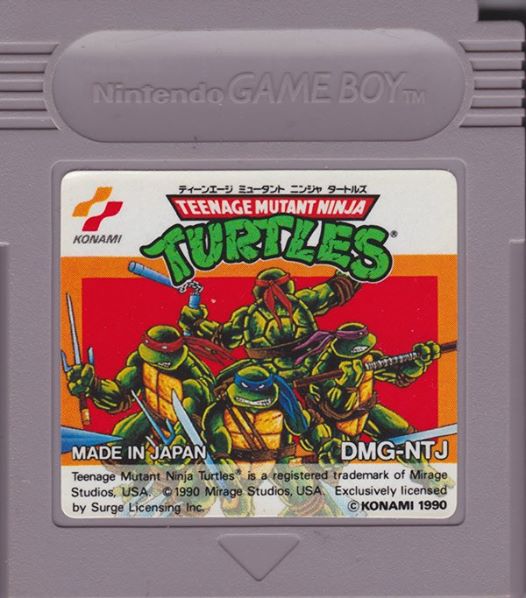
And if you want the Genjin collection, DMG-AG3J. The Teenage Mutant Ninja Turtles Fall of the Foot Clan came out in 1990 in Europe, US, and Japan. In Europe, it was called Teenage Mutant Hira Turtles. It was released by Konami, distributed by Ultra in the US. It’s a side-scrolling platform game where you play the Teenage Mutant Ninja Turtles. If you don’t know what these are, well, you’re lucky. I gotta admit, listen, I’m not a big fan of the Ninja Turtles, but I can appreciate a good Ninja Turtles game. Like, the Ninja Turtles arcade game was amazing. You know, I’ve played… there was one on the Super Nintendo that was pretty good. But listen, this is not a good game. It’s not just my bias against the Teenage Mutant Ninja Turtles. You know, I was in high school when it came out.
Someone said, hey, have a look at this cool new comic book. And I just didn’t get it. It’s just not my thing. I prefer Archie Comics or, you know, Casper. But hey, maybe you like Ninja Turtles. This is not gonna satisfy your Ninja Turtle needs. I guarantee you that. When you start the game, you have a choice of level that you start on. That’s right. You don’t have to work your way through the levels in this game. You can just start on whatever level you want. And how many levels are there? 100 levels? No. 50 levels? No. There are five levels. That’s right, five levels.
Five fairly short levels. So when you start the game, you have a choice of attack as A or jump as B or vice versa. I recommend vice versa. If you play it the default way, it feels kind of counter to most games. You know, it just feels unnatural. If you jump and attack at the same time, you get a jump kick. If you duck and attack, you throw a ninja star. And that’s it. As you walk through these levels, you will be confronted by a variety of enemies. By variety, I mean two or three. There are generic bad guys. There are generic bad guys in a slightly different color. They all seem to be made of some sort of paper, since you just have to touch them and they die. There are little hovering robots, I guess. The little game boys with propellers flying around. They don’t look too fierce and they don’t shoot at you and they also seem to be made of some sort of paper as they burst into flame as soon as you touch them. And then there are these other robots that walk around.
They look kind of like a chicken and they’re kind of interesting and they don’t seem to hurt you in any way except if they touch you, you lose a little bit of life. But they don’t have any kind of attack. Nothing really has any. There are no fighting moves. It’s not even like Double Dragon where you can do some interesting grapples and punches and kicks and stuff like that. It’s all just push the button and make things die. The bosses are a joke. They all have some kind of cheap exploit.
You just kind of get behind the character and kind of mesh your sprites in with his and whack the button a few times and that’s the end of them. Now the story in this game is rather interesting. There’s a woman named April who is in distress and needs to be rescued. I’d say it’s kind of unique for a video game. There are power-ups and guess what they are? Pizza. That’s right, because the Ninja Turtles love pizza. What else are you gonna put? You know, sometimes when you kill an enemy the power-up will appear in the floor and you can’t even get at it. Just awful.
I mean you can finish this thing so quickly. I’m sure even the most die-hard Ninja Turtle fan was disappointed with this game when it came out. It’s so lazily slapped together. I guess they figured, you know, handheld video games people will be amused by anything and they were probably right at the time. It was just amazing to have a video game in your hands. But still, if you look at the games that came out in 1990, there’s some Mario classics and you know this just has nothing to offer. You can find this game really cheap. Anywhere Game Boy games are sold you can find these for pretty much the lowest price range. I think Alleyway and this are the cheapest games you can find. There are other Ninja Turtle games which I may review someday but believe me stay away from this one. If you would like to torture yourself DMG-NT for the European version, DMG-NT-USA for the US version and DMG-NTJ for the Japanese version. Turtle power!
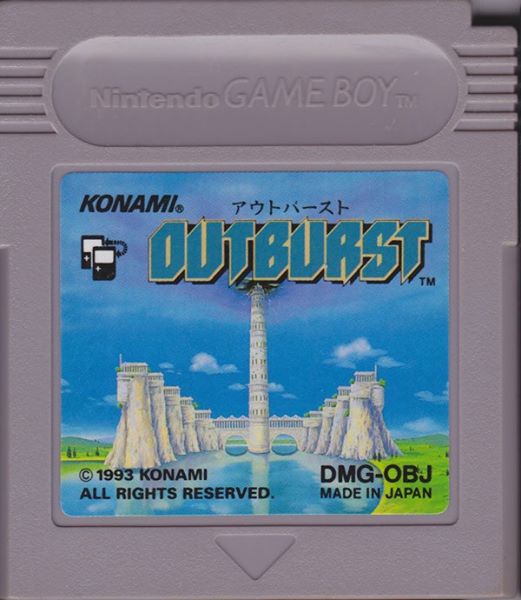
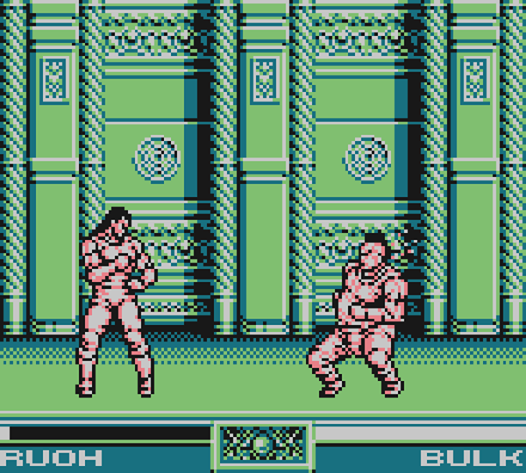
I was yelling like a wild animal. I felt like a jackass screaming at the top of my lungs. Outburst by Konami. This game came out in 1993 for Game Boy, also known as Raging Fighter elsewhere. It’s a fighting game. That’s right, a two button fighting game. Now around the time the fighting game craze, the big Street Fighter 2 craze, that was around the time of the 16-bit era.
So most of the console fighting games came out on 16-bit or later systems. There’s not a lot of fighting games on Sega Master System or NES so you didn’t really have to deal with a lot of two button fighters. But they did exist and on the Game Boy there was plenty of them because what else are you gonna do? And they were good and bad. One of the best was, I think, Battle Arena Toshinden, which I haven’t reviewed yet because I don’t have a copy of it. But when I get it, I will give it a review. Well known as one of the better fighting games on the Game Boy. I used to play Killer Instinct and it was around the time Killer Instinct had been still in the arcades. It was not very good, partly because the game was designed to be played with more buttons. When you try to squeeze that down into a Game Boy cart, it looked okay but it just didn’t play very well. Mortal Kombat was horrible. Mortal Kombat 2 was okay, not bad. And there was some other ones. Street Fighter 2 was alright too, but you know what? I prefer Outburst because Street Fighter 2, you know, you’re kind of used to Street Fighter 2. If you play fighting games, you know Street Fighter 2.
It’s just not the same, you know? It’s like you’re taking something away. Outburst is an original fighting game for the Game Boy and it really takes advantage of the lack of memory on the system and also takes advantage of the two buttons very well. The control scheme is quite good. The structure of this game is like any fighting game. You’re in some kind of future world where they have to do some kind of tournament for no reason to prove who’s the strongest or defeat aliens or some stupid thing. At least you’re not rescuing a princess. You can actually play a two-player game if you can find someone else who’s got Outburst or Raging Fighter and Link Cable, but that’s never gonna happen. So you’re gonna play one player. You can play in story mode or you can play in tournament mode. There’s a practice mode too so you can practice all your moves. The controls in this game, A is kick, B is punch and you can actually go in the options and switch that around and change your time limit and stuff like that. Up is jump, down is crouch.
If you go down and right and hit A, you do a low kick. If you hit down and right and hit B, you do a low punch. If you do up and right and hit A, you do a jumping punch. If you hit up and right and hit B, you do a jumping kick. You can do a forward jump just by going up and right. So here’s the important part. Down and right is guard and you’re going to be doing down and right a lot in this game. Of course it has the typical fighting game roster of characters. The AI seems pretty good, especially for a Game Boy game. You’d kind of expect, you know, my expectations were low because I’d played Killer Instinct so much and that game was really terrible AI. You could just kind of spam the enemy by just doing lots of the same kick over and over again. There was really not much strategy to it. It was all about memorizing the moves and really that, for me, that ruins so many good games. They either have too many special moves that I can’t memorize or you can just kind of spam the enemy with the same move over and over. The opponents all have their own special moves. Luckily you only have to remember two moves for each opponent. Start off with Redin and the English version his name is Tau. His special moves are left, down, right, A, does kind of a combo move with a whole bunch of punches and kicks and stuff like that. There’s another move which I have trouble executing where you basically jump over your opponent and press down. That’s what it says but you kind of have to sort of kick him in the head with your toe. I find most of the time it’s easier just to actually kick the guy in the head. The next character is Vandal. He’s a little bit slow, a little bit stronger. His move is right, down, right, B and it does like a little flipping somersault move. There’s a combo move where you hit down for a second then right, A.
Now Asuka, a little bit slower, has this kind of another one of those combo moves or it’s just a whole bunch of moves that are executed in a row where you go right, left, right, A and then you can shoot a Hadouken bullet by going left, down, right, B. Bulk is your typical big, slow, tough opponent. He has this head bang move where he head butts you and you go right, right, right, B.
It’s very useful and it really takes a lot of health off the opponent. He also does kind of wrestling move where you jump over someone and press B and you’ll see it’s like a little wrestling slam thing. Miyabi is really fast, really good, close, not so strong so you can’t take a lot of punches. Her special moves are down, up, and A and she does like a spin move. Hold down for a second then go up, A. It took me a while to actually get this one to execute but it does like a spin kick.
Ruo is another good balance character. Ruo and Shades are to me almost the same. In the Japanese version Shades is called Shadel. I’ll go over Ruo. Ruo does a Hadouken, like an energy ball, left, down, right, B and Shades or Shadel does exactly the same move. Ruo does like some kind of uppercut punch which is down, left, right, B and then Shades, Shadel does his own kind of version of it which is down, left, right, A. I think if you’re going to buy only one Game Boy fighting game I’d probably stick with Battle Arena Toshinden but this one’s pretty good too. If you want kind of a typical straightforward fighting game this is it. I would choose this one over Street Fighter 2. I would definitely choose this over Killer Instinct or Mortal Kombat. Even Mortal Kombat 2 is not that great and Primal Rage is not really my thing. Samurai Showdown is not bad either. There’s a few other good ones. It works really well on Game Boy Color. The characters end up kind of pink and the background kind of blue so it makes it really easy to see what’s going on. For the Japanese version search for DMG-OBJ. If you’re looking for the European version it’s DMG-OB-NOE. For US it’s DMG-OB-USA.