Game Boy Crammer · Episode 9
Bubble Bobble, Chase HQ, Parasol Henbee & more Game Boy History
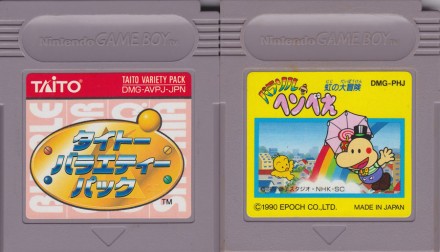
Reviews of Bubble Bobble, Chase HQ, Parasol Henbee & the History of the Game Boy, part 2.
Welcome to Game Boy Crammer, Episode 9. Today, I'll be reviewing Bubble Bobble, Chase HQ, and Parasol Henbee. I'll be doing a little section on the history of the Game Boy, Part 2. Let's get on with the show! Next to a big review!
Bubble Bobble is an arcade game by Taito. It was first released in the arcades in 1986, and after that it was ported to almost every computer and game console around. It's a non-scrolling platform game. You play this cute little anime-style dragon. You can move left and right, you can blow bubbles, and you can jump.
When you shoot an enemy with a bubble, it'll encase it temporarily. You can pop bubbles by jumping on them or using the spines in your back. If you pop a bubble with an enemy in it, the enemy is defeated and turns into a prize, which earns points. If you can pop several bubbles with enemies in them simultaneously, you get better prizes.
If you take too long to pop the enemy out of the bubble, it'll come back angry. If you take too long to defeat all the enemies, invincible enemies like the Skell Monster or Baron Von Blubba will try to kill you. There's a hundred different levels. As you go through the levels, new enemies are introduced.
Some of them start firing projectiles at you, and one hit and you're dead. This game was really popular, and there were a lot of sequels, like Parasol Stars, Bubble Bobble Jr., and even Puzzle Bobble, which you're probably familiar with. It's one of the first games where you had different endings. It's not complicated to play, but just the way the bonuses happen.
You know, in some early arcade games, if you did things a certain way, you'd get a slightly different kind of bonus show up. This one is just completely made of that. Everything you do affects different kind of bonus things that show up, and it makes it a lot of fun because you can play the same level so many times and just get different stuff all the time.
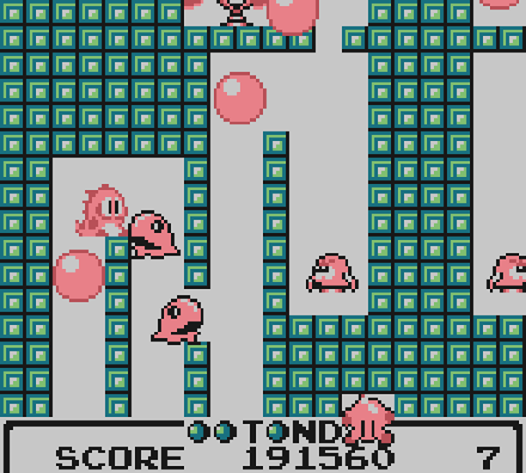
Well, let's get to the Game Boy version. The main difference with Bubble Bobble for Game Boy is that the screen scrolls around. In the arcade version, the NES version, and most other versions, you see the whole level on screen. But in this version, you have to scroll around. This would be more of a problem, I think, if it were trying to represent exactly the same levels as the arcade game, because don't you hate getting kind of an inferior version of something?
However, these are different levels. They've been tested with this scrolling thing. After a while, I don't even notice the scrolling at all. Yeah, it takes a little getting used to if you're a really hardcore Bubble Bobble player, but, you know, it's a different kind of experience. Now, here's a weird thing about this game.
The way they render the bubbles and the projectiles and the prizes is they use a little hardware trick on the original Game Boy and Game Boy Pocket. They kind of flicker it so it makes actually more gray levels than you could normally get, and then you can display more sprites on the screen. Just like the original, like the NES, there's a certain limit on how many sprites can appear on a line.
You get this kind of sprite flickering. To get around that, they just flicker all the bubbles and all the prizes and projectiles. The persistence of the LCD display was slow enough. You know how the original Game Boy had kind of a blurring problem? Well, it actually used that to its advantage, because, you know, when you flip those little LCD shutters, they kind of hang around a little bit for, you know, a microsecond or whatever.
You can clearly see the bubbles and stuff. However, when you play this thing in a Game Boy Color, it's really hard to see. The projectiles and bubbles are very difficult to see, so you probably want to play this on original Game Boy or Game Boy Pocket or something like that. Even with my Game Boy Color with the front light, it was very, very hard to play.
And when I was doing screenshots and recording the audio and playing it on an emulator, the bubbles and projectiles kind of, they're easier to see, but you can see they're kind of flickering like the left side of the bubble one frame and the right side of the bubble the next frame. So that's a big consideration.
If you only have a Game Boy Color, I wouldn't recommend this one. On later levels, it's a huge disadvantage, because you just don't have the reaction time when you see projectiles coming at you. You can't even tell what some of the prizes are. They're just kind of vague. So this thing came out in 1990 in Japan, 1991 in Europe, but also it was re-released in 1997 as part of the Taito variety pack, which came with Sagaiac, Elevator Action, Bubble Bobble, and Chase HQ.
There was another one called Classic Bubble Bobble, which came out for Game Boy Color in 1999. It's not the same game. There's only about 60 levels, and the game differs in some other ways. It's got a different feel to it. If I get a hold of that one, I'll do a review on it. Now, the original arcade version was a cooperative game.
You could play two players, so you don't have that in this version. And actually, it changed the storyline a little bit. In the original game, you had to rescue a damsel in distress. How original. The only time you see her, she's just kind of chained up at the bottom of the level advance screen. In this game, you get to save a male damsel in distress, so it's very progressive.
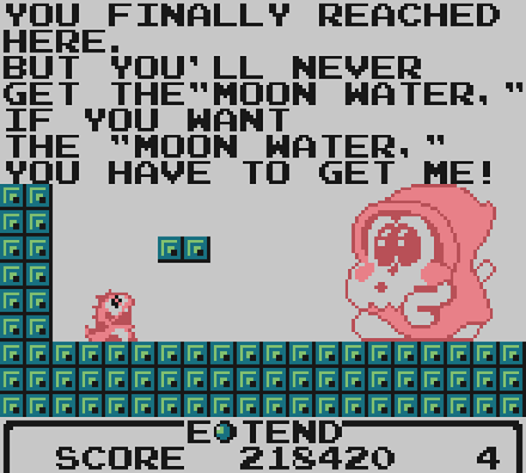
They took all the females out and just replaced it with, you've got to go save your brother by getting him moon water. In addition to just killing these monsters, there's other things you can do, which is using the bubbles to get around the screen. This is something that's not that important in the early levels, but later on you absolutely need to be using this.
And if you don't do it right, you'll be very frustrated. The most important thing to learn is riding bubbles. And the way you ride bubbles is you hold your jump button down when you're on top of a bubble. Don't just try to keep tapping and jumping because the timing has to be exact if you want to do that.
Just hold your button down and you'll keep bouncing on the bubbles. So you have to kind of watch where the bubbles are going. You can kind of generate them. Let's say you're stuck in a hole. You can kind of blow bubbles on one side of it and they're just kind of hanging there. You blow bubbles on the other side, they'll start to go up.
And that way you can ride that up to the top. Another thing that you need to learn later on, this is especially important in levels 98, 99, anyway, in the 90s, because you can get stuck in these really narrow holes. It seems like there's no way out, but there is a way out which is to hit both buttons simultaneously.
It doesn't work every time and you're hard to explain, but you can kind of generate a bubble that way and sometimes get your way out of a hole. Now another thing you can do with these bubbles is you can climb up through the bottom of the level through the top, which is sometimes the only way you can get to certain things in a level.
There's a lot of situations where you defeat some enemies and you get these great prizes, but then you can't get to them because it's impossible. But sometimes you can go through the ceiling and come up through the floor. Another thing you can do with bubbles is you can point blank shoot the enemies with bubbles.
If you time it just right, the bubble will pop as soon as it's created. So basically you're creating a bubble and popping it. You really have to use this technique in later levels. There's a little trick in this game. I rarely use it, but sometimes in the early levels I have a little bit of time to look around and think about this.
If you end the level with, so like, let's say your score is 1-2-3-5-5-0, or 1-2-3-6-6-0, 1-2-3-3-3-0, or you know what I mean, anything that's got a number number zero at the end. If you get the enemy while your score is as a double digit near the end, every bubble on the screen that you made will turn into a 700 point prize.
You can get these situations where, you know, you've blown all these bubbles all over the screen, they're just kind of hanging around and you get your score exactly right and you jump at the last bubble and it just rain prizes down. It's just so much fun. If you do need to change your score, bomb up against the wall and blow bubbles against the wall.
You get 10 points for bubble popped. So, you know, you can kind of fine tune the score. Personally, the way I do it is, every one in every 10 levels maybe I'll get the stuff raining down. I don't really pay attention to it that much. Now there are special kind of bubbles that float around. You've got these bubbles with liquid in them and you pop those and then it releases like a water slide and ride down or it'll actually knock out enemies too.
You've got like an electricity thing, like a lightning bolt, and it goes the opposite way that you pop it. So if you sort of hit it with your back, it's going to shoot out away from you, which is, you can kind of get to some hard to shoot enemies that way. And there's these fire bubbles. You pop these and it makes like an oil fire.
Now the fire doesn't hurt you because you are a dragon. So they got that right. It does slow you down. There's some levels where you need to kind of set a little fire down to defeat some enemies. And then you get the extend thing. Now extend is, you collect these bubbles with E, X, T, E, N, and D. If you can spell the word extend, you get extra lives.
Now normally you get extra lives by earning points, but this gets you an extra little chance to get an extra life. There are these little candies hanging around, and it's hard to tell which is which on the Game Boy because it's not, you can't see the colors. Like in the arcade version you can see the colors.
Some of them make your bubbles go faster, some of them make them go further, and there's like kind of a rapid fire. And they come up pretty often too. There are these umbrellas that show up once in a while, and it lets you skip ahead a bunch of levels. I tend to ignore them because, you know, you miss out on a lot of points, but if you really just want to advance further down the line a bunch of levels, well then you grab the umbrella.
And the shoe, I find the shoe shows up pretty often. The running shoe lets you run really fast. I don't really like it. I find that I can't control myself very well with it, but I used to like it in the arcade version, but I find the Game Boy version because the screen is so constrained it's very easy to get into trouble.
Oh, and there's so many other things. There's like a, there's an item that'll just zap everything and makes it like a big lightning bolt come down, which will hurt you too. There's things that fill up the screen with water. There are potions that make the screen fill with items for 30 seconds. You have to collect all the items to get big points to get them all.
There's just so many. I thought I had them all written down, but I played it just when I was making the screenshots, and I came up with, I found a book with a skull on it that blows up everything on the screen, a bomb. I just always see new stuff that I haven't seen before. So I guess part of the fun is finding all that stuff.
I might tell you everything. The enemies in this game, your standard grunt enemies, these things called Zen-Chan or Bubble Buster. It's like a little wind-up toy Pac-Man kind of thing. And then you get Jawa looking wizard things called Stoner in English and Maita in Japanese. These things shoot fireballs.
Okay, then you get these things called Monster in Japanese and Beluga in English. It looks like a little whale. You get these little helicopter popcorn looking things called a Poo-Poo, also a hullabaloon in English, and it flies around with a little beanie propeller on its head. Then you get these little springy dome things that jump around called Coilies or Banebo.
These really fast running little monsters that shoot fireballs called Incendo or Hidegonsu in Japanese. And then you get a little drunk guy called, or in Japanese he's called Drunk in English. He's Willy Whistle. And it's this little thing that jumps around and throws like a boomerang thing that bounces off the wall and comes back and hits you.
They're pretty deadly. Then you have the Invader or Super Socket. This thing looks like a classic Taito Space Invader, and it acts just like one too. Now in the Game Boy version, every 25 levels you get a boss. These bosses are no fun. They're not impossible, but you're going to have to practice them a lot.
The first one's not that bad. The second one is pretty rough. The third one is really, really hard. And the final boss, well, you're going to want to really observe the pattern on this thing because it's pretty tough. The first boss, you have to jump to the middle of the room. There's a power-up, and this lets you shoot fire at the boss.
You just have to kind of hang around the top part and jump around and try to shoot him. I didn't have that much trouble with it. The second boss, I found kind of tough. I had to figure out the pattern a little bit because if you just go in there and hope to survive by your reflexes alone, you're not going to be able to do it.
Projectiles come at you way too quickly. And the third one, it took me so long to get this one. You definitely have to memorize the pattern. And the final boss is ridiculous. The way you get this boss is, like the other bosses, you have to jump to the top of the middle of the room to get some kind of power-up.
This thing gives you, like, lightning bubbles. So what you have to do, because remember I mentioned before, lightning bubbles, you need to use your back to pop them, and they're going to shoot away from you. Well, you can also just pop them against the wall, and they'll fire back in the opposite direction.
So what you do is you grab the thing, and you jump against the wall, and bang, bang, bang, bang, pop all these bubbles against the wall, and it's going to shoot lightning bolts behind you. It's hard. You have to hit that thing so many times. But if you really observe the pattern, you can figure out when it's safe to go.
You kind of have to hang out for a while on the bottom and survive, and then wait until that opportunity when you can go up on top and get them. If you're really watching the pattern, you can figure it out. If you don't watch the pattern, well, you're not going to survive very long. And you have to hit this thing a lot to kill it.
Now, if you do finish the game, you get to start again with a higher skill level. However, to get that, you need to have something called the Good Ending. To get the Good Ending, you have to defeat the final boss after getting the cup, the crown, and the jewel items. And then you get to... I think you get a new...
I didn't do this, so I'm not sure. Start in Expert Mode after that, but that never happened to me. And finally, passwords. KGBJ, easy to remember. KGBJ. That will let you select any level you want. So you type that in and you just hit left or right, and you can select your level. And also try KZ5K, which will give you a secret level.
It's not that exciting, but I don't know how you'd normally get to that level. If you're looking for this cartridge, look for DMG-B2A or DMG-B2USA-1. But I highly recommend the Taito Variety Pack, because you're going to get Chase HQ and Saigaya and Elevator Action all in one cartridge. So it's a little bit more money.
I paid about $30 for it, but then you get all those games in it, so it's not bad. That one is DMG-AVPJ. This is one of the games I had when I had a Game Boy back in the 90s. It's one of the ones I play the most. It's not just about getting to the end of the game. You can just keep going back and playing these same levels over and over and discovering new things.
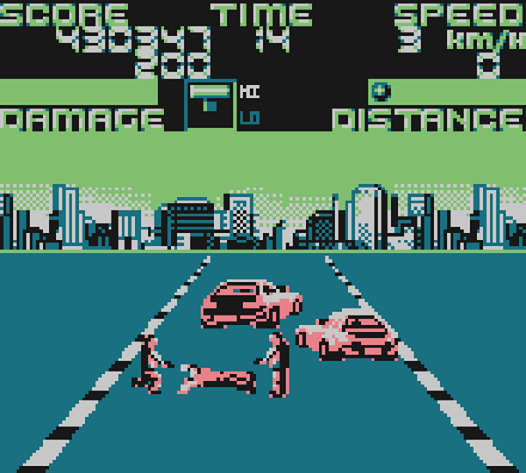
I don't think you can ever get bored of Bubble Ball. Taito, Chase HQ. This game was originally an arcade game that came out in 1988. It was a racing game where you, instead of a finish line, you had to catch up to a criminal's car, smack into it until you damaged it enough that you could stop him and arrest him.
And it was pretty successful, and it was ported to all kinds of systems. So Chase HQ came out for the Game Boy almost all at the same time in Europe, US, and Japan, basically December 1990, January 1991. When you're shopping around for this game, don't confuse this with Super Chase HQ for Game Boy, which is a North America exclusive that came out in 1994.
So this driving game has two different control schemes. I find the first one to be completely useless, and the second one is a little confusing, but better. In the first control scheme, use up arrow to accelerate, then you steer left and right. Now that's always tough, because you have to keep that accelerator nailed down the whole time.
So trying to steer left and right, you lose a little bit of control. And down, you press down for brake, A, and B. If you use the second control scheme, B button is accelerate, so you can just keep your thumb on that the whole time. Down is still brake, but then select activates your turbo. You don't have to hit it that often, so it's not a big pain to go and hit the select button.
And then you shift gears with A. So it's really easy to accelerate, hold the B down, then just tap the A a little bit, and you're pretty much just holding the B down the whole time. So while you're playing, there's a dashboard that tells you your speed, that tells you how close you are to where you're going, how far you're going, how far you're going, how far you're going, that tells you how close you are to the car you have to catch, and how much damage.
Now, the damage is not your damage. The damage is the other car's damage. I hope you're a big fan of police brutality, because you pretty much just murder everyone on the road that gets in your way. Cars just explode when you touch them. And if you do touch another car, it'll send you out of control.
Now, there's a little trick. When you go into a skid, steer the opposite way, and then steer back. So you have to kind of go, let's say you hit a car, and you start sliding left. Well, then you hit left to steer into it, and then right to steer back out. It's very far from any kind of realistic physics.
Now, the gear shift, you hit it around 100. You know, you accelerate so fast in this car. It doesn't really matter that much. You will have some trouble sometimes accelerating on a hill, and sometimes you'll have to tap the accelerator, because just starting in low gear sometimes just kind of stalls out.
There's not a lot going on in these levels. They're pretty much straight, boring roads. Sometimes there's cactuses. Sometimes there's light poles. You go through a tunnel. Once per level, you get to a fork in the road. Always go left, except on level four, where you have to go right. Just when you, you'll start to hit the middle of the level, and it's like nothing's happening.
You get this big blank stretch of road, and it's like, start heading towards the left a little bit. So you have these turbo things. Kind of save them up for when you actually approach the enemy. And when you touch any other cars, it kills your turbo, so you want to kind of use it carefully. When you do finally get to the enemy car, don't just bap into the back of it, because when you tap the back bumper, it kind of speeds off.
So what you want to do is kind of pull up right beside it, and hit it from the side. It does a lot more damage, and you can finish them off really quickly. Otherwise, you get into this thing where you just tap his bumper, he speeds away. You hit a curve, or you hit another car, and then you're, you know, eats up valuable time.
When the time runs out, you have continues. You have four continues in this game. For the first couple of levels, if you can get there before the timer runs out, that gives you a continue on each level. It gives you a lot of time to finish. So it's really not that challenging to finish this whole game.
Really, the way they ramp up the challenge in this game is adding more annoying cars on the road. They just, it seems like, they just spam the road with lots and lots of other vehicles. And once you get good at pulling out of those skids, they're really not much of a challenge. And this is a quick game.
This game has five levels. And really, if you play them correctly, they're only going to last two minutes. So, really, you can finish this whole game in ten minutes. Nothing ever changes in this game. Everything looks the same. It's the same road, the same rocks in the road, the same cars, the same everything.
Curves never really change. Basically, you're playing the same levels with a slightly different pattern and basically the same car that you catch up to. Look, it's not like Chase HQ is a great game to begin with, in my opinion, but the Game Boy version is just slightly worse. You're not going to have any fun with this game.
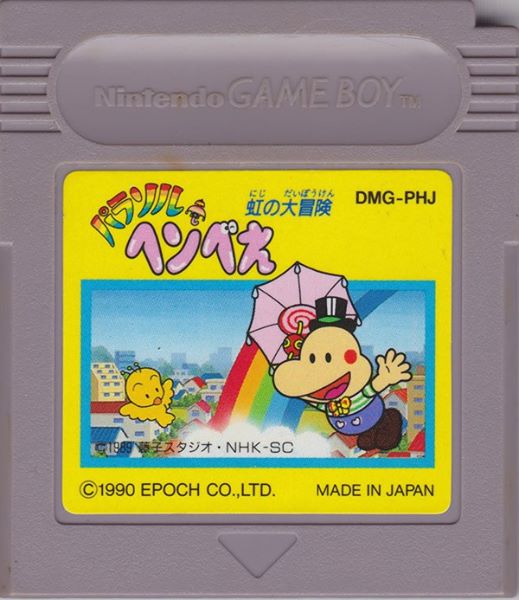
I got it as part of the Taito Variety Pack, which I do recommend because you get Bubble Bobble and Elevator Action and Sagaya as well on it. If you do want to torture yourself, search for DMG-HQ or DMG-HQJ. Parasol Henbee Parasol Henbee is a side-scrolling platformer produced by Epic in 1990. This thing only came out in Japan.
It was based on an anime series basically like Doraemon. It ran for about 200 episodes in 1989. And there's actually an English version of it somewhere. If you look it up on YouTube, you can see a couple of episodes. It's actually a pink hippo with a magic umbrella. Now there's a version for the NES or Famicom, but it's not the same game.
Parasol Henbee for Game Boy is a different kind of game. You walk along platforms and you can use A for jump and B for spins. Spin is used to attack enemies, enemies which include friendly family dogs, snakes, bats, cats, birds that try to poop on you, and you have a parasol. Now you can use this parasol when you are falling.
So if you tap up when you're falling or jumping or in the middle of a jump, it will help you. In different parts of the game, you can get a parasol power-up which will let you float through the levels Kirby-style. So you can just kind of fly above the level. And there are a few things that you can't get to like 1-ups and stuff like that.
The only way you can get to them is with this magical parasol. When you use the regular parasol, it just kind of slows your fall. It doesn't give you much control, so it's not really good for getting over large gaps and stuff like that. In fact, I find most of the time I hit it by accident and get into trouble.
There's a back wall in a lot of these levels, and you can get up on the wall by climbing a post, and then you can walk along the wall. So you can avoid some danger. Danger like garbage cans and holes in the ground and stuff like that. And push down to get back down. And you just have to get to the end of the level.
There's a time limit, and you get bonus points for having extra time left. Now, why can't you just spin all the time while you have an energy meter? And you have to eat Onigiri, little rice balls, fruit, and stuff like that to get energy. There's also a four-leaf clover, which gives you lots of energy, and there's a butterfly.
If you catch that, it'll give you... it'll keep you spinning. So it's kind of like the star in Mario, where you're invincible for a while, but you can still fall off things. There are 14 levels. Once in a while, you're gonna hit a auto-scrolling cloud level. So you're gonna be jumping from cloud to cloud.
You can ride across rainbows. The skill level required for most of these levels is very low. Although, once in a while, you're gonna hit some really difficult moving platforms. I shouldn't say difficult, but difficult compared to the rest of the game. The control of the character is pretty good. It's a little slippery on surfaces.
At least you have quite a bit of air control, so you can kind of land on moving objects not too badly. Once in a while, you get one of these try-your-luck type of levels, where you just have a bunch of objects. It's a... a grid... a screen full of objects, and you have to choose one, and then you get a prize.
And eventually, if you choose the wrong one, that's the end of it. However, you know, when I was testing this thing with an emulator just to do the screenshots and sound effects, oh, I discovered that that whole thing is rigged. It doesn't matter which one you pick. Just pick them all in a row, because, you know, I tried doing a save state, then going back to see if I could pick something different.
No, no matter what you pick, the outcome is exactly the same. What a rip-off. And as you go further in the game, your luck gets worse and worse. I guess in 1998, I thought, no one's ever gonna know. There are a few bosses, but they're not totally the same thing every time. Like, you're not just jumping on a boss's head.
There's a few situations where you have to jump on pigs, spin against a boulder to set yourself free. So you have to think about these bosses a little bit. I won't tell you about the final boss. Maybe I should. No. The music is really catchy and cute, and the sound effects are great. The graphics are wonderful.
I love the design. The enemies are just classic, cute, Japanese-style video game graphics. I never found there was anything glitchy about it. It was all pretty good. However, if you're looking for a hardcore game, this is not it. This is a little bit on the kids' side of things. Kids would really enjoy it because it's kind of rewarding, but it gets a little harder later on.
So I think if you're a gamer, you're not gonna have much fun with this. But it is adorable, and if you can find it for pretty cheap, I wouldn't hesitate. If you want to track this game down, search for DMG-PHJ. You can ride across rainbows. You can ride across rainbows. You can ride across rainbows. November 98, in North America, or October 98, in Japan, the Game Boy Color was released.
Now, this was basically smaller than original Game Boy, a little bit bigger than Game Boy Pocket, but not much. And it used two AA batteries, kind of like the Game Boy Lite. It was more powerful. It would still play old Game Boy games, but it had a double-speed processor which would kick in for Game Boy Color games.
You had these black Game Boy games that came out at the time, which could be played in either one. You could play it in the middle one. You could play it in the original Game Boy. You could play it in Game Boy Color, and it would kick in with special Game Boy Color features. Or you could get these clear Game Boy Color games, which only played in Game Boy Color, and they took advantage of the faster processor and other goodies.
And, you know, it was such a great system. It only was really around for, like, if you think of it, it came out at the end of 98, and by 2001, the Game Boy Advance came out. So it was really near the end of the Game Boy, original Game Boy Lions run. Actually, the Game Boy Color came out in many different colors compared to the previous models.
There was Atomic Purple. That's the one I have, which is a clear purple. There was Grape, Berry, Kiwi, Dandelion, Teal, Pokémon Gold and Silver, Pokémon Center Edition, Pokémon Edition, Hello Kitty Edition. There's a clear one, which I'm still looking for, but that was Japan only. There's Clear Green, which I just saw yesterday.
Clear Black, Midnight Blue, Ice Blue, Clear Orange, Japan only. Tommy Hilfiger Edition, and Clear Blue. And to me, this is, to me, the best Game Boy system for playing games. I mean, a lot of people do like the original Game Boy, especially if you're a musician. The sound of the original is much better than the following versions, though.
If you're not really into it for the sound, and you just want the best screen, Game Boy Color was the best system. Now, there's a Game Boy Advance, a couple of Game Boy Advance models you can use, but if you just want a Game Boy where the cartridge actually fits in the device, then Game Boy Color, to me, is the best.
Game Boy Color, to me, is the best system, and I really think the quality was much better. The plastic seemed to be less prone to cracking. It just, it was really tough. I mean, you can really beat these things up, and they'll still come back. You know, when deciding on what kind of Game Boy to get, get all of them, because you can get them for so cheap.
If you don't care about the color and the condition of the buttons, because that's so easy to fix, you can get Game Boys for so cheap. I think I got my Game Boy Color for eight bucks. If you're not fussy about color, you can get them for pretty cheap, and pretty much, Game Boy Lite's the only one that's a little bit hard to find.
Game Boy Pocket seems to be the cheapest one around. I've seen Game Boy Pockets for four dollars in very good condition, so it's not expensive to pick up a full set. This podcast is not about the Game Boy Advance. This is about Game Boy, a real Game Boy. As far as this podcast is concerned, I cut everything off at Game Boy Advance.
Now, personally, I still play Game Boy Advance. That's not what this is about. However, some people love playing Game Boy games, original Game Boy games, and Game Boy Color games on a Game Boy Advance. You can play on an original Game Boy Advance. This thing came out in the middle of 2001. There was no backlit screen, but it's got a big, very, very clear screen.
Many people say it's the most comfortable Game Boy ever made, as far as holding it in your hand. You've got the controller and the buttons to the side of the screen. It's very light. The batteries go for 15 hours on two AA batteries, so a lot of people really like playing in Game Boy Advance. It doesn't hurt to have one around, because they're so cheap.
Game Boy Advance is... I've seen them for less than 20 bucks. I've seen them for 15 for what seems to be a good condition, so there's no reason not to have a Game Boy Advance. However, if you want a backlit screen, you might want to look at the Game Boy SP. The Game Boy Advance SP came out in 2003, beginning of 2003, and so it's the one you've probably seen it before.
It looks like a little flip phone. It's more like a DS type of design without the two screens, but it folds open and you've got the screen on top. You can play Game Boy games in it. You pop them in, and they kind of stick out pretty far. Now, it is the same with the Game Boy Advance, the regular Game Boy Advance.
The cartridges do stick out quite far, but to me, I find that it gets in the way with the Game Boy Advance SP. They're not as comfortable to hold. I don't think anyone thinks they're more comfortable to hold than any of the other Game Boys. In fact, to me, that's the least comfortable. You've got your hands close together.
Everything's kind of boxy. The shoulder buttons can kind of get in the way. You can use the shoulder buttons to toggle between widescreen, and you could with the Game Boy Advance, but they just never got in the way. With the SP, it kind of gets in the way. However, it's got a backlit screen. If you want a quick way of being able to play Game Boy games with a backlit screen, you can't go wrong with the Game Boy Advance SP.
They tend to go for 40, 50, in really good condition. There's the AGS-001, which had a frontlit screen. This was a kind of weird Fresnel lens, a very strange technology that wasn't around very long and not used for very many other things in the Game Boy Advance. And this frontlit screen would take light in from the side and reflect it down on the screen from the front, so it was no actual backlight.
This was done to save money. Backlit LCD screens were available, but they were too expensive at the time, I guess. It's not bad. I mean, when you compare it to modern screens, it's not great, but a lot of these Game Boy games were made to be seen on very hard-to-see screens, so I never found too many situations where I couldn't see what was going on.
Game Boy games tend to be very bold and they're kind of expecting the screen to be low contrast. I don't think it's a big problem. It doesn't look great, but it's okay. The backlit Game Boy Advance SP, they're expensive. You can get them, but they're... Look for the AGS-101. Generally, if you see a Game Boy Advance SP in a store and it's used, you can guarantee it's the AGS-101 with the frontlit screen.
Now, one great thing about the Game Boy Advance SP is you have a frontlit screen that you can rip out and stick inside a Game Boy Color, and then you can have a Game Boy Color with a frontlit screen. It's wonderful, but it's a very tricky project, which I mention in another podcast, so... Other than that, you have the Game Boy Micro, but the Game Boy Micro does not accept Game Boy and Game Boy Color titles, so it's really great for Game Boy Advance and not so good for Game Boy Color, but I still have one.
They're wonderful. You should get them before the price goes crazy because they're already up to $100 used. One really cool thing you could do with your original Game Boy Advance, this is the side-by-side version, is you could install a lighting system called Afterburner, and Afterburner would frontlight the screen a lot similar to the way the Game Boy Advance SP does, and I believe you can still get these, so that's another alternative, and some say it's the most comfortable way to play these games, so you might want to consider that.
In conclusion, with the price of these things still nowadays being so low, it's worth getting a couple of alternative Game Boys just to have a choice of, you know, sometimes I want to play the black and white ones, sometimes I want to play the color. I wouldn't recommend just getting a pre-Game Boy Color version because there's so many games that are either Game Boy Color exclusive or you're missing out on a lot by not playing the Game Boy Color version.