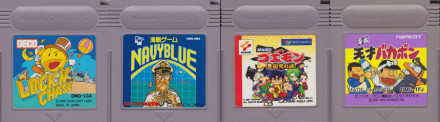
Reviews of Lock & Chase, Navy Blue, Ganbare Goemon Kurofune Tou no Nazo & Heisei Tensai Bakabon.
My name is Ray Larabie and I'm talking to you from Nagoya, Japan. Welcome to episode number 35 of Game Boy Crammer. Today I'll be reviewing Lock and Chase, Navy Blue, also known as Battleship, Ganbare Goemon, Kurofune, Tou no Nazo, and Heisei Tensai Bakabon.
Let's start the show! Next to a Game Review! Lock and Chase by Data East was released in the summer of 1990 in Japan, the US, and Europe, and Australia. It's also available on 3DS Virtual Console. Originally, Lock and Chase came out in the arcades in 1981. It was made by Data East. It was really their answer to the Pac-Man craze.
It was a maze game. It looked a little bit like Pac-Man. You were collecting dots. The bad guys looked a little bit like the Pac-Man ghosts. They even had the same kind of eyes and colors. It came out on the Intellivision, Atari 2600, Apple II, and then in 1990 came out on the Game Boy. This is an early Game Boy game. You play a thief in this game. You're running away from cops.
You're collecting coins that are lying around in this maze, and the object of the game is to clear all the dots to finish the level, and you go on to the next level. Lock and Chase was a really simple game. I remember seeing this in the arcades, and I remember thinking, oh, it's a little bit like Pac-Man, except you have one little thing you can do.
You have a button that will lock doors behind you to trap… you can trap a policeman temporarily, or you can just divert their path. Now, this Game Boy version of Lock and Chase, they didn't just make a port of Lock and Chase. They really enhanced it. They redesigned the graphics so they're more suitable to Game Boy.
The original Lock and Chase was a black background. The policemen were colored kind of like Pac-Man ghosts. They didn't really have outlines. In this version, they actually grew them with nice outlines. They actually have different personalities. There's one cop who's like the chief. He has his big eyebrows.
There's a little short guy that hops around. There's a guy wearing sunglasses, and another guy with weird eyes. Despite the lack of color, they still managed to differentiate the different cops. In this version, the lock button is A or B. It doesn't matter. You can only lock two doors at a time, and they're timed.
Basically, they stay locked for a little while, and then they disintegrate. Once one lock disintegrates, you can put another one down. If a cop is right on your tail, you can't lock a door in front of them. You need a little bit of distance. There are six stages in this game. Each stage has three levels.
Now, on the first stage, it's pretty much straight-up Lock and Chase. Unlike the arcade version, after you finish the first level, the next level looks different. They actually change the mazes, whereas the original one, you pretty much were looking at the same maze with slight variations. In the arcade version, you had prizes, kind of like in Pac-Man, where you get the strawberry and stuff like that.
They left that out of this game, but it really doesn't matter. The two prizes you can get, a bag of money, but it's not just points. When you grab a bag of money, cops get mad. They get so mad, you can walk right past them. They stay mad for about, eh, a couple of seconds. The other prize you can find is a big diamond.
This is like the power pill in Pac-Man. Your character starts flashing, you can run around and beat up cops. They come back pretty quickly, but you get a lot of points. And much like Pac-Man, you get more points for each subsequent cop you take out. After the third level of each stage, you'll get a bonus screen.
This is a slot machine. You're gonna spend those diamonds that you picked up to play the slots. With a little luck, you can win some extra lives. You can even win some extra diamonds, which you can use to keep playing the slot machine. You can get up to 99 lives. You start with three lives. If you run out, you can continue.
There's no save game, but if you look around online, you can find these codes that'll let you start on whatever stage you want. Two, three, four, five, or six. I don't want to tell you about all the gameplay elements that you're gonna see in this game, because at the start of each stage, they introduce each element in a really clever way, so you can kind of ease into it and get the idea.
The music is wonderful. It just has this great, really catchy music, but it's not really blaring in the foreground. I've never seen a flicker in this game. Everything just runs perfectly. The interstitials you get between stages are really cute. You may think, well, six stages with three levels. That's not a lot of levels, but there's more.
After stage six, three, the game will give you a code, which you could look up online, but don't. That will let you start on stage seven. These stages go all the way up to 13, and it gets hard. As far as I know, there are no cheat codes to start on those stages, so basically you have to start on seven and make it all the way to 13.
The difficulty in this game is just perfect. It starts off a little bit easy. Anybody can really clear stage two, stage three, and then it gets gradually, gradually harder. In fact, I didn't find any of the stages to be really, really tough until about six two and six three. Six two is pretty hard. Six three, I don't want to tell you exactly what happens in it, but when you get to six three, you want to take your time. Plan what you're gonna do.
Do that little thing you have to do with the thing to put it in the thing to get the thing. I don't want to tell you, but just move it a little bit each time and then take a stroll around. Let the cops follow you, then move it a little bit more, then just roll around. That's the best way to get through that level. Don't try to do it all in one shot.
This is a universal game, so the Japanese version, the English version, they're all the same. Doesn't matter which version you get. I was really surprised by Lock and Chase. When I saw the cartridge, I was just thinking about playing Lock and Chase in the arcade. I was never overwhelmed by the game. It was just kind of okay.
You know, there were a lot of Pac-Man type of games that I thought were better than Lock and Chase. Pac and Pal, for one. I love Pac and Pal. Ladybug. Lock and Chase was always kind of so-so for me. I didn't really like it. I was really surprised to find, you know, such a great game called Lock and Chase.
It really is a work of art. It's just incredible. I'm not exaggerating. You're gonna love this game. For the Japanese version, search for DMG-LCA. All the other versions, DMG-LC. Or get it on Virtual Console. I want a special meeting, too. With Captain Every Day of Station Navy Blue. Kaisen Game, Navy Blue by Pac N' Video was released in December of 1989 in Japan.
A very early Game Boy release. In the U.S. and Europe, it came out three years later as Battleship. Pac N' Video was this company. They started in the mid-80s. They made Rambo for MSX and NES, Knight Rider for NES, Predator. On the Game Boy, they made Trump Boy, Trump Boy 2, Lunar Lander, Mind Sweeper.
And then in 1999, Battleship on the Game Boy Color. Battleship is a guessing game. It's not really a strategy game. You may know this game as a plastic game you play on a table. But originally, this was something you play on graph paper. It dates back to at least World War I. Russian officers might have played this before World War I.
It was first turned into a commercial game in 1931. It was a game called Salvo. But the one most people know is the 1967 Milton Bradley version. Where you were playing on a 10 by 10 grid. And you had a shield. So you had one grid that was vertical. That also acts as a shield so your player couldn't see your board.
And then you had your board where your ships were. Anyway, you'd have these pegs. Red ones and white ones. The white pegs were for a miss. The red ones were a hit. So that way you can keep track of the enemy's grid. You could remember where you fired. And you can remember where you actually got hit. So you can figure out where their ships are.
Your opponent would place ships on the board that you couldn't see. And you'd basically fire back and forth. You'd call out coordinates. And they'd have to report back, hit or miss. And there were countless versions of this on a computer. This really lends itself to a computer game. Because it's probably really easy to program.
And as the years went on they tried to dress it up with more graphics. So you could see the ships firing at each other. And make it look a little more dramatic than just crossing X's on a grid. In this version of Battleship things are a little bit different. They tried to mix it up and make something a little more interesting.
That works better as a one player game. Because one of the things about Battleship is a lot of it is luck. But a lot of it is psychology. You try to, you know, suss out the behavior of your opponent. They never put ships in the corner. So don't fire at the corners. This game has 50 stages. When you start off you only have four ships.
You have a Battleship, Destroyer, Frigate and Submarine. Battleship is five. There's a Carrier, which you'll get later as eight. And it's a four by two. So that's kind of thick. There's a Cruiser, which is four. Destroyer, which is three. Frigate is two. And a Submarine is one. So you take turns firing at your opponent back and forth.
They fire at you. You fire at them. You can see where you've hit ships. And that's Battleship. But there's more to it. If you hit B instead of firing your next shot, you have a chance to use an item. The availability of items will change as you go up a few stages. Every four stages you go up a level and you get more abilities.
If you lose certain ships, you're going to lose abilities to do these moves. So you kind of want to use them right at the beginning if you can. Just in case. But, you know, you might lose a ship and then you can't use it anymore. If your Battleship is still intact, you have a chance to use a weapon called a Harpoon.
This will shoot in a five pattern, like a dice. It's a really good way to get a lot of hits in the beginning and kind of sweep the area of ships. But your opponent has these too. Because taking out ships will remove these abilities, the sooner you take out enemy ships the better. You're also going to have a radar.
This will search a four by four pattern. Later you'll get a bigger radar. So it won't actually destroy the ship, but it'll tell you where they are. But the problem with this is it doesn't actually mark it on the map. So you have to remember where you use it or you're wasting your time. There's a Mark 45 which will let you do two shots instead of one.
You can shoot them anywhere you want. They don't have to be adjacent. As the game progresses, you'll get more weapons. And they'll do kind of similar things, but in different patterns. Destroy all the enemy ships and you go to the next level. And after you win that level, you get a password. There are a lot of strategies to win a Battleship.
Most of them I think deal with trying to psych out your opponent. But since this is a computer, you can't really do that. And it doesn't really figure out your patterns. What you can do is try to stick to a checkerboard pattern. It just increases your chances of hitting bigger ships. You can also try doing a spaced out checkerboard pattern.
So you do every second checker. It's not a surefire way to win, but you waste less shots that way. You don't want to start grouping. Don't do lines. Don't do like a vertical line, horizontal line to try to hit something. Checkerboard is the way to go. At least the 10 year old version myself thought this was a good strategy.
At first I didn't like this game because I didn't really figure out the items thing. Once I discovered the items, this game got a lot more interesting. Because at least there's a disadvantage to losing ships. Which is really missing from your basic Battleship game. This game must have been popular because there was a sequel.
Kaisen game Navy Blue 90. Which is weird because the original game came out a few days before the beginning of 1990. This one came out in December 1990. They should have called it Navy Blue 91 maybe. But then Navy Blue 98. Another Japan only game came out in February of 98. That makes far sense. I haven't tried these.
As far as I can tell it's the same kind of deal. Also on the Famicom there was Kaisen game Navy Blue which came out in 1992. There's no reason not to get Navy Blue the Japanese version instead of Battleship. Because there's no reading in this game. The Japanese version looked for DMG-NBA. For the other versions DMG-NB.
There's also a Game Boy Color version. Which I believe is the same game. It was released by Majesco. DMG-AIPP. Goe Goe! Goe Goe! Konami! Ganbare Goemon. Kurofune Tou no Nazo. Was released in Japan in December of 1997. And the Spring of 98 in Europe and the US. The English version was called Mystical Ninja starring Goemon.
Other than the language. The only difference between the English version and the Japanese version is. The Japanese version has a battery and a save. And the English version you get a password save. This game was developed by KCE Nagoya. That's Konami Nagoya. They're really only around from about 1997 to 2002.
And they made very few games. For Game Boy Color they made The Mummy, The Grinch, International Rally. This game was the only game they ever developed on Game Boy. This game is kind of a Zelda type of game. It's an overhead view. You slash with a sword and you fire projectiles with your sword when you're at full health.
It's all very familiar. You have a heart level at the bottom. It's not hearts but it's the same kind of idea. In Zelda you can wield a weapon with your A and B button. In this one just your A button. Your B button is jump. When you start the game you have three different characters you can choose from.
There's a robot ninja. The titular Goemon. Ebisumeru. This old dude. They're all similar but the robot ninja has a higher jump. The difference is pretty subtle. You can wield two different weapons with your A button. You have your main weapon which is your sword. In Goemon's case it's a pipe. In ancient Japan some weapons were banned so they had to use these tobacco pipes.
They made them really big so you could clock people with them. And the other weapon is a shuriken. That secondary weapon is the same for every character. When you press select you can switch between your main weapon and your shuriken. Shurikens do run out but if you have full health it's kind of like having full health in Zelda where your sword kind of shoots.
Same idea. Actually the little shuriken that shoot out of your sword are actually more effective than the regular shuriken which are in limited supply. You can buy them or you can buy them in boxes. You roam around the world. It's not really an RPG in that your character doesn't really have stats other than health.
You are able to power up your weapon a little bit. So it's barely an RPG. It's more of an arcade game. So I mentioned boxes. There are boxes all over the place. You can find money in the boxes. You can find shuriken in the boxes. And once in a while you'll find something that adds to your health bar.
It doesn't even recharge your health bar when you get it. Health is very hard to come by in this game. You have to either buy it in a shop or find it in. If you find it in an inn it's only 20 gold. That'll recover your health gauge right to the top. If you go to a store you can buy an onigiri, a little rice ball.
That's 10 gold. But it only gives you one little notch in your life gauge. If you want a full recover it's 100 gold. These inns are very hard to come by. And actually when you get kind of deep into the level it's very hard to go back and go to the inn. You probably won't survive. So you really, really have to watch your health meter screen.
Enemies are all over the place. Generally it's the same three or four groups per level. There's no advantage to fighting these enemies. You don't get any prize, any gold, any experience. You're better off just avoiding them. And your jump is actually really useful. It took me a while playing this till I discovered that you can just…
Especially when you have the robot ninja. You can do these really long jumps across everything. Not everything, but most enemies. You probably won't need to walk through for the story because it's very linear. As long as you explore every room you're gonna get what you want. There are four chapters to the story.
And for each chapter there's an item that you need to get through it. And the first one you need a piece of bamboo so you can cross the water. You know, you can do the ninja thing, breathe through the little bamboo reed underwater. But it's really obvious what item you need. People are gonna tell you what it is.
Or you're just gonna find someone and have to do a little challenge to get that item. So in the first chapter you're gonna find a guy and he's gonna challenge you to a little game. It's not a very difficult game. If you get it wrong you get to do it again. However, at the end of each chapter there's a boss.
These bosses generally aren't that hard. They get harder later. But the problem is, after you finish the boss, you're gonna get a mini game. If you fail at this mini game, it's game over. So you can defeat the final boss, lose at the mini game, and you're right back at the beginning of the game. I played the first level so many times.
In the first mini game you have to do a race. So how do you race? You whack the A button as fast as you can. After five attempts going through the whole level, getting to that boss, defeating everything with all my health, and then losing at this race, I decided I had to play this in an emulator and use an autofire.
It's the only way I can get through it. Because I physically can't press an A button that fast. It's that hard. Maybe when I was younger I could press the A button really fast, but not anymore. I tried even, you know, double fingering it, doing like a little bongo thing. No, couldn't do it. If you have the English version of the game, you could get to that point of the game and then look up the password somewhere, and then skip to the next level.
It's gonna be the same thing. You know, if you have the Japanese version, you're kind of stuck. This is where I switched to the English version and played the rest on a ROM. The path in this game is not linear, but it's almost linear. It's pretty much linear. You can kind of branch out a little bit to find boxes and stuff, and then you can find your way back on the path.
So you're never really gonna be lost if you just pay attention a little bit. At the end of the next chapter, you get another boss, a tug of war game. It's exactly the same as the first game. You have to push that A button really fast. If you couldn't pass the first one without cheating, you won't be able to pass this one, because it seems to require the same amount of crazy button pressing.
Chapter three, you get kind of a boss rush. You get minigame after minigame. I don't think anyone can survive these. Some of them are kind of easy. Then there's a memory game. If you miss six times, it's game over, because you better be writing those down. And the part I got stuck on, there was a minigame where you had to match these faces.
It's kind of like a sliding tile puzzle, I guess. I tried so many times, and that's where I gave up. I just couldn't even pass that one. The bosses themselves weren't that hard. They're actually not very challenging at all. They generally move back and forth and pause and fire. Or there's kind of an ant boss that you can kind of jump over pretty easily.
So there's one more chapter after that. I assume it's impossibly difficult. The music in this game is pretty good. The graphics are great. I love the enemies, although they're very heavily Zelda-based. I don't like to accuse games of being a Zelda clone, just because they're a little bit like Zelda. But this one is pretty blatant.
If it weren't for the stupid minigames after each boss, this game might be tolerable. But the lack of health is a real pain. You can't make any mistakes. You can open up every box in the game. You won't find one health. And you can battle. You can kill every enemy in the game. You won't find one health.
You have to buy these things in a store. And the stores are so rare. And the inns are so rare, too. The enemies are so boring. It's the same thing every time. They're either too easy or too hard. And there's no incentive to fight them. You just kind of walk past them if you can. It just doesn't feel like fun.
I don't recommend you get this game unless you're maybe into collecting all the Goemon games. I'd probably get the English version, because at least you can skip levels and passwords. The Japanese version is DMG-AGDJ. English version, DMG-AGDE. Next to a big review. Heisei Tensai Bakabon was released in February of 1992 in Japan only.
Heisei Tensai Bakabon is a platform game which came out on the Famicom just a few months earlier. It's based on a manga series and later an anime series. Tensai Bakabon is a young boy, a mischievous boy. He's got a part-time job shining shoes. But he's not really the main character in the series. The main character is the dad, Bakabon's papa.
He used to be a genius. He was in some kind of accident. And now he's not so smart. He's always coming up with stupid plans and ideas. And the big catchphrase is, これでいいのだ。 It'll be all right. When he's trying to convince someone to go along with his crazy plans. This manga came out in the late 60s. And there were four TV series.
First one started in 1971, went to 1972. The second one, 1975 to 77. Then there was a long wait. Heisei Tensai Bakabon came out in 1990. Heisei refers to the time period. The Heisei period started in January of 1989. And there was one more series after that in 1999 to 2000. But this game is based on the 1990 version.
You control Bakabon's dad. Use the D-pad to move around. You can push down to duck. A is jump. B is umbrella. Or if you hit B and the D-pad, it'll run. It's a little tricky with the timing of the B and the D-pad to run. Very often you'll try to run and he'll take out his umbrella. If you push up while jumping, you can jump up a little higher.
And then grab onto an edge and pull yourself up. You're walking around levels and they're kind of puzzle levels. You could compare it to Prince of Persia in a way. It's a lot of running and jumping puzzles. Swinging, bouncing, avoiding spikes. And you can shimmy up a space between two walls. On the top of the screen you can see your current score.
And you can see some dots. Those are health dots. If you drink milk, it refills your health. If you eat a bowl of ramen, you'll get more dots that you can fill up. And there's a countdown timer. The umbrella. The thing you're going to be accidentally opening all the time. You can use this to parachute down slowly.
Now you can fall pretty far, but there's a limit. If you fall from the top of the screen all the way to the bottom, you're going to lose about half a health point. And if you're moving horizontally when you open that umbrella, you'll kind of coast a little bit. But you can't control yourself while you're falling.
Umbrella's good for keeping your balance if you're walking on a tightrope. Once in a while you get these narrow walls. Like a really tall, thin wall. You're going to see a little symbol. That means you can use your umbrella to sort of bounce and jump. It's not something you do on purpose. It just kind of happens automatically.
The speed at which you're running or walking when you do that jump will determine how you'll get over the fence. There are many bosses all through this game. They're not super challenging, and they're kind of fun. It's a little bit of a sword fight. And you're going to sword fight with your umbrella and beat these bosses.
There's a main boss at the end of the level, and there's also a sub-boss in the middle. And there's a couple of situations in the game where you need your umbrella to protect yourself from falling objects. It doesn't happen very often, but it's kind of obvious that you need it when you're at that point.
Apart from the milk bottle and the bowls, you can also once in a while find a clock power-up. That'll add 100 seconds to your time limit. There are points everywhere. Lots of coins all over the place. You get bonus points for time left over, but you don't actually get anything for the points. It's just for keeping track of your score.
And it's really cute. This thing, I thought it was a cat, but it's actually called Unagi Inu. It's an eel dog that comes across the screen and brings you some milk. Right at the beginning of the game, you're going to be in a circus stage. The lions will be taking swipes at you. A lot of circus-related stuff.
And this will be the first time you use your umbrella to protect yourself… from a clown. After that, you go into Ninja Land. There's a lot of frog stuff going on in this level. A lot of rotating blades, too. The next level is kind of a phys-ed, gymnasium kind of thing. There are spiked floors everywhere.
You're going to be swinging off bars all the time. There are people shooting kind of pea shooters from boxes. This whole game is so strange. But this was the really hard part for me. At the end of this section, you have to fight an athlete. This guy has a backwards hat, and he loves running and jumping.
You have to do a race. It's not like some games where you have to push the button really fast. No, you're just running. But you have to kind of jump over obstacles, and the time limit is very tight. So you have to do it a whole bunch of times and learn the pattern, because you can't just figure it out.
There's a lot of situations where you have to jump on a wall, and then kind of do a running jump off and land on the other wall and keep jumping. By this point in the game, I hope you've mastered the running jump, because it is really annoying when your umbrella opens up. It happens all the time when I play.
You have to hit D-pad, then B in that order. Not at the same time, and just don't hit B first. Oh, that umbrella. After that, you go into a kind of science world. Till finally at the end of the game, I don't want to tell you what you're going to see, but you're going to get a puzzle where you have to jump on these number tiles in a certain order.
It is really hard. You just got to try it a bunch of times. It sounds like it's not a long game, but it's pretty long. Some of these levels are pretty long and take a long time to get through. The way the character moves is really irritating. You know, the controls are so difficult, but I think that's kind of supposed to be the challenge of this game, too.
You know when you're playing one of those really bad games where the controls are really bad and the challenge is just getting past the controls? That's kind of like this. If you have no patience for that kind of thing, you probably want to avoid this one. If you've got a lot of patience for weird Japanese games that are kind of lousy, but at the same time kind of good, this one's pretty good.
Plus with the continues and the passwords, you can kind of take your time and chip away at it a long time. I can't say I ever got used to the controls, but I could learn to tolerate them a little bit. And you would think, usually in a game like this, they put in stupid minigames. Oh, you know, you're gonna have rock, paper, scissors, concentration, tile puzzles, stuff like that.
They don't do any of that stuff in this game. They showed a lot of restraint, because this is the kind of game where they usually put that kind of thing. It drives me crazy. This game is pretty much unknown. There's very little information about it. This game isn't Japanese. There's no English in it at all.
But there's nothing critical to gameplay that you need to know. Except for the part where you have to race that guy. You kind of figure it out after you lose it a couple of times. Heisei Tensai Bakabon. Look for DMG-TFJ.