Reviews of Teenage Mutant Ninja Turtles 2, Namco Gallery 3 (Sky Kid, Babel, Family Tennis, Jantaku Boy), Klax & Q-Bert.
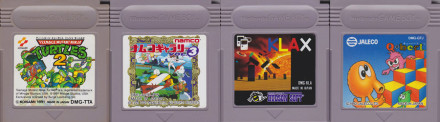
My name is Ray Larabie, and I’m talking to you from Nagoya, Japan. Put down that flappy bird, it’s time to listen to Game Boy Crammer, episode number 35. Today, got a lot of stuff to review. Teenage Mutant Ninja Turtles 2, Namco Gallery 3 (this has four games in it) Sky Kid, Babble, Family Tennis, Jantaku Boy, we also have Klax, and Q-Bert. A lot of games to cover, there’s no time for chit-chat and dilly-dallying. Let’s get on with the show. Teenage Mutant… Teenage Mutant Ninja Turtles 2. Back from the sewers. Was released in December 1991 in the US, and November 1991 in Japan.
May 92 in Europe, this is a sequel to Teenage Mutant Ninja Turtles… Follow the Foot Clan. This game is a side-scrolling platformer, it’s very similar to the first game, with some improvements. The first, most notable improvement is it isn’t a buggy piece of crap. This game actually does work properly.
Power-ups don’t just materialize inside a wall, everything works. The problem is it’s very similar to the original in that you don’t really do much in this game. You’ve got these generic bad guys that you kind of swat like flies. You can pick one of four Ninja Turtles, the weapons look different but act the same.
There’s not much to the combat, you can kick people or you can punch them, it doesn’t really matter. If you play this game on easy, it’s really forgiving about the timing. If you play it on hard, you have to be a little more careful and you can take a lot of damage if you don’t time your hits exactly right.
So you’re walking down these hallways just hitting guys and murdering them, I guess, because they disappear. I assume you’re killing them. Since this is a game based on physical contact, you might think, oh well, there must be weapon power-ups or you can gain abilities. No, this whole game you’re just swatting flies.
At the end of the game, you’ve got the same weapon you had at the start of the game and no new abilities. You can do a jump kick and kind of a slide kick. I think the only power-up is the pizza. Once in a while you’ll see a generic bad guy holding a pizza over his head and you just kind of kill him and grab his pizza.
That’s not very nice. It’s no wonder the generation that grew up playing this game turned out to be the most homicidal generation of all time. Probably. The backgrounds are actually really good in this game. There’s this opening animation sequence they put a lot of effort into and these really nice detailed backgrounds.
The music is the same repetitive theme over and over but the quality is better than the first game. The sound effects are a little bit better too. One thing I’m surprised they kept from the original game is the stiffness of the walking in the animation. You’ve got these ninja turtles. When you see them in the cartoon they have these dynamic poses but in this game they’re just walking completely upright.
There’s no lean or anything because they’re obviously sticking to their sprite boundaries. When you use the weapons it’s this really short range hit. It just looks bad. This game is challenging but I find that the levels range from incredibly easy and monotonous to challenging in the same level. You’ll have these levels where you’re just walking down the hallway just killing everything that comes at you one at a time.
And then you’ll have a boss that’s kind of challenging. It is a lot longer than the first game and in this game you can’t just play whatever level you want. You have to do it in order. You have four lives in this game and a continue. Well, you have four different turtles but it’s essentially four lives.
There’s no reason not to get the Japanese version because everything’s in English anyway. You should only play this game if you’re crazy about the teenage mutant ninja turtles. If it wasn’t a turtles game no one would ever have played it. It just doesn’t have much going for it. If you’d like to purchase this bland game search for DMG-TT or DMG-TTA for the Japanese version.
Namco Gallery Volume 3 was released in Japan only in the summer of 1997. This comes with four games. Three of them were only ever on the Famicom. So this is the only place you can get these games on the Game Boy. The fourth game is a Magon game, Jantaku Boy, which originally came out of the Game Boy.
Just like the other Namco Gallery games you can save your scores with a password. So one password contains the high scores for all the games. First we’ve got Sky Kid. Sky Kid is a horizontal shooter. Came out in 1985 in arcades. This thing ran on the Pac-Land game hardware. If you remember Pac-Land was one of the original side scrolling platformers.
So it had that whole scrolling thing already in the hardware I guess. There was a sequel to Sky Kid called Sky Kid Deluxe. Came out in 1986. Same idea with more enemies and more missions. It wasn’t a huge game in the arcades. I remember seeing it but it wasn’t a big hit. Sky Kid came out on the Famicom in Japan in August of 1986.
It came out on the NES a year later in the US. In Sky Kid you control a plane. You move up, you move down, you shoot, you can loop. A to shoot, B to loop. B also drops a bomb. You start on the runway. You’re going from right to left. First thing you do, go up and you’ll hit a tree. And fly around and shoot stuff.
When you get hit, you’re not necessarily dead. If you’re high enough on the screen, your plane will start to dive bomb. But then if you hit the loop button or… I’m not sure how you get out of it. I just wiggle and hit all the buttons. And then you can get out of it sometimes. If you’re lucky. If you get hit and you’re diving, you pull out of it.
Then you get hit again and you pull out of it. You do that too many times and you can’t pull out of it anymore. Enemy planes will come from behind sometimes. So you can’t just hang on the right side of the screen. You gotta keep moving around. There’s a big disadvantage to staying low. There are a lot of really nice ground targets you can hit for points.
There’s anti-aircraft guns you can avoid by staying low and shooting them. But if you get hit, you don’t have a chance to pull out of a dive. You can shoot on 45 degree angles. However, your bullets don’t go too far. So if you want to strafe the ground, you can kind of dive at the ground. But you have to get pretty close.
If you see an anti-aircraft gun, it’s very risky to just kind of dive at it. Because it’s shooting at a 45 degree angle too. So you have to kind of time it between the bullets. I mentioned bombs before. You’re going to hear a little alert. A beeping alert thing. And you’ll see a little bomb on the ground.
You have to dive really low and pick up that bomb. Just dive into it and it’ll pick up on its own. And then you can fly with the bomb. B will drop the bomb. This is what the whole mission thing is. At the beginning when you start the level, it’ll say your mission is to bomb this target. Sometimes it’s a base.
Sometimes it’s a fortress. Sometimes it’s a ship. Sometimes a flying saucer thing. The goal is to drop that bomb right in the center of the target. If you have a fortress, you’ve got to hit the middle of the fortress. You get some points if you hit the edge of it. But you really hit the middle is the goal.
While you’re carrying the bomb, you can’t loop. So you’re at a big disadvantage. And if something hits you and you go into a dive, you lose that bomb. So not only is it challenging to hit the target. A target which is usually shooting at you. But not losing the bomb is very difficult. You’re not required to bomb the target.
You can get through the whole level without really shooting much. And you can still complete the level. It’s all about points. When you’re looping, it really makes you invulnerable. So you can kind of, you know, especially if there’s anti-aircraft guns. They make these little flak explosions in the air.
You can just loop through those things. They don’t affect you. If you point in a direction while you’re looping, it does a different kind of loop pattern. At the end of the level, you’ll have to land your plane. It’s not a very difficult landing. It’s not like Top Gun or something like that. You just kind of push down and land it.
If you miss the runway, you’ll run out of fuel and crash in the ocean. And when you crash, you lose a life. When you run out of lives, you can continue. When you start the level, you have a choice of two different pilots to choose from. I don’t know what kind of difference it makes. On the Famicom version, you’d play two players who’d want to choose which is which.
Doesn’t seem to make a big difference in the Game Boy version. You’ll notice just before you land, there are three lovely ladies guiding you to the landing. If you’re a jerk, you can shoot them and they turn into Maneki Neko cats. It has no effect on points or anything if you do. If you see some ladies just hanging around on another part of the level, not near the landing, they’re special ladies.
Put your plane right on top of one and do a loop. Don’t push a direction while you do a loop or you’ll probably crash into the ground. Just hit B. And when you loop, a bunch of hearts will come out. You can catch those hearts at the end of the level. You will get kisses. Those kisses are worth a thousand points each.
So unlike a lot of women in video games, these ones aren’t really for rescuing. You just have to try to impress them by looping in front of them. And usually there’s a pair of them, so you can actually loop twice and catch more than four. I’ve caught up to six once. I don’t know if it’s possible to get all the hearts.
The arcade version had 20 levels. A little bit later, you’re going to see some submarines that pop out. Now in the Famicom version, these would shoot at you. In this version, they don’t shoot at you, and they’re worth a lot of points. You want to try to get those if you can. Just don’t crash into them.
There are a lot of cute little Easter egg things going on. If you see a sign, there’s a sign with a woman on it and a sign with a Pac-Man character. It’s the same kind of Pac-Man with the long nose that you see in Pac-Land. Do a loop above the billboard, and you’ll get either a medal or a bomb. Don’t grab the bomb. That’ll kill you.
The medal’s worth a thousand points. If you see kind of a cute character of some kind, try doing a loop. I don’t want to spoil what everything does, but, you know, there’s a lot of little Easter eggs that are not really worth a lot of points, but do some cute little things. So when you see something strange, try shooting it or looping it and see what happens.
If you do get to the flying saucer, it’s possible to take one of those down if you fly above it. It’s sort of a flying saucer. I don’t know if it’s a blimp or a flying saucer. It’s got little propellers. If you drop a bomb right on top of it, exactly in the middle, you can take it down. There’s no big reward, and there’s actually only one level in the game where that’s the mission, is to take down one of those saucers.
But if you just feel like taking one down and you happen to have a bomb, try it out. The game does end, kind of. I’m not sure what level it was. I think in the 30s, it said I had a happy ending. And, you know, people threw me up in the air and caught me. And then, after that, the game just continued on. It seems to go on forever.
All in all, a very enjoyable game, different from the usual type of shooter. Once R-Type came out, there was kind of a template for a side shooter. And this was, you know, something before. A little bit feels a little bit like Time Pilot, just the way the shooting works, and just feels really different.
To me, this is worth the whole cartridge alone, just because it’s the only way you can play Sky Kid on the Game Boy. Next, we’ve got Tower of Babel, Babel No Toe. This came out on the Famicom in 1986, Japan only. It’s a platform puzzle game. You play an explorer, Indiana Borg-9, nice. And you’re looking for the Air Garden of Babel.
How do you do that? You get past level 54 on the Tower of Babel. To get through these levels, you have L-shaped blocks. This whole tower is just lousy with L-shaped blocks. You can pick them up, you can put them down. You can balance them on top of each other, you can put them on top of each other. You can balance them on top of each other to make stairways.
You only have a certain number of moves to complete the level, while your character has power. And every time you do a move, every time you move a block, pick up a block, put down a block, it uses up power. But you can get more power by picking up certain items. So you don’t have an exact set of steps required to finish the level.
When you’re holding a block over your head, you’re protected from above. There’s a, right in the beginning, there’s a bat that’s bouncing up and down. You can protect yourself from the bat. The bat will kill you instantly, like a regular bat, you know. You can climb vines. In fact, you can kind of offset yourself on the vines, so if an enemy’s coming down the vine, you can be going up at the same time.
And every level has a goal. Every level has an exit you’re supposed to get out of. One of the difficult things is flipping these blocks around, because when you pick them up, they kind of follow the same direction you’re going. So let’s say you’re picking up a L-shaped block that’s on your left, and you pick it up and turn to the right, that block will flip around.
If you want to give up on a level, just hit your select button, but you’ll lose a life. Other enemies you’ll encounter are the Priests of Ur. These guys have wandered the tower ever since the tower was created. They’re immortal, but they’re not allowed to leave the floor they’re on. If you kill them, they come back to life.
You can squish them with blocks, but they can’t move blocks on their own, so you can trap them. The babbles, this is kind of a rock creature. They just wander, they just walk back and forth, but they’re handy because they create new blocks. They drop them so if they get to the edge of a platform, they’re going to drop a block off the side.
There are some levels later on where you’re going to need blocks that are supplied by these babbles to finish the level. There are power-ups all over the place. The most common one is a jug. For every one you collect, you get 100 points. After you finish the level, you get an extra strength point, which means you’ll have more moves to finish the next level, the more of those you collect.
Crowns show up once in a while. If you pick up a crown, this gives you a little speed boost. After you squish a bunch of enemies, you get these jewels. They make you invincible for a few seconds, and you can be like Pac-Man. You can just run into your enemies and get a lot of points. These lamps keep showing up once in a while, like a little Aladdin’s lamp kind of deal.
They show up when you knock a whole bunch of blocks down, but they’re always in a really hard-to-get location. There are little crystal balls that show up once in a while. Those are keys to open a lock, so there are some levels where you need to access a bunch of these things to open the exit. And there’s a really rare power-up.
If you can get one of these priests of Ur to land on the block that you’re carrying and just kind of balance them up there for a while, Shooting Star shows up, you get a huge speed boost. Now, when you first play this thing, it looks like all you can do is pick up a block and put it down, but you can create different shapes by putting them down in a certain way.
Like, if you take the corner of a block and wedge it into the corner of another block, you can get it to stack really high. Rotating blocks is really difficult. Once you have two blocks, there’s kind of a trick you can do by shuffling the blocks back and forth to get it to flip. It’s really hard to explain how block flipping works in a podcast.
You really have to experiment. All in all, I found this game to be pretty frustrating. At least there’s no time limit, but the limited number of moves, you know, having an energy thing makes it so you don’t really want to experiment too much, especially at the beginning of the game. You just want to kind of play around with the blocks to see how they work, but you’re really punished for doing any kind of experimentation.
I would have preferred if that energy thing was something that showed up later in the game, maybe, or maybe I’m being a baby about it. It’s just not my kind of game. Next, we’ve got Family Tennis. This game came out for the Famicom in December of 1987. When you start the game, you have a choice of exhibition, tournament, world tour.
You can choose what kind of court you want to play on. There’s a hard court, grass court, clay court, or Cosmo court. The court affects the bounce and speed of the ball. Cosmo court is in space and has a really fast ball and really high bounce. When you’re playing the world tour, you can actually play a tournament in space.
In space. You know, you’re in a glass court, you can see a star field behind you, and you can see the planet Earth below. Don’t make me explain how tennis works. This is a tennis game. The rules of tennis apply. It feels more like a modern tennis game than some Game Boy tennis games. You serve with a timing thing. You wait for the ball to bounce at the right height, and you have to time it.
You can control where the ball goes with the D-pad when you hit it. B is a regular kind of shot. A is a lob shot. And like any good tennis game, it’s all about the timing and the feel of it. You’re not just hitting the ball back and forth like pong. There’s a lot more to it than that. What I don’t like about this game is that it makes you switch courts, and then you’re playing facing you, like you’re at the other side of the screen in perspective, playing down, and the opponent is on your side.
I understand why you do that in a two-player game, because it’s a disadvantage to be on the other side. But in a one-player game, it doesn’t really make sense. Why don’t they just put the camera on the other side so I can see what I’m doing? I find half the time I can play pretty well. I can get a good serve.
But when I’m on the other side, I try to serve. I just hit the net or vault it every time. That’s a big disadvantage with this game. To me, that’s what makes it not fun, is having to switch sides. If you’re okay with that kind of thing, you might like this. If you’re a big collector of Game Boy sports games, this is the only way you can play family tennis on the Game Boy, so there’s that.
Other than that, there’s probably lots of other ways to play tennis on the Game Boy. But still, not bad. And finally, Jantaku Boy. This came out in January of 1992 on the Game Boy. It’s mahjong. It’s real mahjong, not like that matchy-tie mahjong stuff. It seems like a competent mahjong. That’s about all I can say about it.
And that’s it for Namco Gallery Vol. 3. To me, this is the weakest one in the collection because there’s only really one game I’d want to play, which is Sky Kid. If you want to get this one, look for DMG-AV3J-JPN. Next to a big review. Clacks from Hudson was released in Japan in December of 1990, summer of 1990 in the US.
There’s also a European version from Mindscape that came out also in 1991. That’s not the same thing. And there’s a Game Boy Color version of this, too, and that’s also not the same thing. Clacks is a puzzle game. It’s a blockbuster game. Blocks are coming down. You have to stack them. You got to get at least three in a row.
It’s like tic-tac-toe. You can do diagonals. You can get them horizontal or vertical. But you can only stack five high. You have a stacker. You can move from side to side. You can hold several blocks on your stacker, and then you can put them down in the spots you want. So if tiles are coming really quickly, you can grab a whole bunch and then sort them out later.
You can only drop a certain number of them, and then it’s game over. The original Clacks was made in 1989. This is around the time Tetris was out, and Tetris was this huge hit. Atari was having a lot of trouble with the licensing. So they went ahead very quickly and put together this game. It was made on the Amiga, and then they ported it over to an arcade system.
Same arcade system as Escape from the Planet of the Robot Monsters. It’s kind of overkill for a puzzle game, you might think. But it had this kind of 3D perspective thing going on. The conveyor belt comes out of the screen towards you, so you can actually see the blocks really far away coming down, so you have time to kind of think about what to do next.
To be honest, I never really liked Clacks that much. I really felt like it was kind of a rip-off of Tetris and just not that interesting. But it’s okay. The music was really cool, and the graphics were pretty slick at the time. Extreme! Welcome to the 90s kind of thing. The catchphrase was, it’s the 90s, and it’s time for Clacks.
When you see graphics from this thing, do a Google Images search for Clacks. You’ll see how 1989, 1990 style this game was. So, this Game Boy version. Obviously, there’s no color, but you’ve got stripes and patterns, so you can kind of figure out what’s what. The rules are the same. You’re trying to stack a certain number, but you have these challenges.
So, every level, it tells you, you know, you need to get this many in a row, or you need to make an X shape, or all kinds of stuff. Also, when you start the game, you have a choice. You can start on the first level and get no bonus. You can start a little further into the game and get a bonus and even further into the game.
When you drop your pieces, and you will, it’s game over, but you can continue. What’s not really nice about this game is you don’t get the perspective thing. You don’t see the blocks coming from a distance. You know, in the arcade version, they kind of move. They’re kind of rolling, chunk, chunk, chunk, flipping down this conveyor belt.
Visually, it’s really interesting, but it’s also useful to see those tiles far away. In this version, they’re just coming from the top of the screen. You have very little time to react, and the actual play area of the screen is really small. The European version of this, from Mindscape, actually, they made the 3D perspective thing.
So maybe that’s better, but I don’t have that one. I’ve got the lame Hudson version. The Game Boy Color version of this has the perspective thing going on. The actual gameplay part of it is really small. Like, in the Game Boy Color version, you know, the actual grid where you’re putting the tiles down is a really small part of the screen.
The rest is this kind of, you know, fancy graphics and stuff and the conveyor belt on the top. It’s really wasteful when you consider the size of the Game Boy screen. The Game Boy Color version is famous for having Easter eggs in it. There’s a snake game, like the Nokia Snake game. There’s a wedding proposal in there, and some other little puzzle game in there, like a little adventure game.
In the Game Boy Color version, you have a password system, and you can use the Game Boy Printer to print it out. I found it to be very, very boring, but I also found the original Clacks to be very, very boring. It’s just not really my kind of puzzle game. There’s so many great block puzzle games in the Game Boy.
There’s really no reason to choose this, and there’s definitely no reason to choose a black and white one. Give this one a skip, but if you want it, DMG-KLA for the Japanese version, and DMG-KX for the U.S. version. Qbert by Jaleco Entertainment was released in Japan, U.S. and Europe in early 1992. There was also a Qbert by Hasbro Interactive that came out in 2000, but that’s not just a colorized version.
That’s a separate game. Qbert was an arcade game that came out in 1982, an American arcade game by Gottlieb. Gottlieb used to make pinball games, they made bowling type of games, they made all kinds of mechanical arcade games, and eventually they got into video games, but not a lot of them. In Qbert, you play Qbert.
He’s a little orange guy with a nose, no hands, he’s just got little feet, although in some of the advertising, it shows him with hands. Qbert jumps on cubes to change the color of the cube. The top of the cube changes colors when you jump on them. You don’t have a button in Qbert, you’re just moving around.
It’s one of the few games where you just move the joystick, like Frogger and Pac-Man. But you’re not just jumping on cubes to change the color, you’re also avoiding enemies and picking up prizes. Originally, when they were designing this game, they had Qbert’s nose shooting things, so he could actually shoot, but they got rid of that, but he still has this kind of projectile shooting nose look.
Qbert was a huge hit in the arcades. It was really visually stunning, you know, you didn’t just have this black background with stars or dots, you had this, you know, these three-dimensional looking cubes, which in 1982 was a big deal. Qbert was a really marketable character, so just like Pac-Man and Donkey Kong, you’d see Qbert stickers, Qbert lunch boxes, and there was even a Qbert TV show.
Since Qbert moves in diagonals, you’re looking at this pyramid of isometric cubes, and you can only move on diagonals. And because of that, in the arcade game, they actually turn the joystick 45 degrees. With a standard eight-directional arcade stick, it’s a little hard to hit the diagonals. You have to hit two switches to hit the diagonals, if you’re hitting up, down, left, or right, on one switch.
So what they did was they took a four-directional, and they turned it on a 45-degree angle. That makes this game a little bit difficult to port, because generally, if you look at your Game Boy controller, or almost all your controllers, 45s are not really a thing, you know, it’s more about the up, down, left, right.
45s are a little harder to hit. So, to prevent you from changing these cubes to the appropriate color, you have these enemies jumping around. There are balls, there’s a ball that actually is an egg and turns into a snake, and you got these other weird little things running around. The only defense you have is to jump on these discs.
They’re these little spinning rainbow discs. You jump on that, and if you’re lucky, the snake, which is following you, will jump off. And when the snake falls to its death, everything else dies. So it’s an easy way to get rid of all the enemies in one shot. Another interesting thing about this arcade machine was, maybe because of the pinball heritage of Gottlieb, they included that thing that they have in pinball games that makes that big smack sound.
And this occurred when you fell off the pyramid. You lose a life if you fall off, but also the machine scares the hell out of you. There’s an actual mechanical coil that smacks the side of the cabinet. Another quirk about this Tubert game was, it actually came with a voice synthesis chip, but they didn’t use it to make actual speech.
They used random phonemes to make a weird kind of rumbling sound. So you get this little swear word balloon that comes up when he dies, and this weird garbled speech comes out. Okay, let’s get to the Game Boy version. Before you start the game, go to the options screen. You can turn off the music, and you can choose to have the joystick rotated 45 degrees.
Which means, if you, instead of pressing diagonals, you can actually press up, down, left, right, and that’ll represent diagonals. It’s hard to wrap your brain around, because you’re instinctively, you want to push them in the direction you’re going. And, you know, if you had a handheld controller, like an NES controller or a Super Nintendo controller, you could actually turn the controller 45 degrees to make it mentally work.
But with Game Boy, you can’t really turn it 45 degrees without turning the screen as well. Technically, it’s better because you’re never gonna miss, but it really depends on your Game Boy. I found in my Game Boy Color, maybe because I’ve cleaned the controller, I can hit those diagonals okay. I have an emulator which has sort of a PlayStation-type controller, no problem. But then, when I recorded the sound, I was recording with a, um, I have a Super Nintendo gamepad that I use, and it was really hard to hit the diagonals.
I could get them, but I really had to nail it. The first level is much like the arcade. You’ve got a pyramid, you’ve got to change the color of the blocks by jumping on them once. If you don’t start the game right away, it’ll actually give you a tutorial of what you’re supposed to do. It’ll show you all the enemies, and it’ll also tell you which items you want to catch. You’re gonna see an enemy that’s got sunglasses. That’s not an enemy.
You want to actually grab that for points. That’s Sam. He’s worth 300 points. There’s another one that looks like Sam in reverse that’s got big eyes. He’s worth points too. It’s easy to figure out because the other enemies that kind of look like that, little faces, they jump on the sides of the cubes.
If you see guys walking around on the tops of the cubes, those are worth points. You’ll see a couple of different balls. There’s a light one and a dark one. They never go up, they always go down, with gravity. But the light one will turn into a snake, Coily. The snake will hunt you down. So this is where you want to use those discs.
You jump on the disc, the snake follows you, all the enemies are wiped out. There are a couple of enemies that look like Hershey’s Kisses. One has a swirl going to the left, one has a swirl going to the right. They never change direction. They just go… One goes left, one goes right. It’s pretty obvious. You have cherries, apples that you can pick up for points. Cherries are worth a lot.
And there’s also a little tiny white ball. Grab that. That freezes all the enemies temporarily. There are ten levels in this game. Each level has four stages. Between the stages, you get a cute little movie scene. That’s something that was not in the arcade version. And, after each level, you’re going to get a different type of gameplay, which is explained at the beginning. Before the level starts, you’ll see Cuber do a little demo. So level one, you’re just changing the top of the cubes by jumping on them once. Level two, you have to jump on them twice to change. And later levels, it gets really complicated because you have to jump…
If you jump a third time, it changes back to its original color. So then it becomes kind of a puzzle. You really have to think about where you’re going to jump. And you really have to use those discs to your advantage because there are some levels where you can’t, you know, you keep changing your tiles back to the original color. The only way to get through it is to strategically use those discs. You start with four lives. You can get extra lives with points. If you run out of lives, don’t worry because you can continue as many times as you want. There’s no save game, so you can’t start on whatever level you want.
But, for as long as you have your Game Boy on, you can keep playing and playing to try to get to the end. The music in the game is pretty good. It’s different from the arcade. They tried to recreate the sounds of the voice synthesis chip with samples. I really enjoyed this more than the original Q-Bert.
I found the original Q-Bert not complaining. I mean, in 1982, it was kind of a big deal, but I always found that with home versions of Q-Bert, it was a little too repetitive to be that interesting. Really, you had the same pyramid. Things just got a little faster and harder and I just really couldn’t get that far in it.
This one, the difficulty ramps up pretty gradually. It really doesn’t get troublesome until about level six, level seven. And with the continues, you don’t feel like you’re always going right back to the beginning. Plus, you got the cartoons. The personality is there. And the graphics are wonderful. Even with the lack of colors, they use a lot of patterns and stuff and they made everything really clear.
The outlines are really clear. You’re never going to miss an enemy. In the arcade game, everything was all on the screen. In this one, it scrolls around, but I never find that it’s a big problem. And you have a pause. If you hit pause, you get to see the whole thing scale down. You can see what you’ve done and what’s left to do.
I was expecting a so-so game and it actually is a really great game. It’s one of my favorites for Game Boy. There’s so many times where they take a classic game and kind of ruin it or just try to do a straight copy to Game Boy. It’s always a real delight when a game is a big improvement over the original, which I really think this is. Despite the lack of color, despite the scrolling, it is a better game. If you’re looking for this game, look for DMG-QTJ.
There’s no reason not to get the Japanese version. Everything’s the same. European version, DMG-P-QT. American version, DMG-QT.