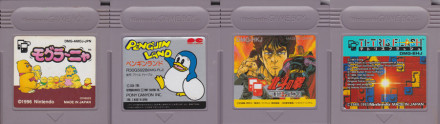
Reviews of Mole Mania, Penguin Land, Fist of the North Star & Tetris 2 (Tetris Flash).
(secret level: Othello World)
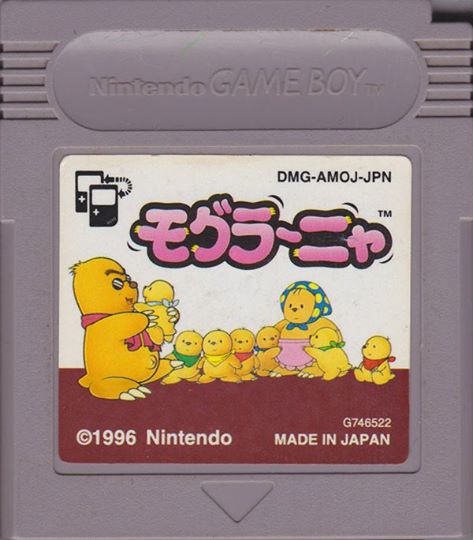
My name is Ray Larabie, and I’m talking to you from Nagoya, Japan. Welcome to episode number 38 of Game Boy Crammer. Today I’ll be reviewing Mole Mania, Penguin Land, Fist of the North Star, and Tetris Flash. But before we get started, I got a message from Krezna Susila.
Krezna let me know about this contest. It’s a Game Boy game contest. Not playing games, making games. If you’re a programmer and you’ve made Game Boy games, or you just want to start getting into it, this could be your opportunity to have some fun. The contest will be held three months from now, so you’ve got time to get a game going.
You know, if you think about it, those games that Acclaim and LJN used to make, I’m sure they didn’t take three months to make those. If you want to find out about this, go to j.mp slash gameboycontest. J.mp slash gameboycontest, let’s start the show. Let’s do a big review. Mole Mania by PacSoftonica was released in Japan in June of 1996.
In the U.S. and Europe, it was released in early 1997, and has been out on virtual consoles since 2012 on 3DS. In Japan, it’s called Mogura Nya. This is an action puzzle game. It’s a top-down view maze type of game where you’re pushing objects into holes, etc. When I first saw this game, I thought, oh, it’s going to be another one of these action puzzle games where you’re pushing things around, but it’s a lot more than that.
First of all, Shigeru Miyamoto. That’s right, the Super Mario guy. He had a part in this. In this game, you play a mole, a bad dude named Jinbei, kidnapped your whole family and your wife, and you have to get them all back. To do that, you got to deal with mazes. You’re going to be pushing objects to try to solve mazes.
You’ve played these kind of games before, except this one’s different. This one, you can go underground, so there’s a whole different element to it. And it’s not just the same thing all the way through. Different gameplay elements are introduced as you go along, and it’s one of these games where they really take the time to explain everything to you.
There are signs all over the place to help you understand what things do, and they really make sure you understand it. Like, they’ll tell you, hey, did you go back and read those signs? So you don’t need to read a manual or anything. You just pick it up and go. And to give it some more depth, you’re not just pushing and pulling.
You can throw certain objects. Some of them you can pull, some of them you can’t. There are all these rules for these different objects, and depending if you’re standing a hole or not, if you’re beside a hole, it makes a difference. It’s not just a simple push the blocks around to solve the problem. There’s a lot to it.
And a lot of these mazes, there’s not just one way to finish it. And the great thing, no time limit. You’ve got a heart at the bottom of the screen, so you can take a few hits before you run out of health. There’s a lot of health to be found, besides the little hearts that you can find here and there, and a guy with a cart that you can get hearts from.
You can push cabbages into holes in the ground. If you push enough cabbages in, you get a little piece of a heart. And no passwords! This has a battery in it, which is rare for this kind of game. The animation is beautiful. There are story scenes that are hilarious, and there’s a lot of slapstick comedy and stuff like that.
It’s actually kind of touching. It’s pretty sweet. The bosses are really creative. You’re not just pushing things like there’s the boss right at the beginning. It’s a kangaroo that’s jumping up and down. You have to push tacks under where it’s going to land, so you can see the shadow, and you push the tack, and then it lands on the tack.
The music is really catchy. It’s repetitive, but it’s good. I don’t want to go into too much detail about how you play this game, because it explains everything, and part of the fun is having it reveal all these different gameplay elements to you. To keep this review short, you gotta get this game. I know it doesn’t sound exciting, Moles, and even if you’re not big on puzzle games, you’re going to like this one.
But if you’re going to get the Japanese version, make sure you can read some Japanese, otherwise you’re going to miss a lot. You’ll probably have to look up stuff online, so you’ll probably want to get the English version if you can. Or just get it on a virtual console. If you do get the cart, you will have to replace the battery, because 1996, that thing’s dead.
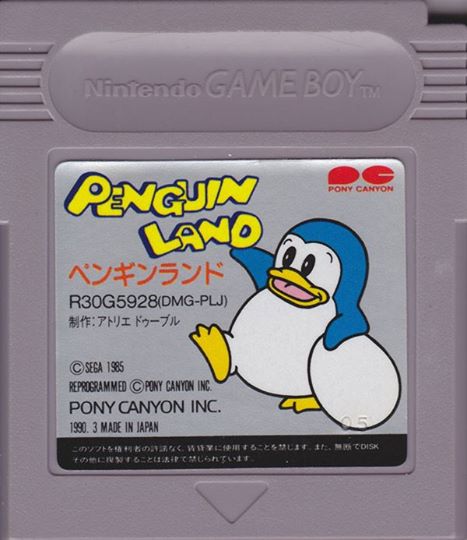
So if you want the Japanese version, Mogrenya, DMG-AMOJ-JPN, for Mole Mania, US or Europe, DMG-AMOE-USA, DMG-AMOP-EUR. Penguin Land was developed by Italia Devil, published by Pony Canyon, the record company, and was released in Japan only in March of 1990. Penguin Land is a platform puzzle game. It’s from a series of puzzle games called Doki Doki Penguin Land that was developed by Sega.
First one came out in 1985. It was called Doki Doki Penguin Land. It came out on the SG-1000 and MSX. SG-1000 is basically the Sega Master System. And there was an arcade port of the SG-1000 version that had the same kind of hardware as an SG-1000. There was another one called Doki Doki Penguin Rando Uchu Daibouken, Outer Space Adventure.
That one came out on the Sega Master System, and it was just called Penguin Land. This game is a port of that game. Okay, so you are a penguin. There are three penguin eggs, and they’re lost on a far away planet. You have to guide the eggs down to the bottom of this frozen cavern without breaking it.
The egg can fall three blocks down without breaking. You can land on the egg, but it has to be able to squeeze out from under you. If the egg can’t go anywhere, you’ll crush the egg. And there are enemies that look like polar bears, but they’re not polar bears, they’re space bears. They will destroy the egg too, and they can kill you, and you can stop the screen again, so it’s all about saving the unborn.
These eggs are precious. Your life worthless. If you fall through the bottom of the screen, you pop up through the top, but it’s not just a matter of getting this egg to the bottom of the screen. This thing scrolls down and down and down. It’s a really long level you’ve got to get down and not make any mistakes.
If you don’t move the egg quickly enough, this bird comes out and throws cinder blocks at it. There’s a timer, you get a bonus if you beat the timer. There’s a shield power-up, and you can also drill holes in the ice. You push the direction you want to go, and you hit A, and it makes a hole. B is jump. But you can’t make holes in every kind of ice, just the regular ice.
There are blocks that are kind of cracked. If you drop an egg on that, it’ll go right through. Or if you drop a block on it, you can push these rocks that fall. You can crush things, you can crush those space polar bears with rocks. There are blocks that are completely unbreakable, these solid blocks.
The jumping is okay, you can jump pretty high, but the bears generally walk back and forth. They will run towards you, and they always try to get to the same level as the egg, so if they have a chance to go down and get to the egg level, they’ll do that. And there are levels where you can use that to your advantage.
Later, you can see conveyor belts, floating islands. You can start on any level you like. There are 25 levels, so you don’t need a password. You can change the music, there are three soundtracks, and that’s all there is to it. That doesn’t sound so bad, but there is something that makes this game terrible, which is the scrolling.
And the level was the full width of the screen. In this one, instead of making everything smaller, they kept everything big, and they made the whole screen two screens wide. Instead of gradually scrolling as you walk across the screen, kind of maybe keep you centered on the screen, when you walk towards, let’s say you’re on the right side of the screen, and you walk towards the left, you’ll hit a point at the middle where the whole thing scrolls over.
But the whole game freezes and scrolls over really badly. Walk back the other direction, one pixel, the whole thing scrolls over again. So whenever you’re doing anything in the middle, you get this constant scrolling back and forth, where you just don’t even want to move anymore. Yeah, it’s a 1990 game, so maybe they didn’t really know how to do scrolling, but a lot of other games had scrolling. It just makes it so irritating, and it was really obvious that this game was rushed out the door. And even when the egg is going down, the scrolling up freezes the whole game, as everything scrolls up. So you’re constantly waiting for this game to catch up with this scrolling thing. It’ll just drive you crazy. I’m not saying Penguin Land’s a bad game, but better played on other systems, and it’s been ported to all kinds of systems. But if you want to get it for someone as a joke or something, I don’t know, look for dmg-plj.
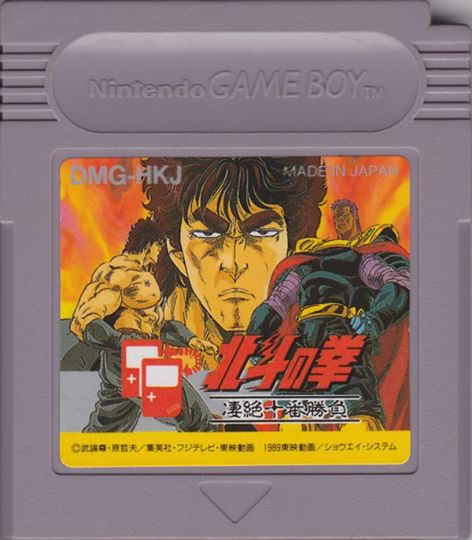
… … … … … … … … … … … … … … … … … … … … … … It’s a very macho comic, with macho man doing macho things, rescuing helpless women and making heads explode. In 1995 an American movie came out called Fist of the North Star, and it was crazy bad, or good if you like that kind of thing. There are lots of video games based on Fist of the North Star. All the ones I’ve played are bad, bad, bad, bad. It’s like Ultraman or Dragon Ball, it’s just somehow this license attracts bad games. Now we gotta give this game a break.
This is a fighting game that came out before Street Fighter II. Street Fighter II came out in 1991, so this is a couple years on Street Fighter II. And don’t forget, Street Fighter I was pretty lame. There were some OK fighters before that, but Street Fighter II was really the one that defined what a fighter is supposed to be. 11 very macho men are gonna battle it out to see who’s the best man in the universe. A punches, B kicks. Some fighters can’t even kick. If you hold select and A while you’re choosing a fighter, you can see the stats of the fighters. You can actually build up stats on these fighters and then save your game with a password.
So that’s something kind of unusual compared to your average fighter. You can improve your defense level, the amount of damage you can give out and absorb, and all kinds of stuff I never paid attention to. Now normally when you play a fighting game, you’re probably used to playing three rounds. In this one there’s one round and then it’s game over and then you continue. At the beginning of the game you can choose a versus game if you want, if you can find someone to play against. There’s team mode, but just pick normal one. You can choose lots of different characters.
Kenshiro, Heart, Shin, Jaggi, Aigur, am I saying that right? Souther, Rao, Falco, Han, Hyou, and Kaio. Each character has a set of special moves, but it’s not even across the board. For example, Heart, who’s this kind of rubbery dude. If you hit B, he charges at you with his belly. If you hit A really fast, he just kind of alternates punches really fast. But then if you pick Kenshiro, he’s the main character of the series. He’s got a whole bunch of moves. If you jump towards the enemy and hit B, he does a jumping kick. If you tap towards the enemy and hit B, he does a hopping kick. Down and B sweep kick. Hit B really fast, he does a really fast kick, like a Chun-Li style kick. And a whole bunch of other stuff. Most characters have a charge attack. All you do is you hold down A and you’ll see under your health bar there’s another bar. If you hold that down, it’ll charge up and then you can release it and it’ll do some sort of attack. Usually it’s some kind of projectile attack. But if you’re attacked while you’re charging up, the charge goes back down to zero. So you have to kind of get some distance between you and the enemy before you can charge up and do these attacks. All these characters have different kind of strategies you can use against them. You just have to try them to see what’ll work. I found with most enemies, if you have a character that can punch and kick, you kind of jump at them, kick at the last minute. Or if you land on them directly, then you do your punch. So if you’re in close range, do a punch because the kick won’t work close range. Or if you jump just a bit in front of them, do the kick. That’s the old kick them in the head strategy. There’s also kind of a flaw with some characters. It doesn’t work with all of them. Sometimes you can corner them, get them right in the corner, and then you kind of crouch down and just keep doing the kick, sometimes the punch, and they won’t fight back. It’s not an honorable defeat, but it works sometimes. The music in this game is not great, but this is almost a launch title. This came out just a few months after launch. So we got to cut it some slack there.
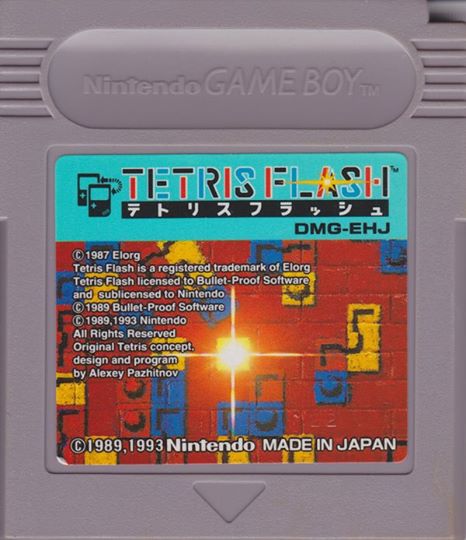
All of the sound effects, there’s one sound in the whole game, just a little psh psh. If you look at some of the early Game Boy releases, people weren’t really sure what size characters should be on screen. If you’ll remember the Batman review, Batman was so tiny, and the original Super Mario Land was pretty tiny, too. However, being small is no excuse for being hard to see. Other fighting games, like Super Chinese Fighter, have really tiny characters, but they’re really clear and have a lot of personality. These are very tiny, and they don’t really have outlines. They’re solid shapes, and what they’ve done is they’ve taken these characters with no outlines. Sometimes they have partial outlines, but they put these in front of detailed backgrounds. So a lot of times things just blend in. Now in the Game Boy Color, you have the advantage that, you know, you have a layer of pink that shows up on top. The characters show up pink, the background goes green. But in black and white, this thing is really hard to play. You can’t see what’s going on. I think if you’re a big fan of Fist of the North Star, you’re gonna be disappointed because you don’t really see heads explode. You can’t really see the character. They don’t even show you a character portrait before each fight. Heads are supposed to explode. If you’re really curious about fighting games before Street Fighter 2, you might be interested in this, but for everyone else, you’re really not gonna have any fun with this. Fighting games generally aren’t good in the Game Boy, so you might as well try to get the best ones out there. Everything’s in English in the Japanese version. There’s no reason to choose one or the other. For the Japanese version, Hokuto no Ken Seizetsu Juuban Shoubu DMG-HKJ. If you want Fist of the North Star, DMG-HK. Tetris 2 by Tose was released in the US in December of 93. In Japan, June of 94, but it was called Tetris Flash in Japan. The European version, Tetris 2, fall of 94. Tose was also responsible for Hyper Load Runner, Malibu Beach Volleyball, Roadster, Maru’s Mission, Tower of Druaga, Yoshi’s Cookie, all kinds of stuff. Of course, it’s a block puzzle game. It’s like Tetris when Tetris first came out in the late 80s. It was like a gold rush. People realized, oh, we don’t have to make a game a side-scrolling platformer. We can make a game that’s about dropping puzzle blocks. This is the kind of thing I covered in Klax, my review of Klax, how everybody was just scrambling to try different kind of block puzzle games just to see what could be as catchy as Tetris. So you had your Puyo Puyo, Dr. Mario kind of thing, and lots and lots of variations on Tetris. This was especially noticeable on computers, where everybody had a Tetris and people tried different shapes of blocks, exploding blocks, all kinds of stuff, 3D Tetris, but most of them were not as good as Tetris. To me, I could never compare Puyo Puyo or Dr. Mario to Tetris. They’re good, but they’re just not Tetris. There’s just something different about the mental process that you go through when you’re stacking these things. It’s unlike anything else.
When Tetris 2 came out, I never even tried it. This is my first time trying it. It just didn’t look that interesting to me at the time. Well, anyway, I tried it, and it’s great. A worthy sequel of Tetris, I think. The game is very similar to Tetris. You have falling pieces, but you have some different shapes this time. Instead of the regular T block you have, it looks kind of like a V. It’s like a T with a piece missing. There’s an L block that has a piece kind of offset, so imagine an L block that’s 4 long, except the corner is dropped out. You have a new shape that’s like a big L.
It’s like a 3 by 3 L, except the corner is knocked out. Then you have another one that’s like that V I just told you about, except there’s an extra piece at the bottom. So imagine a T, a long T, where it’s 3 by 3, and then a chunk taken out where the intersection is. These pieces that have kind of separate corners, for example, the one I just told you about that’s like an L with the corner missing. Those pieces fall separately, so you can land the kind of floating piece on an edge, and the rest of it will continue falling, and you can still control it as it’s falling. So just that alone gives a lot of different texture to Tetris. There’s a lot of different strategies you can use. I played a lot of kind of Tetris clones where they tried to add new pieces to the basic set, and it works out terribly, because, I mean, those are the perfect pieces. But these ones, you have the advantage that it breaks into separate pieces as you’re putting it down. There are a lot of situations where you’re just gonna have, you’ll drop the main part of the piece and there’ll be one free little square, you can just move down exactly where you want it. You’re not just filling in lines in this game, you’re matching colors. There’s black, white, and gray. You need to match at least three, vertical or horizontal, but there’s no diagonals, to clear pieces. The object isn’t just to clear the level. At the beginning, you’re gonna see these flashing dots. If you get rid of all those flashing dots, it clears the level, and you go to the next one. At the beginning, it’s very simple, because there’s just a few at the bottom, things aren’t moving very fast, and you can clear those levels pretty quickly. But later on, you get more of these dots, and they’re kind of hidden by other dots. So, you’ll have the flashing dots down at the bottom, and then these other dots that you have to clear out, just to get down to those things. It’s like Tetris, but there’s this other thought process going on of matching the colors. It’s like having a little bit of Dr. Mario or Puyo Puyo in there, but you’re still doing the regular Tetris thing. It’s very hard to explain this game. I can guarantee you, if you like Tetris, you will like this one. The music, it’s not as good as the original, but at least you can turn it off, and there are three different songs you can choose from. There’s a puzzle mode, but the main mode, you’re just clearing levels and getting points. There are 30 levels altogether, and there are three speeds. Do get this game. The US version, DMG-EH, Japanese version, Tetris Splash, DMG-EHJ, European DMG-EH-SCN. Okay, let’s see, it’s up, up, down, down, left, right, left, right, B, A. Huh, secret level. Othello World. It’s a Japan-only game for the Game Boy. It came out in the fall of 1994. It’s published by Tsukuda Original. It’s the only game they ever made for the Game Boy. They made a bunch of games for the SG-1000, Sega machine.
Othello is a board game. The real name is Reversi. It’s played on an 8×8 grid. You have 64 game pieces. They’re white on one side, black on the other side. When you put a piece down on the board, let’s say you’re black and there’s a white piece and a black piece on the other side, you put it down and the white piece turns black. You have to have a piece that’s your color on the other side in order to flip the discs. This game was created in the late 1800s. It’s kind of along the lines of checkers in that kids can play it. I mean, you can be… I remember being about six years old playing this game. It’s really not hard to understand. The rule set is really simple. It’s like when you’re a kid, you start by playing tic-tac-toe, then you move on to checkers and maybe this one. It’s a very simple game, but it is tricky. There are certain moves you can do at the beginning. If you don’t do them right, you can really maybe not lose the game, but at least the middle part of the game is gonna be very difficult if you don’t get those first few moves right. The corners are very important. The corner pieces can’t be flipped, so you can kind of anchor yourself down in those corners. One of the strategies is to force your opponent into the pieces next to the corners, which will sometimes allow you to grab those corners. There are only certain moves you can make on the board, and sometimes you can’t make any moves, so another strategy you can use is to try to force the opponent to have very few moves. Eventually, the board will be filled up or nobody can move, in which case you tally up the pieces and whoever has the most wins. It’s one of these games where it looks like you’re winning, and then at the last minute your opponent can just wipe out a whole bunch of discs. So back to the Game Boy. This version is very simple. You choose who’s gonna play. You can choose a human player and a human player or a human player and a CPU. There are different skill levels of CPU to choose from. If you’re not an experienced player, you should probably pick the first one until you get better at it. You can turn off the music, and you can set a time limit. One good thing about Othello is it’s one of those games where the CPU doesn’t really have to do that much thinking. It’s not like chess.
You know, even with the pretty weak CPU of Game Boy, you don’t have to wait a long time for the opponent to make its move. The AI can use look ahead strategy, and it’s very hard to beat this game. You know, if you play it with a higher CPU level, it’s really hard to beat, because it’s basically looking ahead. It’s not like chess. The look ahead moves are really useful, and because there just aren’t as many possibilities compared to chess, it can look ahead, you know, almost to the end of the game and see the future. So you really have to take your time and think about how to trap it and think about how to limit its moves. When you’re playing against a human opponent that’s not really that skilled, there’s a few tricks and strategies you can use, like trying to grab those corners and stuff like that. But when you’re playing against a CPU that has look ahead moves, that kind of trick isn’t going to work. There are a lot of other ways to play Othello. If you’ve got a phone, it’s probably a lot more fun, but I wouldn’t say no to this one. It’s just a straightforward, passable Othello. There’s a Super Famicom version of it, too. If you’re looking for this game, search for DMG-ATOJ.