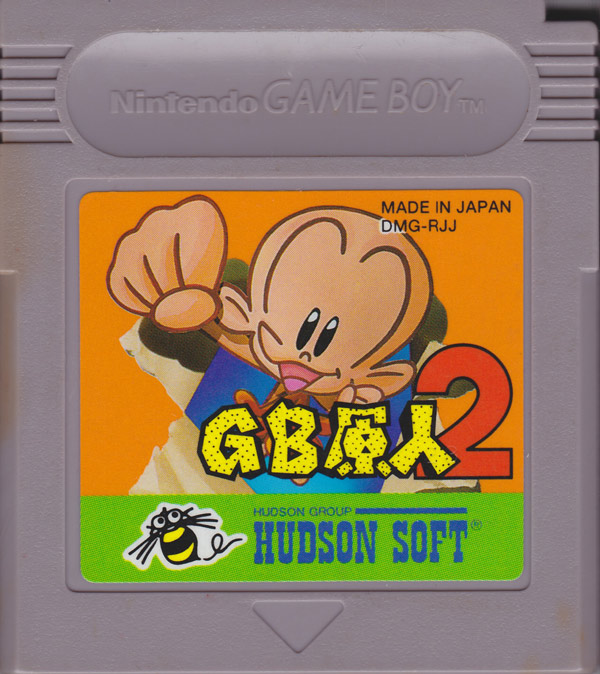
Reviews of Bonk’s Revenge (GB Kid 2), Krusty’s Fun House. Wayne’s World & Bubble Ghost.
My name is Ray Larabie, and I’m talking to you from Nagoya, Japan. Welcome to episode number 39 of Game Boy Crammer. Today I’ll be reviewing GB Kid number 2, Bonk’s Revenge, a Simpsons game: Krusty’s Funhouse, Wayne’s World, and Bubble Ghost. Thanks to everyone who’s written to me and all the nice tweets and stuff, I really appreciate it.
Because of these tweets and likes on Facebook, I’ve gotten so many more new listeners just in the last month or so. Now, unfortunately, there’s going to be a change. When I produce these episodes, it takes a lot of time to play the games, research, record the sound, take the screenshots, record my review, edit it, mix it all together.
But what ends up taking a lot of the time is just the screenshots. I have to go through hundreds, sort through them all, figure out which ones are the best ones, scale them all, put meta tags on them, upload them to the site, put them in the right order. It’s taking an hour and a half sometimes just to put all those pictures together.
In that amount of time, I could do an extra game review. So unfortunately, no more graphics. I might put a scan of a cartridge sometimes. And with all these games, you can find screenshots on GameFAQs, MOBI games, all over the place. Thanks to Brian Inwood for the idea of doing Bubble Ghost. It was on my list.
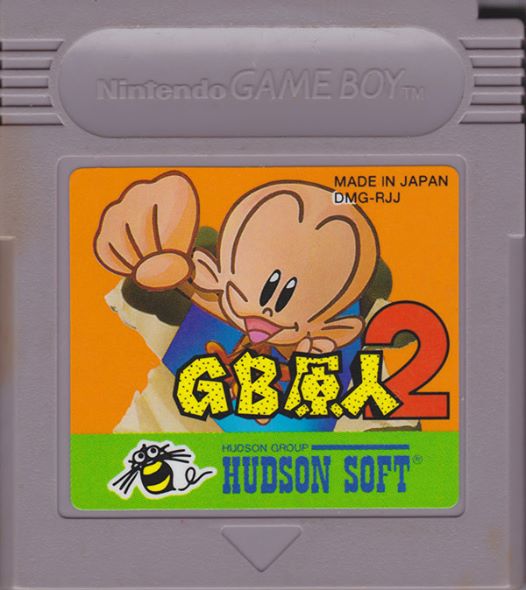
I’d been putting it off. You can see the comment on Game Boy Crammer on Facebook. Okay, let’s get on with the show. Bonk’s Revenge was released in Japan, U.S. and Europe in the fall of 94. In Japan, it was GB Genjin 2, Genjin meaning caveman, Bonk’s Revenge in the U.S., and B.C. Kid 2 in Europe. In episode 8 of Game Boy Crammer, I did a review of the first game.
This is a platform hop and bop game. You play a caveman. In addition to jumping, you can flip through the air and land on your head on stuff. This series was a flagship series for the PC Engine, or TurboGrafx-16. There are three games in the series on TurboGrafx. I played all three. The first one was very much like the Game Boy version.
The second one is very different. It’s the same kind of game. It’s just all the levels are different. It’s just a different theme. In this Game Boy version, you’re dealing with space and robots. There are six rounds to get through, a boss at the end of each one. At the end, you’ve got a boss rush and a final boss.
There’s no save game on the cartridge, but you can save with passwords after each round. Like the first game, there are smiley faces all over the place. If you collect a hundred of those, you get an extra life. There are little hearts. It gives you one health. There’s a large heart that fills up the whole thing.
There’s a crystal heart. They look like the little recovery hearts. If you get four of these, you get an extra heart on your life bar. And there’s meat, just like the first game. When you eat the meat, you’re going to cycle through a bunch of different versions of Bonk, and you can try to stop it on whichever one you want.
Once you become this different form, if you get hit, you go back to your original form. So there’s one called Master Bonk. He has stronger headbutts, and he does kind of a slam thing on the ground that will shock enemies. There’s Hungry Bonk, which instead of hitting enemies with his head, it’ll actually bite them and try to eat them.
And then you have Thief Mode. It looks like, you know, he’s got a striped suit on and a little ball and chain. This will let you get into locked rooms. You’re going to see these locked rooms all over the place. There are no keys. You just have to become this version of Bonk, and you can go into these rooms.
There are four different kind of rooms. There’s one that’s called the Bank. It’s just full of smiley faces. There’s about 50, I think. There’s a room full of meat, so you can just turn into whatever character you want. You don’t get points for anything in this game. There’s actually, unlike the first game, there’s no point system at all.
There’s a hospital where you can get a big heart to fill up all your health, and you get a crystal heart, which is one of those ones. You need four of those to get another heart on your health meter. And once in a while, you’re going to get a jail. The jail will take half of your smileys. I don’t know if it’s just me, but I always felt like on the later levels, I got the jail a lot more often than the first levels.
I hardly ever saw it. On the later levels, if you’ve got 99 smiley faces, you might want to hesitate before going into a possible jail and losing half of those. There are the regular flowers, just like in the first game. Sometimes you, sometimes they bounce you upwards, sometimes they give you a prize, sometimes a thing comes out to attack you, and sometimes they try to eat you.
You’re also going to see these little tiny flowers. Grab one of those, you’re going to go to a bonus level. But it’s not as interesting as it was in the first game, where you had different types of games to play. This one is just the same thing every time. You’re standing in a ring with an opponent, looks like Robocop, looks exactly like Robocop, and you have to hit him in the head and knock him off the side.
The first round isn’t so bad, the second one, it’s really hard to knock him off the edge. If you run out of time, you lose, that’s not fair. If you win, you get an extra life and you’re going to get a crystal heart. If you lose, you get a whole bunch of bandages and you go back to play the level with double damage, meaning everything that hits you hits you twice as hard.
Don’t forget, in this game, you can pretty much fly, it’s a little bit like Kirby in that way. There’s some levels where if you really want to, or let’s say you have one heart left and you don’t want to risk it, you can kind of try to get some air, jump really high, and just keep hitting the button really fast.
If you can hit that button fast enough, you’ll travel horizontally across the screen in a straight line. The bosses are a lot like the first game, there’s always a place you have to bonk them with your head. Watch out later, there’s one that looks like the alien from the movie Alien, and it actually jumps from wall to ceiling.
Watch the pattern, if you go in the bottom left or right corner, just stay there, wait till it comes down, you can hit him in the back, just take your time and just hit him one at a time, you won’t take any damage at all, and that’s going to be really important at the end during the boss rush, because you’ll have to fight all these bosses again.
It’s not a very hard game, if you have trouble getting through tougher games, this is one of the games you’re going to enjoy, because there’s not that much to it. There are lots of opportunities to get extra lives, I didn’t use the save games, I just went through in one shot. The music was really good, the animation is great, it’s just as good as the first game, it’s not really a big improvement, it’s just more of the same.
There’s no reason you shouldn’t get the Japanese version if it’s available, because there’s no reading to do in this game. Look for DMG-RJJ for the Japanese version, DMG-RJ for the American version, DMG-RJ-EUR for the European version. Wow, the glamorous world of TV. You gotta be kidding, how can they expect a genius like Krusty to work in a dump like this?
Hi, boys and girls, come on board the Krusty the Clown show. Krusty sure looks different in person. No way is that Krusty, Krusty’s a real clown, that’s just some lumpy old dude in a clown suit. Krusty’s Funhouse, developed by Audiogenic, published by Acclaim, was released in the US in January of 1993, it was called Krusty World in Japan, that came out in the summer of 94, and the fall of 94 it came out in Europe, Krusty’s Funhouse as well.
This is a platform puzzle game, it started off on the Amiga, there was a game called Rat Trap by Fox Williams that came out in 1991, Acclaim had a reputation, you know when you think of these licensed games that are often bad, sometimes good, but usually bad, and often they had Acclaim at the beginning of them, or LJN, or Ocean.
Acclaim was one of these companies that was taking advantage of these licenses in the early 90s, you can look back at what Acclaim released at that time, and it was a lot of really low budget licensed games, these contracts went to the lowest bidders, that’s probably why there were so many lousy licensed games, especially Simpsons games, I mean the Simpsons arcade game was fun, but there’s a lot of bad Simpsons games, however, this is based on an okay game, Rat Trap is not mind-blowingly great, but it’s still a good game, maybe it’s better that they just slap the Krusty brand on this game instead of making some lame generic hop and bop platform game.
So this rebranded Rat Trap game came out on the Amiga NES, PC, Sega Master System, Game Boy, Super Nintendo, and the Genesis Mega Drive, but it’s not like they took this game and changed anything about it, all they did was they took the main character who’s this little kid with purple hair, they changed it to Krusty the Clown, and the rest is the same.
This is kind of like Lemmings in a way, except the opposite, you’re trying to kill these rats, but you’re still trying to lead them to a destination, even though it’s their doom. Maybe you’re not killing them, it sure looks like you’re killing them. You will see other Simpsons characters, but the trap that you’re leading the rats to has an animation of let’s say Bart pounding them with a boxing glove, or various ways of death, but just give up any expectations of this being a Simpsons game.
And Krusty doesn’t even act like Krusty, he just has a big smile on his face, and even when he gets hurt he doesn’t act like Krusty. Okay, the gameplay. You’re walking around these big scrolling levels, it’s a platform game, the controls are really good actually, they’re pretty crisp, the scrolling is great, like when you jump on platforms it’s like a platform game should be, just everything works.
When I first picked this game up I didn’t read any instructions or anything, I had a tough time figuring it out, I just kind of wandered around, I didn’t really know where I was going. So, what you have to do is, you go in the first door, that’s world one. After every world, you get a password. Each world has several stages.
The first world has eight stages, second world ten, and so on. You can do them in any order, but you’re probably best doing them in order. The first door you’re going to come across is door one. Just do that one, it’s the easiest one. In fact, in world one you’re going to have to do door one, two, three, four, five, six.
To the left of the sixth one is eight, but you’re going to have to go back and do seven, which is to the right of four, and there’s a secret entrance. You’ll figure it out. Anyway, the first one’s really easy. The thing that I didn’t get at first was, there are two different kinds of blocks at the beginning.
There are the regular blocks that you can kick, you just walk up them, hit your button, and you kick them. You get prizes, you get power-ups, I’ll get to that later. The other kind of block is kind of a sandy looking concrete block. If you stand on top of that, push down, you’ll pick up the block. When you want to put it down again, you just press down again.
You can pick it up, put it down as many times as you want. And that’s basically what the game is about, is putting these blocks down, because these rats, they cannot climb anything bigger than one square. So you’re going to have to make a step for them. You can actually place this block in midair if you go right up to the edge of a block, and you’ll see it has a little animation of Krusty almost falling off the block.
You can drop the block down, it’ll float in the air. You’re going to need that a lot. You need to lead these guys into a trap, so there are pipes you can lead them into. There are these sort of punching elements on the wall that bop the rats and send them flying. At least for the first few levels, the solution is self-evident.
You just have to run around and look, and you can kind of figure it out. There aren’t really any big secrets near the beginning. Later on, it gets ridiculous. But the first world, once you figure out that you can pick up blocks and put them down, and you need to exit the level after, once you figure that out, it’s actually pretty fun.
Apart from the basic blocks you can pick up, you can get these ones that look like a pipe, an L-shaped pipe. You’re going to need to connect some pieces once in a while. Right near the beginning, I think the fourth or fifth level, there’s an L-piece missing. You have to pick it up and put it in. There’s a fan that’ll actually blow rats up into the air.
There’s a jar. There’s some that you can kick and they’ll slide. And there’s some you can just stand on and they’ll break. Or you can throw projectiles at them to make them shatter. You’ll see that in one of the early levels. When you kick these blocks to get prizes and power-ups, the prizes are a horn and a purse.
You get a bunch of points for those. I don’t know how many points you need to get extra lives, but there are extra lives all over the place. You’re going to see burgers, a hot dog, a mug, and like a milkshake. A squishy, I guess. Those give you health. If you see a little crusty, the clown face, that will give you an extra life.
There are small projectiles and large projectiles. The large ones bounce around. They’re supposed to be pies. They seem more like grapefruits. There are enemies walking around, these snakes and stuff like that. There’s no real big advantage to killing them. And later on, you’re really going to need those projectiles.
So I recommend only killing enemies if you need to. They’re just predictable walk back and forth types. You generally can just jump over them, but they’ll shoot at you sometimes. When the mice are dying, you don’t really get any indication that you’ve killed them all. So you don’t really know when it’s time to leave the level.
You have to kind of go and check around, see if there’s any mice left. There’s a few times where I sent the mice to the trap or what I thought was the trap. I went around the level to collect some prizes and blocks and stuff like that. I came back and I kind of had to look around to see, are there any rats left?
Like there’s no indicator that, hey, you killed all the rats. There’s no time limit on these levels. So that’s really nice. You can just take your time and explore. Especially at the beginning, you want to go look around and see what you have to do. And a lot of the challenge is finding the block to begin with.
Like they kind of tuck it away in a hard to find place. If there’s a really hard place to jump to, that’s probably where they put the block that you need. Your character has health, but it’s not indicated on the screen. You can take a few hits. You’ll see that he’s kind of getting tired. That means you need to get some health pretty soon.
But there’s no clear indicator of exactly what your health is. You can fall pretty far, but you can’t fall forever. You will take damage if you fall really hard. The music is very repetitive in this game, and it is disappointing that there’s no Simpsons-y kind of stuff going on. But as for an action platform puzzler, it’s pretty good.
I don’t know why people hate it so much. I mean, it does get hard, and I wish they’d have passwords on every stage. But there’s enough extra lives and stuff like that, and it’s not too bad. If you’re not really into this kind of game, I don’t think you’re going to want to finish it. But it’s worth playing around with if you happen upon this game.
If you want the Japanese version, there’s no reading to do, but I find the Japanese version is actually not that common. It’s probably easier to find the US and Europe. Krusty’s Fun House DMG-FK for the US and European versions. DMG-FKJ for the Japanese version. And what’s your name, little boy? I’m Bart Simpson. Who the hell are you?
Why, I’m your old pal Krusty. Oh yeah? Then what’s Krusty’s secret motto? Oh, instead of feeling sad and blue, keep a Krusty smile on you. Listen pal, I don’t know how you found out Krusty’s secret motto, but you’re still an imposter. Kids in TV land, you’re being duped. Why you little… Next to a big review.
We’re not worthy! We’re not worthy! We’re not worthy! We’re stuck! What is your most popular video game right now? Desert Storm Commando Warrior. That would have to do with that limited skirmish in the Middle East. Yes. Wayne’s World by Radical Entertainment, published by THQ, was released in November 93, US only.
This came out around the same time as Wayne’s World the movie. Wayne’s World came from a Saturday Night Live sketch, but actually it was around a little bit before that. In 87 there was a show called It’s Only Rock and Roll. It was in the summertime, it was a sketch comedy, had some people from Second City.
Mike Myers brought this sketch over to SNL. You had Dana Carvey as Garth, Mike Myers as Wayne. Two guys that had their own cable access show. It always felt a little bit like Bill and Ted’s Excellent Adventure, but this actually came out before Bill and Ted’s Excellent Adventure. And while it seems a little bit tired now, at the time it was really funny.
I remember seeing this in the theater and people were just cracking up. This was at the time really funny. The Scooby Doo ending thing, it’s been done a million times, but at the time it was really new. When I got my second video game job it was at a place called Grey Matter. The day I started working they had just finished shipping Wayne’s World.
It shipped like the day before or something like that. So I just, when I went for an interview I just cut the tail end of that game being finished. Now that was Wayne World for the Super Nintendo and it’s legendary. It makes a lot of the top ten worst game lists and I tried to play it a few years later and you really can’t get through it.
It’s just really impossible to get through, it’s just so hard. So this one was from Radical Entertainment. This is a Vancouver game company. They’re still around now. They formed in 1991 and this game was in 1993 so they just made a few games before that. This was their second Game Boy game. It was a game called Battle of Olympus, which was kind of a side view Zelda 2 style platform role playing game.
This game was made simultaneously for NES and Game Boy. And as far as I know Radical and Grey Matter never really collaborated on this. Now a lot of the levels are kind of themed the same. You start off in the music shop, which is the same way the Super Nintendo version starts, but I think that’s just a lack of ideas.
I mean if you’re going to make a platform game out of Wayne’s World, you’ve got a music shop, you’ve got a donut shop, there’s really not that much you can do considering there weren’t a lot of locales in the movie that really lent themselves to a platform game. This game was published by THQ. They were notorious for making these quick knockoff games and they always went to the lowest bidder.
And it wasn’t just because they wanted to make bad games, it was out of financial necessity. When you did a licensed title like this, the original licensee took a lot of the money. Now if you made your own original title, you got to keep a lot of the money that was made with the game, but Wayne and Garth need their cut.
So let’s get to the game. You play Wayne and sometimes you play Garth. If you play Garth, you have a gun that shoots lasers or electric lightning bolts or something. If you play Wayne, hand-to-hand combat. You start off in a music shop, you’re going to be shooting drums and cymbals, jumping on amplifiers.
In most levels you just have to get to a door at the other end of the level. They’re very linear, sometimes you can get lost, you know, but it’s pretty linear. For the most part, you don’t have to kill any enemies. If you can get past them, just go past them. You have a health bar and you have lives.
You can refill your health bar with these E power-ups you see once in a while. If you see a T power-up, that gives you time. Now the time limits are brutal in this game sometimes, if you don’t get those T things. If you don’t care about points, it’s still a good idea to defeat some enemies because that’s where you can get those T power-ups that will keep you going.
Sometimes it gives you 30 seconds, sometimes it gives you 60 seconds. There’s a P power-up. If you’re Wayne, it gives you a special kind of kick. It really doesn’t give you any advantage. If you’re Garth, you get sort of a spread shot. Well, not much of a spread shot. Two shots come out of your gun instead of one.
Once in a while you see an L, I think it has something to do with your kicking or something. I didn’t really seem to have much of an effect. If you find a donut, you get a little bit of extra life, but just a little bit. It’s not like the E power-ups. There’s nothing really different that’s going to happen.
I mean, you’re going to be jumping and shooting enemies or jumping and kicking enemies. The combat is really rudimentary, except for a few bosses. For the most part, you’re going to want to do a little sweep kick, just crouch and kick. You’re probably wondering what kind of enemies did they choose for a game based on Wayne’s World.
Well, you’ve got bouncers, you’ve got killer robots, you’ve got more bouncers, and cats. Yeah, you have to murder cats. Well, most of the time you can jump past them, but there are points where you will have to kill cats. It’s kind of disturbing and sad. I mean, when you think of their personalities, you can’t really picture them murdering animals.
To break the monotony, there is one level that’s a little bit different in that you have to keep turning on lights. You walk through the level, the lights start flickering going out, and if you pick up a light, the lights come back on temporarily until you get the next light. So you have to make sure you can hop across platforms to get to the next light, to get the next light, and so on.
And there are going to be situations where you can’t see the platforms. You have to memorize where they are. But what makes this really difficult is the collisions on the platforms are brutal. You know some games you can kind of hang on the edge of the platform. This one is unforgiving, constantly falling off platforms.
You can’t tell what’s a platform or what’s background. A lot of times something just… there’s no real rhyme or reason to it. I know some games you can kind of tell the difference. In this one you just have to try to jump on things to see if they’re background or not. It’s really inconsistent. There’s a little bit of dialogue from the show.
There’s some interstitials where you’ll see them chatting and stuff like that. And it sounds like the kind of things they’d say. When you get to the final boss… It might happen. Sure, the monkeys might fly out of my butt. You just have to get your timing really good. Because it can kill you in about three shots.
So you want to just really time it carefully. Hit him a few times. Actually just hit him once and get out of the way. And wait for a moment where you can hit him. Don’t just go in there and start hitting him. Because you can only take about three kicks. And when you’re running through that final level, try to get to the time extension.
Once you get that, you’re set. There are some bonus levels where you have to collect a bunch of donuts. And if you get them all before the time runs out, there’s a whole bunch of bonus donuts that show up. And a time extension thing and all kinds of stuff. Well, the first time you get to it, there’s enough slack that you can kind of figure it out and finish it.
And then the time gets tighter and tighter. By the time you get to the last one, you have to be so pixel perfect, you might as well not even try. Like you would have to do it exactly perfectly. Nothing wrong. There are only four main stages in this game. It’s a really, really short game. I was so surprised when I saw the ending credits.
You know, I finished this boss that seemed kind of like a sub-boss. It’s just… It’s not really a boss like you’d think of a game boss. You’re just fighting Benjamin from the movies. You’re just fighting a guy that takes off his jacket and you beat him up. That’s it. End credits. It’s such a short, short game.
There are no continues in this game, but there is a cheat. When you’re playing the game, hit pause. Hold B and A at the same time. Hit left, left, select. And it’ll bump you over to the next level. If it doesn’t work, try it again. It’s one of these things. You have to do it two… You know, unpause, pause, do it two or three times, and it kicks in.
This game’s kind of famous for having Easter eggs in it. Some programmer put a picture of his girlfriend and his own picture and his friend’s picture. So if you’re really interested, you can look up these codes. I just found it frustrating. I kind of wished they had spent a few more seconds getting the collisions on the platforms working.
Drives you crazy. If you were looking for this game, look for DMG-WN. Let’s do a game review. Bubble Ghost, developed by Opera House, published by FCI in US and Europe and Pony Canyon in Japan. It was released in US, Japan, and Europe at the end of 1990. Bubble Ghost originally came out in 1987. It came out on the Amiga, Atari ST, Commodore 64, Apple II, Amstrad.
When I first started playing this, it seemed familiar. I realized I played this before when I was a teenager on the Commodore Amiga. Bubble Ghost is an arcade game. I wouldn’t call it a puzzle game. Use the D-pad to move a ghost around. Use the A button to blow air. You can hold it down or tap it. And the idea is to push a bubble to the exit.
In the first room, you just blow the bubble to the end. It’s very simple. And then as you keep going through each room, it gets more and more complicated. You’re going to have items that you need to activate to, for example, right near the beginning, there’s a candle. You’ve got to blow up a candle to get the bubble to go past the candle.
While that might sound boring, what makes it fun is the physics. The bubbles’ physics have kind of an analog feeling to it. So you have to use skill. It gets very nerve-racking because later on, you’re getting that bubble through very narrow passages. Luckily, this bubble has pixel-perfect collisions.
Like, you can be going up a 45-degree angle wall, and your pixels will just be brushing against the edge, and the bubble won’t pop. The graphics are really clever. A lot of the background elements are not actually necessary to gameplay, but just make it look a little more interesting and fun. I like the way they depicted sharp objects, like pins and stuff like that, using gradations.
Like, it looks sharp, even though it’s big chunky Game Boy pixels. There are 35 levels, but there are no save games. You can continue. There’s the time limit. You’ll see a bar at the bottom. The more you have left on that bar, the bigger bonus you get when you exit each level. Even though this game was originally published by Accolade in the US and Infogrames in Europe, it was developed by a company called ERE Informatique, one of the first French video game companies.
And I think this is their best-known game. I think the graphics look better in the Game Boy version than they did in the Amiga version. Everything just looks a little more polished. The Amiga version looked pretty amateurish, and that ghost was just too condom-like. Like, he doesn’t really look like a condom in the Game Boy version, but if you see, look up screenshots.
Search for Amiga Bubble Ghost, and you’ll see what I’m talking about. He’s a condom. I found this one more challenging than the Amiga version, because in the Amiga version, you use the mouse to control the ghost, so you could get a lot more precision. But this one, you have to position the ghost in an analog way, which I think adds to the fun.
It requires a lot more skill. And pay attention, right near the end, I started going backwards through the levels. I’m like, I think I’ve seen this before. And I noticed the level numbers were counting down. Ah! So watch out for that. There’s no reading to do in this game. There’s no reason not to get the Japanese version if you can find it cheaper.
If you’re looking for the US or European version, look for DMG-BG. Japanese version, DMG-BGJ.