Game Boy Crammer · Episode 11
R-Type, Rod-Land, Hero Shuugou!! Pinball Party
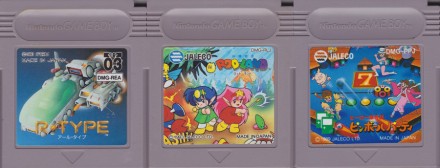
Reviews of R-Type, Rod-Land, Hero Shuugou!! Pinball Party and a guide to cartridge types.
Welcome to episode 11 of Game Boy Crammer. Today I'll be reviewing R-Type, Rod Land, Hero Shuugou! Pinball Party, and in the hardware section, a guide to cartridge types. Last weekend there was a huge flea market at Mase Nagoya. This is a dome stadium near the port of Nagoya, and twice a year they have something called the Mammoth Flea Market.
I ended up with 28 Game Boy games, three Super Famicom games, and a couple of Sega Saturn games. Also, three Gameboys. I got a Game Boy Color Clear. Someone had put a screen protector on it, and I popped that off, and it's like a beautiful clear screen underneath. And I got a Game Boy Pocket, the black one, and the original Game Boy Colors one. The other Game Boy Pocket, which is in the retro color, so it looks like the same colors as the original Game Boy, the kind of beige with the pink buttons. Someone had tried to repair the screen, it was all messed up, so I ordered one on eBay. You can get a lens for a Game Boy for not that much money. It seems like these lenses are available for any type of Game Boy, and it was only seven bucks with shipping.
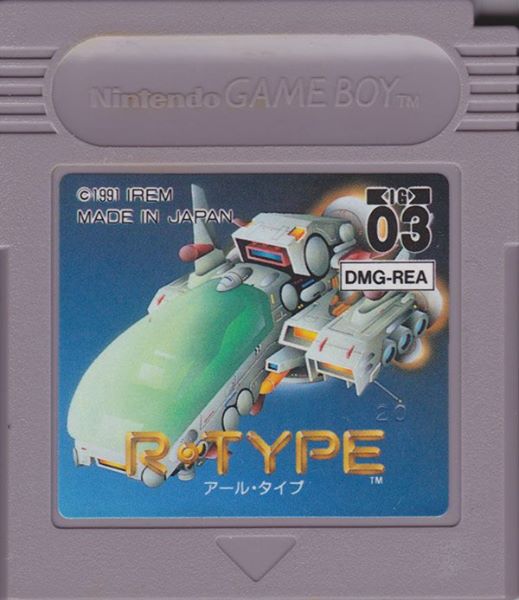
Enough of my yappin', let's get to the reviews! R-Type by iRAM came out in 1991 in Europe, Japan, and the US. A year later, R-Type 2 was released. iRAM. You may remember them as the company that made Moon Patrol. I think they're most famous for the R-Type series. So R-Type is a side-scrolling shoot-'em-up arcade game. Came out in 1987.
It's kind of like Gradius, I guess. You can blow up bad guys and bosses. In the arcade game, there are eight stages. In the Game Boy game, there are six. This is the Mega Man of side-scrollers, I would say. IGN voted this number seven in the top most difficult games to beat. But much like Mega Man, it's more a matter of memorization than anything. Whereas a game like Gradius, I found was really difficult to get through, I played the PC Engine version, and that was really tough to beat. Just the sheer number of bullets coming at your ship, and you don't really have a way to defend against them. R-Type is different. If you know where everything is, you can defend yourself. What makes this game different than all the other shooters is you have something called the Force. Now, the Force is this small device. You get it pretty early on, so you're not too long without it. You catch this thing in the front of your ship or the back of your ship. It's indestructible, so you can actually use it as a shield. If you're really careful, you can kind of run into all the enemies with this thing. And you can also send it out.
If you hit your, uh, not fire button, the other one, you can actually send it out and it'll go on its own. And it keeps firing on its own, too, so you can give your thumb a rest. The key to getting through this game is, there are two keys, actually, memorization and using the Force. As for weapons, you have a main shot, which is a, which is a charge shot. So you can fire like a little key shooter, or you can hold the button down and let go of a big shot. And the length of time you hold it down makes a stronger shot. Then you have these orbs. More indestructible stuff. You can collect them. You can kind of grab it so it'll stick to the top or the bottom of your ship.
They kind of lag behind when you move. They don't stick with you. They act as a shield. Now this Force thing that sticks on the front or the back of your ship, it actually, uh, gets power-ups. Your ship doesn't actually get the benefit of the power-ups. So when you send the Force out on its own to do its, you know, sometimes you need to get it to smash through something or take care of a boss. You have your little pea shooter gun, so you want to keep getting power-ups to build up that Force. You can upgrade it so it'll shoot sort of diagonal lines that reflect all over the place.
Not unlike Gradius. And then you have like a missile thing where it shoots out missiles that follow the ceiling and follow the floor. They're very powerful. Unlike the arcade game, you can't tell what the power-ups are by color, so they've given them little numbers. It's not very complicated. You'll figure it out. I find the biggest danger in this game is touching the edges. Because it's a little more cramped than the arcade version, it's very easy to bang your ship on the edge, and the collisions are not very forgiving on that, and your, uh, indestructible orbs will not help you. That's where I find I make the mistake, is not getting shot by anything, because you can block stuff with the Force. The problem is bumping into the sides, mainly. It's hard, but not as hard as people say, I'm really sure. I can get to the end of level four, no problem. Level four is very tricky.
I should explain what this is all about. When you get to level four, there are these, in the arcade version, they look like spaceships. In this version, they just look like, um, little square flowers. You'll know when you get there, because you're gonna get killed. There's a hole at the top of the screen. These things come down, and then they loop around in a path, and you have to, basically, you just have to survive and shoot these things. The trick is, stay at the top. Don't go down to the bottom. When they come out the top of the screen, they always go down. They never turn left or right. So most of the time, you can stay on the top and just keep blowing these things away, and then just kind of dodging when you need to. Pretty much just stay on top and move back and forth. It's really hard to explain, so if you really do get stuck on this part, because I sure did, there's a video. You might want to just speed ahead through that part so it doesn't spoil the game for you, but go to j.mp rtype gb. One word, j.mp rtype gb, and you'll see a YouTube video there, where this guy plays through the entire game with one ship. He doesn't get killed. Oh, speaking of one ship, I've never seen a one-up in this game. Once you're done, you're done.
You have three continues, you know. Hey, try to do it in one ship. The way the bosses work, you can sit there and shoot at them if you want, or, hey, why not send the force to do the work for you? So the first boss is this kind of scorpion thing with a weird little tail that shoots out. Well, all you need to do is shoot your force into its mouth, and then just hang up at the top of the screen. The bullets won't hit you, and you just let it do its thing. Take a little nap.
The next boss is almost the same kind of thing. You've got this snake that keeps flying around, and there's an orb with a little eye on top, but you can't really shoot the eye. So what you do is you get your force thing to sit on it, and you go down to the bottom of the screen very carefully, and you can get to a point where the snakes will never touch you, and you just sit there and let the force do its work. Even the final boss is the same kind of thing. At first, you can't really shoot it. There's a tiny little gap that you can't shoot through, but eventually, if you stay alive long enough, just hang at the left of the screen and dodge. You can send your force in and just keep dodging the stuff. Most of the bosses are like this. There's a weird situation at the end of level three where you have to choose up or down. You'll kind of get to the end. You'll think, well, how do I defeat these enemies? Well, like most of the tricks in this game, you use the force, send it out, and you can get it to finish it for you. There's no save game in this game, so there's no battery to replace. There's no Japanese to read, so there's no reason you can't get the Japanese version. Here's the weird thing. If you wait for the high score screen to show up, hold left, down, A, and B together, and you'll get this little graphic editor. You can actually draw pictures with it. I don't get the point, but it's just kind of a fun little Easter egg. Also, when you're on the main menu, press down and select, and you can turn the music off, and you can change the difficulty level from easy to hard. If you're looking for the Japanese version, DMG-REA-JPN, or DMG-RE for the European or US version.
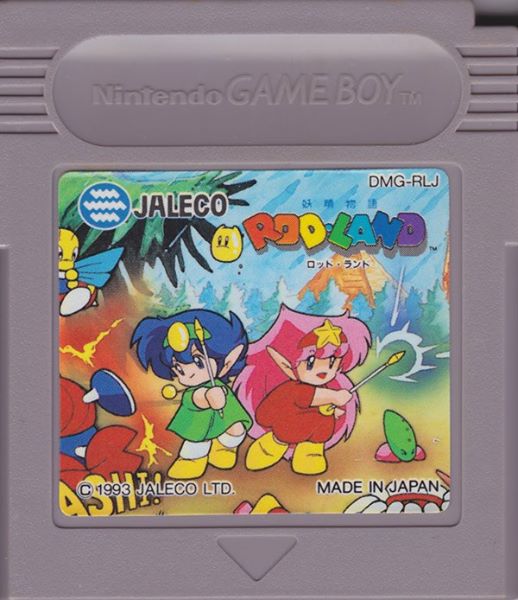
Rodland by Jaleco Entertainment was released in 1993 in Europe, and Japan was not released in North America. It's based on an arcade game by Jaleco that came out in 1990. The full name in Japanese is Yosei Monogatari Rodland, which means a fairy tale, Rodland. It's a little bit like Bubble Bobble in a lot of ways. I wouldn't call it a Bubble Bobble knockoff, but it has this very similar feel. The player controls a fairy. You can play Tam or Rit, and they are ladies, and you're rescuing your mom, so it's a very, very different storyline than your average game, where you're rescuing a damsel in distress. Now, in the arcade game, the screen contains the entire level, and it's a level of platforms, generally platforms and ladders. In this version, the screen scrolls around, so it doesn't all fit on screen, so just like Game Boy Bubble Bobble, you have to kind of scroll around to see everything. You use the D-pad to move around. You use the A or B button, they both function the same way, to create ladders. So you hit A and up, and you create a ladder, or A and down, and you create a ladder going down. You can only create one ladder at a time.
The A button activates your rod. So you can use this thing to whip monsters into submission for a few seconds, or you can repeatedly whip them back and forth until they're defeated. Now, these ladders, since you can't jump in the game, you can just generate a ladder anywhere you want to kind of act as a jump. So if there's an enemy coming at you and you want to jump over, and you create a ladder, walk part way up and jump off, you've avoided him. The other thing you can do with ladders is you can let enemies climb up, generate a new ladder, and that ladder disappears, and they all fall. Nobody dies by falling in this game. You start the game with three lives, if you have the European version. If you have the Japanese version, you start with nine lives. As far as I know, that's the only difference between the Japanese and the European version. If you do buy the Japanese version, don't worry, you don't need to read anything in this game. Much like Bubble Bobble, you can clear the board just by killing all the enemies really quickly. However, if you want to go for points and extra lives, you've got to use a little strategy. Now, all around the board there are flowers. If you collect all the flowers, the enemies will turn into turnips, kaburais, which means turnip in Japanese. They stay for about half a minute. If you defeat them, so you can whip them back and forth until they are defeated, and instead of turning into a power-up, they will turn into letters. These letters spell the word extra, so you're probably familiar with this from other games. If you complete the word extra, you're going to get an extra life and 10,000 points. This is a little easier than your typical collect EXTRA kind of strategy, because if you defeat a monster in turnip mode and you get the little bubble that changes, if you just sit there and watch it, it'll actually cycle through all the letters, but don't let it go too long or it'll disappear. So it'll actually go EXTRA and you can grab the one you want. So if you need an X, you can just sit there and time it right and then grab the X, which makes it really easy to get extra lives in this game, at least early on. Later, you'll have enough trouble surviving. I would say around the 20th stage it gets a little hairy, but for the early stages, just take advantage of this and try to load up as many lives as you can.
In fact, I would recommend not even, for most of these stages, early on, don't even attack the monsters. Collect all of the flowers and then let them turn into turnips and then just try to get the extra. In some levels, you're going to have to ride balloons, which is very similar to Bubble Bobble. Sometimes you have to jump on them, create a ladder and jump down on the balloon to access certain parts of the level. Most of the levels you can access with your own ladders.
Now I mentioned power-ups. When the monsters are their normal selves, when they're not turnips, whip them back and forth, they will turn into a little power-up. There is a bomb that makes a little explosion, but it's very short-range, so you pretty much have to have other enemies bearing down if you use that one. There's a kind of a TNT kind of thing that shoots a wave out either side, so it just, you know, anything on that vertical plane, they'll wipe out. There's a rocket, but it only hits the first enemy, which catches me so many times. Like, you know, so many games, that type of weapon will just clear out the whole room. No, it just hits the guy in the front.
There's a ball with an S on it. If you grab that, it will bounce and hopefully hit some enemies. There's kind of a little thing with four spheres together. If you hit that, they kind of shoot and bounce all over the place. There's a flamethrower and an icicle that lets you shoot projectiles. You don't even have to hold your button down. Just walk around and stuff will shoot out of your mouth for a few seconds. And the enemies? They keep introducing new enemies as the game goes on.
I don't need to tell you what they all are. However, a little later on, you're going to get these wasps that fly around and they're kind of irritating. And I find on those levels, I just want to knock them out as quick as I can. Probably not worth getting extra on those levels. There are 50 levels in this game. Every 10 levels, you get a boss. And the bosses are pretty easy to figure out and kind of fun. So I don't want to spoil them for you because I don't think you'll have that much trouble with them. Although, meh, they're a little bit of trouble. Build up a lot of extra lives and you should have no problem. It's not a super, super hard game. It's like Bubble Bobble in that it's pretty easy to play, but difficult to perfect. There are no save games and there are no cheats in this game. You pretty much have to set some time aside to try to play it all the way through. Now, this game is a little bit more expensive than your average Game Boy game.
I paid a little bit extra for it. It's slightly harder to track down. I don't see them around in stores much. I had to order mine from a website. But I do think this is one of those critical games. I'm going to put it in the top 10 at least. It's so addictive and so fun and to me, as good, if not better, than Bubble Bobble. Oh, I'm not going to go that far. Bubble Bobble is still better. Although the bosses are much more fun in this than Bubble Bobble. So do a search for it.
The Japanese one is pretty hard to find, but it's DMG-RLJ for the European version DMG-RL. Now, I'm sure you've noticed when you look at Game Boy cartridges, they come in different colors. The standard gray ones are the original Game Boy cartridges than work in any type of Game Boy, including the Game Boy Advance, but not the Game Boy Micro, because they don't fit. But you can play it in any kind of Game Boy. Not the DS or the 3DS. They started coming out with other colors later. There was the Tamagotchi card, which was white, and then Donkey Kong Land was yellow, and then Pokémon had the blue one and the silver one. And then they decided we'd better get serious and color code these cartridges, because we've got a new thing coming out called the Game Boy Color.
Now, the Game Boy Color has two types of main types of cartridge. You've got the black cartridges, which will run in a regular Game Boy or a Game Boy Color. And then you have the clear carts, which only run in Game Boy Color. And the clear carts are kind of handy, because you can see which ones have a save game, which is almost all of them. You can actually see the battery right through the top of the case.
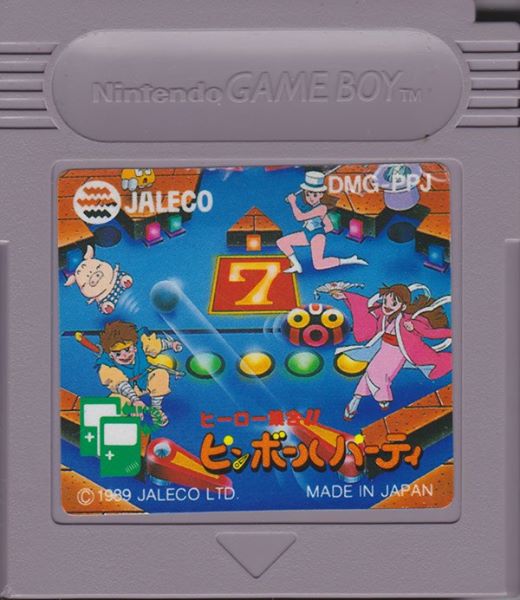
Hero Shuugou! Pinball Party. This early Game Boy pinball game was released by Jaleco Entertainment only in Japan in 1990. It's not the first pinball game to come out in the Game Boy. If you're familiar with Revenge of the Gator, this came out just a few months after and was obviously very influenced by it. Hero Shuugou! means like a big get-together of heroes. So when you start the game, you have a choice of one player normal game, one player extra game, and two player normal game.
Extra game is just an alternative pinball table. So basically you have two different pinball games in one. Let's start with the first game. The first game is three screens. You start on the bottom screen, you launch the ball up to the top screen, or you can do a skill shot and end up on the second screen and get some extra points to start off. Each screen is very simple. There's not a lot going on. For example, on the top screen, you've got three bumpers and three targets and a loop where you can lock the ball. That's it. If you compare that with Revenge of the Gator, there's always a lot of stuff going on. Very, very sparse, which could be forgiven if it were fun.
The paddles are so sluggish, you really don't feel like you have any control over where the ball is going. The ball tends to slide off the tips of the paddles, sometimes seems to go through them. The physics are just not very good in this game. Now I'm not expecting complete realism on the Game Boy, but it has to be fun, right? So when you drop down to the second screen, you end up on a kind of difficult to get out of screen where you have to knock down some targets. There's a moving bumper going from left to right in the middle of the screen. It makes it a little more interesting. You can kind of use that to hit what you want. So you have to knock down a bunch of targets, but there's a side drain and there's another sort of side trap that throws your ball down a level. So it's actually kind of difficult to stay on this level for too long. Now here's, I didn't have an instruction manual of this one. You can spell the word Jaleco by hitting these targets in a certain order. I've done it. I don't really see what it does. Like I didn't look that carefully at my score when it happened. It didn't really make a different sound when it happened.
So I'm not exactly sure what happens when you complete the word Jaleco. You would think in a pinball game, there'd be some sort of sound or effect or something to tell you that you've got some kind of bonus or something, but it just doesn't seem to indicate what's happening. But that could be just my not having read the manual. And then on the bottom level, you've got a pair of double flippers. So there's four flippers on the bottom. So it doesn't really give you a big advantage, but it can kind of go in between. So it's a little more of a hazard. And it's on this bottom level where the major flaw in control is really obvious. You have to knock down a bunch of targets and there's some on the left. Now in a real pinball game where you have actual analog control, you can pretty much hit anything you want if your timing and skill are good enough.
But in this game, I played it so many times. I played it for almost a week solid. I just couldn't hit those side targets. I mean, sometimes I would accidentally bounce it all over the place and it would hit them, but it was almost impossible to just target them. And then I thought, well, maybe it's me, maybe it's not. I'd better run this thing in an emulator. So I put this thing on an emulator with save states, which I don't normally do when I'm reviewing games, but sometimes I just, you know, in this case, I just wanted to get down to the bottom of it. What's really going on? So I did a save state where the ball is coming straight for the paddle. I loaded the save state and just tried hitting the ball with various, you know, different timing and stuff like that just to see if I could make any kind of difference. And no matter what I did, the ball would only go in three different directions. So there's no subtle angle you can hit. There's no subtle timing and skill that you can, you know, no matter how good you get at this game, you're only going to, the ball is only going to go in one of three ways. Now it depends on the velocity of the ball and stuff like that, but the whole idea of pinball, the whole appeal of pinball is that you have little control.
You have these two little paddles and you're supposed to control everything about the ball just by your timing and skill. And if you don't even have that, if you can't even rely on your skill and timing to play a pinball game, then really what's the point? It's almost like a game of chance at that point. Now there's nothing really to accomplish in the first game. I mean, other than getting a lot of points. You can get a multi-ball by locking the balls in the top screen.
However, when you release the balls, you kind of have this problem where, okay, when you have these multi-screen pinball games, what happens when one ball drops down to the next level, right? Now you've got a ball down there. It's just hanging around in limbo. Is it going straight down the drain? Let's say you're, you're on the top screen, you've got three balls and you've lost two and you still have one ball left and you're bouncing it around. There's nothing to do because you can't lock the ball anymore. So you're just basically pounding away at these two jet bumpers, biding time until you screw up and let the ball go down. Then in the second level, all the other two balls are already there bouncing around. So you have to hit them really quick and hope that you don't lose them down the next level. And there's really nothing to accomplish. There's no, there's really no goal other than just whapping them around, keeping them from going down the drain and getting points. Compare that to any other pinball game where, where you try to, when you're in multi-ball mode, maybe you can hit a jackpot or a super jackpot by, you know, hitting a ramp or doing something. Well, there's nothing to do except just hit bumpers. It's very confusing. You're never quite sure where the balls are going to show up when you drop down to the next level. And it's just kind of a poorly thought out situation. I think there's a reason a lot of other multi-screen pinball games don't have multi-ball. It's just not fun.
Now they give you a nudge feature. You can nudge the table to apparently move the ball around, except it doesn't do anything. The ball can be right at the top of the screen, headed straight down, and nudging it all you want won't change the path the ball one single pixel. It does nothing. Very frustrating. So there's really very little replay value into this first game. I mean, there's no bonus screens to get to. There's just nothing except getting points.
So let's go on to Extra Game. Now Extra Game is a little more interesting. They were definitely looking at Revenge of the Gator pinball when they made this. This game starts off two screens high. The bottom screen has sort of a bumper with a funny face on it that moves side to side, and the top screen has a very lovely magician with a hat with monsters that come out. And these monsters can destroy your paddles if you don't hit them quick enough, or they can shrink your paddles. So that's kind of fun, and it's kind of easy to get out of this screen. The enemies that come out are usually really easy to hit, and there's just three targets to knock down. And then you go up the top left hole, and you're off to another bonus screen. And you keep going to different bonus screens by exiting from the top left hole. If you go to the top right, you get some kind of little bonus screen where you knock down some numbers, but you can't keep advancing to the right. So if you advance to the left, you'll keep going up screens. They've got some things that are very similar to other pinball games on the Game Boy. You've got sort of Space Invaders knock down all the targets, disappearing bumpers that appear and disappear that you have to destroy. And then you get one screen where you've got this giant tank boss where you have to destroy the guns, and then you go up the top left, and you get an extra ball. Sometimes you go up there and a little pig comes out and tells you no bonus. And there's also another screen where you have to spell the word Jaleco, but in this case it actually tells you you completed the word, and you get a bonus. So it's much better than the first game. You know, I would say when I play it, I don't really notice that the physics are that bad anymore just because there's so much stuff to do. It seems like there's two different teams working on this game. One of them wanted to make the most boring pinball game, and one of them wanted to make it a little more like Revenge of the Gator. Oh, and there's a situation sometimes when you drop the ball down to the first screen.
Instead of paddles, you get a breakout-style, arcanoid-style paddle where you can bounce the ball up, which is actually great because you don't have to rely on luck anymore. You can actually keep the ball going as long as you can keep hitting it. Having the second game there really saves it. Otherwise, there'd be no point having this game. The music is kind of an irritating little loop. There's different songs, but it's very strange because when you're in the bonus levels, it seems like skipping CD or something. The music will just change when nothing happens.
It just seems to be very random, but the music does change. It's not always the same thing. Graphics are okay. There's some cute little anime stuff going on here and there, but nothing that's special. It just doesn't have that cute factor. There's no real theme going on. To me, I think that's important with pinball games is having a strong theme. There's no reason to make a generic pinball game. They could have made it about something except for a pinball party. What does that even mean? And you can't save your high scores on this card, so don't worry about changing the battery. I've seen this game for under 10 bucks. It's pretty cheap, so if you're into collecting a lot of pinball games on your Game Boy, it's worth getting. But otherwise, there's so many better pinball games on the Game Boy that you can just skip this one. Search for dmg-ppj, and you'll find out all about it.