Game Boy Crammer · Episode 12
Metroid 2, Sagaia, Malibu Beach Volleyball
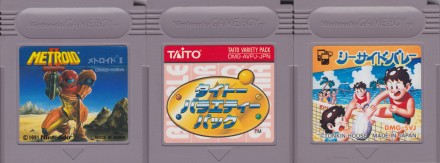
Reviews of Metroid 2 - The Return of Samus, Sagaia and Malibu Beach Volleyball.
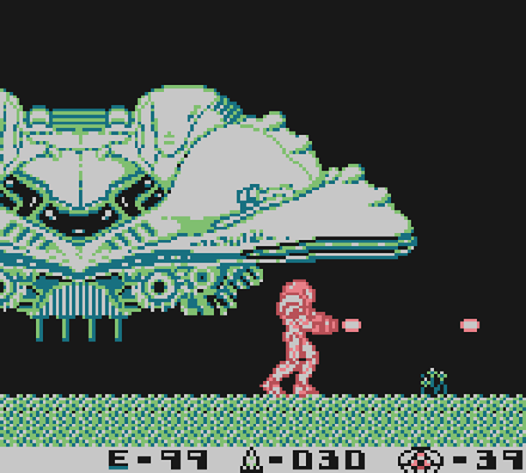
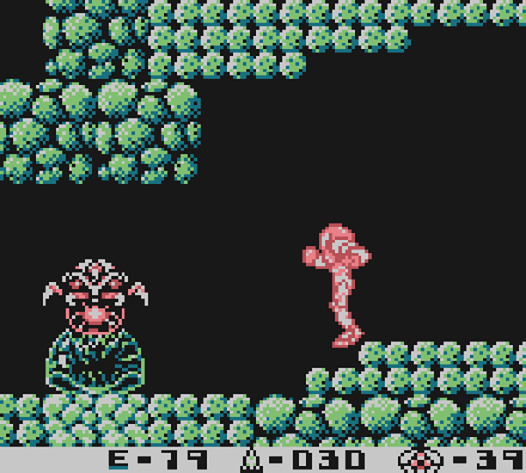
Welcome to episode 12 of Game Boy Crammer. In this episode, we've got Metroid II The Return of Samus, a shooter called Sagaya, and Malibu Beach Volleyball. Let's get to the reviews!
Metroid II The Return of Samus was released in November 1991 in the US, and January 1992 in Japan, a rare case where it was released in the US first. Metroid is a platform shooter, but it's more than that. It's more like an RPG, but it's not quite an RPG.
Metroid is really its own thing. There's a long series of Metroid games, and this is the second one in the series. Metroid started a few years earlier on the NES. Story-wise, this one is a direct sequel to that one, but you don't have to play the original before you play this one. In fact, if you really care about the storyline, you want to play everything all the way through, you want to just go through the whole journey, you might want to start off with Metroid Zero Mission on Game Boy Advance.
That's basically a retelling of the original Metroid story done in a more modern Metroid kind of way. The original Metroid is charming. It's missing a lot of stuff that became standard in other Metroids. I don't want to give you the full story in detail, but the gist of it is, it's in the future, there's a Galactic Federation of Planets, and some space pirates discovered these Metroids, the planet SR388.
And these Metroids will basically suck out your energy and use it as its own. It's a little bit like the aliens in the movie Alien. They're xenomorphs. So these space pirates captured one of these things, they wanted to rule a galaxy with them. So these little crab dudes with heavy shells found this little girl in an Earth colony, she was the only survivor, and they gave her some special kind of armor and trained her to fight the Metroids, or something like that.
You know, I read all this stuff in Nintendo Power Magazine, there was a comic that came with it, but I'm not a good storyteller. By the end of the first game, she destroys the head of the space pirates, this giant mother brain. So in this game, they sent a squad down to kill all the Metroids. They went to the home planet SR388, where the Metroids come from.
The squad was never heard from again. So then they sent Samus down there, because she knows how to deal with these things. If you've played any other kind of Metroid game before, you're probably familiar with the idea that it's not totally linear. In many games, you're in one area and then you get different abilities so you can access different parts of that area.
For example, there are certain doors, you need a different kind of weapon to open up, areas that you can't normally reach until you've upgraded yourself. This game's like that too, but it's a lot more simplified. It's like they tried to go in a more simple direction with this game. In this game, instead of having doors blocking anything off, you have lava.
You have to destroy some Metroids, and then the lava will go down and then you can access another area, and so on and so on until the end of the game. There's no real door locking. In fact, when I got to the first door, I thought, oh, I guess I have to have some special kind of weapon to open this thing up.
No, just fire five missiles at it and it'll pop right open. As you're going through the game, you're going to find these little save game spots. The music changes, and if you stand on this thing and hit start, it will save your game. Unlike some Metroid games, if you've played a lot of the Metroid Prime games on GameCube or Wii, it'll recharge and refill your missiles and stuff like that.
Not in this game. If you have one health left, you'll still have one health left when you come back. The save games are fairly generous, but you have to set some time to play this game because you can't just save any time. The control is pretty simple. It's run, jump, and shoot, and eventually you start getting more abilities, but by that time you'll be getting pretty good with the controls.
To switch from the beam weapon, your main weapon is a gun, and to switch to missiles, you hit the select. But unlike some of these other games, usually you can select between different types of weapon, like you'll have various beam weapons and then a missile. In this one, you have main beam weapon and a missile.
If you get a new beam weapon, let's say the ice beam, and you want to go back to the original beam, you have to go back to where you found that power-up. If you push down twice on the D-pad, you turn it into a little ball and you can roll around. Pretty early in the game you're going to get a power-up that'll let you drop bombs, and then about a minute after that you get something called a spider ball or sticky ball.
You can roll up walls and stuff like that. It's very strange in this game, though, because usually all the other Metroid games I've played, and I've played a lot of them, you get this ball much later, because it's the kind of thing where there's things that you can't quite reach and you know you have to get there somehow, but then later you get the ball and it's like, aha, I can go back to all those places and access all that stuff.
Well, you get it within 10 or 20 minutes of playing the game, so it's pretty much, you might as well give it to you right at the start. That's a little disappointing, because that's kind of a fun puzzle element in all the other games. When you defeat enemies, you get power-ups. If you pick up a missile power-up, it gives you five missiles.
If you pick up a little ball of energy it leaves behind, you get five on your energy, and sometimes you get a bigger one that gives you 20. The weapons in this game, you'll have the normal shot, you'll have an ice beam that freezes things so you can kill them, or you can actually use them as platforms to jump on, although I never found any important puzzles in this game that required jumping on frozen enemies.
But you can use it, I've used it a few times. There's something called a wave beam, which is just a really wide, wavy beam. And then there's the spacer, which is three parallel beams. Also a plasma beam, this is the most powerful beam, but it is very narrow. Unlike most of these Metroid games, you're not really required to use any of these particular weapons, except for a couple of very specific circumstances in the game.
You're not going to have to go back and change beam weapons very often. Now whenever you kill the required number of Metroids in an area, you're going to feel an earthquake. Well, you won't feel it, you'll see it and you'll hear it. When you see that earthquake, it means go back and check where you saw some lava before, and now you're going to be able to access another area.
It's actually a really handy way of knowing if you've cleared all the Metroids in one area. If you're stuck, it's probably because you have to go back and find more Metroids. I really found a map help, I just searched on Google Images for a map, and I just have a lousy sense of direction. It's actually not that hard to navigate, but sometimes you're just not sure if I really get all of them.
Now as you go through the game, the Metroids will mutate. You get these regular Metroids that take five missiles to kill. They look like a little jellyfish. If you have the freeze beam, you can just freeze them with the ice beam and then shoot them with some missiles, so they're actually pretty easy to take care of.
Then you get something called an Alpha Metroid. It's a bit smaller target, but it also takes five missiles to take care of it. Then you have a Gamma Metroid. This one's a bit harder, takes ten missiles to take it out. Then the Zeta Metroids, you have to hit them in the face or in the belly, but if you duck, it can't hit you with fireballs.
Well, usually. Those take 20 missiles to kill. Then you get the Omega Metroids. These ones are pretty hard. They take 40 missiles to take out, and I always find after I kill one, I have to go back and find an energy power-up and, you know, basically fix myself up and save the game and then go back and kill them.
And there's a few tougher ones, but I don't want to spoil the game. On the lower right corner of the screen, you can see the number of Metroids you need to defeat to finish the game. Right near the end of the game, this number is going to go up a bit and then go down. Before you get to the final, final boss, make sure you go back, replenish your missiles and your health, and save, because there's no way you're going to do it in the first shot, and you have to have full health and full missiles to defeat it.
I found this game to be a little disappointing. I mean, the first Metroid was so classic, and I found you really had to think about the puzzles a lot more. In this one, it's more like you can pretty much see all of the hidden stuff, like usually there's some kind of hint, oh, I see a little missile power-up, I can go and get it.
Maybe that's because in this game, when you get to the final boss, you have to have almost all of the missile upgrades, because you'll need a lot of missiles to defeat the final boss. It's good to have all of the energy upgrades, but you can defeat the final boss without all of them. Maybe that's why they made all these things so obvious.
The music is pretty bad. The original one had this moody music. In this one, it feels very random. There are parts where there's no music at all. The sound effects are not great. They're pretty binky for such a serious game. Now, of course, I don't expect a lot of color in this game, but there's not a lot of variety in the areas.
It's hard to tell where you are, because everything just looks like rocks and bricks. There are a few slightly different-looking areas, but they're not very different-looking. This game has serious enemy placement issues. There are parts of the game where you just run through hallways of nothing. Nothing's going on. It's so boring.
Or the enemy placement is just not challenging at all. There's kind of a pattern to it. You'll be spider-balling your way up a wall, and you can just hold the button down, because all the enemies are kind of timed exactly the same. And it never really gets that challenging. Some of the bosses get challenging near the end, which is nice, but for the most part, most of the time, the challenge is in trying to remember where you went.
Killing the Metroids is almost disappointingly easy. You kind of feel sorry for them, because they just don't put up a fight. This game also fails in storytelling. All of the stories in the manual, which I guess makes it easier to distribute, because there's a universal version of this game. There's no Japanese or English versions.
Like, one game, there's almost no reading in it, and the gameplay doesn't really tell you what's going on in the story. If you didn't read the story, what happens at the end is so bewildering. It would just be complete nonsense. Whereas some of the other Metroid games just are so good at storytelling.
I'm not saying it's a bad game, but if this is the only Metroid game you play, you should go play some other ones too. Could this be the worst Metroid? It might be. Metroid Other M on the Wii I wasn't too impressed with? I'm not sure. This game looks pretty good on the Super Game Boy, although I would rather play it on a Game Boy Color, because, well, it makes it a little bit easier, because the sprite layer is a different color.
You know, she ends up looking kind of pink in the background, kind of bluish, so you can really see the enemies very clearly, and you can kind of see the doors and the powers and stuff like that. You will have to replace the battery, because this game has a save game, so it's probably going to come with a dead battery.
It's definitely not rare and not expensive. With all its flaws, it's still one of those essential Game Boy games. You pretty much just have to play it. Search for DMG-ME or DMG-MEA. Let's do a game review! Sagaya is a shoot-em-up game developed by Act Japan, published by Taito in 1991. It was never released in North America or Europe.
It was also part of the Taito Variety Pack, which came with Bubble Bobble, Chase HQ, and Elevator Action. Now, Sagaya was part of the Darius series. Now, Darius was Taito's entry into the side-scrolling shooter market. It's along the same lines as Konami's Gradius. You're in some sort of ship shooting from left to right at bad guys, destroying bosses, going through tunnels, trying not to touch the sides, and getting power-ups for your ship.
There's a Darius, too. It was ported and renamed Sagaya in some systems, but the Game Boy version of Sagaya is unique to Game Boy. The thing about Darius was you'd finish a level, and then you could branch out and go in a different path, so you could play the game over and over and take a different path each time.
Kind of like Star Fox, how you could finish the game in a different way each time, or Galaga 88. The other thing that was really different about Darius was the arcade cabinet had this wide screen, and it was actually three picture tubes, and it used a system of mirrors and stuff, and it would actually overlap and make one long, long picture tube out of it, so it would look like one wide screen, which makes it a little bit hard to play on an emulator if you want to play real Darius, because it's wide, wide, wide.
But this Game Boy version is completely linear. You're playing eight levels from beginning to end. Otherwise, it's basically the same kind of thing. When you start the game, you can choose how many lives you want to start with. If you want rapid fire on and off, you can change the difficulty and the control scheme.
You can use A to shoot, B to bomb, or you can switch them the other way around if you want. At the bottom of the screen, you've got three power-ups, weapon, bomb, and shield. This is not a one-hit wonder game, because you can get shields. You start off with no shields, but some of the enemies look inverted, negative.
Whatever is black is white, and whatever is white is black, so you can really tell which ones have the power-ups in them. It's not really a mystery, and the power-ups will power-up your weapon, bomb, and shield. When your ship is destroyed, you don't lose all your power-ups. They just go back a little bit.
It's like taking a little step backwards, but you're not starting from scratch each time, which is really nice, because in later levels, you can keep building up your weapons, and you don't have to lose them every time you lose a life. However, lose a whole bunch of lives in a row, and you're back to the little pea shooter.
The shield is pretty straightforward. The weapons are strange, because sometimes you power-up the weapon, and it's not as good, but then you power-up one more step, and it's better. You start off with a single shot, two shots, three shots. Then you've got, like, three shots that fire a little bit apart, and then you get a laser, which is now...
It's like taking a step backwards. You get this thin little laser. Got more power, but it's nice to power that one up a little bit. And then next, once you've powered up that laser, you get, like, a wave gun that shoots, like, a big, really wide swath in front of your ship. And if you can keep that thing going, you can really plow through the bosses near the end of the game.
All the bombs improve slightly. They're kind of handy sometimes. You can just hold your B button down and kind of hope that it hits stuff. First, you get a bomb that drops down. Then you get a bomb that drops down, and then a bomb that drops up, and then you get... Eventually, you get bombs going in four directions.
I don't know why you really want to bomb stuff behind you that often, because it's not a threat anymore, but it's there. And you can keep powering up your shield. I find I'd never get it that high, because I keep getting hit. But you can actually keep that shield going for a long time. I've gone through several levels without losing the shield, which I can't say that for Gradius.
Gradius, I found, was a lot harder than this game. Now, I don't really need to walk you through this game, because it's pretty straightforward. The bosses are really easy to figure out. There's nothing really mysterious about them. You can kind of tell where you're supposed to hit. Not too far into the game, you're gonna see a level where there's kind of a moon hanging overhead at the beginning of the level.
That's not a piece of the background scenery. You will die if you touch that moon. Don't touch the moon. There's also another spot in the game with a bunch of little dots you have to shoot to kind of chew your way through, pretty much exactly like there on Gradius, but I wasn't prepared for those. Did you play this on Game Boy Color?
I don't know if it's cheating, but you can see the enemies a lot clearer, and there's a part of the game where these missiles come up through the floor, and they're barely visible. In black and white, it must be very hard to see them, but in color, you can see. Oh, those are little pink things on the floor.
I should avoid those. This game is all about fish. Everything is fish-related. You get turtles and seahorses and crabs and even a horseshoe crab. If you're into fish, this game is for you, although I end up hurting a lot of fish. Maybe it's not for you if you're into fish. There are eight levels in this game.
There's a few spots where they're gonna throw old bosses at you because what old game didn't do that? And there's really not that much more I can say about the game. I really like it. It's more friendly than some side-scrolling shoot-em-ups, and it definitely has a variety of stuff. The bosses keep it interesting all the way to the end, and the different skill levels and starting with different lives gives it a little more longevity, too.
I would like to have the branching levels a little bit, but some Game Boy games are so cheap with the number of levels they give you that I'm pretty happy with eight. I do recommend you get the title variety pack so you get those other games. You can get it on its own. It's not that hard to find. There was actually a version released in China in 1991.
Uh, search for DMG-119CHN, or look for the Japanese version DMG-S8A. Don't touch the moon. Next to an age review. Malibu Beach Volleyball. Now, I'm not gonna do a lot of sports games reviews, but this is one I happened to get in a mystery pack of Game Boy games, so. This thing came out in 1989. It was called Seaside Volley by Tonkenhouse.
So it's one of the very first Game Boy games, and then Activision released it in the U.S. in 1990. And it's volleyball. You can play a men's team or a women's team. You can play as the best of one or three games. The scoring works like, like volleyball, I guess. I don't know about sports, but it seems like a volleyball game.
You use A to bump the ball or spike. You hit B to jump, and D pad to move around. It doesn't matter because it's just too hard. I play this thing, you know, I've had it for a couple of months, and every once in a while I keep it around, and it's like, maybe I'll try it again, and I play it. And to this day, I have not scored one single point.
Not one point. I'm not talking one game. I mean one point in any game. The other team never misses. They never screw up. Spiking, I guess you can spike, but I never get that far. It's just so hard to hit the ball. I mean, you know, you're dealing with a Game Boy, so everything's really small, and you can't really tell where the ball is in 3D space.
So you would think they would compensate by, you know, those Wii games where the player will kind of jump out at the ball and stuff like that if it's kind of close. Well, this one is unforgiving. You have to be pixel perfect exactly where the ball is. There's kind of a, you can kind of jump if you hit the D pad and jump while you're trying to hit the ball, but it doesn't automatically go for the ball.
It's going to go in whatever direction you go, very precisely. You can't manually change which character you're controlling, so sometimes you try to, you're expecting a spike, you're trying to move your character into position, but the wrong one is moving, or they're both moving, and you end up missing the ball.
Maybe some of you are very good at volleyball sports games. I just think this thing is way too hard. The graphics are kind of cute, the sound is okay, but it's just so, so hard. I swear, not even one point for months. I'm going to get rid of this game as soon as I can. I was only keeping it around to do this review.
So, I don't recommend Seaside Volley or Malibu Beach Volleyball, but if you really want Seaside Volley, look for DMG-SVJ. Do a search for that, or DMG-SV, the English version. I doubt that language matters because it's all in English anyway. Seaside Volley, go get it. No, no, don't get it, don't get it.
Maybe I'm just not good at sports, I don't know.