Game Boy Crammer · Episode 22
Tamagotchi, Mickey Mouse, Tumble Pop & Desert Strike
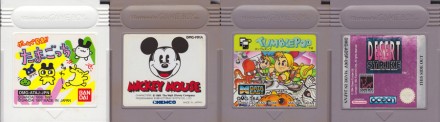
Reviews of Tamagotchi, Mickey Mouse, Tumble Pop & Desert Strike.


My name is Ray Larabie, and I'm talking to you from Nagoya, Japan. Welcome to episode 22 of Game Boy Crammer. Today I'll be reviewing the hardest game I've had to review so far, Tamagotchi. I got the platform puzzler, Mickey Mouse, a Bubble Bobble sort of thing called Tumble Pop, and the axonometric shooter, Desert Strike: Return to the Gulf. I got an email from Russell Phillips who told me about this thing he uses for his save games, which I've never seen before. It's called the Mega Memory card, and you can actually pull the save games right off your Game Boy card and save it onto this card, and you can save them onto the computer, too.
And it'll hold games from multiple cards and feed them back into the game. He highly recommends this thing. Go to j.mp slash Mega Memory, and you can see a review on YouTube, j.mp slash Mega Memory. I got another message from Simon Robertson telling me about something called the Modolith. Let's do a search for Modolith, M-O-D-O-L-I-T-H.
If you listened to the episode where I described how you can install a backlight, and maybe it sounded like a little too much work or maybe over your head, this is a service which will install a backlight for you. It's $40 to install a backlight. For the amount of work it is to install a backlight, it's a pretty good deal.
They'll install ProSound. In every Game Boy, there's a little preamp that kind of boosts the output. It's not the highest quality preamp, so if you're using your Game Boy for chiptune kind of stuff and performances or recording, this will make it sound better. Like even myself, I don't record the sound off a Game Boy.
I tried it, and it had a terrible hiss to it. It's just not a very good sound straight off a stock Game Boy, right off the headphone jack. And you can also get an RCA plug too instead of the regular headphone plug. They can install a clock speed switch which will slow, I guess it works on games too, it'll slow the games down.
They mainly use it for chiptune stuff. You can actually make this really low frequency sound, an LED power indicator, and you can even get these custom buttons. You can get like NES buttons or Super Nintendo buttons. If you want to customize a Game Boy and you don't want to do it yourself, it's really not that expensive.
I don't think they're making a lot of money with this, like they must be doing it just for the love of it because there's a lot of labor in installing this stuff. So definitely check that out, Modolith, and let's start the show. Tamagotchi from Bandai was released in the summer of 1997 in Japan and the fall of 1997 in Europe and the US.
Tamagotchi is not really a game, it's actually classified as an activity toy. It started off in 1996 in Japan as a keychain LCD toy. It had a little square LCD screen and three buttons that you could use to interact with the virtual pet. The first part of the name, Tama, is egg in Japanese, Tamago, and then the second part is watch, Tamagotchi.
It was a huge fad. Everybody had these things around 1997 and they never really went away. They kind of fell out of favor, but they're still around now. In the mid 2000s, there was a new version that was really advanced. You could actually marry the two virtual pets, like from one egg to another and stuff like that.
The first one was very simple. It's a pet, it needs to be fed, it needs to be cleaned, and you have to play with it. And the first version was all in real time. There was no pause. You could kind of cheat and pause by pretending you're going to set the time and just leave it on there, but generally it was all in real time.
Kind of annoying for school teachers because these things would make sound during class. Later versions you could actually hit pause on them. So this is a real time thing. It's kind of a long term project, raising one of these virtual pets. That's why a lot of people don't really get it. Like if you think of this as a game, of course it's a pretty lousy game.
With a game you're getting these kind of dopamine highs by getting rewards all the time. In this game there's not really any reward except the reward of parenthood. In fact, there's more sadness than happiness in Tamagotchi, because they eventually die. And when you're first starting off they die pretty quickly.
So only a year after this thing was released as a keychain, Bandai put out a Game Boy game based on it. Rather than trying to complicate things by expanding it into some big Tamagotchi universe, they kept it really simple and pretty much made a copy of the keychain game on the Game Boy. They do everything in real time on the Game Boy, so this thing has a pause, you can actually turn it off and your game will save.
So you don't have, it's not really real time. And while you can't really speed up time during the day, when your pet is asleep you can go up to the clock and you can speed up time, so you don't have to sit there and watch this thing sleep for hours. And the graphics are very true to the original. They kept kind of a really pixely simple look, which probably at the time looked pretty lame, but now looks kind of cute and retro.
Tamagotchi actually comes in a white cartridge, and there are two sequels to this game. Tamagotchi 2, which has a little bit of a front end that's a little bit like a role playing game. You have a character that can walk around in sort of an overworld. Essentially it is the same game. The third game is more about breeding.
It's almost the same game except you have sort of a breeding aspect to it. You can do some genetic experiments, I guess. The other two games were released in Japan only. When you start a new game you're presented with a whole bunch of different eggs. Pick one at random. They actually, you know, if you really care about raising a very specific type of Tamagotchi you can pick a specific egg, but just pick one at random.
Once you get your new Tamagotchi you're going to have to feed it. Give it onigiri. I think it's bread in the English version, but in Japan it's the onigiri, it's a rice ball. It needs its carbs. Give it a whole bunch of that until it's not hungry anymore. Then you can do some of the games. There are only three games which you can play with your Tamagotchi.
Now you have to play these games to keep him happy. First you have the smile game. Your Tamagotchi will be thinking of a direction, left or right. You have to choose left or right, and if you're right you win. You have five chances and if you get at least three then you win the game and your Tamagotchi will be happy.
I don't know if this is true, but this may not be scientific, you'll have to test this for yourself, but it seems like if you take your time, if you don't choose left or right right away you seem to get more hits than misses, but that could be my imagination. Next you have a study game. You have three difficulties and it's a math study game.
Your Tamagotchi is going to answer the question itself. If you let it think about it a little bit before you hit your A button it'll have a better chance of getting the right answer. It seems like you can push left or right to push him towards the right answer. I found that after the first few times they can kind of figure it out on their own.
And finally the sports game. If you have three difficulties, your Tamagotchi is going to have to catch baseballs which are falling from the sky. In the Japanese version you have to press the A button and choose the direction you want to go to hop towards the balls as they fall, and you end up missing a lot of them.
A lot of it is luck because sometimes if the ball is on the far left side of the screen then the next one is on the far right, you just don't have enough time to go get it. The more you win this game, the more skill your character gets, and later on it's going to be able to do all this stuff on its own, you can just sit there and watch it.
Now these games are not really fun games, they're really supposed to be fun for your Tamagotchi, not for you. Like I said, this is not a game, this is an activity toy, so don't expect it to be fun. Okay, so back to the main screen, you're going to see your Tamagotchi probably happy if you've done a few games.
When they're really happy they kind of bounce around, when they're kind of okay they kind of just walk back and forth. You're going to see in the top left part of the screen you'll see a day counter, shows you how many days it's been alive, you'll see the little kanji for day up there. Now each day is like a year of your Tamagotchi's life.
There's a clock, which will tell you what time of day it is, this is important because you'll need to know when your Tamagotchi wants to go to sleep or wake up. As I mentioned before, when it's night time, your Tamagotchi's asleep, you can fast forward time. You just move your cursor over to the clock and just hit your A a whole bunch of times.
Now in the top right you'll see different slots, there's three different slots, you'll see your Tamagotchi that you've grown is in the first one. You can actually choose the other slots and grow some at the same time. I recommend waiting a day before you grow your second or third one because it's kind of hard to maintain all three at the same time and it can get really confusing.
I played it a couple of times and one time everybody looked the same, like I had all three that looked the same even though I picked different eggs and it was kind of, I had trouble remembering which one was which and which one I just fed and it was one of them that liked a certain kind of food and the other one didn't.
So if they're a little bit apart in age, they're less likely to all die at the same time. So you do have to feed your Tamagotchi. Now I mentioned the rice ball or bread in the English version. There's also meat, a carrot, and ice cream and cake. Ice cream and cake are the same thing as far as I can tell.
You can give them one or two of these a day. They're not totally necessary but sometimes you can't make your Tamagotchi happy by playing a game or anything and they're just kind of sad. You can just give them an ice cream cone or some cake and cheer them up a little bit. Now each Tamagotchi has its own taste for food so they'll like certain things and not like other things.
You can kind of figure it out. But whatever food it doesn't like, you don't want to force it on them too much. But you do have to give them a balanced diet if you want them to live long. If you want to really get into it, you can find a guide online that'll tell you which Tamagotchi type you have and what type of food they'll like.
The Tamagotchi types are kind of interesting. You start off with there's only two types, there's a black one or a white one, and then as they grow they split into more types and then by the time they're at their fourth stage there are lots and lots of different types that could become. So you don't really know what you're going to get at the beginning.
And as they grow older, they'll develop their tastes. So you know, something that starts off liking only let's say the onigiri and the carrot might end up growing up to like only meat and carrot or something like that. So on your control panel you'll see a little light bulb. Be careful not to hit that thing.
That's only supposed to be when your Tamagotchi goes to sleep. Your Tamagotchi goes to sleep, you hit that, and then you can speed up the clock to wake it up. You'll inadvertently accidentally hit it once in a while, but it's not good for your Tamagotchi to do that. I don't exactly know what happened, but apparently it's bad because all of mine died because I maybe hit that light too many times, I don't know.
Your Tamagotchi will eventually get sick and you'll know there's like a little skull icon that appears. They can get the flu, they can get a belly ache, or a diaper rash. Now the stomach ache they get from the way you've been feeding them. If you've been giving them more than two snacks a day, that's probably what caused it.
And diaper rash is if you forget to flush the poop for too long. And the flu is just all around not taking care of your Tamagotchi. Now if your Tamagotchi gets the flu, you always want to give them the shot. You have a choice of a shot or a pill. For stomach ache, a pill for sure. As for diaper rash, it depends.
With the younger ones, you want to go with the shot. When they get older and they get diaper rash, you have to give them a pill. But it depends on the type. I would say if you're in your first three days, you probably want to go with the shot. If you make it past four days, probably go with the pill for diaper rash.
But if you really want to be sure that you can find a guide online, that'll tell you the specifics. As for the flush command, which just flushes the poop away, when your Tamagotchi gets older, you can kind of preemptively flush and it'll actually produce a toilet. There's a status screen which will show you the health of your Tamagotchi.
You can see the weight, you can see how smart they are, how happy, how they're like a body level. There's also a praise and scold feature. I don't quite get what this is. Like, you know, I've used it when my Tamagotchi didn't want to eat a carrot but then reluctantly ate it. I thought, well, that's good.
And I don't really know what it does. I'm not sure when you're supposed to scold them or anything like that. There's also a help screen, where there's a professor that'll give you advice, I guess you could call it. It's pretty bad. The Japanese version is very simple and the English version seems really poorly translated.
But there is an option there to send your Tamagotchi home. That fires your Tamagotchi off into space back to its home planet. In other words, it deletes it, but then you don't have to watch it die. It can die of old age or maybe during transport. It'll burn up on re-entry. Before you start the game, if you check out the options screen, you're going to see something called memory.
This is your graveyard of Tamagotchi. Anything you raise and it dies, you get to keep a little memorial of it in your graveyard. You're going to be using this pretty soon after playing. And that's all there is to it. It takes quite a while to play. Well, I mean, it doesn't take a while to play if you kill off your Tamagotchi really quickly.
My first couple of attempts only lasted maybe an hour or two. I can't be completely objective about Tamagotchi because I was never into it. I never had the keychain. I never really played any of the games, but I really think this game just was a bit of a poor effort. Like, I understand they wanted to keep it kind of the same as the keychain, but, um, why didn't they make a variety of music instead of the same irritating loop?
Why didn't they add maybe another mini-game? Maybe just randomly change the game once in a while with something else besides the same, you know, choose left or right or, you know, look, I understand these are supposed to amuse your Tamagotchi, but meanwhile, you know, how much effort would it have taken to give you a tic-tac-toe or rock-paper-scissors or anything different?
That part feels really monotonous, especially, you know, after your sixth or seventh hour of just catching that little ball or watching your Tamagotchi solve math equations. It's pretty tedious. I mean, by its definition, it's supposed to be kind of tedious, but they could have made a little bit more effort.
And there was absolutely no effort put into the help system. And I also feel like they could really give you a little bit more feedback. I mean, it's not a keychain game. They have text. There's enough memory on this cartridge, I'm sure, to add a little more text to give you some kind of feedback about what's going on with your Tamagotchi.
It's really hard to tell, especially when your Tamagotchi gets sick. You pretty much have to look it up online, because there's no help. You don't know what to give them. You have to kind of experiment and end up killing off a lot of Tamagotchi. I don't think I'll be reviewing any of the other games, because they seem to be pretty much the same kind of thing.
I think if you really like Tamagotchi, or you're interested in starting it, I'd probably recommend one of the newer keychain-type games than playing it on the Game Boy. But all in all, Tamagotchi was kind of a neat thing, and kind of an interesting stage in the evolution of games and virtual pets. Think about how advanced virtual pets are now on the 3DS, but it really started out with this little keychain game.
Tamagotchi is probably the easiest Game Boy game to get. Every time I go to a junk store or something like that, you'll find a pile of junk in one of these cartridges sitting around for a buck. If you buy a pack of games, you'll always get a Tamagotchi in there. They, uh, they, I guess they sold a lot of them.
You will have to replace the battery, because, I mean, it's not much good without the saving. There's no reason not to get the Japanese version. There's really, like, as I said, there's no useful information to read, so as long as you can figure out the menus, which are mainly visual, you should be okay playing the Japanese version.
If you want to track this down, look for dmg-ataj for the Japanese version, atap for the European version, atae for the American version. Mickey Mouse by Chemco was released in September of 89 in Japan. It was released in Europe and the U.S. as Bugs Bunny Crazy Castle. What? Mickey Mouse and Bugs Bunny?
Same game? How could this even work? How did this even happen nowadays? Well, before I get into the game, let me get into some of the details about what's going on with Chemco. Chemco made a game for the Famicom in 89 based on the movie Who Framed Roger Rabbit, and they had the rights to release it in Japan, but when they tried to release it outside of Japan, it was already an NES game based on Who Framed Roger Rabbit.
Instead, they bought the rights to Looney Tunes, and they made a Looney Tunes version. So this was originally Roger Rabbit, then released as Looney Tunes. And after the movie finished playing, Chemco lost the rights to even release Roger Rabbit games in Japan, but they did manage to secure Disney rights, but only in Japan.
Roger Rabbit was produced by Touchstone, which was a Disney subsidiary, and... This is getting so complicated. So Chemco kept releasing their games with Mickey Mouse in Japan while they had the Looney Tunes license everywhere else. That's why you keep getting this Chemco, Mickey Mouse slash Looney Tunes type of game, and they're exactly the same game, with just one of them is Mickey Mouse and one of them is Bugs Bunny.
After a whole bunch of cookie-cutter sequels to Bugs Bunny Crazy Castle, they ended up losing their rights to Looney Tunes as well, and they ended up using the almost public domain Woody Woodpecker. I don't know if it's almost public domain, but it doesn't seem like a hard license to get. So, you know, this Chemco story is...
Go on Wikipedia. Look up Crazy Castle on Wikipedia, and you'll find the amazing, wacky story Bugs Bunny Crazy Castle. I've been avoiding Bugs Bunny Crazy Castle because the Angry Video Game Nerd kind of ranted about how bad it was, and it looked really bad. Um, actually, it's okay. I mean, I wouldn't want to buy a whole series of these games, because it does look like the same game over and over, and maybe it just gets more confusing.
It's not bad. I mean, it's not... super challenging. Here's what it is. It's a puzzle platform game. You don't have a jump. You move around these levels and collect hearts, or if you're Bugs Bunny, you collect carrots. You avoid bad guys. You can push objects onto them. You can get a boxing glove to beat them up, and basically, you just have to collect all the hearts slash carrots to finish the level.
The first ten levels might be nice to play if you've got a hangover or something, or you're just tired of getting beaten up by Mega Man. It does get a little more complicated later on, but at the beginning, it's pretty simple. Um, you go through portals. Um, they're marked, so you can kind of figure out where you're going to come out on the other end at the beginning.
Later it gets more confusing. And, you know, a little memorization a bit later on. The game lasts quite a while, because there are 80 levels. That's a lot of levels for a 1989 game. It's not like you progress through different types of level. It's all pretty much the same thing over and over, with a little more difficulty added on as you go.
Here's the weird thing about this game. If you hit the select button, it slows the whole game down, and you can toggle the speed of the game. So if you're finding it too challenging at some point, kind of slow it down. Take it easy. So think of it as, like, Mappy Light, or, you know, a late 80s type of platformer.
But when I say platformer, don't picture walking through scrolling levels. This is, like, one level that you're on. It's a few screens wide and a few screens tall. In addition to doorways, you can go up and down stairways. Be careful, because once you get on a stairway, it keeps going. Like, you can't stop halfway and turn back the other way.
There are pipes that you go through and stuff like that. It's one of these games that, you know, if you find it for a buck, maybe go for it. I don't think I'm going to get into the sequels or anything like that. I think everything you need to know you can get from the first game. So you can save your game any point with a password.
There's no battery to replace. There's no Japanese in this game. There's nothing to read. So there's no reason you shouldn't get Mickey Mouse over Bugs Bunny. Same game, exactly. If you're looking for Mickey Mouse, get DMG-MMA. If you want Bugs Bunny Crazy Castle, look for DMG-BB. Tumble Pop by Data East was released in Japan in November 1992 in the U.S. in March 1993.
It never came out in Europe until the summer of 2012 on Virtual Console for 3DS. This was originally an arcade game, but came out in November 1991. There have been a lot of arcade conversions on the Game Boy, but when you take a, you know, those were usually 1980s arcade games. So this is a 90s arcade game, so there's going to be a little bit lost in the translation.
The arcade version was a little bit like Bubble Bobble, a little bit like Snow Brothers. You've got a screen that doesn't scroll with platforms on it. You play a kid and you suck up monsters with a vacuum cleaner and spit them out. It's a little bit like Kirby in that way. The more monsters you can suck into your vacuum cleaner and spit out, the more damage you'll do and the better prizes you'll get.
The catch is if you turn on your vacuum too long, it will overcharge and explode and kill you. If a monster touches you, you die, and you have several lives. You can earn new lives by picking up power-ups or spending gold at a store. Some of the power-ups are letters, and if you collect the word Tumble Pop, you get sent to a bonus stage.
In the arcade version, you'd play in different locations, and then you'd finish a few levels. At the 10th level, you'd fight a boss, then you'd go to the next level until you finished the game. What was kind of remarkable about Tumble Pop was it was very, very easy. This was the kind of game that if you never played a video game before, you could probably figure out.
I remember playing this thing in the arcades, and yeah, it did empty my pockets quite a few times. When they ported this thing over to the Game Boy, they had to cut a few corners. You know, this is a 1991 game being ported to a Game Boy. It's not like, you know, when you're converting Bubble Bobble or something that was made prior to the Game Boy's development.
This game is pretty taxing. Instead of the linear approach to the levels, what they did in the Game Boy version is they have an overhead world map. So you're walking around on this world map, and you have different places you can go to, like a tent, a factory, a house. When you go into these, you get a selection of levels.
To get to the boss, you have to kind of head down a track, and then you have to clear levels to get to the boss level. But you can take different paths, and you don't have to clear everything. You know, you can just kind of take the shortest path to get to the boss, and that's it. You don't have to finish all those other levels.
In the store, where you get these coins, and you get power-ups, you can actually trade in those power-ups for coins, or you can buy more power-ups with coins at a shop, and you can buy extra lives. And this is one of these games where there's no shortage of extra lives. They're always giving you extra lives, and if you're not getting them, you can always trade in your power-ups for extra lives.
In the arcade game, the power-ups worked a little differently. They kind of, you kind of pick them up, and you've got to use them. In the Game Boy version, it's a little bit more of an RPG kind of thing, where you're building up stats, in a way. You can build up your jump ability, your vacuum's power.
You can make the timer last longer, and you can go faster. And overall, the gameplay is very similar, but what is different is the screen scrolls. I know this happens a lot when they port arcade games over to the Game Boy, because of the small screen. And it's not too bad. It's actually pretty easy to play with the scrolling screen, and they actually make it kind of interesting, because they have some screens where there's no bottom.
You can keep going down, down, down, and you keep looping across the same screen, or you can keep going up, up, up, up. There is a disadvantage in that you can't see what's below you when you're jumping down. I don't know if that's a deliberate design decision, but it does prevent you from just constantly dropping down.
The bosses are quite a bit easier than the bosses in the arcade game. When you first start playing this game, it just seems like so much fun. You know, you start getting used to that vacuum cleaner, and sucking up those monsters, and it's really great. And then you go after level, after level, and you start realizing difficulty doesn't really increase.
They put more enemies on the screen, which causes a lot of slowdowns. What happens is you can get more of them in your vacuum, and it actually makes it easier. In some ways. In some of the later levels, you can suck up five monsters in a row. You shoot like a ball of stars that bounces all over the screen, taking all the other monsters with it, and then it leaves a 1-up behind, so you can just get extra lives that way.
There's no real ramp-up of difficulty. You know, I was going through levels 20, 30, 40, and I thought, it's going to start kicking in pretty soon. And as you clear some of these bosses, it opens up more parts of the map, so you can get to three more areas that you couldn't get to before. And then finally, you're going to open up an island that you can go to, kind of, well, it's a big scary castle, which is more of the same kind of levels.
It's slightly harder, I guess. Well, then I thought, okay, well, something's going to happen at the end of this, right? So I beat the final boss, I was just back out on the world again. So I walked around, I checked some of the old buildings, I went in there, and okay, well, there's some of these levels I didn't do.
Remember, I said you could take the shortest path to get to the boss, so I tried going through some of the other paths. After a while, I thought, well, you know, I'm a podcast reviewer, I really need to thoroughly try to get to the end of this game. Is there an ending? So I spent hours and hours going through all these levels, doing the same thing over and over and over.
Now, it's fun, but I mean, it doesn't get more difficult, and at the end of it, there was nothing. I finished all the levels and all the bosses, just to check I did all the bosses over again, just to see if it would make a difference. You know, I was just wandering around, it seems like you're just doomed to wander the Highlanders.
Oh, and you remember I said if you collect the letters to spell the word Tumble Pop, it sends you to a bonus level? Well, after a while, you're going to dread that bonus level. Sure, you can get some extra lives and grab a few coins, but the problem is, well, you know how some games, when you get that kind of bonus level, you know you collect the word extra or something like that, and it's like a kid in a candy store, you're just jumping all over the place, and there's power-ups and coins, and it's just a free-for-all?
Well, in this one, it's kind of like a kid in a candy shop, but there's no candy, except for once in a while, some guy just throws a single candy out. You're on an empty screen with six little platforms, and once in a while, a power-up drops and you go and catch it. Sometimes you miss it, sometimes it's on the opposite side of the screen, and there's no way you can actually get there in time, so you just have to sit there and watch it disappear.
It's about two minutes of just nothing much to do, and it's not rare. When I played the arcade version, it was, I think I've only seen the bonus level about three or four times, and it's a screen full of coins. In this one, I see it pretty much every three rounds I can finish the word Tumble Pop, and there is a time limit.
In the arcade version, if you run out of time, a demon comes out and chases you, a little bit like the monster in Bubble Bobble comes out, but in the Game Boy version, you just die if the time runs out, which it almost never does. Now this game is endless, but luckily you do have passwords. There's a two-player mode, and there's a construction mode.
You can actually make your own level and then play it. Look, Tumble Pop isn't terrible, and if I hadn't tried to play it all in one sitting, it probably wouldn't have been so bad. I think if you find it for pretty cheap, or maybe play it on a virtual console, it's kind of fun to play once in a while, and with the password system, you can just keep kind of chipping away at it for a year if you want, you know, just play one level once in a while.
Just don't sit there and try to play the whole thing all the way through, and if you do beat that final castle boss, just that is the end, don't keep playing. If you want to find the Japanese version, search for DMG-T6J and the US version DMG-T6J. And it's also on 3DS Virtual Console. Desert Strike Return to the Golf was published by Ocean in Europe in early 1995, and at the same time by Malibu in February 1995.
Desert Strike had come out a year before on the Sega Genesis. It was a huge game for Electronic Arts. It's a shooter, but it's a top-down, kind of on a fake-angle shooter, I guess isometric or axonometric. It came out on Super Nintendo, and there was a really great version on the Amiga, that's the version I remember.
The physics were very much like a flight sim, as far as a shooter goes, you know, you're used to a shooter having very, very rigid movement that doesn't feel physical. This feels a little bit like a helicopter, I'm sure it's a lot easier to control than an actual helicopter, but there was an effort made to give it a sense of realism, and the look of the game.
The helicopter didn't look hand-drawn, in fact, they used 3D modeling to model the helicopter. Now, a lot of people think Donkey Kong Country was the first game to have rendered 3D sprites, but it was kind of creeping into lots of games at the time. I remember when I worked back at Grey Matter, we were doing a game called MTV Extreme Sports.
I think it was actually finished, but it was never released. And we used 3D Studio, not 3D Studio Max, the original 3D Studio in DOS, to make all the vehicles and a lot of the backgrounds and stuff like that. And then when I worked for Game Tech, we used, we did a game called Quarantine, and we used the 3D graphics to make the sprites.
I think it was something everybody was coming up with at the same time, because the tools were right there. So this helicopter looks like a real helicopter, it feels almost like a little toy helicopter that you're flying around. And the graphics are fairly realistic, like the people on the ground are not scaled up huge with giant heads, they look like little people.
And the explosions look amazing. Okay, not so much in the Game Boy, but the Amiga version, the explosions look really good, they're digitized fiery explosions. It actually takes place in a square map, usually there's water, and then you take off from a frigate. You can do the missions in any order, you have certain goals that you have to meet, but it is kind of a good idea to do them in order, because they're, you know, in the first level it doesn't really matter, in the second level and after that, for example, in the second level you have to pick up spies, they have information that will let you find some scud launchers.
But if you don't do that, you end up kind of wasting your time running around the level blasting stuff, and then you don't have much fuel left to go back and find those scud launchers. It was a little insensitive to do a game about the Gulf War, like, just like a year after it finished. I don't know, I always felt a little weird playing it, like I don't really, it's not a theme I'm really into.
You know, you're fighting this terrorist leader called General Kilbaba, which is a model after Hussein. It's pretty gross. So that always turned me off this whole series, I gotta admit, it looks great, and it's kind of fun to play. So you're flying this AH-64 Apache helicopter, and you can kind of go at your own pace, you're free to fly around this level and take your time, there's no time limit.
However, there is a fuel situation. You start with 100 fuel, and you're constantly running down, and you don't have to go very long before it tells you, warning, low fuel. And if you run out of fuel, you crash, and you have only so many lives to use up. So the good thing is, though, after you die, it doesn't send you all the way back to the beginning of the level, you just kind of pop up where you left off.
Your helicopter has health points, or as they call it, armor, you can pick up power-ups for that. To pick up power-ups, you fly over the power-ups, and a hook will drop down automatically, and you have to kind of place it exactly in the right spot, and it will pick up people, or ammo, armor, fuel. There are a lot of buildings around the level, and you can blow some of them up, and sometimes there's something inside, sometimes there's nothing, sometimes there's a guy shooting at you.
And there's all kinds of enemy hardware, there's lots of anti-aircraft stuff hassling you. Soldiers will shoot at you and launch missiles at you. It's a rare case on the Game Boy of kind of an open-world game, where you can kind of do whatever you want. Take the mission at your own speed, do it in the order you want to do it.
The controls are not super intuitive, but you kind of get used to it. Move left and right on the D-pad, you rotate your helicopter. Forward and back, you move forward and backwards. But it's in relation to the helicopter, not related to the screen. So if the helicopter's facing down, everything's backwards.
It's a little hard to wrap your mind around the first couple of times you play it. After about an hour, it feels like second nature. The A button fires Hellfire missiles. Or you can hold A down, and then you can strafe, you can slide left and right with your helicopter. This is very important, because when you're fighting enemies that are shooting at you, they're not very good at leading their shot.
So if you just kind of bop back and forth with your helicopter, you can avoid a lot of enemy fire. The B button fires Hydra missiles, so you just tap to fire those. Or if you hold it down, it'll shoot a chaingun. Now this is all limited ammo, but the chaingun has lots and lots of ammo. I don't think I've ever run out of ammo on that thing.
To get to your map and status screen, you hit select. Hit B to switch from the map to the status screen. And on the map screen, you can use your d-pad, and you can go through all the different stuff that's on the map. So you can look at fuel, you can look at the ammo crates, various types of enemy, etc.
Before you start the game, you can choose a co-pilot. This does make quite a big difference. Your co-pilot operates the winch and the guns, because the guns kind of auto-aim. You don't actually have to precisely line up with the enemy. That's why it's really good to use the strafe button. You can kind of move back and forth, and you'll keep the guns trained on the target.
However, there's a trade-off with winch operation. The gun is better at the winch, you don't have to be as accurate with the winch, and it'll pull it up quicker. If you're trying to destroy, let's say, a power plant or a refinery, and you're trying to do it with your chaingun, it can take a long time.
I don't know how many bullets it takes, but you can just sit there and duck-duck-duck-duck-duck. Which is fine if you had all day, but meanwhile, your fuel is running out. While it's kind of a pain to have to go around looking for ammo, and managing ammo, it really, if you want to get through this game, you really have to pay attention to that stuff.
If you don't, you're going to run out of fuel. And once you run out of fuel, that's it. If there's no barrels left, sometimes you can blow up buildings and find new barrels. If you have a map that you downloaded from somewhere, or maybe from Nintendo Power magazine, maybe you can find exactly which building to hit to get that fuel, but generally, you're stuck.
Once on the second level, I had everything done. I rescued all the hostages, it was perfect. Except I was on my last life, and my fuel was running out, and there was no more fuel canisters. I crashed about, hmm, maybe five meters away from that frigate. Ah, just... This is not the kind of game where you can just go around and wing it.
You have to plan. Or at least you have to play the level so many times that you just have to memorize where everything is. That's one thing I don't like about this game. I'm not a person who likes a game where you have to have prior knowledge, where you have to memorize things, and... because really, to get through that second level, you have to know where everything is.
There's no way you can play that level, and you've never played it before, and actually finish the mission. You need to know where everything is. Because you can't waste time blowing up buildings that have nothing in them, or just have some guys shooting at you. Even if you take no damage in the whole level, it's still hard to get through because of the fuel situation.
The first level is no problem, there's fuel canisters all over the place, you can just kind of bumble your way through. On the second one, it is really tight. You have to plan exactly where you're going to go. If that sounds like your idea of fun, great, I mean this is a super popular game. This was like THE game that year.
It was amazingly popular, I'm very surprised it never came out in Japan. There's not a lot of music in this game, but the sound effects are pretty good. You put some headphones on, it sounds pretty decent. If you're into the Game Boy Advance, you might want to have a look at Desert Strike Advance. Because you know, with a game like this, it's kind of all about the realism, and you know, this doesn't look that great on the Game Boy.
It looks great for a Game Boy game, but it doesn't look great for Desert Strike. If you played on the Super Game Boy, the default palette is this hideous bright yellow, so I recommend changing the palette to something a little more desert-y. I originally bought this game from my nephew, and then he recently gave it back to me to review on this podcast.
Thanks Bradley! If you want to find this game, search for DMG-ADSP or DMG-ADSE.