Game Boy Crammer · Episode 21
Donkey Kong, Karamucho no Daijiken, Doraemon DX 10 & Top Gear Pocket 2
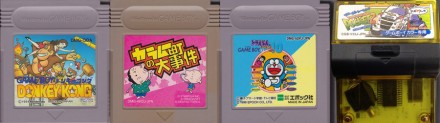
Reviews of Donkey Kong, Karamucho no Daijiken, Doraemon DX 10, Top Gear Pocket 2 and tips on cleaning cartridges.



My name is Ray Larabie and I'm talking to you from Nagoya, Japan. Welcome to episode 21 of Game Boy Crammer. Today I'll be reviewing Donkey Kong, a snack-based game called Karamucho no Daijiken, Doraemon DX10, and Top Gear Pocket 2, and a few tips on cleaning cartridges.
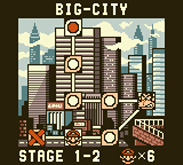
Let's get on with the show! Let's do the game review! Alright son, point out the animal that did this to you. The beast is back. Now with 100 levels of pain, Donkey Kong, new for Game Boy. Donkey Kong. Donkey Kong was released in the summer of 1994. It's an original Game Boy game, so you can play it in the original Game Boy, but it has some enhancements for the Super Game Boy.
You get this nice frame and some custom palettes and stuff like that. This game does have a battery, so you're going to have to replace it. This is one of the games I picked up in the 90s. I actually just bought a new version of it. Someone gave me a Game Boy and I went over to the game store and I thought, oh, what am I going to pick up that's cheap?
I saw Donkey Kong there. I assumed it was just going to be exactly like original Donkey Kong, because it's just called Donkey Kong, not like Ultra Donkey Kong or anything like that. It is Mario in this version. The original was Jumpman, but you can see right on the package there's Mario with his little ham on his hat.
So I got it, I played it, and it starts off like Donkey Kong, although it's a little bit different. You know, in the original Donkey Kong, you couldn't fall off anything without dying. In this one, you can jump off a level, you can throw your hammer up in the air and catch it on the next level, and you can do kind of a jump.
There's a whole bunch of moves you can do, you discover. So it makes these levels kind of easy. Okay, not as challenging as the original. You know, Pauline gets taken away by the Donkey Kong. We're into puzzle levels. You've got to put keys and locks, and every once in a while, you get like a little cinematic, which informs you, hey, there's a new gameplay element.
So many new gameplay elements are introduced in each level. And it turns into kind of a puzzle game. They're puzzle levels, still action. You're still running and jumping. There's lots of interesting little puzzle elements in each level. And then you get a boss stage. You know, in the first one, you pick up barrels and throw them at Donkey Kong.
And they're actually more challenging. That's more like the original game. And the game saves your progress. You know, it doesn't save after every level, but once you complete a boss, it'll save. So how many levels are in this thing? I think about 160. I haven't actually counted them all. I never actually got to the end yet.
I'm still playing it. It's one that I pick up and play once in a while. Since you can save your game, you don't have to just sit there and blast it all in one go. But I was really surprised, because I was only expecting original Donkey Kong when I played this. You move around like you would an original Donkey Kong.
You use A to jump. If you hold down while you're jumping, you do a handstand, and then you jump again. You do a really high jump. You kind of flip up and jump. So you can actually jump. Let's say you're on the first level of Donkey Kong. You can hand flip. You don't even have to use the ladders. You can just kind of handstand and flip your way up to the next level.
You can even walk around while you're doing a handstand, which is handy if you need to line something up. To pick up objects, you stand on top of them and use the B button. You have to get to the lock. But in a lot of situations, you can't just walk over with the key. You have to kind of throw it or drop it down onto something.
And then there's a certain time limit where the key will reset to its original position. And you can actually get a good throw. It's pretty easy to aim stuff. Like in the levels where you have to throw barrels at Donkey Kong, it's pretty intuitive and not very hard to hit them. You're going to have to flip a lot of switches.
You have to stand on them and hit B. And there's another kind of flip that's like when you're going, let's say you're going right, you hit left and hit A at the same time. That's kind of a flip. It's hard to explain, but if you just kind of fool around with your character a little bit, you can figure these things out.
You can climb ladders, you can climb ropes. There's a lot of wires, so you can cross over dangerous areas by grabbing a wire and inching your way along. But if you push up, you can kind of flip around and do a really high jump. Now you can die from falling, but you have to fall really far. Most falls you have, you know, you're injured, well, you don't have health in this thing, so, you know, you're temporarily unable to move. You can save any time, but it'll always put you back to the last boss point.
And in between levels, you can play little casino games. You got like a little roulette wheel, and you got a slot machine where you can get extra lives. I could go into more detail about what happens in these levels, but part of the fun is just the surprise bit. You know, every time you finish a whole level, you get some different kind of element to that.
I don't want to tell you what it is. Not just a gameplay element, but kind of an environmental element to deal with. Just to make things more interesting. The boss fights do get, the first ones are not that challenging. They do get pretty tough. There are nine main levels in this game. I haven't finished eight yet, but I imagine there's going to be something big at the end of nine. I'm going to say Donkey Kong is an essential Game Boy game. Definitely you can get a lot of game for your money. It's a good long-term player, like you don't have to finish it all in one shot, and it's just fun, fun, fun.
Now there's no reason not to get the Japanese version if you can get it for cheaper, because there's not a lot of reading to do in this thing. Any of the story or explanation is done by visual example. And unfortunately, nobody's hacked this to make it so you can play Pauline in this version, but I'd like to play that.
You can get this on Virtual Console on 3DS. Search for DMG-QDA for the Japanese version, DMG-QD for the European and US version. Karamucho no Daijikan was released in December 97 in Japan only. The name translates to Major Incident of Karamu Town. Karamucho is Japan's most popular spicy snack from a chip company called Frente. They have different forms of chip, but the most well-known one is like little potato sticks. They're very, very spicy. Not like your typical wimpy barbecue chip.
They're very, very spicy. They're very, very spicy. They're very, very spicy. They're not like your typical wimpy barbecue chip. They're pretty strong. The name Karamucho, the kara means karai, spicy, and the mucho is Spanish for very. On the game cartridge, the cho is the kanji for town, but on the chip package, they just use the katakana.
So the joke is it's karamu town. But generally, karamucho means very spicy. It was developed by a company called Freeq Soft. F-R-E-E-Q Soft. They also did something called Kaseki Sose Reborn, an RPG. The publisher of this game is Starfish. It was a sequel released in December 1998. Karamucho wa osawagi.
Porinkis to okashina nakamatachi. And that's a sequel that focuses on the nacho chip characters, which I'll talk about later. And then another sequel in 2000. Karamucho wa osawagi. Okawari. Now how can they make a game out of chips? Well, they've had these commercials for years, starting in the 80s and all the way up till now. Their mascots for these commercials are two granny and a great granny. And actually, if you look at some of the commercials in the 80s, it actually almost looks like a platform game. The gimmick with these grannies is, when they eat these chips, they exclaim, The actual katakana he and the dash comes out of their mouths. So that's one of the weapons in the game, is the he.
Their names are he obasan and he he obasan. This is a puzzle platform game. The game opens up with two grannies, and they're witnessing aliens stealing snacks from a store and escaping in a flying saucer. He he obasan stays behind. She's pretty old, but he obasan jumps and chases after them, and the game starts.
So you're on a big scrolling level with platforms, and you are this granny. To complete the stage, you have to collect all the door parts and exit the doorway. Door parts, at least at the beginning of the game, look like an ace of diamonds. It's a little square with a diamond in it. If you try to exit the level too soon, the door will show a meter indicating how many are left to go.
You'll see like a little white bar show up on the door, and if it's almost all the way to the top, you know you only have probably one left. In the early levels, they're pretty obvious, but later on, you know, it's easy to miss them. Sometimes they're underground or hard to get to. You can jump with B, and you can use a power-up with A. The jump is very generous.
You know, if there's an enemy, you can easily jump over it, and you have quite a bit of air control. You know, generally in these kind of puzzle platformers, you get kind of lousy controls, but this one is pretty tight. If you pick up the spicy symbol, you'll know when you get it. It's a little power-up, and it'll make granny squint for a few seconds. During that time, hit the A button, and she'll do her hee sound.
So the actual katakana hee will fly out of her mouth, and it will push enemies off-screen, and a bit later, it'll destroy certain blocks. There's also a little shiso symbol, a little leaf, that will make, it looks like a spade. That will make granny flash and become invulnerable for a few seconds. You're gonna find this sour symbol.
It looks like a su-hiragana, so it's like a horizontal line and a vertical line with a curl. That's always gonna be near a pipe. When you pick up this symbol, granny is gonna, her mouth's gonna go, ooh, really sour, and then she's gonna shrink, and then go through the pipe. So this is a way to transport yourself through the level. There's a fish cracker, looks like a fish, and if you grab those, the porinki tortilla chips will show up.
They're really cool little chips with berets, and they, uh, they'll form a bridge for you, or ladder, depending on where it's placed, so, uh, this is often a shortcut to get to a part of the level. A lot of the levels are set up, so you're gonna have to jump over these things, because they'll bring you to the door too soon, you won't be able to finish the level.
You can only use these once. There's another symbol that'll let you cross water, and as the game goes on, more and more power-ups show up. The enemies are pretty simple, there are some uh, you start off with these, they look like blues brothers, just guys with sunglasses and hats. You can actually stand on their heads, you can jump right on them. You can knock them off the screen with the hee thing, or you can uh, take that shiso thing, which will make you flash, you can walk right through them.
But often they're used to complete the level, like you have to stand on their heads and stuff like that. Your jump is really long, so it's actually not that hard to jump them. Some of the enemies have pointy heads, and you can't land on those, or you're going back to the beginning and losing a life. There are hidden passages all over the place. You just have to kind of jump around and figure it out. Usually there's a clue.
Altogether there are a hundred levels. You don't have to start at the beginning each time, you get a password, and it's only a four-letter password. You're not gonna have to do any reading in this game, it's uh, pretty straightforward. The only part that might be weird is when you pause, there's an option to restart the level. Start, select, start to restart. A lot of times you'll kind of paint yourself into a corner and you can't get out of it, so you'll have to be doing that a lot. But it doesn't count as a lost life when you do that, so you can do it as many times as you want.
Also, when you're paused, you can pan around the level. So this is very important for levels where things are kind of hidden. The difficulty kind of ramps up around twenty five or so. You know, the first few you think, oh this is gonna be uh, this game is gonna be a breeze. And then it starts getting kind of difficult. And it's the kind of levels where you just need to spend a few minutes on it, try it a few times, and oh okay.
But some of them are kind of hard. There's a few situations I've gotten to, only on level thirty, where you have to kind of jump and use that key power and time it a certain way to hit a block. So there's a little bit of arcade action. It's not just puzzle. I found the music to be very good. The graphics are just wonderful. The animation is very cute. Everything's got a lot of character and personality. Like when you cross the water, you turn into this little, I'm not sure if it's a raccoon or what, you turn into another character.
I'm not that familiar with the commercials. Since I moved to Japan, they haven't been playing those commercials much. I've eaten the snacks quite a bit, maybe too much. I've had to cut down. They're very good. And this is one game I'm definitely going to play all the way to the end. It is a lot of fun, and it's the kind of thing you can just pick up and play a little bit once in a while. It's not an expensive game, but I don't see it around that much. So Karamucho no Daijiken. Search for DMG-AKDJ or DMG-AKDJ-JPM.
Now, since I've recorded that review, I've gone on a little bit of a bender on Karamucho. I do have to make a correction. I kind of mentioned that the Porinki, I kind of suggested that they might be that little triangular snacks might be nachos. They're not nachos. They're more like corn chips, but like Chex cereal.
You know, where they're kind of a mesh and are hollow in the middle. They're very sweet, kind of nice. Then I grabbed a bag of supamucho, which I had before. I didn't realize it was in the mucho family. It is not sour at all. It claims to be sour, but it's only about one-tenth as sour as your average salt and vinegar chip.
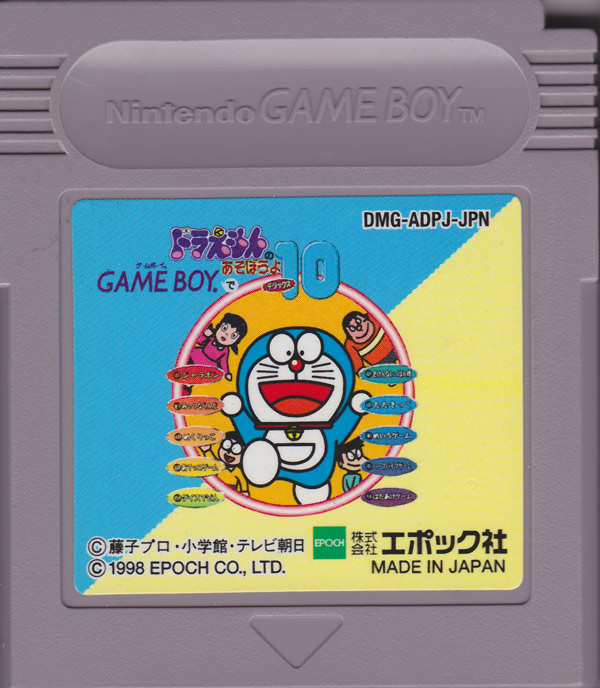
I don't recommend it, but the regular Karamucho is wonderful. I've got to take it easy on those. Let's do a big review! Doraemon DX10. The full name of this game is Doraemon no Game Boy de Asoboyo DX10 by Epoc. This thing came out in 1998, the end of 1998 in Japan. The name translates as Doraemon Let's Play DX10.
It's a series of ten children's games. Now, to get this cartridge to work, you're going to need to replace the battery, since it has a save game in it. The strange thing about this game is, it came out very late in the Game Boy's life, and most of the games that came out at that time either had a black cartridge or a clear cartridge.
This has a straight-up, standard gray cartridge, which means it doesn't have any enhancements for the Game Boy Color. Now, I see this game everywhere for really cheap. I've found it in a couple of these variety packs I keep picking up with random games in it, so I imagine it must have been pretty cheap, and definitely aimed at very young children. Doraemon is a robotic cat from the future. It's a manga that came out just at the beginning of the 1970s. It came out in anime form in 1979, and it's still going today. It's just a huge, huge character. It's been translated into many languages, but check on YouTube, you can find lots of Doraemon there. If you're trying to learn Japanese, I highly recommend Doraemon Books.
It's a very good kanji level for beginners. So when you start this game, you can go to options, you can look at a gallery of pictures, if you like, or just go straight into the game. You pick the first option, which is Hitori. This means you're going to play on your own. Of course nobody's going to want to play this game with you, so you better play alone. So you're going to have to pick who you want to play, one of the Doraemon characters, and you pick an opponent. And then you can choose whatever game you want to play. The first game is Mahjong.
Now this is not full on serious Mahjong, but it is. The play mechanics are the same as real Mahjong, by which I mean it's not that Shanghai kind of Mahjong. You know the kind where you're matching two different tiles. No, no, no, no. This is like poker. This is real Mahjong. Now, when I first came to Japan, my brother-in-law's kids had this Doraemon Mahjong game, and I played it, and it helped me learn how to play Mahjong, at least the basic mechanics of it. I can't say any of it stuck in my mind, but at least I was able to do the basic thing of playing Mahjong. It's a very simplified version where, uh, it's like playing poker for babies. Well, that's exactly what this is. This is a very simplified version of Mahjong. In fact, if you do want to learn Mahjong, maybe this is a way to do it.
However, I'm not going to explain every bit of the mechanics of playing Mahjong, because you're probably better off just getting someone who knows how to play to show you how to do it. You're playing against your opponent, and whatever score you get, you can save your game. It'll ask you if you want to save. You know, there's nothing in English here, so you have to kind of guess at what everything is, but the first thing it asks you after you finish the game is you want to save, and then the second question is do you want to play again? The next game is, mmm, it's like Tic-Tac-Toe. You load up a 3x3 grid with whatever characters you want, then you sort of randomly roll the dice, or pick tiles, and see which characters you get. It's completely luck. There's no strategy to it.
The next game is memory, and you're playing against the computer, and it seems to be pretty fair. It doesn't always remember where everything is, and, you know, it's your typical match-two-tiles memory game. The fourth game is Mastermind, basically. You've got three rows, and you have different Doraemon characters, and you place them in the row, and it'll tell you if you have three of the correct characters there, you'll get three empty circles. If you have a character in the correct location, you'll get a solid circle, and you just go down the line until you run out of space, trying to guess it. It's pretty self-evident.
The next game is dice. You just roll dice. There's nothing much to it. Next game, you have a bridge, and a bunch of mahjong tiles on the left, and a bunch of mahjong tiles on the right. Your opponent's on the right, you're on the left. You roll the dice, and you can move your characters forward, and to try to invade the other side of the bridge. The strategy here is to load up the bridge as much as you can, so the other player can't move. I'm sure you can figure it out. Then there's sort of a whack-a-mole game, and then there's a horrible, horrible maze game. Yeah, I know it.
The rest of the game doesn't give you high expectations for any kind of arcade excitement, but still, they could have put some effort into it. It's just awful. You have, like, a doko demo door, which is a teleporter, and there are ghosts running around randomly, and you have to find a goal, but since the whole map scrolls around, you can't really see what the goal is.
Just forget it. And then you have skateboarding. In skateboarding, you're on a half-pipe, and you have to jump to get some medals. There's some skill involved. This is actually the most arcade-y part of this whole thing. The last game, Semaphore Flags, I could not figure it out. That's the whole thing. So, mainly the reason I wanted to mention this is, you know, you might be tempted to see, you might see the little Doraemon with a ten on it, and it's got, like, a blue and yellow diagonal shape on the front. You definitely want to avoid this one. There's no value in it whatsoever. I don't think a little kid would enjoy it, and my main reason for doing this review is to help you avoid it.
But if you absolutely don't want to avoid it, dmg-adpg-jpn is what you want to search for. Next to an arcade review. Top Gear Pocket 2 by Kenco was released in December 99 in Japan, and early 2000 in Europe and the US. In Europe, this was called Top Gear Rally 2, and in the US, it was released by Vatical Entertainment.
It's a racing game, a sequel to Top Gear Pocket. Now, I won't be reviewing Top Gear Pocket the first one, because you know, with racing games, it's not like you want to go back and try the original. You just want to get the best one. And people had a lot of complaints about the original Top Gear. It was a mediocre game, bordering on annoying. From what I've seen on YouTube, yeah, best avoided.
But this one is great. It's like a real racing game. It almost feels like a Game Boy Advance game. Almost. You've got championship mode, arcade mode, versus mode, and time attack mode. Eight different cars, six tracks with variations of each course. You've got pavement, you've got gravel. It's got a save game, so you will have to update the battery. You've got daytime, nighttime, and rain and snow. It's amazing that they were able to take this machine that is not suitable for racing games and actually crank out a pretty decent racing game out of it. It's not going to blow you away.
This is not the best racing game you've ever played, but it is one of the best racing games on the Game Boy. The controls are very good, pretty intuitive. You can play in automatic or manual mode. You can get a little extra speed in manual mode. Depends what you like. You start in 10th place and you have to pass nine cars before the end of the race.
You don't just breeze past these opponents. They are wily. They will tangle with you. They don't just kindly let you pass. You have to really think about it. This is something that was missing from the previous version where you could just breeze past the other cars. You have to be very careful not to slam into the cars because they'll slow you right down.
When you start the game, you'll have points which you can spend on cars. As the game goes on, you'll have more cars to choose from. And if you do well, you get more points. When you start the next race, you have a chance to upgrade your car. Now I play this game pretty far and I ended up restarting the whole game because I kind of ended up in a poverty cycle.
You want to upgrade that top speed as much as you can just so you can start winning races and earning extra cars. What happens is you end up spending money on the acceleration, the braking, and the handling. And you don't have enough money to buy another car. And then you start losing races because the courses get harder and harder and your car is underclassed. So get that top speed up.
You can make up for all the other stuff by just driving better. These are unlicensed cars but if you know about cars, I think you can guess what they're supposed to be. I really like the look of this game. The cars are kind of narrow and cartoony. They're cute little cars. At the starting line, you want to get your tack. You know, it goes from green into red. Well, if you start in red, your tires will just spin out and it'll slow you right down. You want to get it just under that. So just kind of tap the accelerator.
Get it just under that. Don't slam it right away. Experiment with it a bit and you can get that real sweet spot where you can get a really nice boost at the beginning. And when you're passing other cars, just remember when you touch the sides of this one, it only slows you down a little bit. So sometimes it's worth it to run on the edge of the road a bit just to pass a guy so you don't have to touch his back boat. The sound is very good actually. It's not the best engine sound you've ever heard but it's pretty decent. There are textures on the road. It's amazing how they could do this on a Game Boy Color.
It's kind of a weird optical illusion on the dirt roads where it looks like the road's not moving but just try to ignore it. The rumble pack effect is pretty good. I could take it or leave it but it's kind of fun. However, if you're going to use the rumble pack you may want to opt for a tabbed, soldered in battery instead of just the taped in battery. Although I've had no problems with this.
There is a risk that all the vibration will shake that battery loose. The only thing that's kind of lacking is there's no variety in the pacing of the cars. You never see a whole bunch of them bunched up together that you have to pass through. You pass a car, you never see the guy again, you wait a little bit and there's another car and you pass that one.
So that part's very repetitive. If you want to show off what a Game Boy can do you can kind of pop this in and just show people, oh it's almost a Game Boy Advance. And the frame rate is so smooth. And this game is really cheap too. I got this thing brand new in the box for less than ten bucks with the rumble pack and the manual. It was factory sealed so I don't think it should be hard to get this thing. There's no reason not to get the Japanese version. Everything's in English anyway. Look for cgb-v33j Hardware!
Hardware! Your Game Boy cartridges are filthy. They're full of puke and urine and who knows what else. These things have been stored in toy boxes and babies' mouths. I've even seen some stored in the bottom of a bowl of Cheerios. You know, if you have just a new cartridge and it doesn't look too old and you just want to clean it up, take a Q-tip with a little bit of alcohol and you rub it inside and usually that does the trick. Most of the time that's going to work. But then once in a while you get a cartridge where you can tell it's pretty dirty and maybe the contacts look oxidized or the gold is worn off. Then you have to get serious about it. So what you're going to have to do is take your Nintendo security bit. That's a 3.8 millimeter security bit. Go get one if you don't have one because you need it if you're going to be a Game Boy collector.
You don't know what kind of filth is in here. There might be a little centipede or little tiny frogs in there. So you make sure you open that up. Undo the screw and open it up and see what kind of filth is in there. Generally I soak everything with alcohol if it's really bad and then just swab it all up with the Q-tips.
I don't think you can really damage anything with the alcohol as long as you dry it out reasonably before you actually test it. But generally splash around. If you've got a save game in there you might want to think twice about soaking it too much, you know, if the battery is still good. But most likely you're going to be replacing that battery anyway if it's an old game.
Now, when things get really extreme sometimes the contacts are really really damaged on these things. You know, you can kind of work on it a little bit more with the Q-tip and kind of scrub vertically on the, kind of go with the grain of the gold connectors. Then sometimes even that doesn't work and you have to go in and use a pencil eraser. It's kind of harsh.
It'll take some of the gold off so you've got to be very gentle with it and only use it where necessary, where it's really blackened or worn off. When you have a case where the gold is worn off, the contacts have no gold left on them. You're just left with the grey metal. Basically there's not much you can do except clean it more often.
You just have to, you know, clean that thing. And generally a white eraser works in those cases, like a pencil eraser. It doesn't, it's not abrasive and it will just take off the grey. And then you just clean it as best as you can and then you just realize that every once in a while you're going to have to clean that thing again.
It's going to be a high maintenance cartridge. That's about all you need to do to clean cartridges. I mean, there used to be an official Game Boy cleaning kit, but really it was like fat cotton swab you just shove in there and clean with. Most of the time, you're not supposed to blow into the cartridge.
I still do, but you're not supposed to because you get all kinds of spit and drool and humidity into the cartridge and that will make it oxidize even more. But sometimes when it's been in your pocket and you're far from home, that'll do the trick. Anyway, good luck and keep those filthy, disgusting cartridges clean.