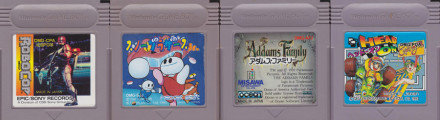
Reviews of Robocop, Snow Bros, The Addams Family & Head On.
Game Boy Game Boy Game Boy Crammer Game Boy Game Boy Game Boy Crammer My name is Ray Larabie and I’m talking to you from Nagoya, Japan. Welcome to episode number 31 of Game Boy Crammer. Today I’ll be reviewing Robocop, Snow Brothers, The Addams Family, and Head On. I’ve got a site I want you to check out.
Go to j.mp slash Game Boy Cram, one word, j.mp slash Game Boy Cram. This is a Japanese site with screenshots, original price, release date, and description for… I don’t know if it’s every Japanese game ever released, but certainly a lot of them. It’s a huge long scrolling page and it’s got background music.
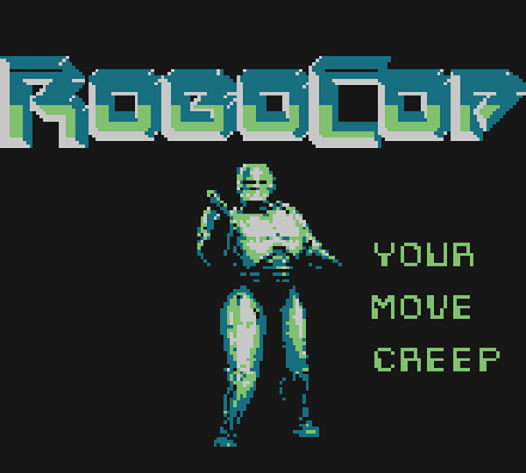
Sometimes it’s hard to figure out the names because Google Translate tries to take the katakana names and translate them into English. And like, for example, alleyway is a ray way. But interesting anyway. Let’s get on with the show. Next to… A game review. Robocop by Ocean Software was released in December 1990 in the U.S. and Europe.
March of 91 in Japan. This is a run-and-gun game based on the 1987 science fiction movie Robocop. Not to be confused with the 2014 science fiction movie Robocop. Also, not to be confused with Robocop 2 or the unbelievably bad Robocop 3. Robocop came out in arcades in early 1988. And it was just, at the time, just looked amazing.
And it was a rare situation where the computer version was actually made before the arcade version. The arcade version was licensed from the computer version. Even though Data East is listed as the developer for the arcade game, it was actually Ocean Software that did it first. They were working on it while the movie was still in development.
This version of Robocop is not exactly like the arcade game, but it is the same type of game. You can walk left to right, and you can shoot, and you can shoot on 45-degree angles. And you can crouch. Now, the new movie isn’t out yet, but I can tell you, the old Robocop was not limber. You know, the whole point was, he was big and clunky and slow, but strong.
Here’s an interesting tidbit I found on Wikipedia. The title music on Robocop for Game Boy was actually used in a series of TV ads for the European kitchen appliance company, Aristotle. So, of course, you play Robocop in this game. You’re walking from left to right most of the time. Use B to shoot, A to jump.
You’ve got a health gauge on the bottom of the screen and a timer. If you run out of time, it’s game over. If you run out of health, it’s game over. But a game over isn’t so bad in this game. While you can’t really save your game, at least you can continue as many times as you want. It resets your score to zero, but you can try as many times as you like to clear a level.
There are not a lot of enemies in this game. Most of them will shoot at you, but there are some that do flying kicks, some that throw grenades, and motorcycles kind of fly at your head. Oh, and baseball bats. You would think that getting hit by a machine gun would do the most damage. This is Robocop, and Robocop is apparently vulnerable to baseball bats.
When you see a baseball bat guy, take him out as soon as you can. The grenades are particularly bad, too. If you’re lucky, sometimes you can blow up a grenade while it’s in the guy’s hand, but it’s very unlikely. Guys are going to be showing up in upper story windows, and pretty soon you’re going to find a nice little pattern for getting rid of those guys.
They shoot in bursts, so you can kind of time between it and hit them back. And if you’re directly below someone shooting at you, you can kind of offset yourself and shoot upwards, and he can’t shoot you, but you can shoot him. If there’s a motorcycle coming, duck. When you’re in close enough range, Robocop will automatically go to a punch.
It’s not really something you do on purpose, except with barrels. There are these really tough barrels that kind of get in the way. You have to get right up to them and hit your B button, and you’ll punch right through that barrel. In between levels, there are minigames. Unlike most games that have minigames, these are actually pretty good.
There’s target shooting, where you have to rescue hostages by placing crosshairs and trying not to hit the hostage, and a few other fun surprises, where I got stuck for a long time with the first ED-209 boss. The time limit is pretty tight, and you don’t have a gun. You have to walk up to this big thing and punch it in the face.
The trick is, there’s kind of a sweet spot where you can crouch in front of the robot, and he’ll fire right over your head. You have to be pixel perfect to get that right spot. Once you figure that out, you can crouch, let him fire, and get a couple of punches in and run back. It took me a lot of practice to get it.
Well, once you figure it out, it’s not so bad. The game gets harder and harder as it goes along. It gets really hairy near the end. There’s a section with elevators and stuff, and there’s just constantly stuff firing at you. Luckily, you’ve got power-ups to help you out. There’s a box with a letter P on it. That’s health.
Be careful not to shoot the power-ups. They can be destroyed with bullets. There’s a power-up that looks like three bullets. That gives you a spread shot. It’s not great, actually. Because it fires slower, it kind of leaves you vulnerable. Sometimes it’s helpful. There’s another kind of bullet. I don’t know what it is, but it makes kind of a laser sound, and it’ll actually go through enemies.
You can shoot a whole row, and it’s more powerful than a regular shot. All these special weapons have limited ammo, but your regular gun doesn’t. When you have the regular gun, just keep firing. Much further in the game, you’re going to get this weapon that you only get to keep it for a short time, but it makes like a big fireball and just kills everything in this path.
I really like this game, and there weren’t a lot of really good Game Boy games that came out in 1990. This one’s pretty decent. It’s not a long game, but it’s pretty good. If it’s cheaper, get the Japanese version. Everything’s in English anyway. For the US version, search for dmg-cp-usa, European dmg-p-cp, and the Japanese version dmg-cpa.
Snow Brothers Jr. was released in May of 1991 in Japan, January of 92 in the US, and later in 92 in Europe. The US and European versions were simply called Snow Brothers. If you see Snow Brothers Jr., it’s the same game. The only difference between the Japanese version and the American version is there’s some intermission stills that show the storyline of the game.
Those are in Japanese. Other than that, everything’s the same. Snow Brothers is a platform game. This thing came out in the arcade version of the game, I think this was on the Neo Geo arcade system. When I was in college, the local corner store had a Neo Geo system, so I think this is what I played it on.
At the time, I was really into the Amiga version of Bubble Bobble, and this is very much the same kind of game. It was obviously inspired by Bubble Bobble, but I wouldn’t call it a Bubble Bobble clone. The original version, you could play two players at the same time, but in this game, just one player.
The original arcade version, you played either Nick or Nick, The original arcade version, you played either Nick or Tom. One had red clothes, one had blue clothes, and so in this one, I’m not sure if it’s Nick or Tom, and I’m not sure it matters. Instead of shooting bubbles, like in Bubble Bobble, you throw snow at enemies, and you know how in Bubble Bobble, one bubble will encase the enemy.
With this one, you have to throw a whole bunch of snow. With one snowball, the enemy will be incapacitated, but then it’ll, you know, if you wait too long, it’s gonna melt, and they’ll come back and attack you. So you want to keep throwing snow at it until it’s encased in a ball. Once this enemy is fully encased in snow, you can push the ball, or you can jump on it and kick it.
That ball will bounce around and eventually smash. If you can hit enemies with that ball, you’ll get prizes. Prizes and power-ups. So, just like in Bubble Bobble, if you just take out one monster at a time and pop the bubble, you can do that to clear the level, but if you want to get a lot of points and power-ups, you want to try to get everything in one shot.
Use A to jump and B to shoot snow. You can’t get hurt from falling in this game, and some levels you can fall through the bottom and come out the top of the screen. In Bubble Bobble, there are a lot of puzzle kind of situations where you had to use the bubbles to climb on. In this game, it comes up once in a while, but there’s not a lot of situations where you have to throw snow at an enemy, turn it into a snowball, jump on the snowball to get up.
It does happen a few times, but it’s not a major part of the game. The arcade game had 50 levels. In this one, you get 60 levels. Every 10 levels, you get a boss. I remember in the arcade game, if you kept pumping it full of quarters, you could eventually get to the end of the game. And I recently played it on MAME, where it’s not much of a challenge because you’re not limited by quarters.
So when I got to the end of this game, I thought, well, what I thought was the end was 50, and there was 10 more levels after that. Pretty good deal. Despite the lack of color, everything’s really clear. It’s easy to see what’s going on. In fact, I always found the arcade version to be a little bit cluttered.
The backgrounds are very gaudy, especially in some of the later levels. It’s hard to even see what’s going on. It gets pretty chaotic. In this one, it’s a lot cleaner and easier to see what’s happening. The prizes that you’ll get are different types of sushi. And it makes sense, because, as we all know, snowmen love sushi.
But you also get potions, because snowmen love potions. Now, but in the arcade game, these potions were different colors, and they gave you different abilities. In this one, of course, there was no color, so the potion bottles look different. One of them makes you walk faster. One of them increases the amount of snow that you throw.
It takes less shots to build a snowball around an enemy. And one of them gives you more throwing distance. And once in a while, you get this weird one that makes you blow up like a balloon or something. You can fly around the screen and attack enemies. I don’t even remember what that potion looks like, because it happens so rarely.
Once in a while, you get this thing, and I’m not sure how I trigger it. I think it’s a potion. And a bunch of weird, creepy faces, like the mask in the Scream movie, come down from the top of the screen. These are not your friends. A void. You want to try to wipe out these enemies, and what they’ll do is they’ll produce letter power-ups.
S, N, O, and W. If you collect S, N, O, and W, I don’t know what happens, because I only ever got S, N, W, or N, O, W, or S, O, W. I never got all four. I assume something good happens. There’s supposed to be something that comes after you. You know, like in Bubble Bobble, if you take too long to finish the level, you get that uh-oh, this kind of skull ghost coming at you.
Well, in this one, I know in the arcade version something like that happened. In this one, I don’t know, the time limit must be pretty high, because I’ve never seen it. The bosses are all a little different. Generally, you have to hit them at snowballs. One of them, the snowballs don’t seem to be effective.
You have to kick the snowballs at it. If you do make it to the final boss, which is the sun, here’s a little tip. Stay at the bottom of the screen. When you shoot the snowballs, they’ll come out the top of the screen, and it’s just a little easier to deal with. You can just stay in the bottom platform and kick snowballs at the bottom.
You can’t build up a lot of lives in this game. I’m not sure what the deal is with lives, but for most of the game, I couldn’t get past two lives, and then for some reason, the last ten levels, I could get up to four. I don’t know what’s going on there. If you can knock out all the enemies in one snowball, a bunch of notes come down, like a scrolls with a Japanese character on it, and they stay just for a couple of seconds.
They’re worth a lot of points, so you want to grab those if you can. If and when you run out of lives, you’ve got ten continues. The music changes after every boss. It’s not unpleasant, kind of nice. After each boss, you get sort of a pachinko level, where you can kick the snowball to the left or the right, and you’ll get one of four prizes, and one of those prizes will be a letter that’ll hopefully let you spell the word snow.
I don’t think the level designs are exactly the same as the arcade version. They’re reminiscent. Like, you see a lot of the same stuff, and the first few levels seem to kind of be the same, but it’s not exactly the same. I don’t think it is. The controls are really nice in this game. You can always get this snowman to go where you want.
I feel you’re a lot more in control than you are in Bubble Bobble. Now, this game was designed by Toaplane, and for sure, in the Japanese version, it’s Snow Brothers. It’s not Snow Bros. And it’s not Snow Bros. So if you were thinking it was a name based on the musical group Bros, you would be incorrect.
Also not based on Blue Mercedes. There’s no save game, no battery to change, and there’s no way to continue your game. But there’s a cheat. You can select what stage you want to start on. You’re gonna have to use all your fingers for this. Hold up, select, and B at the same time, and then press start.
Up, select, and B at the same time, hit start. Pick whatever stage you want. Snow Brothers is pretty amazing for such an early Game Boy game. This is just the spring of 1991. Rarely did I see any slowdowns or sprite flickering. It plays really well and looks great. I recommend this one. However, if you’re gonna buy this game, it’s kind of expensive.
If you want this thing in a box, you’re gonna be paying a lot. Even the loose cartridge, I just got lucky and got one for cheap. Even for the loose cartridge, you’re gonna be paying quite a bit. And as of this recording, it’s not been released on Virtual Console. For the Japanese version of this game, look for DMG-SJJ, or just DMG-SJ for the US or European version.
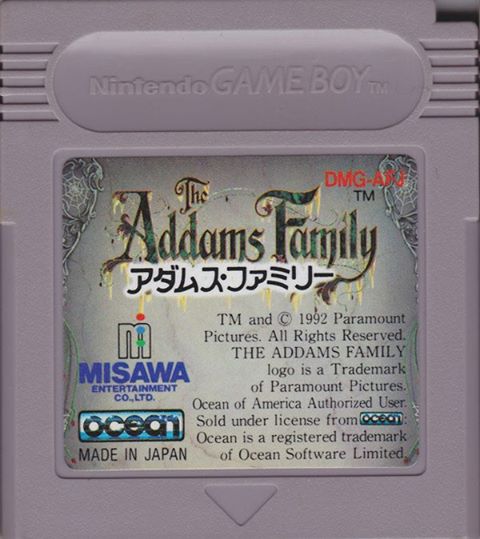
The Addams Family from Ocean Software was released in 1992 in the US, Japan, and Europe. The Addams Family is based on a comic that was in New Yorker Magazine in the 1930s, 1940s, and on. Then they made a live action TV show in the 60s, several animated series, more live action series, and then some big hit movies.
There was a bunch of video games made about Addams Family, and also one of the best pinball games ever. This game is a platform game. You play Gomez, the master of the household. You start outside the mansion. You can jump, you can fire a weapon, you can duck, you can use select to switch weapons. You start off with daggers.
There’s no unlimited weapon in this game. Those daggers can run out. You have to look for flasks and test tubes to replenish them. Later on, you’ll get some hot coals, golf club. Still don’t know what that does. Building blocks, ice cubes, icicles, and that’s about it. Not a big variety of weapons. When you see a test tube or a flask, you’ll get a little energy for your weapon.
Make sure you have the weapon that you want to refill selected before you grab the flask. You have a health meter, a small heart refills one heart, a large heart gives you two. You’ll find some potions lying around. If it has an F on it, you’ll turn into Frankenstein. You can take a few extra hits that way.
The S potion is for the water levels. You’ll get a little more control in the water. The W potion, you turn into Wolfman, makes you go really fast. There’s a Dracula potion, but I never found it. As you walk through the game, you’ll notice that the art direction is very poor. Inside the house, the stairs are almost the height of your head.
The scale is completely off everywhere. It seems like there was an art team doing the characters and another team, what am I saying team? There was one person doing the characters and one person doing the backgrounds, and they never visited one another’s cubicles. The character controls are not atrocious, but what is atrocious is the collisions.
If an enemy comes even close to you, you start to lose health. And you get the typical kind of flashing thing when you get hit in a game where you’re invulnerable. But while you’re invulnerable, your weapons are disabled. The level design is very poor. There’s a lot of sections where you just walk down all the way and there’s nothing there.
Then you walk all the way back. Enemies regenerate if you walk off the screen and walk back. An example of lousy level design. When you walk up the stairs, as soon as you get up the stairs, an enemy is on you. Like you are being attacked as you come up the stairs and then it knocks you back down the stairs.
Then you do it again and hope that the enemy doesn’t attack you again. Like you don’t even have a chance to dodge it. You are being attacked. This kind of thing happens all the time. Bats are always annoying in games. These might be the most annoying bats I’ve ever seen in any game. They’re small, but their collision boxes are huge.
You can shoot at them and they’ll still damage you even though they’re not even close to you. Just run away. Then you have these big evil looking black ghosts. You just hit them once and they go flying off the screen. It’s just not fair. You think a big black evil ghost would be more dangerous than a stupid bat.
This game has to be completed in a certain order, but nobody tells you what that order is. You just have to go on to your doom. Learn your lesson the hard way. For example, you start in front of the mansion. Maybe I’ll go explore outside. I can go to the left. I can go to the right. Or maybe I’ll just go in the house.
If you go in the house, you’ll eventually find a toy box. You go into that toy box, you’ll find a big underground level. You go all the way to the end of the level and you’ll find a boss. A big teddy bear. It doesn’t really match the art style of anything else. It’s swinging a mace around and around, so you kind of jump over it and there’s a little spot to hang out.
And then fire your daggers at its back and you can see it’s doing damage. Oh, great. Okay. So, you know, once you figure out the little pattern, it’s pretty easy. And then you don’t have enough daggers to finish it. Well, maybe you should have conserved some daggers. So after you die, you come back and you’ve got a full set of daggers.
You shoot the thing in the back over and over, being very careful to make sure you don’t miss any shots. And you still can’t kill it. There’s no possible way to kill this thing and you can’t leave the level. You basically have to use up all your lives. You can commit suicide. You can valiantly fight that bear.
You won’t beat it. And it’s game over, so don’t do the house first. I went into a basement and it was fire and stuff like that. And there was a boss down there. And I had a golf club and I had fireballs and daggers and blocks. Nothing seemed to hurt it. I couldn’t tell if I was doing damage or not. I don’t think I was.
So I just kept fighting and not winning and running out until it was game over again. I’ve played a few bad games, but this is the most infuriating game I’ve played on the Game Boy so far. Stay far, far away from this game. And for the first time, I’m not going to tell you what the product ID is. Because I don’t want you to play this game.
We’re gonna take a call on the Addams Family. Head On from Tecmo was released in December of 1990 in Japan and in the US. Except in the US it was called Power Racer. Head On is a port of an old video game from Sega from 1979. And it was the first game where you ran around a maze collecting dots. About a year before Pac-Man came out.
You drive a car around a track. The goal in this game is just like Pac-Man. Collect all the dots. And you’re going to be going clockwise. Everyone else is going to be going counter-clockwise. There are five lanes. And there’s a car going the other way. And that car wants to smash into you. Use the D-pad to change lanes.
Use the A to go faster. This is one of these games in the arcade that at the time it came out, it was probably kind of cool. But really, by 1980, a year later, it was looking pretty sad. I remember it was one of those games where if all the other games had a lineup, you’d see Head On just sitting there.
Ah, I guess we’ll go play Head On. The first few times I played it, it seemed like kind of pointless. Kind of like tic-tac-toe, like there’s no real way to win this. But there is a lot of strategy to it. It’s all about using the accelerator. You want to time it so the other car can’t change lanes to smash into you.
It’s the kind of game where if you just pick it up and play it a couple of times, you’ll just think it’s dumb. But if you really give it a chance and play it a bit more, you’ll kind of get into the swing of it. And it is a lot of fun. In the normal race, there are nine levels. You start off facing one car.
Later, you’re going to get more cars and cars that can change more than one lane at a time. That’s a big advantage you have over the enemies. You can change more lanes. But you don’t want to be holding the gas while you’re changing lanes. So you usually want to let go of that gas and then change the lane and hit the gas again.
If you can complete all nine levels, the game will tell you, you are great. Now there’s a special mode in this game. Special mode adds a few little elements. And you can play against a second player. But that’s not going to happen. You have three difficulty levels and you can choose stage zero to nine.
In special mode, there are hazards on the track. These will vary for each level. Sometimes you get oil slicks. They’ll make your car spin out and enemy cars spin out. This just causes a slight delay. There’s no damage or anything. And you can kind of lure your opponents into it. They’re not very smart about avoiding it.
And there are walls that move. So the lanes can kind of shift and then block other lanes. It can be really handy. There are also some power-ups. Now you’re going to see these power-ups when you pick them up. They’re going to show up right near your score and where it shows you how many lives you have left.
There’s one that just has the letter C on it. Go for that because that’s going to let you clear the round immediately. There’s one that looks like a little black circle in a square. That’s an extra car. I don’t know why they use that symbol. It almost looks like a bomb. That gives you a car in front of your car, or I guess behind it.
So you can do a complete head-on collision with your opponent. And then you still have another car to keep going. It’s almost like having a front shield. Speaking of shield, there’s also a shield. It looks like a little you. It’ll make a bubble around your car. A little bubble. And when you slam into your opponents, they’ll spin out and you keep going.
There’s a bomb icon that actually looks like a bomb. When you use that one, it makes an explosion. And if any other opponents are near you, it’ll make them spin out. It’s not good. You can’t really deal with opponents coming at you head-on. Because even if they’re spinning out, that doesn’t help you.
You’re still dead. So it’s really good if they’re in the next lane. You just want to cause them some problems. It’s also good if you’re changing lanes and you just come near them. You can kind of use the bomb there. There’s an icon that looks like an arrow pointing down. That slows down the opponents, but not for very long.
And then there’s a U-turn. This causes everyone to change direction. There’s no reading in this game. So there’s no difference between the Japanese and the English version. Maybe there was some kind of trademark situation with the name head-on. If you’re a fan of really early maze games, you’ll probably like this.
It’s the kind of thing you can just pick up and play once in a while. It’s not going to be like a long-term thing that you’re going to want to really get into for weeks and weeks. This is a pretty quick game. In the regular mode, it’s not really that hard to get to the end of it. If you’re looking for the Japanese version of this game, it’s DMG-POJ. The US version: DMG-PO.