Game Boy Crammer · Episode 32
Rockman World 3, Alleyway, World Bowling & Doraemon Kart
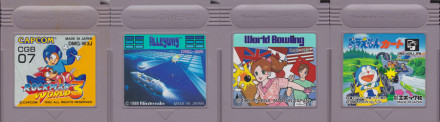
Reviews of Rockman World 3 (Mega Man III), Alleyway, World Bowling & Doraemon Kart.
My name is Ray Larabie, and I'm talking to you from Nagoya, Japan. Welcome to episode 32 of Game Boy Crammer. If you've listened to this show from the beginning, by the time you're finished this episode, you've listened to 114 reviews. Today, I've got four new ones. Rockman World 3, also known as Mega Man 3, one of the first Game Boy games, Alleyway, World Bowling, and Doraemon Kart. Here we go.
Rockman World 3 came out in Japan in December 92, a little bit later in the US as Mega Man 3, and you're a couple of months later as Mega Man 3. It's not the same as Mega Man 3 on the NES. This is kind of a mixture. It's almost like a port of Mega Man 3 and Mega Man 4 on the NES. So if you've played those, you'll be familiar with some parts of the levels. The overall game is different. Now, I won't explain too much about who Mega Man is and what it's all about.
You should listen to my previous podcasts with Rockman World and Rockman World 2. Now this game finally feels like Mega Man to me. Now you have a proper slide move, and you have the Mega Buster Charge. You can hold the button down, charge your shot. The controls have really improved. I find I can move right to the edge and maximize my jumps.
Whereas before, I'd try to get to the edge and fall off. This one, you get this really nice pixel precision when you tap on the controller. Really well balanced. I do notice in this one, though, when you take a hit from an enemy, you're kind of knocked out for a second, which you are in, I think, all of the Mega Man games. But this one, you're knocked out for a little bit too long.
Like, it really is an inconvenience. This game looks great. It finally looks like Mega Man. The backgrounds are detailed. There's, like, moving stuff and blinking lights everywhere. They really put a lot of effort into the background stuff. Like, there's just so much going on in the backgrounds. It's really nice.
Maybe because of all this extra detail, there's a few parts of the game where, you know, there's too many sprites on the screen, you get these slowdowns. Never found it to be a problem with gameplay. In fact, a few times, it kind of helped me out. The music seems really nice. It's much better, and the sound effects are better than the last one.
In this game, you're going to be facing four Robot Masters. These are going to be the ones from Mega Man 3 on the NES. Then there's going to be a mini stage, and then you're going to get four more Robot Masters from Mega Man 4. At the end, you're going to have a new Robot Master, and then you're going to fight Dr. Wily in, like, a two-stage boss battle.
I find that overall difficulty isn't really that hard compared to the last game or the first game. It's just that the levels are kind of long, and your luck can run out, which I really prefer. There's a lot of kind of vertical stuff. Like, in the last game and the one before, there was a lot more... It felt almost like Super Mario. You're pretty much moving from left to right.
In this one, there's a lot of falling down. You're going down holes in the ground and a lot of ladders. You get the E-containers here, the little energy packs. However, when you save your game, you don't get to keep them. Now, when I say save game, it's still the password system, like in the other games. There's no battery or anything like that.
Level design-wise, one thing that could have maybe done differently is give you a few more power-ups. Like, I find the big weapon recharge power-ups. It looks like a big bracelet. Those ones are so rare. Like, in the last game and the first one, they kind of showed up often. This one, you hardly ever see them. You know, 1-ups are pretty hard to find.
Although, you get infinite continues, so it doesn't really matter that much. You're really more of a concern for the end of the game, where you don't want to have to keep doing that same level over and over. It doesn't seem to matter which order you do these in. It doesn't seem as critical as the first game.
You're going to get lots and lots of weapons. I mentioned the Mega Buster. That's your main cannon. Now, this one, when you hold it down for a couple of seconds, it's going to release like an extra powerful shot. If you hold it down a lot longer, it's going to release like a really big shot. That's the key to beating a lot of the bosses and enemies in this game.
You're going to get these skeleton guys. For a long time, I didn't know how to beat them. I tried every weapon on them. I tried jumping over them. They kept getting me. They're little skeletons. They throw a bone at you. You want to hold down your charge shot to do the maximum charge shot. The Mega Buster, that takes care of those guys.
Your little dog, Rush, is here to help you. There's something called a Rush Coil, which was in the last game. When you activate this weapon, your dog will appear, and you can jump on his back, and he'll spring you up really high. It's really good for getting hard-to-find stuff. You get that one from Snake Man, so if you want that early on to get some of the interview packs and stuff like that that are kind of hard to get to, maybe do Snake Man first.
Spark Shock, it's listed as SP on their weapons list. I haven't really found a use for that one. It kind of freezes enemies with electricity, but doesn't really seem to do much damage. I don't really get it, and I got through the game with almost never using it. The only time I used it was when I tried everything on a boss to see what would affect it.
That's one of the things I tried, and it was like, eh, it doesn't seem to work. Maybe it does something. I don't know. The Gemini Laser is this really slow, reflecting laser. You shoot it out, you can only shoot one at a time, and it bounces off walls really slowly. It actually, this is one of the parts that slows the game down. Your framerate starts to slow down, and the thing's bouncing around, so it's kind of helpful in a way.
But you can only fire a few of them, and it takes a lot of weapon energy, so you don't find yourself using it that much. There's a few times where there's been some enemies that are kind of, you know, on the other side of a wall or something like that, and I can kind of get the bullet to bounce around and hit it.
Snake Search is kind of like a guided missile that tracks the floor, so this thing runs along the floor and it hits enemies. There are a lot of enemies that are immune to it, so you have to kind of experiment with it to see which ones are worth hitting. The Shadow Blade, I use that a lot. This thing is really handy.
You remember in the last couple of games where there were enemies that you just couldn't hit because you couldn't jump high enough and you couldn't angle your gun? This Shadow Blade is kind of like a boomerang, I guess. It goes out and comes back, but it doesn't go all the way across the screen, so you have to kind of get a little close to stuff.
But what it does is you can shoot it on angles. You can point straight up, you can hit a 45-degree angle, you can't shoot down. You get that from Shadow Man, so you might want to defeat him first. I'd say that and the Mega Buster were my main weapons that I used. The Shadow Blade is SH. Punk Blade, PU, that's the symbol. You get this from Punk.
Punk is the final robot master, so you're really close to the end of the game when you get this thing, but it is very critical for defeating the final boss. It's like shooting a basketball. It fires kind of a basketball-like arc, and it doesn't use a lot of energy, so you can actually fire a lot of these shots.
I wish you could have this earlier on in the game. And you've got the Rush Jet. That is when your dog, you can jump on your dog's back and he goes, uh, horizontally. It's not like in the other game, like you can't just go wherever you want. You kind of jump on it and it just zips across horizontally.
There was a couple of times where I think you have to use it. The Dive Missile you get from Dive Man, which is a little later in the game. It's a homing missile. Really great. It uses up pretty quickly, but, um, wow, I wish you could have this early on, too. It's really nice. Especially when you're fighting a boss and you're almost finished and your health is running out, you can just turn that on and just fire the last few shots.
The Skull Barrier is your shield you see in a lot of these games. It's very important when boulders are falling on you. The Drill Bomb, DR, is amazing. You can blow up, it's made to blow up barricades. In some of the levels there's these things, like there'll be an energy tank or something behind a wall that can't be destroyed.
This is how you destroy those walls. But you can also use it on enemies. It's like a, it's almost like the rocket launcher in Doom. The Dust Crusher, DU, launches a piece of garbage or something and it just breaks apart. And then the Robot Masters. You start off with Snake Man. This is where I first learned how to use that Mega Buster Charge Shot thing. It really works great on this guy.
Gemini Man's not too hard, but he's got this laser that just wipes you right out, so watch out. You want to have some E-Tanks handy for that one, maybe. Shadow Man's where you're gonna get that ninja blade, so handy. He kind of bounces around, shoots shurikens at you, and does like two different kinds of jumps you use your slide to get under. It's not too hard.
Spark Man, can you even beat this guy without the Shadow Blade? He's kind of on this weird angle where you kind of need that Shadow Blade to get him. Oh, Dive Man, you want to use your shield and activate that, the Skull Bear SK. You want to activate that close to him, you can take care of him pretty quickly.
Drill Man is kind of a different kind of boss than you usually see in Mega Man, except to this point. This one goes underground and pops up out of the ground. You want to kind of time it so when you think he's gonna come up, you're already moving. Like, you don't want to be caught turning around while it's popping up out of the ground.
Giant Suzie is this boss that's like a weird little square thing, and it's really hard to figure out the pattern. I don't know if there is a pattern. It seems like you just have to get lucky, because a lot of times it's gonna charge at you. You don't know if you need to slide or you need to jump. I just don't have the reaction time to make a decision. It just happens so quickly, and you already have to be jumping in order to dodge it.
So I went back and got as many E-Tanks as I could find, and it took me a while to get that one. I just use regular Mega Buster on this one. Oh, Punk is great. Punk looks like a punk. It throws this kind of saw blade at you, but that saw blade takes like a lot of your health away, so you can't make any mistakes.
And the pattern seems to be kind of random. Like, it kind of bounces around, but you don't really know... Just like the last boss, you need a lot of luck with this one. It's not that predictable. Now, just a little bit about the difficulty level of this game. It took me almost two weeks to beat this game, and it almost...
I can't play these Mega Man games all in one shot, because I won't be able to do this podcast. I need to have enough games to review. And so I need to space these Mega Man games out a little bit. This one was like... The first week was just doing the first part of the game. A lot of hours went into it.
And the second took me just as long to finish the final bosses, so basically Giant Suzy, Punk, and the two levels of Dr. Wily. So, Punk, I just had to keep practicing over and over and getting sent back. Then you get to the Wily Machine. This is this... It's a big thing with eyes on it that jumps up and down.
It's got a very simple pattern, so it shouldn't be that hard, right? Well, actually, the first part isn't that hard. Well, it kind of is, because, uh, well, it involves holding a lot of buttons and doing a lot of things, because you have to kind of charge up your weapon and slide at the same time. Your Mega Buster, that's the only thing you need to use for this one.
You charge up your shot, you slide under, and then you have to jump up and shoot it in the eyes, right directly in the eyes. You do that a bunch of times, and that's the end of them. Oh, is it the end of them? No, because then Dr. Wily comes out, riding this thing, and now it gets crazy hard. So I got really good at doing the Wily Machine first form, because I had to go back so many times to do this part.
Another boss that requires a lot of luck, because there's a lot of random stuff going on. It's very unpredictable. And it took me a while to figure out what I'm even supposed to do. This one, you have to use the Punk Blade as your main weapon. You don't need anything else. Dr. Wily's gonna be on the right side of the screen, in his little vehicle.
You're gonna be on the left side of the screen, dodging balls. These balls that hurt you a lot are flying out of two little funnels, um, his vehicle. And what you have to do is shoot one of these Punk Blade things, which is almost like throwing a basketball at the cockpit. But the opportunity is so narrow, because these things are coming at you, and it's almost like trying to shoot a basket while people are throwing boulders at your head.
That's the best way to describe it. It is so difficult. Um, and so many times you think, oh, yeah, I'm gonna make the shot, and it just gets deflected by one of those balls that shoots out. And you can't really tell. When they're making an arc, you can't really predict where they're gonna land. And they don't seem to, you know, in some games you can kind of lure the weapons and then dodge them.
Well, this one, they're just kind of random, so it's a lot of luck. And you have to hit this thing a lot of times with the Punk Blade. Luckily, the Punk Blade doesn't deplete very quickly, so you can miss quite a few times. So that's it, Mega Man 3. I recommend it if you like Mega Man, because this is the first...
You could probably skip the first two if you're a Mega Man fan, because you're not really gonna get anything that's Mega Man enough. This one has all the elements. Everything's in place to make it a proper Mega Man game. Finally. I'm sure people were really relieved at the time it came out that this is finally a real Mega Man on the Game Boy.
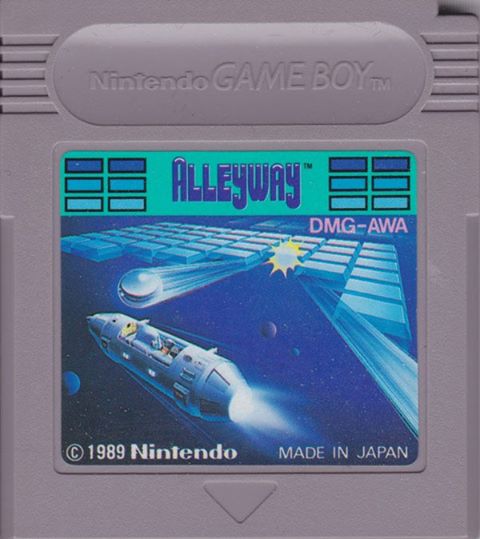
There's no reason not to get the Japanese version. I think the names of the enemies are different. That's about it. And you only see that at the end of the game. And I believe the Japanese version is cheaper. Look for DMG-W3J for the Japanese version, or DMG-W3 for all the other versions. Alleyway from Nintendo was released in April of 1989. It was a launch title for the Game Boy everywhere.
When the Game Boy came out in Japan, this was before Tetris was licensed. By the time the US Game Boy came out, Tetris was ready, but before that it wasn't ready because of some licensing thing. So all you had was Alleyway, Baseball, and Super Mario Land. So there are a lot of copies of Alleyway around.
Alleyway is a breakout type of game. I go into more detail about breakout in my review of Kirby's Block Ball. There's a paddle at the bottom of the screen. You move it from left to right, and you bounce a ball up and break bricks. When all the bricks are gone, you go to the next level. Now, I mentioned Kirby's Block Ball. Gunpei Yokoi, the guy who designed this game, later went on to work on Kirby's Block Ball with Miyamoto.
He actually brought the source code from Alleyway over to that game. The physics engine, the way the paddle works, all that stuff went straight into Kirby's Block Ball. This game is a lot simpler, and even though Arkanoid had been out for a few years, this is much simpler. There are no power-ups or anything. You really are just breaking blocks. It's more of a pure game, much like the original breakout.
You'll notice in the first stage, you've got your bricks that you have to break, and then above that, you have these solid, unbreakable pieces. That's to protect your ball from the top of the screen, but a few levels later, that's going to be gone. When your ball hits the top of the screen, your paddle will shrink.
And that's a big change from breakout, because originally in breakout, the whole idea was to try to get your ball up there, so the ball would just bounce back and forth and break all the blocks for you. So you can do that for a few stages, but later on, you're not going to want to do that too much. Small paddle, very hard to catch stuff. If you need to move your paddle a little bit faster, hold A. If you need to slow it down, like for fine-tuning, hold B.
Actually, I use B a lot when sometimes you get stuck in a cycle where the ball is just bouncing in a repeat pattern and you're just wasting time. You know, it's kind of going in between the blocks you want to hit. Hold B and you can just kind of fine-tune it without moving too far. The ball moves on 15, 30, and 45 degree angles. You'll find in this game, a lot of the time is spent trying to break out of these patterns.
The first levels don't move, but later on, you're going to have levels where everything moves horizontally back and kind of scrolls. Those are actually easier, in a way, because you don't have to worry about getting stuck in a loop and not hitting the brick you want to hit. You'll also get these levels that have advancing blocks. Everything moves down, just like in Space Invaders, just a little bit at a time.
Now, the blocks won't hurt you. They won't come all the way down the screen. They kind of disappear just a little bit above your paddle. It's to your advantage to hit the ones on the bottom before they disappear because you don't get points for them otherwise. The light blocks give you one point. The gray blocks give you two points. The black blocks give you three points.
The black blocks make your ball go faster. On the right side of the screen, you can see your score. Now, you'll notice there's only four digits there. When you go over 9999, you get a little Mario symbol. You get a fire flower, and I think a mushroom. It's kind of a clever way to save screen space. There are 24 levels. The difficulty doesn't really ramp up until about 21, I find.
Then you start getting those unbreakable blocks pretty close to the paddle, and the ball can change direction really fast. I found on those later levels I was holding down A all the time because I just needed to move so fast. Now, where the ball hits the paddle changes the angle. That's kind of basic breakout stuff, right?
But also your movement changes it. I really hate when I get a breakout game where you can't put any English on the ball by moving your paddle. That's dumb. Of course it should. If you move exactly when the ball hits your paddle, the ball will kind of snap upward really fast. This is really important because you're going to have bonus screens once in a while.
The ball doesn't bounce off the bricks. It goes right through them, and they'll be in the shape of Mario characters. Bowser, Mario, that kind of stuff. And the idea is you've got a time limit, and you want to clear out all the blocks before the time limit, and then you get big points. If you're lazily watching a ball bounce around and watching your timer run out, you're not going to be able to hit everything.
That's where that snap technique really helps. You can just kind of get the ball moving faster. You can kind of hit the ball on the end of the paddle, so you can kind of slam it and get these really low angle shots. You get an extra life every thousand points. You can get up to nine. There's no continue. There's no save. No passwords.
So you got to play this game in one sitting. If you want to get to the end of it, 24 levels. In the Virtual Console version, you've got save state, so at least you can take a break. The difficulty with this game is not that it's that difficult. It's that you just kind of lose concentration after a while.
It's kind of a monotonous game, especially when you've got one block on the screen. You're just bouncing and bouncing and bouncing, hoping to get that one block. It's like driving a car across Saskatchewan. So I wanted to play this whole game, so what I did was I put it on the Game Boy Advance. That way I could plug it in, let it charge, you know. I didn't have to worry about batteries.
And I played a little bit one day, left it on pause the next day, played a little bit more. After the third day, I finished the game. I just need the break. I can't just do 24 levels in one shot without going crazy. Alleyway, it wasn't well-loved when it came out. It got some pretty bad reviews, I remember.
Probably because people were already used to, like, Arkanoid was a really big hit, and you had the power-ups and stuff like that. This was a little too simple. But I think it was good because, well, it kind of introduced the Game Boy to casual gamers. You didn't really have to know anything to play this game. You just had to move the paddle back and forth so anybody could figure it out.
Whereas Super Mario Land and Baseball, you probably had to have a little more video game experience just to figure out the interface. You probably don't have to go searching for this game because it just turns up everywhere for cheap. It's DMG-AW. You probably want to get the Virtual Console version because at least you have save states so you don't have to do it all in one shot.
World Bowling from Athena was released in Japan in January of 1990, April of 1990 in the U.S. This was the beginning of Athena's career in making bowling games. They later went on to make Super Bowling for Super Nintendo, Virtual Bowling on Virtual Boy, Pocket Bowling on Game Boy Color in 1998, Super Bowling on Nintendo 64, and in 2010, Super Bowling for iOS.
Athena mostly made Magon games, but they made one great Game Boy game, Money Idol Exchanger, which I reviewed in episode 20. I try to avoid sports games, as you know, but bowling is actually one of the only sports I do, unless you count pinball. In this game, you can play one or two players. You couldn't play with the link cable. This is a very early game, so I think they weren't quite sure of the capabilities of the Game Boy yet. You can really tell.
On the cartridge, the copyright says 1989, so you have to pass over the Game Boy to play with the second player. Take turns. Your first option, are you female or male? Pick either one, but you know what? If you pick a guy, you want to pick a ball that's heavy. If you pick a woman, you got to pick a lighter ball.
I guess it's important to reinforce that sort of thing to kids. Anyway, the next thing you see looks like a select screen, where you're going to be able to pick what country you go to. No, you're going to Japan first. Even though this is a Japanese game, in the American version, it's the same thing. They didn't switch the countries around.
When you see the flags of the countries, you're going to see different scores. That's a score you have to beat to go to the next country. Very simple. You're going to start the game with a practice shot, and then the game starts. Move left and right. Up and down doesn't do anything. When you hit your A button, you'll see a little marker bouncing back and forth. That's your control.
If it's all the way to the left, it's going to curve. If it's in the middle, it's going to go straight. Pretty easy to figure out. You just have to time it. Tap A again. You're going to have another bouncing cursor. You want to wait until that's at the top. If you can time it and hit your A button at the top, you're going to get the most powerful shot you can.
On the right side of the screen, you get a top view. So that's regular bowling rules. After a strike, the next two shots, you get double score. So if you get a strike and then you get a spare, you're still okay. In the 10th frame, you get three shots, as long as you make a strike or a spare. It's really hard to tell what's going on with the pins. It looks like kind of a canned animation that's happening.
You don't get any sense of pins hitting each other or any kind of physics. In real bowling, there's not just one position you can bowl from. You can strike from close to the middle. You can strike from the edges. If you've been bowling, you've seen situations where Granny throws the ball and it just crawls up and gets a strike.
But in this game, there seems to be no random element to it. There's no probabilities. If you do the same shot twice, you get the same result. So really, the strategy in this game, and I guess it's the same with any bowling game where you don't have a physical control, like a Wii or the bowling that Epic made.
Epic bowling is amazing. A little side note. This is a device. It's a set-top device you put on top of your TV. You have a ball that has reflectors all over it, and you bowl, and it actually reads the motion of the reflectors. It came out before the Wii. It's pretty neat. But anyway, when you have non-physical controls, or not even a trackball, and there's no random element to it, really, what you're trying to do in this game is find the sweet spot and keep executing that move over and over.
There's no time to fool around, because with the first level, you just need a few strikes and you can pass it. But then the score requirements get so high that once you get to America, you can't miss. That's the third stage after China. Really, you have to play it over and over, because there's no chance you're going to guess.
It seems like the first level in China, you can pretty much do the same thing and get the same result, although you have to be more accurate in the China level. In the first level, it seems like power can have a big variation, and you'll still get a strike. And then later, the variation has... you have to really hit that thing pixel-perfect.
And then by the time you get to America, it's much more fuzzy. And you're basically doing the same move. It's just slightly different in slightly different timing. However, once you get to the third or fourth stage and you don't really have a chance to experiment, there's no save game in this. There's no continue.
If you lose, it shows your score and you're done, and there's no high-score save or anything like that. I think if you play this game a couple of times, you're going to get pretty bored of it. And there's no chance to be creative, because there's really only one way to get a strike. I tried forever. I tried so many variations.
Because when I bowl, I tend to bowl slightly off-center, which works with the kind of curve I've got, where some people bowl right from the edge. To save you a bit of frustration, just bowl from the edge in this thing. And make sure you pick the right ball. If you don't pick the right ball, you can't win.
If you pick the heavy ball for the girl, nothing happens. I don't think you can even get a strike. And the graphics, you can really tell this is a very early Game Boy game. They hadn't quite figured out how to do the sort order on the sprites. So you'll see the bowling pins, and they're kind of overlapping each other from left to right.
It looks terrible. They didn't even bother making perspective lines on the aisle. This is not beyond the Game Boy's capabilities. The music isn't completely bad, but it's not good. When you do get strikes, or three strikes in a row, you're presented with a cute little graphic. They could have done a lot more, I think.
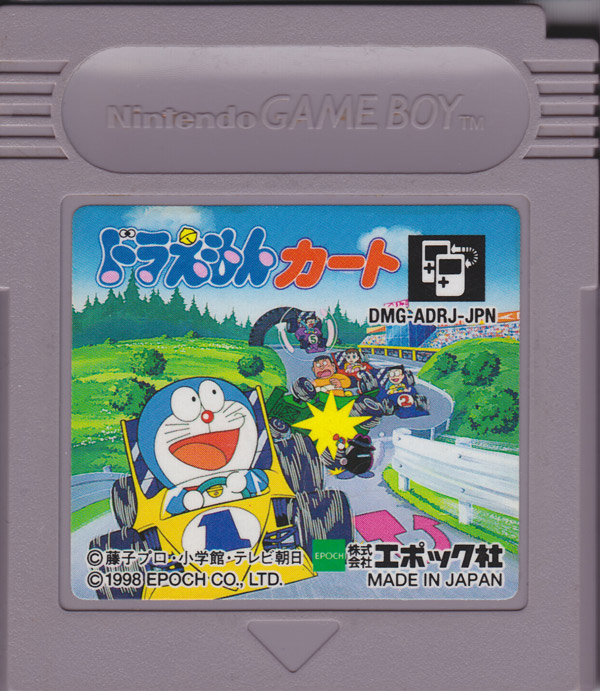
If you do want world bowling, search for DMG-WBA, or DMG-WB for the American version. Doraemon Kart by Epic was released in March 1998 in Japan only. Epic is the developer that created, I think, all of the Doraemon games on the Game Boy. All the ones I've encountered so far. This game is a racing game in the style of Mario Kart.
You're in a third-person view behind your kart, and you race down a track, you pick up power-ups just like in Mario Kart, and you use them against opponents. And all the opponents are characters from Doraemon. You choose the character you want to race with. It's purely cosmetic. It doesn't affect the gameplay at all.
You have a choice of five races that you can play. If you complete all five, you go up to the next level. There's three levels. If you finish all five tracks on the third level, it's the end of the game. Or is it? You start again. You just pick the first option in the menu, and then the first option in the menu again.
And you'll have an extra character to play. It's Doraemon. That's Doraemon's little sister. Adorable. They're both robots. Do you know why they're actually siblings? They both drank out of each other's oil cans. Because they didn't shake the oil, the nutrient levels were different in different parts of the oil can, so she got the smarts.
And she was born in the year 2114. Oh, I could talk about Doraemon all day. Okay, back to the game. You turn left and right with the D-pad. B is your accelerator, and A lets you use these power-ups. I don't think there's a timer boost like there is in Mario Kart. Like, you just kind of hit the gas as soon as it starts.
If you want to hit the brakes, push down on the D-pad. Although most of the time, just letting go of the accelerator is enough to handle the curves. After you beat a level, you'll get a little trophy. And if you want to, you can play like a time trial. The difficulty of the tracks really ramps up in the number of curves they have.
By the time you get to the fifth track, it's just a mess of curves. Surprisingly, the extra tracks you unlock when you get Doraemon, they're not hard. If you can play this game all the way through one more time, with Doraemon, and this time there's going to be six tracks instead of five for each level, you will get an extra secret track.
The sound of this game is pretty bad. You would think it's a driving game, you're going to have engine sounds, tire squealing, or at least the sounds of picking up power-ups and using them. No, you just get this poor quality music loop. The power-ups are abundant. A few of them, it's really hard to see what kind of effect they have.
There's one that looks like a shovel or an arrow. It seems to work if you activate it while you're beside someone. I don't know if you're stabbing their tires or whatever. There's one that looks like a conquistador, you know, the little Spanish helmet. That one flips everyone's car upside down. There's one that looks like a U-turn symbol.
You drop that on the track and if another player hits it, their left becomes right and their right becomes left. And other characters can use these on you as well. There's kind of a cannon shot and there's something that shoots a bubble. I don't know what that does. There's a little bottle, kind of a thin bottle.
If you drop that on the track and someone hits it, it's kind of like the banana peel in Mario Kart. It'll slow you down. So don't pick up bottles if you see them on the track. Another power-up that has a different kind of bottle looks kind of like a thick bottle. That is a speed boost and it's a heck of a speed boost.
Not only does it boost your speed, it increases your ability to stay on the track. And when you get that thing, you zoom way ahead. There's some real graphic problems in this game. There are a lot of technical limitations with the Game Boy. And one of them is how many sprites you can have on the screen and how many sprites you can have on a horizontal line.
When you're a developer and you submit a game to Nintendo to get it approved, they'll allow for a certain amount of flickering. But it's not supposed to be really sustained flickering on the screen. This one has sustained flickering on the screen. When you start the race, it's kind of a mess of characters overlapping each other and really heavily flickering.
I'm not talking subtle flickering. It's like the whole thing is just strobing. When I played this on the Game Boy Pocket, it wasn't as noticeable because you have that kind of blurring going on with the, you know, a little bit of lag on the LCD. On the Game Boy Color, it was really flashing. If you've been playing Mario Kart a long time, you might remember something happened between the Super Nintendo Mario Kart and Mario Kart 64.
They tried to balance it out. Like in the original Super Nintendo version, it was very hard. It was all about pure driving skill. Then in later versions, they kind of made it easier for slow people to catch up. You know, you'd get the bullet which would zoom you way ahead and they kind of tried to bring all the characters together.
There was a big disadvantage to being in the lead because people were shooting red and blue shells at you. This is more like the original one where it's really not that balanced. It's whoever's driving better is going to succeed and whoever picks up the most power-ups. The power-ups seem random. It's not like in Mario Kart where if you're in the lead, you get different kind of power-ups.
Like you'll get more bananas to drop and stuff like that. And if you're in the back, you're going to get more speed boosts. This is just random. So you can be right in the lead and you'll get these kind of front assault weapons that are really of no use. Even if you're really far ahead in the lead, it'll still keep giving you those wide bottles.
The one that gives you the super boosts. So you can get just ridiculously far ahead and a few times actually lap the other opponents. Like the whole group of opponents had passed a second time. Just by getting lucky with the power-ups and kind of denying them power-ups by how it's picking them up. So between the sound, the flickering, and the gameplay imbalance, I can't recommend this game.
I'll try to pick up Doraemon Kart 2; maybe there are some improvements. If you're looking for Doraemon Kart, search for DMG-ADRJ.