Game Boy Crammer · Episode 33
Bionic Commando, Block Kuzushi, Koro Dice & Volley Fire
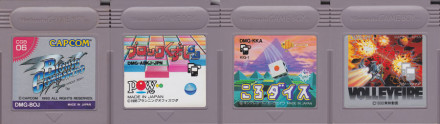
Reviews of Bionic Commando, Block Kuzushi GB, Koro Dice & Volley Fire.
My name is Ray Larabie, and I'm talking to you from Nagoya, Japan. Welcome to episode 33 of Game Boy Crammer. Today I'll be reviewing Bionic Commando, Block Kazushi GB, Koro Dice, and Volley Fire. Big news in the world of illuminating your Game Boy Color. Previously, if you wanted to light up your Game Boy Color, you had to use a front light. Pretty much the only way to get a front light was to rip one out of a Game Boy Advance SP, but it was a pretty wasteful thing and kind of expensive. The screen didn't really fit, so you had to do a whole bunch of modifications to get the screen to fit. You can hear all about my Game Boy Color front light modification in Game Boy Crammer number five. Well, now Kitsch bent, K-I-T-S-C-H, bent, has released a Game Boy Color front light. It's only 10 bucks, but I think I'll pick up another Game Boy Color and do this front light kit. This news was sent by Zuberi Ramon. Thank you very much, Zuberi. Go to j.mp slash gbc light, j.mp slash gbc light, and it'll take you right there.
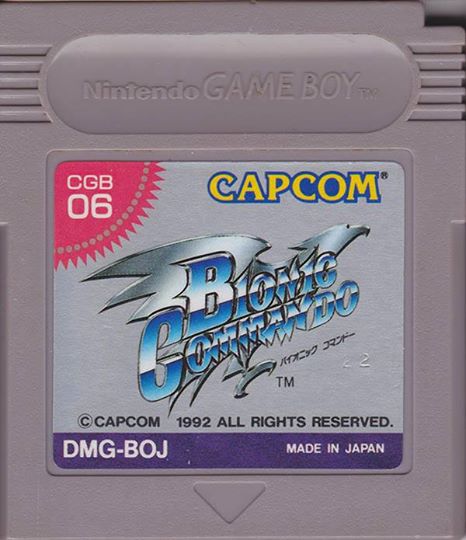
Alright, let's get on with the show. Bionic Commando from Capcom was released in May of 1992 in Japan, October 92 in the U.S., and later in 92 in Europe. It's also out on Virtual Console 3DS. There's another game on Game Boy Color called Bionic Commando Elite Forces. That came out in January of 2000 in U.S. and Australia only. That game did not come out in Japan. Bionic Commando is an arcade game, came out in 1987. In Japan it was called Top Secret. This was a sequel to Commando. You play Nathan Rad Spencer, a commando with a bionic arm, and a grappling hook. You shoot at this hook, and you can pull yourself forward, you can pull yourself up to the ceiling, or you can shoot it on an angle and swing with it. This came out before Earthworm Jim, before Tomb Raider, and all these other games that use grappling hooks to get around levels. But it wasn't the first grappling hook game. Rock and Rope from Konami came out in 1983, an arcade game, and those home versions of it too.
There was another game that came out only in Japan on the Famicom disc system called Arumana no Kiseki. It's kind of an Indiana Jones thing, and it uses a grappling hook. None of these grappling hooks would swing like they do in Bionic Commando. This is a platform game. You have no jump. You have to use your hook to get across things, and you can only shoot your hook on certain things and in a certain distance, so that brings up kind of a puzzle part of the game, where you have to kind of figure out the puzzle of how to get across something. You can't just run and jump across because you have no jump. Because this is an old game, you'll probably find it to be very awkward, because we've gotten used to playing a grappling hook in so many different games, we kind of know how they're supposed to work. This was developed when people didn't quite know how to deal with the interface for a grappling hook in a game. B fires your gun. A uses the grappling hook. If there's a ceiling above you, you point up and hit A, and a grappling hook will shoot out. You can pull yourself right up on top of the next platform, or you can just kind of hang under it. While you're on the ground, you can point up on an angle, and it'll shoot out a grappling hook at a 45 degree angle, which you can use to pull yourself up and swing on. If you're standing on the ground, you can push forward, shoot a grappling hook ahead of you, and pull yourself forward, or use it on enemies. While you're falling, if you shoot forward, your grappling hook will shoot up and on an angle. If you shoot up and on an angle while you're falling, your grappling hook will shoot up, but you get used to it after a while. In any other game after that, the way a grappling hook worked was you pointed the direction you want, and that's the direction it would go. You can kind of chain together these grappling hook moves. So if you're, let's say you're suspended on a ceiling, you don't want to fall below, you can pull yourself up to the ceiling, drop down, and just as you start to fall, push forward and shoot your grappling hook, and it'll shoot a hook up on an angle, and then you can use that to pull yourself up and swing, and you keep cycling that and use that to get across a platform from underneath.
Unfortunately, there's no way to start yourself swinging. You have to kind of shoot the grappling hook at an angle and then swing. You can't just, well, let's say there's a ceiling above you, you can't shoot your grappling hook up, pull yourself up, and then swing. You have to get into a swing by shooting on an angle and then swinging. The storyline, you got to rescue Super Joe. Super Joe is the guy in the original Commando, I think. There are enemies all over the place. Shoot them with your gun. They leave these cartridges behind. Not all the time, but sometimes. If you get 16 of those, you get a 1-up. If you get 32 of those, you get another 1-up. 64, 128, 300. That's the maximum 1-ups you can get. Other items you'll find in the game? Leg armor. All this means is when you land on enemies, you'll damage them, just like Mario. There's a hyper barrel. You get that much later. It lets you shoot several shots at the same time. There's a flare, which lights up dark levels. You can still get through these levels without the flare, but you can't see very far. There's a health bar refill and a permit that lets you get to certain areas that you can't normally get to. And you got some armor.
A visor helmet will take two hits. Body vest takes three hits. Goggles will only absorb one hit. This is how you can increase the length of your health bar. Weapons, you got a standard rifle. You got a wide rifle, grenade launcher, and a Vulcan that's kind of like a spread shot. In the overworld, at the beginning of the game, you're gonna see a map that has 17 locations. You start off on level zero.
You have a choice to descend or move. Descend means you're gonna start that level. Move means you can choose another level. You don't just point where you want to go. You kind of rotate your ship, set your destination, and move. On that overworld map, you're gonna see these other ships flying around. If you encounter one of those, you get a little mini level that you have to escape from.
You can do the levels in any order you want. You can fly to any level, but there are certain objects you need that you can't complete the other level, or there's something that will limit you. So it's probably a good idea to do them in the correct order. Inside the level, there are doorways. They're little doorways that just enemies come out, but they're also bigger doorways. Sometimes they take you to a different part of the level. Other times, they take you to a special comm room. Go up to the little computer, and now you can get some information. You can get friendly information and enemy information. Sometimes you'll encounter a door that you can't enter. That's probably because you missed one of those comm rooms.
You do have to go into them. There are these objects called receivers that you can pick up. Now what these do, oh, they're basically just a key for the comm rooms. If you don't have the right receiver, you can't use the comm room. If you do the levels in the correct order, you'll probably be okay. But if there's an issue, it probably means you missed one of these receivers. In the NES version, and of course in the arcade version, there was no save game. In this one, there is a save. It's a password save, but it's better than nothing. Many of the boss rooms are really simple, and you're gonna find a little sweet spot you can stand. You're supposed to blow up some kind of master computer thing on the right side of that stage, and there are three platforms. If you go to the platform in the middle, and kind of go to the left side of it, hang around there. Just keep shooting your right as fast as you can. If you see a guy on the left, shoot him. Keep shooting on the right. Boss is gone in a few seconds. You're not always gonna get this kind of boss, but it comes up quite a bit. There's an interesting little plot twist, so it's not just playing through level after level the same thing. The controls in this game are frustrating, but given that you can save the game, you really can spend your time working on it, and you can just keep trying and trying to get through it. In some levels, there are these hooks, and you have to swing from hook to hook, and it's really hard to coordinate it all. You know, your instinct from playing all these other games is to try to catch it by pointing at the hook, but remember to shoot on a diagonal, you have to point forward, not up, or not up in diagonal. It's really easy to accidentally shoot your hook upwards, and then you're no longer swinging. Hopefully you can fall to safety and try it all over again. There's a lot of reading to do in the Japanese version.
You're gonna miss a lot of storyline if you can't read Japanese. You can still get through it, as long as you just keep going to the comm rooms and reading, even if you don't understand what it says, you can still get through these levels. And the reason this is important is, the Japanese version of this game is kind of cheap. English version, not so cheap. If you can't get your hands on an English cartridge of this, you might want to look into the virtual console version, or you really won't know what's going on. Bionic Commando! Look for DMG-BOJ for the Japanese version, DMG-BO for the other versions.
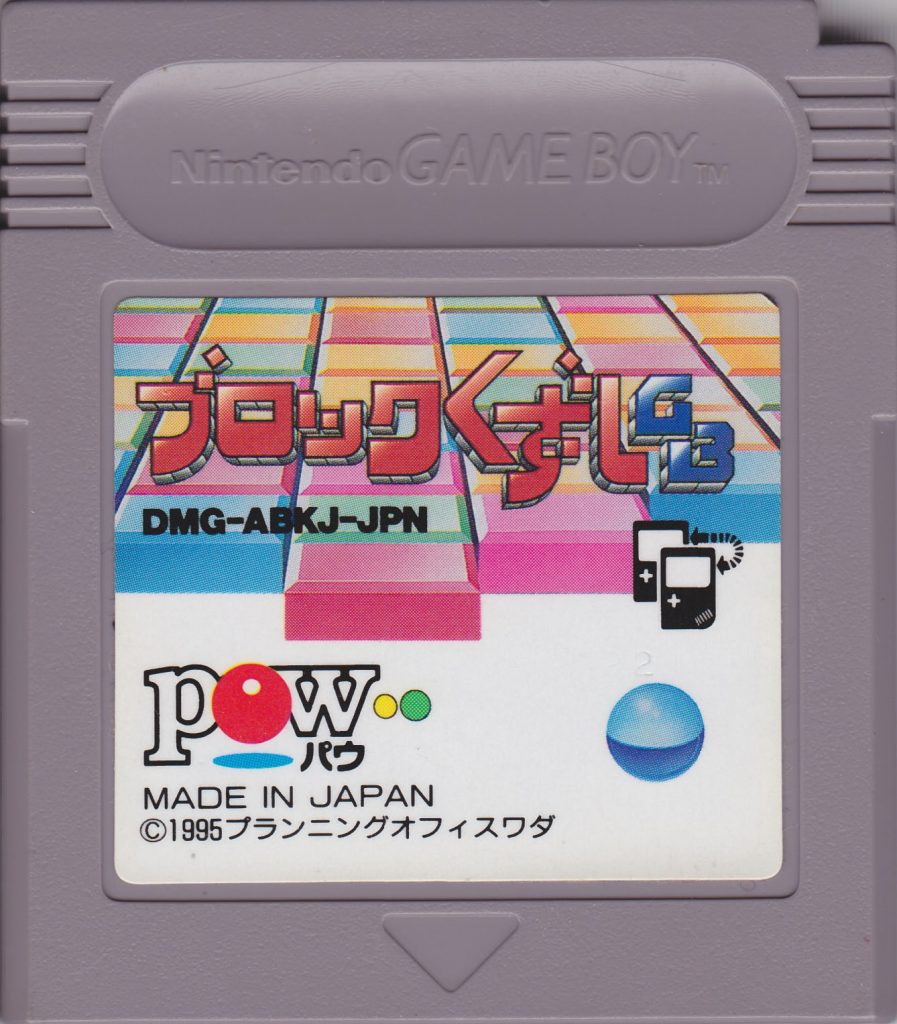
Block Kuzushi GB was released in December of 1995 in Japan only. It was developed by Oersted, O-E-R-S-T-E-D. The only other Game Boy game they made was DX Monopoly GB for Game Boy Color in 2000 Japan only. And they also made the Super Nintendo version of this game. Block Kuzushi is a breakout game, and the generic term for breakout game in Japan is Block Kuzushi. It comes from the transitive verb kuzusu, meaning to pull down, destroy, demolish, or level. It's used in martial arts for unbalancing the opponent. Nintendo, before the Famicom came out, in the 70s you had these boxes you plug into your TV and play pong on them.
Well, they had one called Block Kuzushi, and it was a breakout game that you'd plug straight into your color TV, and you'd have a little knob you could spin to move a paddle. Block Kuzushi GB is a little bit like Alleyway. You're moving a paddle at the bottom of the screen, bouncing a ball up to break blocks. Here all the blocks go to the next level. But unlike Alleyway, they've added a lot more interesting gameplay elements in this one. The one thing you'll notice right away is it's on a black background, which is kind of a problem if you're playing on original Game Boy or Pocket, because seeing a moving ball on a black background with the LCD lag is kind of hard to see. But if you're on Game Boy Color or Game Boy Advance, it's no problem. You wouldn't expect much in the way of story in a block breaking game, but this actually has a really cute opening story.
It's all in Japanese. If you're into ROMs, look around, you can find an English translation of this ROM. The story is completely superfluous to gameplay. It is funny. You start off with two extra lives, run out of lives, it's game over, but you can continue as many times as you want. There's no save game, there's no password, but you can continue indefinitely. You have the typical breakable blocks, blocks that take a few hits, and then you have the unbreakable blocks, just like in Alleyway. But they've added some other really interesting blocks. You have some that are intermittent. They disappear and come back, and you still have to destroy those blocks. Sometimes your ball will go right past them, and they'll disappear just before your ball hits them. So they can be pretty challenging, and there's some that take multiple hits to destroy. There are some blocks that shoot at you.
Often they're in these levels where they're blocked by a block in the front. When you break the block from the front, then it starts firing down on you. Very hazardous, especially when the timing is bad. You have to catch the ball and there's a bullet coming at the same time, and either way you lose. There's some little blocks that are unbreakable. They look kind of like Lego pieces. They've got six little lumps on them. Those make your ball go faster when you hit them, and what you don't want is the ball going faster. So a lot of times you'll have to really think about where you want to hit the ball to avoid those if you don't want it to speed up. Especially when you've got a little narrow part where the ball is bouncing in between and hitting those so many times. It can go down one of those, bounce a bunch of times off those little Lego blocks, and come out really, really fast. There are blocks that move back and forth.
Sometimes they're not moving back and forth when you start the level, but when you break some blocks beside it, it frees that block, and it starts moving back and forth. And it can actually help you because it can bounce the ball back upwards sometimes. There are blocks that are connected to your paddle. For example, if you move left, that block moves left. And if you move right, that block moves right. And you can actually use this block as a little extra paddle up on top. There are exploding blocks. They're marked with an A, B, or C, and each type of block will explode in a different direction. And then power-ups.
It's a bit like Arkanoid, where you hit a certain block and then the power-up will drop down and you have to catch it. These blocks are marked with the letter I. If you get an E block that will extend your paddle so you get a big paddle, R will reduce your paddle, so you want to avoid those. M will multiply the ball, so when the ball hits your paddle, it'll split into two. If you can hit those two balls, it'll split into four, and so forth. Sometimes you can clear the whole board.
It's just a mess of balls bouncing around. If you catch an L, the ball will just cut through everything. It'll destroy all blocks, even unbreakable blocks, so you can kind of clear out the whole board that way. There's also a U power-up and a D power-up. They had no effect that I could figure out. A question mark block. If you hit that, you get a random power-up, but you get it right away, so you don't actually have to catch it. I think there are 49 or 50 levels in this game, and every few screens you're gonna get a boss. This boss is a single thing on the screen. It never really changes between levels, although the type of projectiles it fires will change a little bit later on. You really just have to hit it a bunch of times, and your ball won't speed up because there's no blocks that will speed it up. Once in a while, something happens with the collision box on the boss, where the ball will kind of go inside it and bounce around and kill it right away. Nice when that happens. This game gets really hard because that ball moves really fast, and in later levels you have some levels where it's almost all those Lego type of blocks that speed up your ball. If you don't shoot it right up the middle and get around those, it's almost impossible to catch that ball. Unlike alleyway, you don't have a button you can hit to speed up or slow down your paddle. The control of the ball is a little bit primitive. I find that the angles are not as good as alleyway because you can't do that snap move or you move just when the paddle hits it. You can't put English on it by moving, so if your paddle is moving and you hit the ball, it has no effect. You might as well stay still, and there's really only four different angles that will come out and because of this, it's very easy to get into a repetitive loop where you're frustratedly watching the ball miss all the tiles over and over again. It's not very forgiving either. In alleyway, if you kind of miss it and then snag the edge of it, it'll kind of hook it, but this one, it's pretty fussy. Extra lives happen quite a bit. Extra lives are relatively plentiful. You get them from points, but you also get them from power-ups. If you hit those eye power-ups, sometimes they'll drop down a little 1-up that you can grab. All this time I've been talking about normal mode, but there's another mode called endless mode. In endless mode, the blocks are falling down from the top of the screen. If any blocks get to the bottom, it's game over, and you have a limited number of lives, and there are two new tiles. One is an exclamation point, which makes all blocks move down one. The other one, two exclamation points. That makes the blocks come down two at a time. With both types of game, there's a high scoreboard, but of course you can't save on this cartridge. Block Kazushi GB is a good game. It's a shame it didn't come out in English. I think it's probably because those breakout type of games are more popular in Japan. We already had quite a few of them on the Game Boy, and I guess they figured they didn't need another one, but it's too bad because this one's pretty good, and it really addressed all the problems that people have with Alleyway in that, you know, people complained it wasn't as interesting as Arkanoid. Well, this has a lot of those Arkanoid type of elements.
If you like these kind of games, pick this up. It's a really common cartridge in Japan. I usually see it for pretty cheap. DMG-ABKJ. Koro Dice by A-Wave was released in Japan in December of 1990. A-Wave also made Minipot on the Game Boy, Star Saver, and a game called Max. They ended up getting into fishing games for Super Nintendo and PlayStation and never made it to this century. Koro means roll around. Koro-Koro means roll around. Like Koro-Koro Kirby is is tilt and tumble Kirby in Japanese, so it implies rolling. But the Japanese word for dice is Saikouto, so it's a clever play on words. Koro Dice is a puzzle game that's played on an 8x8 grid. It's a puzzle game, but there's a bit of a random element to it. Before you start the game, you have a choice of easy, medium, or hard. This game has passwords, so you can save your point in the game. The only difference between easy, medium, and hard is the time limit.
The goal of the game is to get the die into the corner. Now, the first few stages the die is in the bottom left, and you want to land the die so the 1 is up. You'll see in the bottom corner there's a dot that is supposed to represent the 1 in your die. While you're rolling your die around, there's a little blocker piece. It's an obstacle, and if you just roll to the bottom corner, that obstacle will get there before you, and you can't roll your die into the corner. So what you want to do is kind of get that obstacle stuck. There are little pyramids that you can't roll through, and neither can this blocker, so you kind of have to get it caught on these pyramids, and then roll down and get your die facing 1 up.
So 1 is facing up towards you, and then you clear the stage. There's a block that has an S on it. This will scramble the dice or something. It kind of kicks it in a random direction. This kind of takes away the puzzle element, because this will help randomize your die. So if you don't really want to think about it, you can just kind of hit that, roll to the bottom corner a few times, and one out of six times you'll get it right. A few levels in, at the beginning of the level, you'll see the letter H on a few tiles, and then they'll disappear. This is to indicate where there are holes. When you fall into a hole, nothing bad happens, but your die is moved to a different part of the screen, and it seems like it puts you in a random place. After you fall into this hole, it doesn't really affect your time limit that much, because you really appear quickly, so you can kind of use these holes as a randomizing element when you are too lazy to think about how that die is supposed to land. A little bit later on, you're gonna get these arrows. If you land on one of these arrows, the arrow will rotate under you, and you can only exit that tile by going that certain direction. So if you land on arrow and it points up, go up to get off the tile, otherwise you're kind of stuck on it. If you enter that tile from the direction of the arrow, it'll slide your die. This is another way you can kind of randomize the die. If you find that you can't get to the corner without flipping your die the way you want it to go, you can kind of slide and then try it again. It's kind of like if you had a Rubik's Cube, and you can just kind of randomly spin it and throw it on the floor a couple of times, and then solve it. There are 50 stages altogether. If you clear all 50 on hard, you're going to have access to a wonderful thing called a sound test.
It's a special password, only for people that are capable of such tedium. This game was never released outside of Japan. There's no reading to do in this game, any words on the screen or in English. I don't think puzzle game people will be into it because of the random kind of element that's going on. The ability to just shuffle at any time really encourages the player to just kind of scramble around and try to jam it in the corner six times. I tried this technique.
I tried just kind of rolling around and jam it in the corner, roll around, slam it in the corner, and I finished some levels in seven seconds without even using my higher brain functions. If you do want it, it's very cheap. I see these all the time for a hundred yen or two hundred yen at the most in Japan. DMG-KKA.
Volley Fire by Toei Animation was released in the summer of 1990 in Japan only. Volley Fire is a space shooter, but it's not the typical kind of space shooter where you're shooting down fleets of enemies. This is a one-on-one shooter, and actually the history of one-on-one shooters goes all the way back to 1975.
There was a game called Western Gun by Taito. It was a coin-op arcade game. In the US it was called Gunfight, slightly different version, but the idea was you had two cowboys on either side of the screen shooting at each other. That's it. There were obstacles between you and the other player that would block the shots like a cactus, and there was a stagecoach that shows up later, and you only had six shots. If both players ran out of ammo, it was the end of the round.
A sequel to this game came out in 1977 called Boot Hill. It might be the first arcade game I ever played. I'm not sure if I played Boot Hill or Gunfight first, or Knight Driver, but it was one of the first games I ever played. This type of combat isn't much fun unless you're playing against another human. In fact, the name Volley Fire is, well, you know in those war movies or those US Civil War reenactments where everybody lines up and fires their guns as fast as they can. That's called Volley Fire. Not exactly fun.
Volley Fire is the same kind of thing. Now, I didn't get a chance to play a two-player game of it. I imagine that's probably pretty fun. You start with a map kind of like you'd see in Star Fox where, you know, you have a picture of the galaxy and there are eight areas you can visit. You have to start off in the first one, but after the first level you can use your B button and you can choose where you want to go next. You can actually choose the order you want to complete this game in. It means every time you play it you can kind of take a The first time I played this game I thought, wow, this is really boring. You move from side to side and you fire and there's a ship at the top of the screen that's also moving from side to side and firing. You're both firing lasers at each other and that's it. The A and the B button do the same thing. There's no auto-fire. You have to keep pressing the button. There's a few rocks in between you and the enemy and you just have to hit the enemy more than the enemy hits you.
There's a health level on the side. It shows you the number of ships you and the enemy have left and there's a health bar for each. When you first appear on the screen and when enemies first appear on the screen you're invulnerable and flashing. I thought this cartridge was a complete waste of time because, well, I mean you have to play with two players, but I kept playing and it started to get more interesting. You clear that level then there's kind of space junk moving across the screen. A little more interesting for firing. The enemy's not really good at figuring out how to fire a laser between a bunch of moving objects, especially when it's a narrow little gap.
So you can kind of take advantage of that. With this game I found the best strategy is to always fire where you think the guy's gonna go. I know it's kind of cliche. Don't try to get one-on-one where you're both shooting directly at each other because your shots cancel each other out and then whoever is misaligned is the one that loses. You want to be always firing in the space where he's probably gonna go. Not on the first couple of screens, but a little bit later you're gonna see like a little satellite come across the screen. You shoot that and a power-up will drop down. At first the only power-ups you get are shields. A big S comes down, but later you're gonna get some other stuff. You're gonna see weapon upgrades. Now I didn't know about the weapon upgrades until later. The first boss that you're gonna encounter is three guns on the top of the screen.
Just kind of move back and forth and you have to shoot them a zillion times each to kill them, but they're shooting kind of a wider laser. If you get hit by one of these things it does a lot of damage, but the fat lasers are easy to shoot down. Much later in the game you're gonna be able to pick up these weapons and if you can hang on to one of these things you can really blast through a big section of the game. I managed to get two upgrades so I got these really wide lasers and you know some of the enemies it just takes two shots to take them out.
And yeah if you're playing against a human player they'd probably figure out how to block those laser shots pretty quickly, but these enemies don't really seem to figure it out. Now it's not just one-on-one. I mentioned the boss has three things on top. A little bit later you're gonna get a situation where you're both firing at each other and there's an enemy for each side also firing at you. And sort of a very strange like a rock at the bottom of the screen that kind of pokes upward once in a while. It's like there's a guy under the screen poking you with a stick. You'll also get these kind of solid polygon shapes like a tetrahedron. You can't destroy them, but what you can do is shoot them until it goes into the enemy's area and then the enemy can't move from side to side. You can actually kind of block him into a spot, but if you shoot it one more time it kind of disappears off the screen and then more of them will regenerate. Don't forget the enemy can do that to you so you want to make sure the enemy doesn't put them beside you. But what really does me in in this game is the mirrors. There are mirrors that scroll by and it's pretty early in the game. When you shoot the mirror the laser will bounce back in your face. So don't shoot the mirrors right? Well I just can't help it. I always shoot them and shoot myself. I find most of the health I lose in this game is on those mirrors.
You don't even have to shoot. The enemy's kind of clumsy about the mirrors too and will kind of wear itself down by shooting itself with a mirror. You could just avoid the enemy if you really have all day. I just get impatient. I try shooting the enemy and try to be smart and I end up shooting the mirror and shooting myself.
There are bosses in this game. Other, you know, I mentioned the three gun boss really early in the game, but they're actually kind of big bosses that have, there's one that you'll encounter a few times that has three big sections in it. There's two side guns and you just have to destroy all three with a lot of shots. To get 1-ups in this game you got to get lucky with those satellites. Once in a while, very rarely, you'll shoot that satellite and it'll drop you a 1-up. You're not going to see it much early in the game. That shows up much later. I thought this game was lousy. Actually it's pretty good. It is tedious. I mean this kind of game has to be. Unless you're playing against a real person or if it had amazing AI there might be some kind of challenge to it, but it is kind of a war of attrition. You're just kind of trying to get the odd shot in and stay safe and rely on the enemy's stupidity to walk right into the shots. So you just don't feel super smart when you defeat these enemies. It's more of a patience thing. In Japan, Volley Fire is pretty easy to find. Look for DMG-VFJ.