Game Boy Crammer · Episode 34
Double Dragon 2, Space Invaders, Magical Drop & Dead Heat Scramble
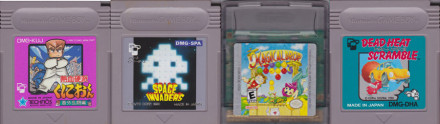
Reviews of Double Dragon 2 (Nekketsu Kouha Kunio-Kun: Bangai Rantouhen), Space Invaders, Magical Drop & Dead Heat Scramble.
My name is Ray Larabie, and I'm talking to you from Nagoya, Japan. Welcome to episode 34 of Game Boy Crammer. Today I'll be reviewing Double Dragon 2, Space Invaders, Magical Drop, and Dead Heat Scramble. Last week I visited Inuyama City.
It's about a half hour 45 minute drive from Nagoya. That's where Japan Monkey Park is. I visited a place called the One More Time Museum. This is Asia's largest pinball collection. This museum has over 150 pinball games. There's about 50 in working order. And video games and electromechanical games. They had one game called Taito Attack.
It's a game from 1976. You have these two guns shooting at the screen. You can play two players. But the guns are actually joysticks. A little bit like Operation Wolf, I think. And you shoot vehicles. It's kind of a parallax 3D kind of thing. It's the only one in existence. You have to ask the owner to turn it on.
And there's only certain hours where it's open. Because I guess they just don't want to wear it out. All kinds of video games too. Some new, some old. Lots of really interesting electromechanical games. There was this one where there's a bridge and a mountain. And an airplane hanger. And you fly a plane.
You can control the speed and the height of the plane. And it's mechanical. And it's done like a hologram. It's reflections and stuff like that. So the plane is actually overlaid on this 3D thing in front of you. It's just an incredible illusion. And when you crash, a little ambulance comes out. It's just amazing.
And the pinball. They've got all the big 1990's pinball machines. You've got your Attack from Mars. Medieval Madness. Twilight Zone. Theater of Magic. All the big ones. Now among all these older pinball games they have. They've got Playboy. Some well known ones. Over there they also have these Sega games.
Which I've never heard of Sega Pinball before. These are 1970's Sega games. This was before the Sega logo changed. And there was one game in particular called Mikoshi. Now it wasn't turned on. But the owner came down and let us play it. It's just incredible. First of all these Sega games have directional bumpers.
So instead of the bumpers just going up and down and pushing the ball away. They actually kick the ball in the direction that it came from. And the slingshots. Instead of having rubber bands around the slingshots. They're actually little plastic things that kind of chunk the ball up. It's a little hard to get to because you can't get there directly from transit.
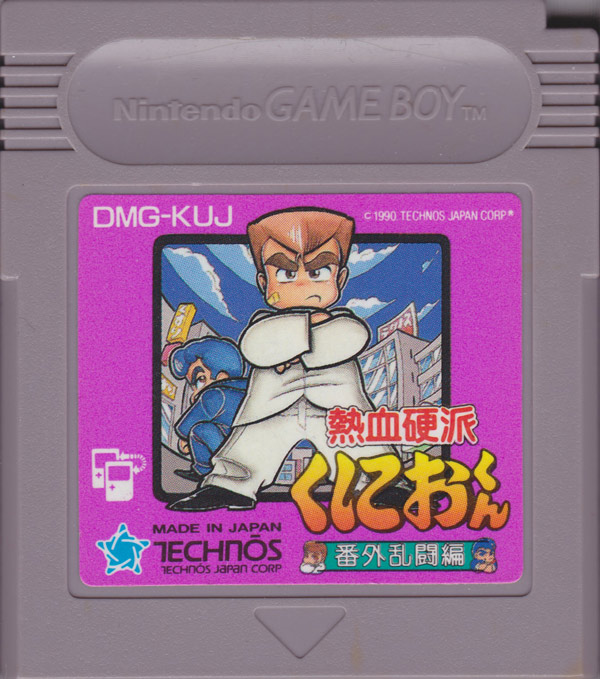
If you're coming from Nagoya you've got to get on the train to Inuyama. Then probably just take a taxi from there. 3000 yen for 3 hours. Play all you want. Okay let's start the show. Next to a big review. Nekketsu. Kouha. Kunio-kun. Bangai Rantohan. Was released in December 1990 in Japan. In the US and Europe it was released in December 1991.
It was called Double Dragon 2. Kunio-kun is not that well known outside of Japan. Although you may know some of the games Kunio-kun started. Kunio-kun was by Technos Japan. They're the ones that made Double Dragon. But it's not the same thing as Double Dragon. Double Dragon was a separate thing. It was created by the same company and the same creator.
But they're not the same dudes. A lot of the really early Kunio-kun games on the Famicom. Were released in the North American market on the NES as. Renegade. Super Dodgeball. Street Challenge and River City Ransom. And they changed the graphics to make it more American. You know they took all the Japanese stuff out of the backgrounds.
And America'd them up. Kunio-kun is a Yankee. Yeah, not Yankee as you might know it. Yankee is a Japanese term for like a street hoodlum. And they tended to have kind of a 1950's style greaser type hairdos. And Yankees are still around today. You see them all the time. Except now they kind of wear tracksuits and crocs.
This game is similar to the Kunio-kun you may know as River City Rampage. In that it's a beat-em-up. But it doesn't have those RPG elements. Like you can't go into shops or do any of that stuff. This is a pretty straight up beat-em-up. You're walking around on a pseudo 3D background, right? Like you're flat characters.
You can move front and back. You're fighting to the sides. Like Double Dragon. You walk through levels. Generally from left to right. But sometimes the other way. And you fight enemies. And you fight bosses. I guess they looked at this game and said, Well, we, you know, we can Americanize the characters.
But what are we going to call it? And they just went ahead and called it Double Dragon 2. Even though it barely resembles Double Dragon. Except it is a beat-em-up game. So there's that. I think that must have been disappointing for people at the time to get this game. Because, you know, it's like if you make a fighting game.
And then you call it Street Fighter. People are going to naturally be more disappointed than if you just called it Fighting Dudes. Because you're not expecting it to be like something else. People probably expected this to be like Double Dragon in some way. When it really isn't. They tried to wrap a Double Dragon story around it.
If you look at the story part. Which is really just at the beginning and the end of the game. Is different in the US and Japanese versions. They tried to wrap it into the Double Dragon storyline somehow. In the English version. So forget Double Dragon. There's not a lot of fancy moves in this game. You basically have a punch and a kick.
A is punch. B is kick. If you hold A and B together. It'll do a little crouch. Just a short crouch. But it really helps with some types of attacks. If you crouch and then press A or B. You'll do a kind of a jumping uppercut. These are really useful against bosses. And any enemies really. I found myself just doing this move over and over.
It's very useful. There's a throw. When you're really close to an enemy. You can use A or B. But I usually find that happens by accident. Like if I'm punching too close. I'll kind of throw the guy. I never actually do them on purpose. And you can kick them when they're down. If you walk over an enemy.
And you hit B. I think you hit A too. It'll jump on top of the guy. And it does quite a bit of damage. You want to be doing this as much as you can. Especially on bosses. Enemies have weapons. But you can't pick them up. See that's the problem. If people are expecting Double Dragon. They're expecting me to pick stuff up and throw it.
There's none of that in this game. Right at the beginning of the game. You're going to have your first boss. It is a boxer. I found this is maybe the hardest boss in the game. Right off the bat. I didn't have much trouble with the other bosses. This to me was the hardest boss. Maybe because I was less experienced when I fought him.
There's kind of a timing thing with the uppercuts you need to do. So you need to crouch under his punches. And then jump up. Once you get the timing. It's actually not that hard. Just keep using those jumping uppercuts. They really work. One way it is really like Double Dragon. Is you never want a situation.
Well I guess it's like this in any beat-em-up. You never want a situation where there's a guy on both sides of you. Do anything you can to get out of that situation. You also don't want to have a situation where there are two guys on top of each other. You want to kind of split them up a bit. In some beat-em-ups you can kind of punch two guys on top of each other.
You know when the sprites are kind of flickering on top of each other. In some games you can kind of punch and you're going to hit both of them. In this game it doesn't really work that way. You'll kind of hit one and the other one will hit you back. So it's always better to try to divide and conquer.
When you move diagonally. It's a really good way to avoid getting hit. You know there's kind of a range in these sort of fake 2D, 3D games. In some games if you are not quite lined up with an enemy. And you punch or he punches you. You'll still connect. In this one you pretty much have to be pixel dead on.
So you can actually put yourself out of alignment and just walk past a guy. And it works a lot of the time. Especially in the bosses you can kind of run around them. So if you need to get some distance. Especially in levels of some subway levels where you can get knocked into the subway track. It's really not that hard to keep moving on diagonals.
And trying to kind of worm your way around to get to the other side. So you know if you really concentrate. There's no situation where you're ever going to have two guys on either side. You can always get around it by moving on diagonals. And some of the later levels. There's one level with elevator doors.
I was doing the diagonals a lot. And I actually found a bug in the game where I kept going up inside the wall. It didn't crash the game or anything like that. And it didn't give me advantage. I couldn't actually punch while I was up there. I couldn't connect with the enemy because I couldn't line up with them.
It didn't just happen once. It would happen all the time if I used that diagonal move. There are three main stages. And for a game with three stages there's a lot of repeating. Like you're going to see a lot of the same kind of subway station. You'll see a lot of street scenes where everything is the same.
Everything is the same except maybe the sign on the shop is different. Not that you're looking at the background a lot in these games. But there's not a big variety of stuff to see in this game. And the final boss is so easy it's kind of a let down. It might even be the easiest boss. The music in this game is okay.
Okay for 1990. The graphics are okay. Like you get the same kind of... You know in these Kunio-kun games there's really funny expressions when people get hit. Like their eyes kind of bulge out and stuff like that. You see a little bit of that. But there's very few enemies. I think altogether there's ten.
That's including the bosses. You're pretty much fighting the same guys all the time. There are no continues in this game that I know of. But you do have three lives. And you have a health bar. So if you keep your health up you can do okay. And hopefully not run out of lives. I found the first couple of times I played I couldn't make it through.
The third time I made it all the way through. I don't know if I can really recommend this game. It's not completely horrible. And if you forget about the double dragon thing it's not too bad. I would at least get the Japanese version if you can. So at least you get funny Kunio-kun characters. On an emulator I tried the American version.
And it's really sad when you see it with the double dragon guys. And it really feels like the sprites are not sized correctly or something. Because the collisions seem to be way off. For the Japanese version search for DMG-KUJ. For US DMG-D2. For European DMG-D2-NOE. And if you're in Japan you can get this on Virtual Console 3DS.
Space Invaders from Taito was released in March of 1990 in Japan. In the US and Europe it was released in October of 1994. You know Space Invaders. It came out in 1978. You may not know that in Japan this game came out as a cocktail table game. They didn't have the upright games until later. Whereas in the West it was distributed by Midway.
And they had the upright cabinets first. Cocktail table later. This game was super influential. It was the first game with in-game music that related to the game. I'm not going to make this a documentary about Space Invaders. Let's just get to the Game Boy version. So when you start the game you're presented with Space Invaders.
There's no special mode. There's no enhanced Space Invaders or anything like that. It's just Space Invaders. The screen layout is very similar. You've got four shields just like the original. I hate when they change the number of shields. You do have less columns of Invaders. In the original you had 11 columns.
In this one you only have 8. But it makes sense because with the size of the Game Boy 2 it's a lot smaller. It makes sense because with the size of the Game Boy screen if you actually scaled down the original Space Invaders and tried to make it completely authentic the Invaders would be too small. You wouldn't be able to see the shots.
I think they did a good job of modifying the game to fit the screen. There are a lot of ports of Space Invaders where they just kind of miss the point on so many things. This is one of the few I've played other than an emulated version or the TV plug and play version. This is one of the only versions where the essence of Space Invaders is there.
It feels, everything feels right. Instead of a dark background you've got a light background which makes sense for the Game Boy screen. You start off with 3 lives. At 1500 points you get an extra life. Then you're on your own. You get points by killing the Invaders. At the top you're going to see the UFO go by just like in the real deal.
That's where all the points are. You know, the people who really play Space Invaders and try to break records they do it by shooting saucers, not by shooting Invaders. I'm not an expert in Space Invaders, but I've been playing it a long time. My strategy is, as soon as it starts, blow a hole through the left shield.
The first column, the second column, and if you can, get the third column. You may have to peek around the edge of it a little bit. By that point, the fourth one has probably reached the left side of the screen. Zip, or maybe you can get another column if you can. Otherwise, zip under them and hope for the best.
Now you're on the right side and they're advancing from the left. And then try to take out the advancing column one at a time. Don't take out rows, take out columns. Because the last thing you want is a whole row of Invaders going really fast down the screen. You want to have a column going really fast.
Get comfortable attacking an advancing column. You don't need to shoot these Invaders in the middle. You can kind of shoot them on the edge. Just graze them with the bullets. And just get ready to dodge shots. And then when you run out of time and it gets to the other side, zip under again and take the column out from the other side.
Just keep doing that. And just remember, when you get to the last Invaders, when you have two Invaders on the screen, they move exactly at the same speed as your gun. When there's a column of two, it's pretty easy to take out. If you go on YouTube and you look at world records for Space Invaders, you can see it's all about the Saucers.
In the original version of Space Invaders, now I don't know if this works in this version, you could actually count the number of shots, and you could actually predict when a Saucer would be worth 300 points. Because it's random, but it's technically not random. So what people do is they take out three columns and then continually shoot Saucers.
When all the Invaders get all the way to the bottom, remember, if they get to the bottom of the screen, it's game over. So they're won from the bottom. You do something called a Nagoya attack. I'm not making it up. That's actually what it's called. If the Invaders are on the last row, pretty much point blank with your ship, their shots won't hurt you.
So you can actually pick them off one by one. But you've got to be really careful, because if you miss one and it comes down, it's game over. You don't just lose a life. It's over. And you can do that for each column as it comes down. But don't forget, they get really quick at the end, and your timing has to be perfect to get that last one, because it's really fast.
And you also want to kind of shoot them in the right order. You have to kind of go back and forth. You have to make sure the last Invader is not on the edge of the screen, ready to drop down where you're going to miss it. Now, here's something different from the arcade version. Every 10th level, it gives you a break.
It actually says, you know, have a coffee break, and has a little picture of a cup of coffee, and you can walk away from it. There's no save or anything like that, but, you know, it kind of suggests take a break every 10th level. And you get a different graphic each time. The first time you get a coffee cup, then you get a little Invader thing.
And beyond that, I don't know. I didn't get that far. I can manage to get to about 20. I think I got to level 23. It doesn't actually get that much harder. That's the thing about Space Invaders, is it doesn't get that much harder, but you don't get any extra lives after a while, you know, after the first one.
So, eventually, your luck runs out. Oh, and this version has an extra digit in the score. The problem with the old one was, once you got to 9999, there's only four digits, it would roll, so you couldn't really show off to everybody what score you got. The difference between the Japanese version and the American version is, the American version came out when Super Game Boy came out.
So what they did was, they gave it some nice Super Game Boy capabilities. You know, the little frame around the screen and the colors. They actually simulate the colors of the plastic overlays on the screen that were used for the coin-op version. But here's what's amazing. And I think it's the only game that's ever done this.
The only one I've ever heard of. The Super Game Boy had the capability of storing a Super Nintendo game on there. So it would actually run Super Nintendo code from a Game Boy cartridge. It would load it onto this chip. I don't think it could be a very big game, so maybe that's why they used Space Invaders.
It's not very big. So what they did was, they put the Super Nintendo version of Space Invaders on the Game Boy cartridge. It actually loads it into the Super Game Boy, and you're playing the Super Nintendo version. Now I actually have the Super Nintendo version of, actually Super Famicom version of Space Invaders, and from what I've seen from screenshots, I don't have the American version of the game to try it.
It looks exactly the same. So I think they put the exact same cartridge code into the, from the Super Famicom or Super Nintendo version, right into that cartridge. It's pretty amazing. And that version is pretty true to the arcade version. Like it looks like the arcade version's just got the moon backdrop and everything.
So if you don't have a Super Game Boy, you might as well get the Japanese version if it's cheaper, but if you got the Super Game Boy, you probably want to get the American or European version, so you can get that Super Nintendo thing going on. For the Japanese version, search for DMG-SPA. For the American version, DMG-SP-USA-1, European, DMG-SP.
Well, there it is in the corner of the bar. I tried to run, but I didn't get far. Those weird little men, I'll blow them away. I'd sell my mom for a chance to play. He's hooked, he's hooked, his brain is cut. He's hooked, he's hooked, his brain is cut. They start off slow, but it don't play clean. It's tricky and low, it's a mean machine.
There's lots of them and one of you. When the walls are gone, they'll get to you. He's hooked, he's hooked, his brain is cut. He's hooked, he's hooked, his brain is cut. Spades Invaders. Spades Invaders. Spades Invaders. Spades Invaders. Faster and faster all the time. An hour of this will blow your mind.
Gotta get them before they get you. And you'll be broke before you're through. He's hooked, he's hooked, his brain is cut. He's hooked, he's hooked, his brain is cut. As the gang looks over your shoulder in awe. They don't believe what they just saw. You slid to the left and slid to the right. You're the Spades Invaders king tonight.
He's hooked, he's hooked, his brain is cut. He's hooked, he's hooked, his brain is cut. Spades Invaders. Spades Invaders. Spades Invaders. Spades Invaders. Let's do a game review. Magical Drop from Classified Games was released in the year 2000 in the Europe and the US but not in Japan. Which is odd because this game originated in Japan.
It was an arcade game that came out in 1995 from Data East. It did come out in North America as Chain Reaction. But there were no console versions except for Neo Geo Pocket Color and Game Boy Color. The sequels of this game came out on various consoles but not the original Magical Drop. And the strange thing is they actually called it Magical Drop on the Game Boy even though the arcade game was called Chain Reaction.
You can still get Magical Drop Touch right now on iOS and Android. In Japan this series came out on all kinds of platforms like Sega Saturn, PlayStation, WonderSwan, Super Famicom, Neo Geo. Magical Drop is a block or bubble puzzle game. Bubbles are falling from the top of the screen to the bottom of the screen in various colors.
You control a clown at the bottom of the screen. Unlike most clowns, this is not a murderous type, this clown just deals in bubbles. Probably not a real clown. You use the B button to suck up the bubbles and use the A button to shoot them back. So let's say you're grabbing blue ones. You can suck up all the blue bubbles and then fire them all back.
Groups of the same color bubble will disappear and anything touching those bubbles will also disappear too. So you can actually take out a big group by just firing a few bubbles down the middle. It's very, very similar to Puzzle Bubble and extremely similar to a game I reviewed in Episode 20 called Money Idol Exchanger.
There are some special blocks that will come down. Some of the bubbles have an arrow. When you pop that bubble, it will clear a row or a column in the direction of the arrow. There are other few variations. There are some bubbles that will take out all bubbles of the same color. It's all pretty intuitive.
When you start this game, you're presented with some really big, really nice looking anime characters. You can start a one- or two-player game. Two-player, you need the link cable thing, so you're never going to play it. You have a choice of skill level, easy, medium, or hard. You can choose a character.
These characters are based on tarot cards. They have completely no bearing on the game. It's just a decorative thing, so pick whatever one you want. I guess it would make more of a difference if you're playing two-player. There's no separate puzzle game like some of the other versions. In this one, it's just bubbles falling down that get faster and faster until you lose.
Now, there's a high score screen, but there's no save on this cartridge. There's no password save. There's no save of any type, so... So that sounds fun, right? Sometimes when they port games over the Game Boy, they don't really consider the screen dimensions and visibility. When you think way back to Super Mario Land, everything was designed to look good on a Game Boy screen.
It was really easy to see what was what. But then sometimes, and this is especially true of the Game Boy Color games, developers try to match the original game, the arcade game or the console version, and they succeed sometimes. So this is one version where they really did succeed. It really does look like, to me, it looks like the PlayStation version a lot.
But that's not really good on a Game Boy screen. Now, when you're dealing with such a small screen, you don't really want to cut out part of the screen. I mean, you want to use the whole thing. They didn't modify the game to suit the screen. When you're dealing with a limited number of pixels, they're only divisible by certain numbers.
Those bubbles on the screen can only be a certain number of pixels. So what they should have done is alter the game to make a Game Boy version. Instead, they tried to make the same kind of thing. They tried to mimic the console arcade version. What happens is you're playing this game on a tiny little portion of the screen.
A Game Boy screen is small enough, but even smaller? The other thing they didn't consider was it's hard to see colors on the Game Boy Color. Game Boy Color has very low color saturation. It's hard to see what's what. The blue and the green look very, very similar. When the action starts getting really fast, it's really easy to mistake green for blue.
What's really important in any of these kind of block puzzle games is how you're able to deal with it when things get really fast. Because you're going to fail eventually, but you want that failure to be because everything was moving too fast, not because you couldn't tell one color from another or something looked confusing.
So they really should have made them different brightnesses or different shapes, just some kind of visual differentiation so you could tell the colors apart. It's really hard to play. When things are going slow, it's not too bad, but when it starts going fast, it just gets really confusing. And I even tried it on the Game Boy Advance SP. Not much better.
I told you you get to pick a character based on a tarot card. Well, they actually put that character right in the middle of the screen in the play area. So you're going to have situations where you're trying to see a bubble on top of this character. If this character has yellow on it and there's a yellow bubble there, or if there's not a yellow bubble there, you might think there's a yellow bubble.
It's really hard to tell. And when things get really fast, you don't have time to really think about it. You're just looking, you know, you're moving so quickly. So most of the time I failed in this game because of that character in the middle of the screen, or because I couldn't differentiate the colors of the bubbles quickly enough.
And that makes this game no fun at all. The play mechanic of this game is wonderful. I really like it. At least in Money Isle Exchanger. Even though it wasn't for Game Boy Color, it was really easy to tell the coins from one another. They look really visually different from one another. This game has exactly the same problem that Puyo Puyo has on the Game Boy.
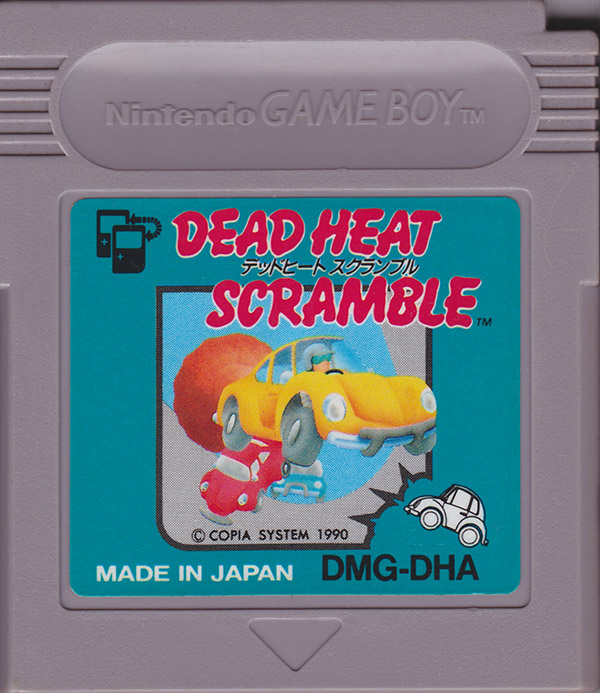
They just tried to make everything too small to make it divisible by a certain number of pixels to fit a certain number of blocks on the screen that it ends up being just not fun to play. But if you want to buy it for someone you hate, cgb-axjp or cgb-axje. Dead Heat Scramble by Copia Systems was released in April 1990 in Japan, December 1990 in the US.
Copia Systems, C-O-P-Y-A, they're the ones that did Popeye 2, Episode 1 of Game Boy Crammer. They also did Go Go Tank. They didn't make a lot of games, but they made some good ones. Dead Heat Scramble is a top-down racer. You're looking at the track from above. The track is a little bit like a bobsled track. It's curved on the sides.
And they have some construction lines in there so you can see the curves of the track. And your car can kind of roll up the side so you can go right on the edge. You have an accelerator, A, and you have a jump button, B. In this game, you don't have to worry about beating the other players. It's a time thing.
Basically, you have a time limit. If you don't get to the end of the race by the end of the time limit, it's game over. But you can continue indefinitely. Your score resets to zero. It's kind of a score game. There's a high scoreboard. There are ten levels altogether. When you start the game, you have three cars to choose from. They handle a little bit differently.
And I'm not sure about this, but I think if you pick one of the... I think if you pick the one on the right, you'll have some trouble smashing into other cars. Now, smashing into other cars is a big thing. It's not just a matter of being able to smash into cars. You need to smash into cars. Smash into any car you can get.
They don't slow you down. They just spin out. Unless you have that third car, it seems to sometimes crash when you hit one of the other cars. I think you hit them a certain way. But if you pick the middle car, the one on the left, you just plow right through them. They will drop power-ups sometimes. Random power-ups.
One power-up is a bomb. And you're going to see right on the left side of the screen on the top, you'll see a little bomb icon. Push up on your D-pad to use that. It kind of shoots a bomb ahead of you on the track. The bomb will follow the track. If you go around the curve, the bomb will follow the curve.
If you manage to blow up a car or a rock, you'll get a lot of points. If you don't care about points, just get rid of this bomb. You can also get a nitro. With the nitro, it's the same thing. You press up. You don't have to hold up. Just tap it. You'll hear the engine whine, and you'll go a little bit faster temporarily.
You can't have a nitro and a bomb at the same time in your inventory. So if you pick up a nitro and you don't use it, and then you pick up a bomb, the nitro's gone. There's a tire power-up. This gives you better handling temporarily. And the most valuable power-up of all, the time stopper. The countdown clock freezes for two seconds.
With a lot of these races, maybe you're crossing the finish line with one or two seconds to spare, so freezing that clock can really help. And I think on the later levels, especially 9 and 10, you have to be pretty lucky and get a lot of these clocks to get to the end of it. There are obstacles on the track. There are posts, oils, slicks. They all do the same thing. They make you wipe out.
You can jump over these things. You can jump over anything. You can get into some tough situations when you crash, and there's a bunch of obstacles ahead of you because you can't get enough speed to get a jump in. And the game will keep putting you back into the obstacles. It's pretty frustrating, especially on levels 9 and 10, where you get kind of these narrow roads with a lot of obstacles in the middle, so you have to be driving right on the edge.
But if you do crash, it keeps putting you back into the posts in the middle of the road, and you can never get enough speed to jump again. You don't want to be jumping too much. Jumping does affect your speed. And the way you go around corners, I guess it is like a bobsled in a way. You kind of want to swing around on the outside of curves.
You just have to kind of get a feel for what makes it go faster. But just don't spend all your time jumping and jumping and jumping. I know it's easy to avoid obstacles that way, but you're not going to go very fast. Boulders keep coming in from off the screen. Well, lucky for you, they look big and round, but your jump will clear them. Even if you just start to jump, you can clear them.
They look high, but they're easy to jump. In some levels, the track will actually split into two tracks, so you can kind of choose which way you want to go. But you're not stuck on that track. You can actually roll up the sides and hit your jump and jump over to the other track. That's especially important if you want to deliberately hit more curves to try to get those time stoppers.
Level 9 and 10 are very, very hard. I don't think 10 is much harder than 9, but they're both very, very difficult. You just have to play them over and over. It's all memorization. And you have to be really lucky getting those time stoppers. If you've played it a lot and you just want to practice one of the later levels and you don't want to go through all the levels each time you turn it on, on the title screen, hit B eight times, then A eight times, then hit B the number of levels you want to skip.
So B eight times, A eight times, B as many levels as you want to skip. At least that way you can really practice levels 8, 9, and 10, because they're pretty rough. There's no reason not to get the Japanese version if it's cheaper, because it seems to be exactly the same. Everything's in English. Look for DMG-DHA for the Japanese version, DMG-DH for the American version.